Drive-Thru Job Fair Comes to Gwinnett

Drive-Thru Job Fair Comes to Gwinnett

Drive-Thru Job Fair Comes to Gwinnett

job fair

Drive-Thru Job Fair Comes to Gwinnett 

The current pandemic has made a massive impact on America’s workforce and wreaked havoc on certain business sectors. While we’re beginning to see a dip in the number of active COVID-19 cases around the country, parts of the economy are still in desperate need of finding workers. Until recently in-person meetings have been known to be the most effective way of engaging potential job seekers with jobs, but they’re not feasible in today’s environment of social distancing. Instead, organizations like Better Work Gwinnett are finding creative ways – like a drive-thru job fair – to connect businesses with job seekers.

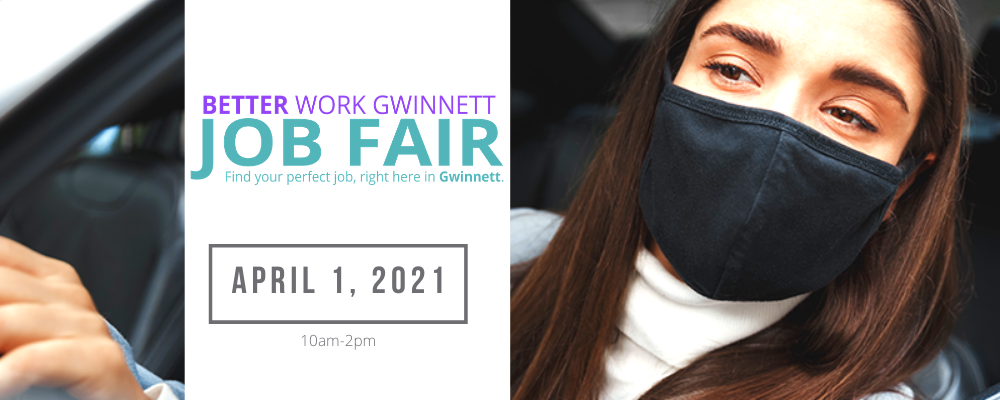
We are excited to announce the Better Work Gwinnett Drive-Thru Job Fair on Thursday, April 1st at the Infinite Energy Center Parking Deck.

This event will connect job seekers with hundreds of full and part time jobs. Businesses will have booths set up around the ramp of the parking garage allowing job seekers to drop off resumes and learn more about each organization. Job seekers will also be able to collect information and engage with potential employers – all from their cars.  

The job fair is a result of a community collaboration among GCO, Goodwill of North Georgia, First Step Staffing, Lawrenceville Response Center, and WorkFaith – all Gwinnett County based organizations. Working together with a common goal of strengthening the community, the Gwinnett Coalition combines local resources to provide training and support services to help job seekers find meaningful work and businesses to gain valuable employees. 

For most people a job is more than a paycheck, but also provides purpose and dignity to everyday life. Unfortunately, there has been a steady rise in unemployment rates in the Gwinnett County area. Gwinnett County’s current unemployment hoovers at about five percent, which is on par with Georgia’s overall unemployment rate of 5.3 percent

“The global pandemic is impacting our neighbors,” said GCO’s Director of the Gwinnett Workforce Initiative, Jace Brooks. “When the pandemic started, Gwinnett County saw thousands of residents out of work, many of them faced housing and food insecurity. A drive-thru job fair will allow job seekers the ability to connect with potential employers while still practicing social distancing and safe health regulations. It’s been great to see local groups working together in such harmony for the good of the community. We know the job fair will be beneficial to our local residents, businesses, and economy.” 

The pandemic has produced a vanishing supply of skilled labor, and the growing local market’s demand is outpacing the supply of workers. Drive-thru job fairs in other areas have been largely successful for filling positions in various industries like, administrative, utilities, manufacturing, and warehouse work. 

To register to participate as a job-seeker, volunteer, or business click here. 


Get Buzz’d At the state Capitol

Get Buzz’d At the state Capitol

Get Buzz’d At the state Capitol

Get Buzz'd Blog Header

A focus on the state legislature and the policies effecting Georgian’s everyday life. 

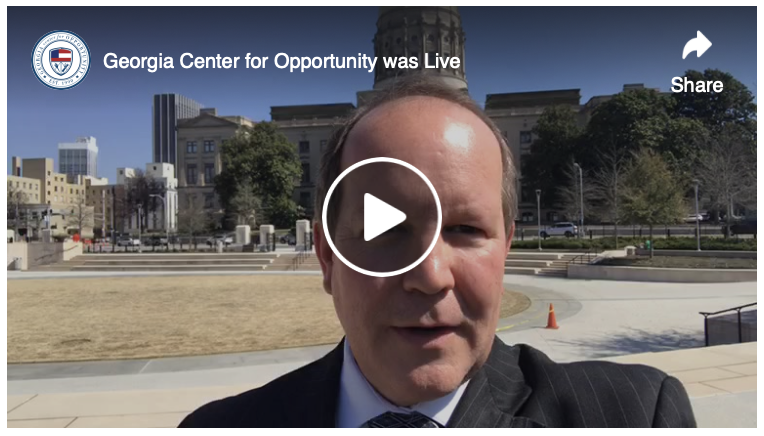
Buzz Brockway, VP of Policy, is in downtown Atlanta at the state Capitol building, and walks us through the proposed changes to The Special Needs Scholarship, occupational licensing, a current protest, and more.


Get Buzz'd - at capitol - March 17 2021

Our state lawmakers create policies that better the lives of Georgians. Learn more about active legislation and how it translates into everyday life for all of us.

Many Special Needs Students Have Struggled with Virtual Classes

Many Special Needs Students Have Struggled with Virtual Classes

Many Special Needs Students Have Struggled with Virtual Classes

Special Needs

For some students virtual classes during the past year have been fine. Some have even thrived. But for many special needs students, it has not gone well, as a parent tells the Georgia Center for Opportunity:

A virtual classroom worked fine for Jennifer’s two older children, but her youngest son, 10-year-old Joey, has Down syndrome. Online learning is entirely unworkable for him due to his special needs.

For example, DeKalb is following a normal bell schedule but staying engaged on Zoom for hours on end is not working. Morning classes will sometimes go well, but by lunchtime Joey is tuned out. It is impossible to get him back online after the lunch break for specials, such as music and art, and Jennifer cannot stay tied up until 2:30pm every day. She has seen academic and social regression for her son as he has little to no interaction with peers.

Additionally, his academic growth is limited due to repetitive practice of current skills on worksheets with no new individual instruction to learn new concepts in language arts or math. As a highly visual and experiential learner, he is missing the magic that happens in a classroom that cannot be replicated on a Zoom call.

“It’s day-by-day and minute-by-minute,” Jennifer shares. “One class he is engaged and on task, and the next minute he is hiding under the bed or taking his shirt off.”

All children, no matter their needs, deserve the opportunity for a high-quality education that meets their individual requirements. 

Today, Axios wrote about a newly released report on 130 studies on the safety of school reopening. The report found:

  • Any benefits to closing schools are far outweighed by the grave risks to children from remote-only schooling — risks that intensify the longer it continues, the report says.
  • The harms include academic loss — so severe that it could set children back for life — and mental health problems related to loneliness and isolation.
  • There are also severe hardships on parents — mothers in particular, about two million of whom have left the workforce to care for their kids as part of remote learning.
  • “Schools are not super-spreaders,” observes the report, written by John P. Bailey, a former deputy policy director at the Department of Commerce.

Fortunately almost 73% of Georgia’s school districts are open for face to face learning. The rest need to reopen ASAP, and plans need to be made to help students who fell behind catch up.


This post originally appeared on PeachPundit.com on March 11, 2021.


Buzz Brockway is a Guest on the Erick Erickson Show | WSB 95.5

Buzz Brockway is a Guest on the Erick Erickson Show | WSB 95.5

Buzz Brockway is a Guest on the Erick Erickson Show | WSB 95.5

On March 4, 2021 Buzz Brockway, VP of Policy, was a featured guest on WSB 99.5’s Erick Erickson Show to discuss legislation (HB 60) that would allow parents and students more education options.

Unfortunately, HB 60 will not come to fruition this year, but we’re not stopping the fight for our kids. 

Listen to Buzz explain the legislation and learn more about what state leaders are considering for our children’s education. 

Listen to Buzz Brockway explain the importance of House Bill 60 on WSB’s Erick Erickson Show.

Key GCO priority bills make crossover deadline

Key GCO priority bills make crossover deadline

Key GCO priority bills make crossover deadline

legislative update

The Georgia legislative session is halfway over, and already we’ve made some important progress in breaking down barriers to work and expanding opportunity for all Georgians.

We reached a key legislative mark on March 8: The crossover deadline. That means that any bill not passed by at least one chamber (either the Senate or the House) is likely dead for the remainder of the session.

The great news is that several key bills supported by the Georgia Center for Opportunity (GCO) made the crossover deadline.


Get Buzz'd capitol update

Watch Buzz Brockway, VP of Policy for GCO, from the state Capitol as he updates us on what legislation is moving forward, and what is over for the year. 

Education

Heading up that list is a measure that would expand the Georgia Special Needs Scholarship. This program helps students with individualized education plans (IEPs) attend a private school that is a better fit for their individual needs. On March 3, the state Senate passed a measure, Senate Bill 47, that opens the scholarship to preschoolers in addition to students with a wide range of special needs, just not those with an IEP.

We’re continuing to work with lawmakers on the House side to pass the bill and send it to Gov. Brian Kemp’s desk for his signature. We’re hopeful that 2021 will be the year this important measure becomes law in order to better serve families of special needs students who have disproportionately suffered during the pandemic.

Occupational licensing

We’re also seeing progress on occupational licensing reforms. Occupational licensing is needed in some industries and job categories, but the laws on the books today in many cases are an unnecessary roadblock to employment for workers.

Two bills on this issue made the crossover deadline. The first, Senate Bill 45, allows people who move to Georgia and hold an occupational license to immediately be granted a provisional license. This will allow these new Georgians to immediately go to work and support their families.

A second measure, Senate Bill 27, extends the time (up to two years) a retiring military member may count their military training toward requirements for an occupational license

Both bills are now pending in the House.


Adoption reforms

We’re pleased that two adoption-reform bills passed the House before the crossover deadline. House Bill 114 would increase the annual tax credit available for adopting a foster child from $2,000 to $6,000. And House Bill 154 would lower the minimum age to adopt from 25 to 21.

Foster and adoptive families play a crucial role in creating stable environments for some of the most vulnerable children in our society. Anything we can do through policy reform to help these families should be a priority.

Justice reforms

In an attempt to address the type of tragic vigilante violence that occurred in the Ahmaud Arbery case, lawmakers unanimously passed House Bill 479 on March 8. The measure overhauls Georgia’s citizen’s arrest law to generally prevent bystanders from attempting to arrest an individual suspected of a crime. GCO believes this is a crucial piece of legislation to prevent unnecessary tragedies and foster greater racial justice in our state.


Bills that didn’t make the cut

Unfortunately, supporters of Education Savings Accounts (ESAs) will likely have to wait another year before we see them become a reality. Although a measure (House Bill 60) to create ESAs passed the House Education Committee on Feb. 26, it never came up for a vote on the floor of the House.

ESAs are an important way to expand educational access and choice for Georgia students. They allow parents and kids—no matter their race, the circumstances of their birth, or their socioeconomic status—to have equal access to the funds needed for a great education. We’ll continue fighting for ESAs in the 2022 legislative session.

On a positive note, bills that would have legalized parimutuel horse-race betting and casino gambling in Georgia are now dead after failing to make crossover.

Benefiting Low-Wage Workers without Minimum Wage Laws

Benefiting Low-Wage Workers without Minimum Wage Laws

Benefiting Low-Wage Workers without Minimum Wage Laws

3 female waitresses

Strategies to help everyone

If it is a bad idea to raise the minimum wage, or even have a minimum wage law to begin with, where does this leave the low-wage worker?

We already examined the empirical evidence showing that minimum wage laws reduce employment among the groups the laws are intended to help. (If you missed it, check out my blog.)

We also looked at the negative impact on small business—that most important job-creation engine. (Check out this blog.)

Now we want to know what we can do to help low wage workers. 

A job is better than no job 

True. Some workers earning a minimum wage will find themselves better off with a law that increases their pay. However, millions others will be hurt. Some are harmed because their hours might be reduced. Worse, many others will not be able to find a job or lose their job. The nonpartisan Congressional Budget Office predicted this number will be 1.4 million people if the federal $15 minimum wage proposal becomes law. 

If you cannot find a job or lose your job, you are not better off. This is especially true for workers starting out in the labor force. They learn things on the job that they cannot learn in a classroom or at home. 

They learn the all-important soft skills required to function in the workplace, such as getting along with coworkers, meeting expectations, and showing up on time prepared for work.

Importantly, they also begin building their net worth. At a minimum, they do this by putting away for their future with contributions—matched by their employer—to Social Security and Medicare. 

No minimum wage law does not mean no standard

The minimum wage is an arbitrary number with little meaningful relationship to the particulars of a specific job. The United States has nearly 6 million business firms with 7.9 million establishments in thousands of industries in over 3,000 counties, according to the Economic Census. Each has its own characteristics in terms of expectations, skills, and pay.

One of my first jobs was in a machine shop. I still recall how the employer misrepresented the minimum wage when he hired me. He tried passing it off as a pay level sanctioned by the federal government. I did not buy it and was offered higher pay. Later I learned others in the shop fell for his ruse—and were receiving just the minimum wage. 

If we would eliminate the minimum wage law, then low-wage workers would look to other standards reflective of the job and industry. 

Think of Kelley Blue Book that helps consumers know the value of a car. There are also companies—like PayScale—helping job seekers know what to expect in terms of pay.  Moreover, the U.S. Bureau of Labor Statistics conducts 12 surveys on pay and benefits—including wage data for over 800 occupations by area—that can be used as guidance. 

It would be better for workers to have knowledge about pay scales based on real factors than rely on arbitrary and artificial standards set by government law.  

The Success Sequence provides an outline of how to reverse the cycle of poverty in our communities. GCO uses this as a framework for much of our work.

Career ladders and skill sets

The Georgia Center for Opportunity works with community groups helping job seekers link with employers. Setting career goals, understanding the skill requirements of various occupations, and having realistic expectations of pay are all important components of putting together a plan to help job seekers grow in their career and compensation.

These plans are what will help them the most if they are stuck in a minimum wage job. It gives them a plan of action on how to meet their goals. It also helps employers who often complain they can’t find good help with the skill sets they really need. This solution involves working with individuals on a one-on-one basis. 

It also takes time—there is no magic button to push. However, in the end, it will be a win-win situation for both workers and employers. Raising the minimum wage is a win-lose situation—some people will win, but many others, including the overall economy, will lose.

Understanding the needs of employers in the labor market also requires us to do a better job at education in preparing our children for their future. As research has shown, giving parents more choices improves the quality of education—and will ultimately benefit our children and society. 

We need to stop coming up with solutions that help some people at the expense of others. It makes little sense to damage the entrance ramp to employment in order to increase the pay for just some workers. Or for the government to have an inflation policy that hurts the poor the most, which I pointed out in this blog

Instead, let’s focus our attention on solutions that help everyone. If you have comments, especially on what are the best solutions, we would love to hear from you. Be sure to post them in the comments.


*Erik Randolph is Director of Research at the Georgia Center for Opportunity. This blog reflects his opinion and not necessarily that of the Georgia Center for Opportunity.