A new bill in KY legislature simplifies expungement process

A new bill in KY legislature simplifies expungement process

criminal justice josh Crawford media statement header

A new bill in KY legislature simplifies expungement process

A new bill has been introduced in the Kentucky Legislature, House Bill 589, that simplifies the process of having criminal records expunged for people who have been convicted of a misdemeanor or class C felony that does not involve violence, sex, a child victim, or public corruption.Under current Kentucky law, such individuals are eligible for expungement after the completion of their sentence and a five-year crime-free period. Unfortunately, a confusing and sometimes burdensome process prevents many people who are eligible from having their records expunged.

The Center for Opportunity’s take: “This bill does not change the crimes for which expungement is eligible nor the requirements of a crime free period once the sentence is completed. Everyone who will benefit from this bill is a non-violent offender who has made it clear their interest is in re-entering civil society,” said Josh Crawford, director of criminal justice initiatives for the Center for Opportunity.

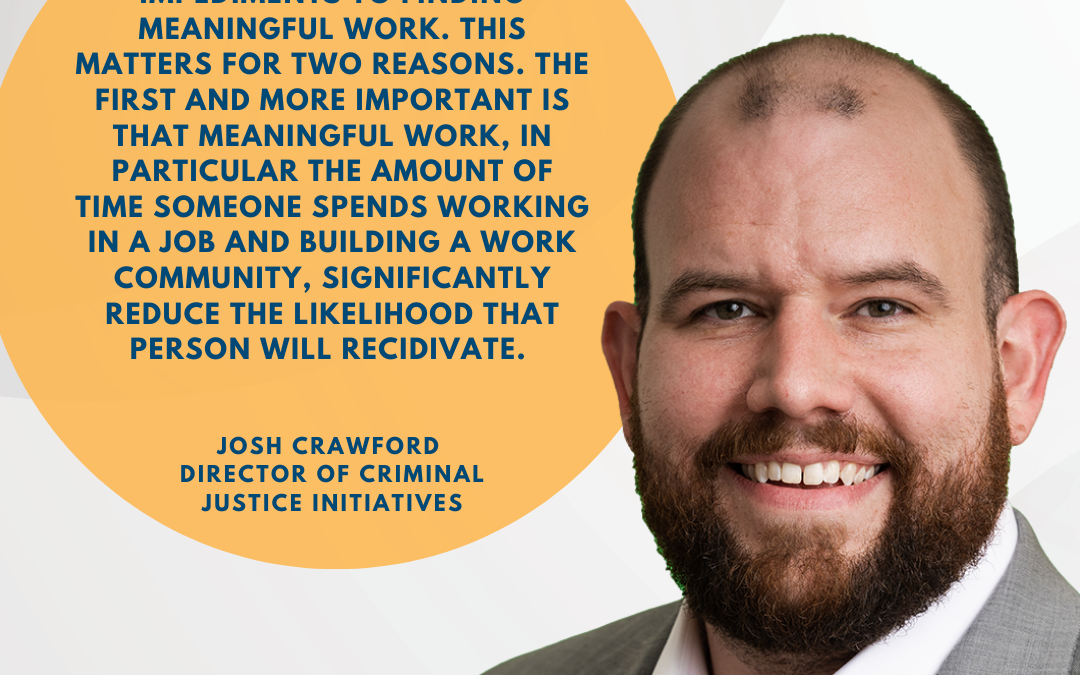
“Importantly, prior convictions can be impediments to finding meaningful work. This matters for two reasons. The first and more important is that meaningful work, in particular the amount of time someone spends working in a job and building a work community, significantly reduce the likelihood that person will recidivate. Reducing recidivism means less crime and fewer victims. Second, Kentucky has one of the worst labor force participation rates in the country. With such a large percentage of our population having a criminal conviction, we cannot afford to exclude from the labor force those who are attempting to turn their lives around and live on the straight and narrow. Kentucky business benefits from an engaged and motivated workforce — those who have earned an expungement under Kentucky law are these exact kind of employees.”


Josh media statement


To learn more about the work we’re doing to increase public safety and assist citizens in getting back to work, click here.

Josh media statement

To learn more about the work we’re doing to increase public safety and assist citizen in getting back to work, click here

GCO applauds introduction of Promise Scholarship bill

GCO applauds introduction of Promise Scholarship bill

Education media statement header

GCO applauds introduction of Promise Scholarship bill

The Georgia Center For Opportunity is thrilled to support new legislation introduced in the Georgia General Assembly creating Promise Scholarship Accounts. Georgia State Senator Greg Dolezal is the primary sponsor of Senate Bill 233, The Georgia Promise Scholarship Act.

Funded by the state in the amount of $6,000 per student for each school
year, Promise Scholarships would allow families to find the right fit for their students’ education. Scholarships could be used on any approved education expense, such as private school tuition, tutoring, homeschool curriculum, virtual classes, college classes, therapies (for kids with special needs), technology, and more.

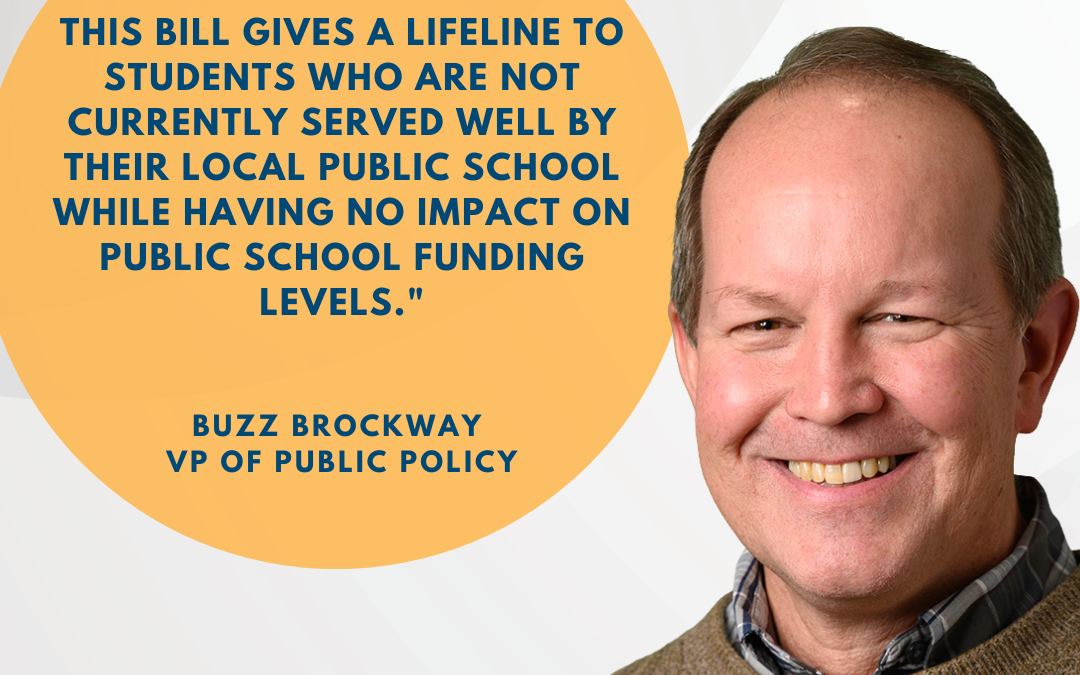
“A quality education levels the playing field for all Georgians,” said Buzz Brockway, GCO’s vice president of public policy. “Promise Scholarships would do that by giving eligible students the unique educational experiences that they need. All kids deserve a chance, including students who may need additional help or require a different learning environment. This bill gives a lifeline to students who are not currently served well by their local public school while having no impact on public school funding levels.”

“Our education system should ensure that all students have access to quality education, no matter their race, past mistakes, or circumstances of their birth.

This bill would be a huge step in that direction for kids in our state,” Brockway added.


Buzz media statment
Buzz media statment
Media Statement: Number of people working hasn’t caught up to pre-pandemic levels

Media Statement: Number of people working hasn’t caught up to pre-pandemic levels

Erik R - statement - July job numbers

Media Statement: Number of people working hasn’t caught up to pre-pandemic levels

On Friday, the U.S. Bureau of Labor Statistics announced that total non-farm payroll employment rose by 528,000 in July. The result was much higher than expected.

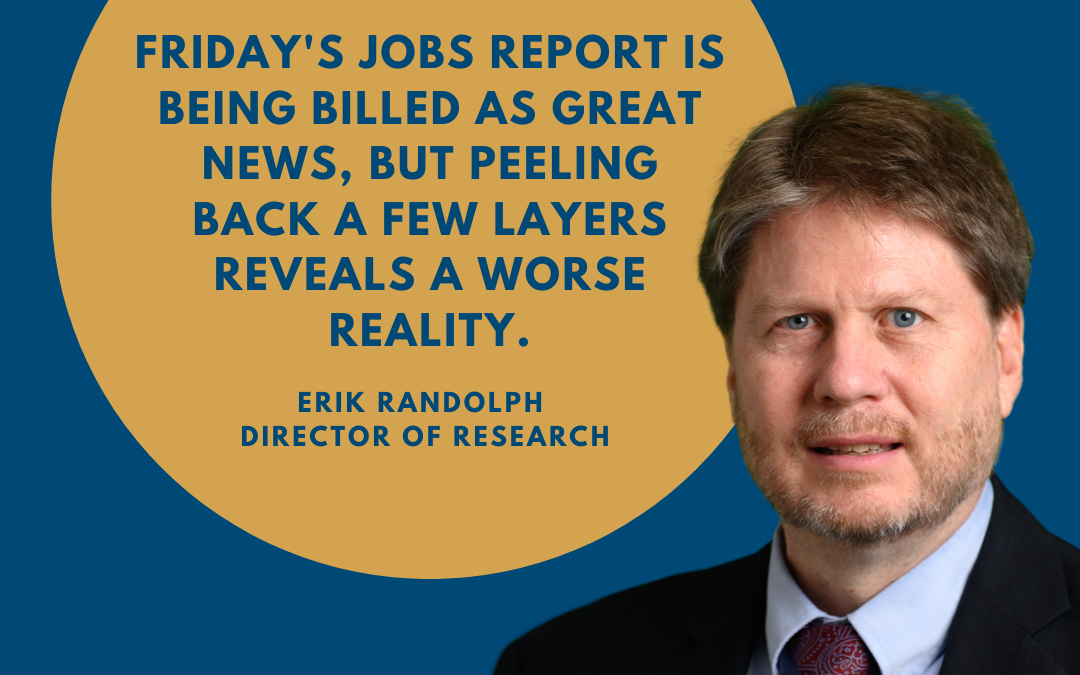
The Georgia Center for Opportunity’s (GCO) take: “Friday’s jobs report is being billed as great news, but peeling back a few layers reveals a worse reality,” said Erik Randolph, GCO’s director of research. “It’s true the number of jobs in the United States is now at pre-pandemic levels. The difference is that the number of people who are actually working hasn’t caught back up. That implies more people are working two or even three jobs to make ends meet in this highly inflationary environment. Meanwhile, wage growth isn’t keeping pace with inflation, putting poor and working class Americans even further behind.”

New Research Predicts Long-Term Pain for Labor Market

New Research Predicts Long-Term Pain for Labor Market

New Research Predicts Long-Term Pain for Labor Market

social distancing

Long-term pain for labor market due to the COVID-19 pandemic

New research predicts long-term pain for the labor market due to around 3 million workers who plan to remain permanently sidelined over concerns of physical illness or physical impairment due to the COVID-19 pandemic.

The Georgia Center for Opportunity’s (GCO) take: “The authors of the long social distancing study have produced very helpful data on those no coming back into the labor force, estimating a 3.5 million shortfall in March by comparing the current observed level with a linear trend using the time period of January 2015 to December 2019 as the basis for the forecast,” said Erik Randolph, GCO’s director of research. “Using the current employment statistics survey instead of the current population survey, our own research shows a shortage of 6.6 million employed persons that would include persons holding multiple jobs. We use the same method of comparison by subtracting the forecasted data from the observed data, but instead of using a linear trend as the basis for comparison that can often overestimate the forecasts, or the reverse, we use an ARIMA forecast model, not for five years but starting at the low point after the Great Recession. In addition, our research provides forecasts and analyses for each of the 50 states where there is a wide disparity when it comes to job recovery.”

For more, read Randolph’s research report on the economic impact of the pandemic shutdowns.


statement

Georgia Unemployment Rate: Lowest Record Since 1976

Georgia Unemployment Rate: Lowest Record Since 1976

Georgia Unemployment Rate: Lowest Record Since 1976

employment rate

State unemployment rate stands at a record low

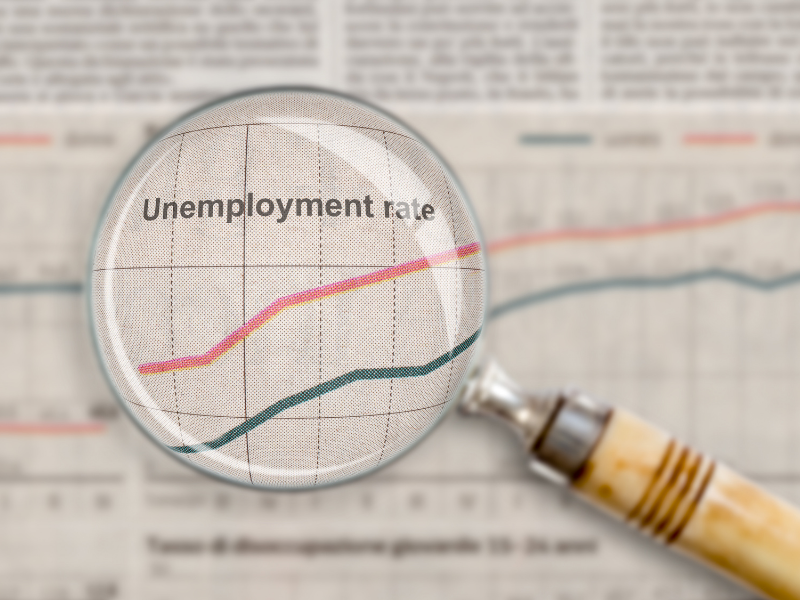
On Friday, April 15th, the U.S. Bureau of Labor Statistics released state employment numbers for Georgia. They show that our state unemployment rate stands at a record low of 3.1%, the lowest since the BLS began tracking in 1976.

The Georgia Center for Opportunity’s (GCO) take: “At 3.1%, Georgia is tied with Arkansas for the 16th lowest unemployment rate, a half point below the national unemployment rate of 3.6%,” said Erik Randolph, GCO’s director of research. “Georgia is among the 16 states that have recovered all the private employment lost due to the pandemic. According to our analysis, Georgia ranks 10th in the nation when comparing private employment to each state’s pre-pandemic private employment growth trajectory.”

“Labor force participation is still an area of weakness. Georgia’s rate ranks 26th in the nation. While Georgia’s labor force participation rate edged up from 61.9% in February to 62.1% in March, it is still below its pre-pandemic rate of 62.8%. It is also well below the states with the highest rates. Nebraska leads the nation with 69.8% participation, just 0.2 points below its pre-pandemic rate”

“The national economic picture is worrisome and can put a damper on the improving job picture. Rising inflation and supply-side problems are creating uncertainty that will impact entrepreneurial decision-making and alter the economic outlook. Some economic indicators are beginning to point to a possible economic slowdown. Although these prognostications are not certain, they are concerning.”

For more, read Randolph’s research report on the economic impact of the pandemic shutdowns.


statement