National Police Week: Community Benefits of a Strong Police Force

National Police Week: Community Benefits of a Strong Police Force

2023 police week, national police week, police, police week, men in blue

National Police Week: Community Benefits of a Strong Police Force

Key Points

  • Each May, National Police Week honors America’s law enforcement members, especially those who have fallen in the line of duty. 
  • Lower crime and violence is a proven community benefit of having more police. 
  • Investing in local police forces is a practical way to reduce violence in areas like Atlanta and Columbus.

Every May, a week is designated as National Police Week to honor America’s law enforcement members, especially those officers who sacrificed their lives while serving their communities. Along with remembering these local heroes, Police Week is an opportunity to reflect on the role law enforcement has in building vibrant communities where everyone can achieve their potential. 


The Community Benefit of More Police: Less Crime. 

In 2020, 21% of U.S. residents had contact with the police, with most interactions relating to traffic stops or accidents, reporting of crimes, or seeking help with non-crime emergencies. Behind all of these interactions is a larger societal benefit of well-staffed, well-managed police forces: less violence. 

Josh Crawford, GCO’s Director of Criminal Justice, notes: “Police are the element of the criminal justice system most visible to the public and the arm with which citizens are most likely to interact.”

That presence is key to discouraging crime and boosting people’s confidence in the safety of their communities. Over the past couple of decades, research has affirmed what many intuitively know—that having more police helps lower crime and violence.


  • 2002: Criminologists from the University of Alabama at Birmingham found that “a 10 percent increase in police levels lowered crime rates by 1.4 percent over time.”
  • 2004: Economist Steven D. Levitt examined data from 122 cities around the U.S. from 1975 to 1995 and found that increased police numbers brought down violent crime by 12 percent and property crime by eight percent.
  • 2015: A Brennan Center for Justice report found that “increases in the number of police officers had a modest, downward effect on crime in the 1990s, likely between 0 and 10 percent.”
  • 2018: A 2018 study looked at police and crime data from 1960 through 2010 and concluded that every $1 spent on policing generates about $1.63 in social benefits, mostly through reductions in homicides.

Georgia’s Communities Have a Police Shortage Problem 

Georgia is one of many states grappling with a shortage of police officers. Areas like Atlanta and Columbus in particular have struggled to recruit and retain enough officers, and communities are feeling the strain as violence rises and wait times increase for emergency responses. 

According to the Police Executive Research Forum (PERF), police shortages have had three major drivers: 

  1. Law enforcement agencies can’t hire enough officers. An April 2023 survey of police agencies found that “police agencies are losing officers faster than they can hire new ones.” The talent pool is also shrinking. Agencies have reported a noticeable decrease in the number of applicants for open positions.
  2. Officers are leaving before retirement age. Based on exit interview data available from police agencies, the top reason officers resign is to take another job in law enforcement. The second highest reason is to switch their career path altogether. 
  3. More officers are approaching retirement. According to PERF’s survey data, approximately a quarter of U.S. police officers have reached retirement age or will be eligible to retire within the next three to five years. 


Investing in Local Police Is Necessary for Growing Vibrant, Low-Crime Communities

According to Crawford, defunding or otherwise redirecting money away from local police is not the answer

“Proponents of ‘defund the police’ are quick to point to the fact that the money taken from police agencies would be reallocated to a myriad of social programs and direct investment in underserved communities,” said Crawford. “Worthy as these individual programs and investments may be, there is no social program that can replicate the essential functions of policing.” 

In 1995 and again in 2009, federal grants from the Office of Community Oriented Policing Services (COPS) helped state and local law enforcement agencies address officer recruitment and retention challenges. The track record of this funding was strong: Police hires increased, and crime went down. Various research on COPS funding suggests another grant round could help police agencies address today’s staffing shortages — as long as the funding is tied to increasing full-time, sworn officers within the specific departments receiving the grants. 

Whether it’s at the federal level or efforts closer to home, we should direct resources to what we know serves our neighborhoods best. Communities benefit when they have more officers with more hours of better training, not fewer officers with less training. 

Georgia parents deserve full transparency from state school systems

Georgia parents deserve full transparency from state school systems

College and Career Ready Performance Index (CCRPI) metrics, Georgia opt out, reporting, learning loss, grading system for schools, Georgia news, ga news

Georgia parents deserve full transparency from state school systems

Key Points

  • Georgia received a waiver from reporting its College and Career Ready Performance Index (CCRPI) metrics, including the A-F grading system for schools.
  • The CCRPI metrics assess student performance, including comprehension of class content and preparedness for college and the workforce.
  • GADOE announced its intention to request a permanent waiver from CCRPI grading, raising concerns about transparency and public input.

In the wake of the COVID-19 pandemic, many state school systems across the country were waived from receiving a grade from the US Department of Education (DOE) under The Elementary and Secondary Education Act (ESEA).

The unprecedented circumstances brought on by the pandemic created unforeseen educational  challenges. Naturally, children who spent time in lockdown, away from school, and relegated to unfamiliar online classes could be expected to fall behind educationally. Like many other states, Georgia received a waiver from reporting its College and Career Ready Performance Index (CCRPI) metrics, specifically the A-F grading system for schools that gauge their performance.

But now the state of Georgia has asked to be permanently excused from reporting the A-F grading CCRPI evaluations. The state allowed less than a week for public comment on the proposal, opting not to announce the request via press release. In the past, similar issues have allowed a 30-day window for public comment, at the very least.

With students back in school and educational institutions back to their regular operations, why make this request now? And why the lack of transparency in the process? The exemption from the A-F reporting requirement takes away the public’s ability to easily assess how schools are performing. It’s a knock against real transparency that serves no one but the educational bureaucracy.

The bottom line is that wise school choice depends on parents’ ability to access information about school performance. Without that information, they’re risking their children’s educational opportunities—and maybe even their future.


“The bottom line is that wise school choice depends on parents’ ability to access information about school performance.”

“The bottom line is that wise school choice depends on parents’ ability to access information about school performance.”

About the CCRPI and temporary COVID waivers

In 2012, the CCRPI was launched. Its purpose was to encourage more transparency in terms of school performance. Parents and the public needed to know more about how their local school systems were performing, and the CCRPI not only provides this information—it also allows parents to compare their child’s current school with others in the area.

In terms of measuring performance, the CCRPI assigns a letter grade of A-F to each school. The scoring system reveals how well students are performing in each school, including how well they comprehend their class content and whether they’re keeping up with their grade level. This score also reveals how well-prepared older students are for college and the workforce.

CCRPI scoring was waived beginning in March of 2020, and schools weren’t required to report data as usual. This waiver continued throughout 2021. However, in 2022, as the nation largely resumed business as usual, the Georgia Department of Education (GADOE) was awarded additional waivers.


Seeking a permanent exemption

GADOE published an announcement on its website on January 25, 2023, informing the public that it intended to ask the DOE for a permanent waiver from CCRPI grading. Although the state collects and aggregates all the required metrics, GADOE now seeks to stop submitting the data completely.

As the ESEA requires each state to create its own school accountability system and report its findings to the DOE, it seems questionable that Georgia would completely extract itself from transparency not only at the state level, but at the federal level, too.

Most alarming was the lack of transparency involved in the process. There was no press release published to announce the potential change. As previously mentioned, what’s even worse is that GADOE allowed for fewer than five business days for members of the public to submit their feedback, rather than the standard 30 days.


Reducing transparency hurts Georgia families 

While GADOE attempts to evade school grading, numbers don’t lie. Georgia’s most recent CCRPI scores from 2019 indicate that over 780 schools in Georgia received Ds and Fs. That’s about one-third of the state’s students. GADOE might argue that the proof of school performance lies in the state’s graduation rates, but graduation rates can be manipulated and aren’t a reliable indicator of how well a school performs academically.

Schools that receive Ds and Fs from CCRPI are, by default, not serving their students well. No matter how high their graduation numbers may be, the real proof is in how well (or poorly) they score according to CCRPI academic standards.

There is no compelling case that can be made as to why Georgia’s exemption from CCRPI reporting is an improvement, or how it helps families in our state.

GADOE appears to be skirting the standard process for notifying the public and seeking appropriate input. It’s up to Georgia voters to make their voices heard and demand continued school transparency from its elected officials.

Inflation is becoming worse for Americans on a fixed income

Inflation is becoming worse for Americans on a fixed income

In The News

Inflation is becoming worse for Americans on a fixed income

Today, the U.S. Bureau of Labor Statistics announced that in April the Consumer Price Index (CPI) rose by 0.4%, not seasonally adjusted. Year over year, the CPI has gone up 4.9% in the last 12 months.

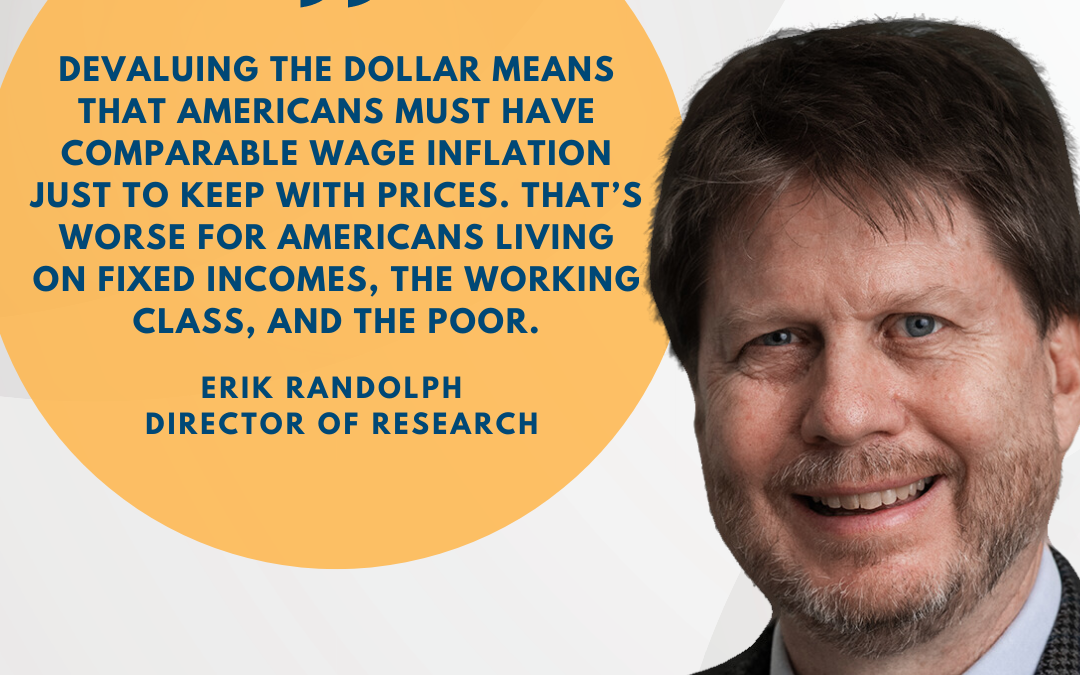
The Georgia Center for Opportunity’s (GCO) take: “Not only has the federal government abandoned restoring purchasing power, they do not appear even capable of bringing inflation down to the Federal Reserve’s inflation rate target of 2%,” said Erik Randolph, GCO’s director of research. “Devaluing the dollar means that Americans must have comparable wage inflation just to keep with prices. That’s worse for Americans living on fixed incomes, the working class, and the poor.”


As Juvenile Crime Skyrockets to Record Levels, States Seek to Crack Down – Tennessee Star

As Juvenile Crime Skyrockets to Record Levels, States Seek to Crack Down – Tennessee Star

Georgia news, in the news, current events, Georgia happenings, GA happenings

As Juvenile Crime Skyrockets to Record Levels, States Seek to Crack Down – Tennessee Star

As juvenile crime has skyrocketed across the nation following the beginning of the COVID-19 pandemic, state lawmakers are looking to pass laws to curb rising youth violence and lawlessness.

Juvenile homicides nationwide increased by 44% from 2019 to 2020 and increased by 83% from 2013 to 2020, according to data from the Office of Juvenile Justice and Delinquency Prevention, as school closures and police reforms have contributed to rising youth crime. Lawmakers in Kentucky, Louisiana, Alabama, Florida and New Jersey have introduced bills to implement measures such as penalty enhancements for juvenile gang members, as well as mandatory holding periods for juveniles charged with violent crimes, to address the rising violence.

“The year 2020 saw a reversal of decades-long reductions in juvenile violent crime,” Josh Crawford, Director of Criminal Justice Initiatives at the Georgia Center for Opportunity, told the Daily Caller News Foundation. “Kids not being in school due to government shutdowns and reductions in proactive policing during COVID-19 played a role.”

As Juvenile Crime Skyrockets to Record Levels, States Seek to Crack Down – Tennessee Star

As Juvenile Crime Skyrockets to Record Levels, States Seek to Crack Down – The Minnesota Sun

Georgia news, in the news, current events, Georgia happenings, GA happenings

As Juvenile Crime Skyrockets to Record Levels, States Seek to Crack Down – The Minnesota Sun

As juvenile crime has skyrocketed across the nation following the beginning of the COVID-19 pandemic, state lawmakers are looking to pass laws to curb rising youth violence and lawlessness.

Juvenile homicides nationwide increased by 44% from 2019 to 2020 and increased by 83% from 2013 to 2020, according to data from the Office of Juvenile Justice and Delinquency Prevention, as school closures and police reforms have contributed to rising youth crime. Lawmakers in Kentucky, Louisiana, Alabama, Florida and New Jersey have introduced bills to implement measures such as penalty enhancements for juvenile gang members, as well as mandatory holding periods for juveniles charged with violent crimes, to address the rising violence.

“The year 2020 saw a reversal of decades-long reductions in juvenile violent crime,” Josh Crawford, Director of Criminal Justice Initiatives at the Georgia Center for Opportunity, told the Daily Caller News Foundation. “Kids not being in school due to government shutdowns and reductions in proactive policing during COVID-19 played a role.”