Better Work Access and Encourage Worker Freedoms

Better Work Access and Encourage Worker Freedoms

Better Work Access and Encourage Worker Freedoms

The Manhattan Institute recently released a report arguing that now is a key time to reform our nation’s safety-net system. The goal should be not to offer more income guarantees but to minimize downside risk so that workers are able to move up the economic ladder. The report comes on the heels of new data from the U.S. government showing that inflation continued to run hot in August—the consumer price index rose 5.3% from a year before.

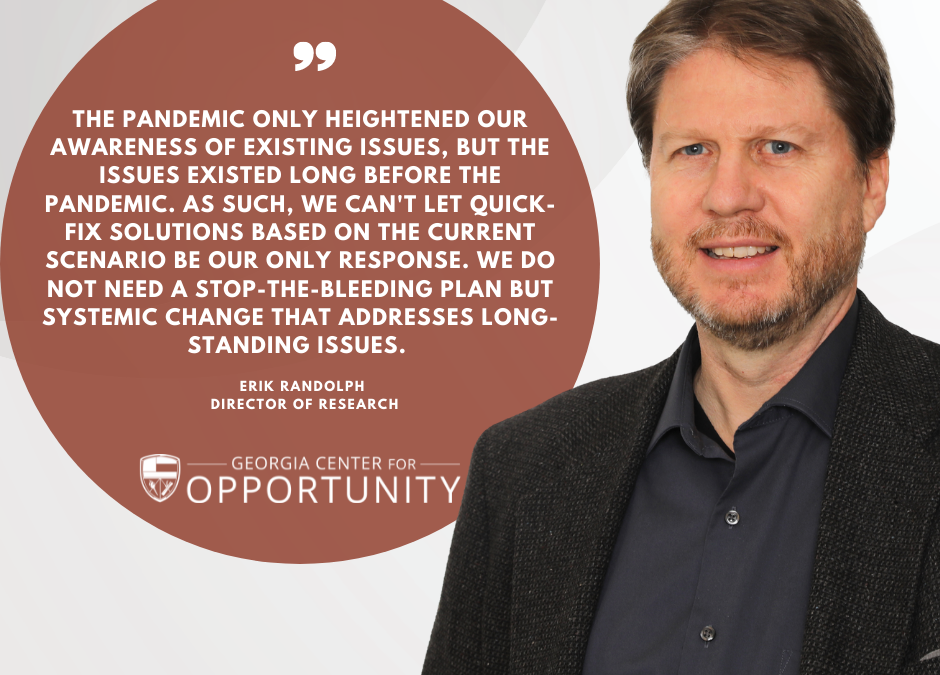
The Georgia Center for Opportunity’s (GCO) take: “The pandemic only heightened our awareness of existing issues, but the issues existed long before the pandemic,” said Erik Randolph, GCO’s director of research. “As such, we can’t let quick-fix solutions based on the current scenario be our only response. We do not need a stop-the-bleeding plan but systemic change that addresses long-standing issues.Policy prescriptions like simply raising the minimum wage ignore the main issue—wages not keeping up with inflation.


The need for changes that promote worker freedom and a sense of security that comes in work will drive markets and empower the actions of individuals. We should promote policies that open accessibility to better work access and encourage worker freedoms. We do this by creating a vibrant market where employers incentivize and compete for workers.”


Erik - statement

Q&A with Hire Dynamics on challenges of hiring in 2021

Q&A with Hire Dynamics on challenges of hiring in 2021

Q&A with Hire Dynamics on challenges of hiring in 2021

construction

April’s nonfarm payroll numbers came in at 266,000, well below the 1 million people forecasters estimated would be hired that month. 

The low number wasn’t because there were a lack of jobs. There were 8.1 million open positions at the end of March. And it wasn’t due to a lack of people who need work. In April, there were 18.2 million people who received some form of federal unemployment assistance.

Hire Dynamics, a staffing and professional recruitment business that operates in the Atlanta area in addition to other locations across the U.S., has experienced the shortage of workers first hand. The following Q&A is an interview with Chuck Fallaw, regional manager for Hire Dynamics.

Q: Please explain what your business does / your focus

Hire Dynamics is a regional staffing agency headquartered in Atlanta GA. We focus on temp-to-hire staffing in the manufacturing, logistics/e-commerce, warehouse distribution, administrative, and call center verticals.

Q: What was hiring like prior to the pandemic?

Prior to the pandemic, we faced challenges with finding talent due to incredibly low unemployment. For example, in Nashville, TN where we had a 1.2% unemployment rate. Their pay rates were naturally rising due to the competition for talent. However, it was still much easier to fill positions than it has been over the last year and a half.

Q: How about during the pandemic?

Hiring during the pandemic was a unique challenge. Many of our clients are considered essential, so their need for talent never slowed down. Outside of true shutdowns, we were still able to fill some roles. That changed quite a bit in the last six months.


What we do matters.

  • Best of Staffing for Client & Talent Satisfaction by ClearlyRated – 11 years in a row:
  • Top 1% of more than 20,000 staffing companies
  • Continuously recognized as a Best Place to Work company throughout the Southeast
  • Superior client loyalty: client ratings 8 times higher and talent ratings 2.5 times higher than the industry average
  • Committed to and engaged with the communities we serve

Q: Right now, are you having trouble filling positions, and if so which ones?

Yes. All of them. Many of the manufacturers we work with are running around 50% of the workforce they typically employ. Obviously, this is tough on productivity, but it also leads to environments that are not as safe, elevated worker’s comp, and general morale issues among the employees. Light industrial staffing (at least in my region) has been the hardest hit. As I mentioned before, prior to the pandemic the economy was roaring, and talent was in demand. When the pandemic hit, those needs didn’t really go away, but the talent did.


Q: In what ways are you trying to recruit / attract employees in this environment?

Grassroots recruiting is very important right now. Getting in front of the talent and helping them get back into the workforce is a big part of what we are doing. We are doing drive-through job fairs, virtual job fairs, and massive recruiting events. In addition, we are coaching our clients on reducing barriers to entry, pay adjustments, and other ways to incentivize employees to come back.


EMPLOYMENT RESOURCES

SYSTEMIC WELFARE IN GEORGIA: PART 1 THE CASE FOR REFORM

In the first paper of our three-part series presenting a vision for systemic welfare reform in Georgia, we explore the need for a welfare system that starts with the assumption that natural support systems, including individual work and a reliance on family and community assistance, should be the primary sources of help when individuals face financial need. This report demonstrates how the current system does not meet these assumptions and points to the need for reform.

SYSTEMIC WELFARE IN GEORGIA: PART 2 PRINCIPLES AND FRAMEWORK FOR REFORM

In the second paper of our three-part series presenting a vision for systemic welfare reform in Georgia, we explore the new system as we imagine it could be, give guiding principles, provide a general framework for how the reformed system can function, and establish preliminary steps needed to implement the vision.

SYSTEMIC WELFARE IN GEORGIA: PART 3 HOW THE NEW SYSTEM WILL WORK

In the third and final paper of our three-part series presenting a vision for systemic welfare reform in Georgia, we propose the creation of new, consolidated program modules (including their structure, design, and expected outcomes) to replace current, disjointed programs. We go on to present a structure Georgia’s governor and executive agencies could adopt to effectively and in relatively short order implement a reformed system.

A REAL SOLUTION FOR HEALTH INSURANCE AND MEDICAL ASSISTANCE REFORM

Medical assistance programs have long needed reforms to address high prices and lack of access. Despite the fact that federal policy tends to dominate medical assistance programs, states do have some flexibility to enact reforms. This study explores how states – and particularly Georgia – have flexibility and can experiment with Medicaid, the State Children’s Health Insurance Program (SCHIP), and the Affordable Care Act (ACA) to improve access, lower costs, and streamline the system to better serve those in need of assistance.

HIRING WELL, DOING GOOD IN GEORGIA

Georgia has suffered from higher unemployment rates and lower high school graduation rates than the national average for many years. This report takes a look at the trends driving those problems and the potential solutions, including apprenticeships, that could lead to greater economic mobility for young adults.

Educating our educators on Senate Bill 47 – Special needs scholarship

Educating our educators on Senate Bill 47 – Special needs scholarship

Educating our educators on Senate Bill 47 – Special needs scholarship

We have some great news to share!

Lawmakers in the Georgia House are likely to take up Senate Bill 47 as soon as today. SB47 makes vital improvements and updates to the Georgia Special Needs Scholarship Program in light of the COVID-19 pandemic. This is an important way we can serve Georgia families and the special-needs community, as many of these students have been left behind due to school closures, learning loss, and lack of access to crucial therapies.

Among other key changes, SB47 would:

    • Expand the program to include a limited list of students with special needs (including autism spectrum disorder, cerebral palsy, and dyslexia) who have a 504 plan and formal diagnosis from a licensed doctor.
       
    • Allow students who attended a public special needs preschool in Georgia to participate.
       
    • Allow students with special needs who are adopted from foster care to access the program immediately.
       
    • Make other updates to the scholarship program in line with the renewed need among families for help due to COVID-19.

Sadly, the Georgia School Board Association is lobbying hard against SB47. The organization recently sent an email to supporters listing a number of objections to the measure and urging people to oppose it.


“Every child deserves to be wanted.” As a parent of a special needs student, Aidan’s mother, Tiffany struggled to find an education option that saw her son’s value.

Our response to GSBA

Here are those objections and our responses from the Georgia Center for Opportunity team:

There is no requirement that a student be re-evaluated to determine the students’ continued needs or eligibility. For example, an elementary student might have an IEP to receive speech therapy that they would not need after a few years.”

This seems like a red herring. It’s unfair to burden both public school systems and parents with constant revaluations in an attempt to catch a handful who no longer warrant an Individualized Learning Plan (IEP) or 504 plan. This would also create a massive burden on schools to evaluate kids who are no longer in the public school system.

The bottom line is that if a child is succeeding in a new environment, that’s a good thing. It doesn’t mean we should take them away from that school and put them back in an environment where they were not succeeding. We must prioritize the needs of individual students and get them the help they need. That standard is even more important for our neighbors in the special-needs community.

“There is no requirement that a private school provide the services in the IEP or 504 plan that the taxpayers are funding them to receive.”

No, but parents aren’t going to send their child to a school (especially if they need to come out of pocket with resources to do so) if the school cannot or is not meeting the child’s needs.

“There is no report to the taxpayers as to whether the students are receiving services or not.”

“Receiving services” is not an indicator of success. Children who are enrolled in public schools are also “receiving services,” but if their families choose to leave based on this scholarship, those services presumably are not meeting their needs. Parents have their children in the school of their choice voluntarily and they aren’t going to choose a school that can’t meet their child’s needs.


“Parents must give up all federal rights under IDEA or Section 504 of the Rehabilitation Act to take the voucher.”

IDEA was something disability advocates had to fight for so that public schools would treat students with special needs the right way. IDEA rights only apply to public schools, so by definition if a child is not in public school, those specific rights do not apply.

This doesn’t mean that these students are being mistreated. In fact, a parent has the ability to leave any private school that isn’t serving their child well, which is currently not the case for public schools. If a child returns to public school at any time, their rights under IDEA are still fully intact. 

An imperfect analogy: You carry insurance on your car in case something happens. Then you move to a large city and can either walk or take the subway everywhere, so you sell the car. Someone might say, “But you gave up your insurance!” No, you gave up your car.


“There has never been an independent evaluation of the voucher program so we have no idea about a number of things including its effectiveness.”

There is literally a report that comes out on the program every year that includes 40 pages or so of information including academic performance data.

Parental satisfaction has been the major measure for accountability for this program and nothing in this bill changes that. That is completely inconsistent with a belief in transparency and accountability for the use of taxpayer dollars.

The issue lands here, providing quality education to all students is the goal and responsibility of our education system. It is a system that must take child and parental needs into the equation. When quality education is not accessible to a child (for WHATEVER reason that is) we must provide options. It is our responsibility to give each child a sense of purpose & belonging as we prepare them for their future.

 

Educating our educators on Senate Bill 47

Educating our educators on Senate Bill 47

Educating our educators on Senate Bill 47

group of students

We have some great news to share! Lawmakers in the Georgia House are likely to take up Senate Bill 47 as soon as today. SB47 makes vital improvements and updates to the Georgia Special Needs Scholarship Program in light of the COVID-19 pandemic. This is an important way we can serve Georgia families and the special-needs community, as many of these students have been left behind due to school closures, learning loss, and lack of access to crucial therapies. 

Among other key changes, SB47 would:

  • Expand the program to include a limited list of students with special needs (including autism spectrum disorder, cerebral palsy, and dyslexia) who have a 504 plan and formal diagnosis from a licensed doctor.
     
  • Allow students who attended a public special needs preschool in Georgia to participate.
     
  • Allow students with special needs who are adopted from foster care to access the program immediately.
     
  • Make other updates to the scholarship program in line with the renewed need among families for help due to COVID-19.


Students are not all the same, so their education shouldn’t be a one-size-fits-all model. 


Sadly, the Georgia School Board Association is lobbying hard against SB47. The organization recently sent an email to supporters listing a number of objections to the measure and urging people to oppose it.


Here are those objections and our responses from the Georgia Center for Opportunity team:

There is no requirement that a student be re-evaluated to determine the students’ continued needs or eligibility. For example, an elementary student might have an IEP to receive speech therapy that they would not need after a few years.”

This seems like a red herring. It’s unfair to burden both public school systems and parents with constant revaluations in an attempt to catch a handful who no longer warrant an Individualized Learning Plan (IEP) or 504 plan. This would also create a massive burden on schools to evaluate kids who are no longer in the public school system.

The bottom line is that if a child is succeeding in a new environment, that’s a good thing. It doesn’t mean we should take them away from that school and put them back in an environment where they were not succeeding. We must prioritize the needs of individual students and get them the help they need. That standard is even more important for our neighbors in the special-needs community.

“There is no requirement that a private school provide the services in the IEP or 504 plan that the taxpayers are funding them to receive.”

No, but parents aren’t going to send their child to a school (especially if they need to come out of pocket with resources to do so) if the school cannot or is not meeting the child’s needs.

“There is no report to the taxpayers as to whether the students are receiving services or not.”

“Receiving services” is not an indicator of success. Children who are enrolled in public schools are also “receiving services,” but if their families choose to leave based on this scholarship, those services presumably are not meeting their needs. Parents have their children in the school of their choice voluntarily and they aren’t going to choose a school that can’t meet their child’s needs.

“Parents must give up all federal rights under IDEA or Section 504 of the Rehabilitation Act to take the voucher.”

IDEA was something disability advocates had to fight for so that public schools would treat students with special needs the right way. IDEA rights only apply to public schools, so by definition if a child is not in public school, those specific rights do not apply.

This doesn’t mean that these students are being mistreated. In fact, a parent has the ability to leave any private school that isn’t serving their child well, which is currently not the case for public schools. If a child returns to public school at any time, their rights under IDEA are still fully intact. 

An imperfect analogy: You carry insurance on your car in case something happens. Then you move to a large city and can either walk or take the subway everywhere, so you sell the car. Someone might say, “But you gave up your insurance!” No, you gave up your car.

“There has never been an independent evaluation of the voucher program so we have no idea about a number of things including its effectiveness.”

There is literally a report that comes out on the program every year that includes 40 pages or so of information including academic performance data.

Parental satisfaction has been the major measure for accountability for this program and nothing in this bill changes that. That is completely inconsistent with a belief in transparency and accountability for the use of taxpayer dollars.

The issue lands here: Providing quality education to all students should be the goal of our education system. That system must prioritize the needs of individual students and families. When quality education is not accessible to a child — for whatever reason — we must provide options. It is our responsibility to give each child a sense of purpose and belonging as we prepare them for their future.


Drive-Thru Job Fair Comes to Gwinnett

Drive-Thru Job Fair Comes to Gwinnett

Drive-Thru Job Fair Comes to Gwinnett

job fair

Drive-Thru Job Fair Comes to Gwinnett 

The current pandemic has made a massive impact on America’s workforce and wreaked havoc on certain business sectors. While we’re beginning to see a dip in the number of active COVID-19 cases around the country, parts of the economy are still in desperate need of finding workers. Until recently in-person meetings have been known to be the most effective way of engaging potential job seekers with jobs, but they’re not feasible in today’s environment of social distancing. Instead, organizations like Better Work Gwinnett are finding creative ways – like a drive-thru job fair – to connect businesses with job seekers.

We are excited to announce the Better Work Gwinnett Drive-Thru Job Fair on Thursday, April 1st at the Infinite Energy Center Parking Deck.

This event will connect job seekers with hundreds of full and part time jobs. Businesses will have booths set up around the ramp of the parking garage allowing job seekers to drop off resumes and learn more about each organization. Job seekers will also be able to collect information and engage with potential employers – all from their cars.  

The job fair is a result of a community collaboration among GCO, Goodwill of North Georgia, First Step Staffing, Lawrenceville Response Center, and WorkFaith – all Gwinnett County based organizations. Working together with a common goal of strengthening the community, the Gwinnett Coalition combines local resources to provide training and support services to help job seekers find meaningful work and businesses to gain valuable employees. 

For most people a job is more than a paycheck, but also provides purpose and dignity to everyday life. Unfortunately, there has been a steady rise in unemployment rates in the Gwinnett County area. Gwinnett County’s current unemployment hoovers at about five percent, which is on par with Georgia’s overall unemployment rate of 5.3 percent

“The global pandemic is impacting our neighbors,” said GCO’s Director of the Gwinnett Workforce Initiative, Jace Brooks. “When the pandemic started, Gwinnett County saw thousands of residents out of work, many of them faced housing and food insecurity. A drive-thru job fair will allow job seekers the ability to connect with potential employers while still practicing social distancing and safe health regulations. It’s been great to see local groups working together in such harmony for the good of the community. We know the job fair will be beneficial to our local residents, businesses, and economy.” 

The pandemic has produced a vanishing supply of skilled labor, and the growing local market’s demand is outpacing the supply of workers. Drive-thru job fairs in other areas have been largely successful for filling positions in various industries like, administrative, utilities, manufacturing, and warehouse work. 

To register to participate as a job-seeker, volunteer, or business click here.