Georgia to join a growing list of forward-thinking states that are prioritizing the unique educational needs

Georgia to join a growing list of forward-thinking states that are prioritizing the unique educational needs

Education media statement header

Georgia to join a growing list of forward-thinking states that are prioritizing the unique educational needs

Georgia Lt. Gov. Burt Jones expressed support for Senate Bill 233, The Georgia Promise Scholarship Act, during a recent radio interview.

“I’m all for public schools. My mom was a public school educator for 30 years,” Jones said. “We’re all about wanting to try to empower parents and give kids an opportunity, particularly kids who are in failing school systems, give those parents other options besides just being stuck in the same system that’s not serving their child properly.”

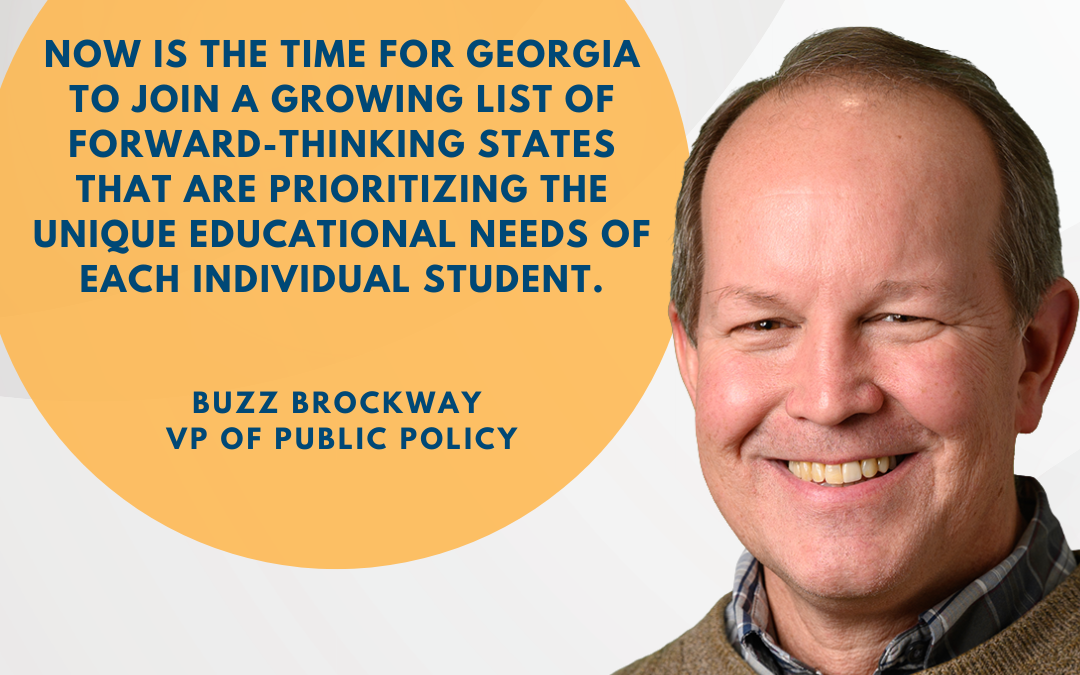
Georgia Center for Opportunity’s (GCO) take: “Now is the time for Georgia to join a growing list of forward-thinking states that are prioritizing the unique educational needs of each individual student,” said Buzz Brockway, vice president of public policy for GCO. “We’re pleased that Lt. Gov. Jones has joined his voice to the vast majority of Georgians who support educational scholarship accounts like Promise Scholarships. We encourage members of the Georgia House to listen to the voice of their constituents and make these accounts a reality.”

SB233 edu subcommittee

EVERY Kid In Georgia Deserves
A Quality Education

EveryKid.info

SB233 edu subcommittee

EVERY Kid In Georgia Deserves
A Quality Education

EveryKid.info

About Promise Scholarships: Funded by the state in the amount of $6,000 per student for each school year, Promise Scholarships would allow families to find the right fit for their students’ education. Scholarships could be used on any approved education expense, such as private school tuition, tutoring, homeschool curriculum, virtual classes, college classes, therapies (for kids with special needs), technology, and more.

Nelson Mullins – Gold Dome Report – Legislative Day 36

Nelson Mullins – Gold Dome Report – Legislative Day 36

In The News

Nelson Mullins – Gold Dome Report – Legislative Day 36

House Education Committee – Policy Subcommittee

The Policy Subcommittee of the House Education Committee, chaired by Representative Scott Hilton (R-Peachtree Corners), met Monday to consider one measure:

  • SB 233, authored by Senator Greg Dolezal (R-Cumming), is the “Georgia Promise Scholarship Act.” The bill amends Title 20 to provide for the establishment of promise scholarship accounts to be funded by the state in the amount of $6,000.00 per school year for each participating student.

Dolezal presented the bill alongside Jamie Lord, who represents the Georgia Center for Opportunity and is promoting the legislation.

The Georgia Promise Scholarship (SB 233): Questions and Answers

The Georgia Promise Scholarship (SB 233): Questions and Answers

The Georgia Promise Scholarship (SB 233): Questions and Answers

Key Points

  • The Georgia Promise Scholarship is a statewide program that empowers parents to access the best education for their child. It creates state-funded scholarships that give eligible families up to $6,500 per student for each school year.
  • Eligibility is limited to students zoned for low-performing public schools and who meet certain other criteria.
  • Applications will be open for families during four periods in 2026. Sign up to be notified of application deadlines and tips.

Across the country and in Georgia, parents have been calling for more choice and flexibility in K-12 education. In 2024, Georgia took a major step forward by passing the state’s first-ever education savings account program, the Georgia Promise Scholarship.

The program started during the 2025-2026 school year, and it gives eligible families up to $6,500 per year to access the education opportunity best suited to their child’s needs. Visit the program website for more information on how to apply. 

What is the Georgia Promise Scholarship? 

The Promise Scholarship gives families financial support to access education opportunities outside the public school system. Families can receive up to $6,500 per year for approved education expenses. This type of program is also known as an education savings account.

How does the Georgia Promise Scholarship work?

The state sets aside the scholarship amount in an account that the parent can direct. Parents can use these funds to choose the education environment that supports their child’s unique learning needs.

When does the Promise Scholarship program open? 

There will be four application periods for families in 2026:

  • March 1-31
  • May 1-31
  • August 1-31
  • November 1-30

Families accepted into the program will receive funding for the 2026-2027 school year. See the Georgia Promise Scholarship website for more details.

What can Georgia families use Promise Scholarships for? 

Families can use the funds for a variety of educational expenses, giving them flexibility to choose the best education for their child’s needs. Approved expenses include: 

  • Private school tuition and fees 
  • Tutoring services 
  • Textbooks and curriculums 
  • Education therapies 
  • Education-related technology 
  • Transportation costs

Who can apply for a Promise Scholarship? 

To be eligible, families and students must meet the following criteria:

  • Parents must have lived in Georgia for at least one year, with exceptions for active-duty military families.
  • The student must be zoned for an eligible public school (one included on the Governor’s Office of Student Achievement’s list of the bottom 25% of public schools based on performance). 
  • The student must have been enrolled in a Georgia public school for two consecutive semesters or be a rising kindergarten student.
  • The student can’t be enrolled in a local school system, charter school, or state charter school while participating in the scholarship program.

The program prioritizes lower-income Georgia families. If applications exceed available slots, priority goes to families with household incomes below 400% of the Federal Poverty Level (roughly $129,000 for a family of four).

Parents must agree to use the accounts only for qualifying educational expenses. Once a child receives a scholarship, they remain eligible through 12th grade, until they enroll in a public school, or until they leave Georgia.

How is the Promise Scholarship amount determined?

Amounts have initially been set at $6,500, which is approximately the average per-pupil amount the state sends to local school districts based on Georgia’s current student funding formula. The final 2026-2027 scholarship amount will be announced soon.

Who does the Georgia Promise Scholarship help?

Parents: Parents know better than anyone that children are unique and that a one-size-fits-all education approach doesn’t work for most kids. Georgia’s Promise Scholarship gives parents financial support to access other education opportunities when the local public school isn’t the best fit.

Students: For families seeking alternatives to under-performing public schools, Promise Scholarships provide an opportunity for students to access other school options, including those that may not be available or affordable otherwise. 

Public schools: States with robust education choice programs see better outcomes for all students, including those in the public school system. Education savings account programs, in particular, have a track record of empowering public schools to improve their budgets and increase student achievement.

Are Promise Scholarships the same thing as school vouchers?

No, they’re two different types of programs. School vouchers allow parents to use public education dollars for private school tuition only. Parents can use the Promise Scholarship for a wider range of education expenses, offering families more flexibility. 

Are Promise Scholarships the same thing as 529 plans?

No. With a 529 plan, parents are responsible for contributing money to an account to save for their child’s education expenses. Promise Scholarships are state-funded and don’t require parents to contribute any of their own money. Parents can choose to use a Promise Scholarship account for education savings because up to 50% of unused funds can be carried forward to the next school year, but the account doesn’t have the same tax benefits that 529 plans do.

Do other states have programs like Georgia’s Promise Scholarship? 

Yes, 18 states have adopted some form of an education savings account program, including all of Georgia’s immediate neighbors. 

Several other states are moving their education savings account programs to a universal eligibility set-up, where every kid has access regardless of income, race, zip code, or other circumstance. 

Georgia is paying attention, and legislators are considering options that will grant Promise Scholarship eligibility to more families. During the state’s 2025 legislative session, senators introduced SB 124, which would allow the children of active-duty military families to be eligible for the Promise Scholarship program, even if they aren’t zoned for a low-performing public school. Georgia lawmakers also introduced SB 152, which would grant eligibility to the biological or adopted children of foster parents, even if their local school isn’t under-performing. 

These bills didn’t become law in 2025, but they could be reintroduced in the 2026 legislative session. If they move forward, they could give more kids the best possible opportunities at school and in life. 

Do Promise Scholarships take money away from Georgia’s public schools? 

No. The Promise Scholarship is funded separately from the money allocated to public schools.

Will Promise Scholarships help low-income families? 

Yes. Programs like the Promise Scholarship are some of the most equitable education pathways for students. They give low-income families more opportunity to access schooling options that are often only available to families with greater financial resources.

Georgia’s Promise Scholarship is also set up to give lower-income families priority if applications exceed the number of slots available.  

Does the Promise Scholarship hurt homeschooling families? 

No. There are no provisions in the proposed law that would prevent homeschooling families from continuing down that education path. 

In fact, Georgia’s Promise Scholarship could make homeschooling an even more feasible option. Eligible families can use the funds to pay for curriculums, courses, tutoring, or other education resources needed to homeschool.

Does the Promise Scholarship hurt homeschooling families? 

No. There are no provisions in the proposed law that would prevent homeschooling families from continuing down that education path. 

In fact, Georgia’s Promise Scholarship could make homeschooling an even more feasible option. Eligible families can use the funds to pay for curriculums, courses, tutoring, or other education resources needed to homeschool.

Nelson Mullins – Gold Dome Report – Legislative Day 36

Georgia school voucher bill stays alive after heated Senate debate

In The News

Georgia school voucher bill stays alive after heated Senate debate

A school voucher bill is one of many that survived Monday’s legislative deadline where pieces of legislation have to pass at least one chamber in order to stay alive for Georgia’ 2023 legislative session. After some intense debate on the Senate floor, Senate Bill 233 sailed through in a 33-23 vote.

School closures during the pandemic added fuel to the school choice movement. In Georgia, enrollment in charter schools and homeschooling have grown since the Covid-19 pandemic. Georgia Center for Opportunity, a nonpartisan policy research organization, said SB 233 will expand school choice options.

“Parents across the country are demanding more educational options in the wake of the COVID-19 pandemic,” GCO’s vice president of public policy Buzz Brockway said in a news release. “Now is not the time for more lip-service or half-hearted efforts to help students reverse learning loss.”

Nelson Mullins – Gold Dome Report – Legislative Day 36

Georgia Senate passes bill to create state-funded education savings accounts

In The News

Georgia Senate passes bill to create state-funded education savings accounts

The Georgia Senate passed legislation to create state-funded education savings accounts.

Under Senate Bill 233, the Georgia Promise Scholarship Act, taxpayers would fund $6,000 per student per school year. Families could use the money to defray “qualified” education costs, such as private school tuition.

“Parents across the country are demanding more educational options in the wake of the COVID-19 pandemic,” Buzz Brockway, vice president of public policy for the Georgia Center for Opportunity, said in a statement. “Now is not the time for more lip-service or half-hearted efforts to help students reverse learning loss. Georgia families need more opportunities and they need them now.