by Georgia Center for Opportunity | Dec 23, 2013
Thanks to your support, Georgia Center for Opportunity is making significant progress in removing barriers to opportunity through Research & Development, Policy Advancement and Delivery. Please review highlights from 2013 and preview our work for 2014.
RESEARCH & DEVELOPMENT HIGHLIGHTS
Central to GCO’s Breakthrough Process is the Research & Development Working Group. Each team is an expert panel from fields of government, academics, business and non-profits that convenes to evaluate research, field studies, public hearings and best practice observations to recommend evidence-based solutions to policymakers and service providers. Here are a few 2013 highlights from our current Working Groups:
Prisoner Reentry: Launched in July 2013, the team’s sixth meeting is scheduled for December 2013. The team has: visited five Georgia state prisons and two drug courts, conducted nearly four dozen interviews and completed initial research; developed policy recommendations on ways to improve employment opportunities for ex-offenders and presented the recommendations to the Governor’s Special Council on Criminal Justice Reform; and presented details of prisoner reentry work to a gathering of 70+ individuals in Washington, DC, who represent leading think-tanks from around the country and world, members of Congress and congressional staffers.
College & Career Pathways: Led by PhD researcher Eric Wearne, the College & Career Pathways team officially kicked off in November 2013. The team has: conducted dozens of interviews with education experts in Georgia, completed initial research and is currently narrowing its research agenda in this critical work.
Alternatives to Medicaid Expansion: This Working Group is in early stage development with an official launch targeted for January. The team is: conducting initial research on Georgia’s Medicaid program, including the details of Medicaid expansion, and expert interviews are in process.
POLICY ADVANCEMENT HIGHLIGHTS
GCO has made an impact through Education Advocacy during the 2013 legislative session resulting in two reforms signed into law:
- Tax Credit Scholarship Program reforms, including expansion of the cap to $58 million per year.
- Special Needs Scholarship reforms, including three specific enrollment opportunities each year.
Additionally, we spoke before the Georgia Senate committee to help prevent horseracing in Georgia and our VP of Policy Advancement, Eric Cochling, continues to serve on the Governor’s Task Force on Commercial Sexual Exploitation of Children.
As part of our Grassroots Outreach efforts, the Policy Advancement team has:
- Recruited and trained advocates on topics including: how to talk with a legislator, how to use social media, op-ed and blog writing and interviewing skills for print and broadcast media.
- Organized the 2013 School Choice Celebration and Rally, drawing over 2,000 people (mark your calendars – the 2014 School Choice Rally is scheduled for January 28, 2014 at the State Capitol).
- Participated in several panels on education reform, including the Georgia Legislative Black Caucus annual conference and Heartland event at the National Conference for State Legislatures.
- Launched Georgia Parents Alliance, an effort to engage over 10,000 parents online to support school choice and reform (see www.georgiaparentsalliance.org).
BREAKTHROUGH DELIVERY HIGHLIGHTS
This past year our Breakthrough Delivery team has consulted with partner organizations such as Arete Scholars Fund and Every Woman Works to improve their delivery capacity, focusing on organizational branding, programs, operations and funding development.
We have established Breakthrough Norcross, a Collective Impact initiative uniting more than 30 partner organizations that serve the Norcross school cluster (includes students living in Peachtree Corners) to develop a shared vision for change: every child in the Norcross cluster will succeed academically, enter into a meaningful, self-sustaining career and develop into a contributing member of the community.
- Breakthrough Norcross has more than 30 non-profit organizations committed to the Collective Impact initiative and others who have shown interest. In early 2014 we will approach more local businesses to join as partners.
- The collective partners have identified key outcomes and corresponding metrics at each stage of a child’s life (e.g., early childhood, middle childhood, adolescence) that cumulatively lead to academic success, and will next research evidence-based interventions and programs available to bring about better outcomes at each stage.
- If local organizations and programs that deliver desired outcomes do not exist in the Norcross community, the Breakthrough Delivery team will incubate programs to deliver services designed to bring about needed change.
2014 PREVIEW
As we move forward to 2014 we plan to continue the important work started in 2013 and launch several new initiatives:
- Research & Development plans to assemble Working Groups that will focus on Stronger Families and Entitlement Reforms.
- Policy Advancement will advocate for the reforms proposed by the Prisoner Reentry and College & Career Pathways Working Groups.
- On the education front, Policy Advancement will pursue the establishment of Opportunity Scholarships that greatly expand the choices available to students in Georgia.
- GCO will also pursue Benefit Corporation legislation in Georgia. This is a new corporate structure that allows social entrepreneurs to access venture capital while remaining true to their purpose (creating positive social benefit) and producing financial returns for investors. B-Corps are a promising platform for job creation, investment opportunities and growth of high-impact organizations focused on a range of social goods.
- The Breakthrough Delivery Team plans to launch up to two additional Breakthrough Communities here in Georgia and are already in initial talks to start these collective impact initiatives.
by Eric Cochling | Dec 20, 2013
Our team at GCO had the privilege of hosting Dr. Rick Hess this week. On Tuesday, Dr. Hess, who is an education scholar (and prolific writer) with the American Enterprise Institute, spoke at an early morning breakfast attended by a group of about 45 people that included politicians, lobbyists, academics, parents, and policy wonks.
While the crowd was diverse, each person shared a common concern about the depressing condition of public education in the state of Georgia and wanted to hear Dr. Hess’ thoughts on the subject. He didn’t disappoint.
Using his book Cage-Busting Leadership as the springboard, Dr. Hess challenged the group to consider how much innovation and real reform could be achieved within the current education system if administrators, teachers, and concerned parents stopped taking “no” for an answer.
He shared example after example of people who were able to break through the “cage bars” erected by overly risk-averse school system lawyers or years of outdated rules that still clogged school procedures and hamstrung teachers from addressing student needs.
The bottom line: With a little questioning and a lot of grit, it is possible to change the system so that children receive better educations.
Although Dr. Hess focused on ways to improve the system from within, he didn’t shy away from endorsing school choice as an important tool for giving children more and better options – and incentivizing the public system to improve. Wisely, though, he warned the audience that just changing laws – even something as significant as vouchers – will not be sufficient in itself to really change education if everyone at the school level simply continues to accept business as usual.
In addition to legal reforms that allow parental choice and school flexibility, we must have pioneering and system-challenging educators and parents willing to question the status quo every time any engrained practice misses the mark of promoting our children’s best interests.
Those were all great points by Dr. Hess and a wonderful reminder that we have more power to change things than we may realize just by asking the question “Why not?”
Join us in asking that question and pushing for reforms that free parents and children to have more educational options and free excellent teachers to change lives.
by Georgia Center for Opportunity | Dec 5, 2013
Monday afternoon, December 2, Breakthrough Norcross celebrated the completion of its three-part “listening tour” with an authentic White House Reception held at Norcross High School.
Prior to the reception, the last of three working meetings were held in which nearly 30 representatives from numerous business, non-profits, churches, and schools reviewed and made final contributions to the Breakthrough Norcross collective impact strategy.
To aid in celebrating this great milestone, Walter Scheib, former White House Executive Chef to the Clinton and Bush administrations, prepared a wonderful meal for meeting participants, as well as numerous other community representatives invited to hear about Breakthrough Norcross’ cradle to career plan for collective impact.
For those unable to join us, CBS Atlanta covered the event. See their re-cap here.
by Georgia Center for Opportunity | Dec 3, 2013
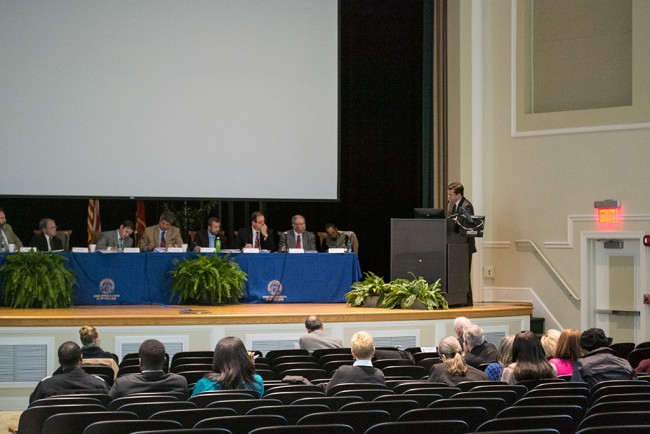
The Governor’s Special Council on Criminal Justice Reform invited organizations from across the state to present recommendations for improving ex-offender outcomes at the Department of Corrections Headquarters in Forsyth, Georgia, Tuesday, November 26.
Eric Cochling, VP of Policy Advancement for Georgia Center for Opportunity, testified before the council with proposals generated from GCO’s Prisoner Reentry Working Group on ways to improve employment opportunities for Georgia’s ex-offenders.
-
- Georgia Center for Opportunity’s Eric Cochling testifying before the Governor’s Criminal Justice Reform Council.
He outlined the following five recommendations for the state to consider implementing:
- Lift driver’s license suspensions for drug offenders who have not committed a driving-related crime.
- Ensure offender’s identification is secured prior to release so they will be ready to apply for a job upon leaving prison.
- Incentivize employers to hire ex-offenders through offering tax credits or deductions, a bonding program, and protection from liability.
- Increase ex-offenders’ chances of being hired by postponing questions about criminal convictions until after an interview has been conducted, with the state setting the example by implementing this recommendation for public employment first.
- Lift professional licensing restrictions to allow ex-offenders to work in occupations that were previously off-limits to them because of a felony conviction that is unrelated to the professional license being sought.
Testifying before the Governor’s Council proved to be a critical first step in presenting GCO’s working group findings to state leaders, as the council consists of legislative, judicial, and executive appointees, as well as representatives from various sectors of criminal justice at the state and local level.
Established by the Governor in 2011 to protect public safety and hold offenders accountable while controlling state costs, the council has proposed significant reforms for adult sentencing and corrections and juvenile justice. Due to the success of the council’s recommendations and landmark legislation being passed during the 2012 and 2013 legislative sessions, Governor Deal commissioned the council to focus on improving prisoner reentry in the state next year, too.
For the upcoming 2014 legislative session, the council is working diligently to compile the best recommendations for the state to implement to reduce recidivism. However, due to the scope of this assignment, bills outlining the council’s recommendations may be introduced over the next couple of sessions.
Eric’s presentation received a positive response from council members leading them to ask several follow-up questions about other states that have enacted similar reforms. GCO is grateful for the opportunity to present and hopes that the council seriously considers our recommendations.
The recommendations for increasing employment opportunities for ex-offenders represent a sample of the reforms being proposed by GCO’s working group. Future recommendations will likely include ways to reduce debt and increase savings for prisoners, establish reentry courts, and implement specialized transitional centers across the state, among others.
by Georgia Center for Opportunity | Dec 3, 2013
A word from our CEO, Randy Hicks, about year-end giving
Georgia Center for Opportunity’s mission is to remove barriers to social and economic opportunity. Consider making a year-end gift to help GCO continue to fight for solutions to childhood poverty, family breakdown, failing schools, welfare dependency and unemployment. We value your partnership in this important work.
At GCO, we are committed to do what is necessary to improve the lives of individuals and families. In Georgia, only three out of ten poor children make it to the middle class by middle age. And even for those children, the threats of family breakdown, poor quality schools, and fewer jobs mean that today’s children are just as likely to move down the income scale as they are up. You can read more about the challenges and costs to society here.
According to social scientists Isabel Sawhill and Ron Haskins, American children can do three things that will almost eliminate the threat of falling into poverty:
- Graduate from high school
- Get a full time job
- Be married and at least 21-years-old before having children
Ninety-eight percent of those who did those three things are not in poverty today.
We have a three-step process for developing solutions and making them a reality. First, GCO brings experts together to dive into some of today’s biggest challenges and recommend both policy and community-based solutions. Second, GCO educates the public and advocates at all levels of policymaking. And third, GCO helps effective nonprofits get even better and build additional capacity to affect change. Read more about our approach here.
Currently, we have several initiatives underway in Prisoner Reentry, Breakthrough Communities, and College and Career Pathways that you can read about here, as well as on other posts on our blog. In 2014, GCO will launch panels on stronger families, community-based healthcare solutions, and other exciting work.
Will you invest in our work at this time?
The success we have had – and the success we will have – is tied to your investment in our work. A significant portion of our budget – and therefore our impact – is determined by gifts that are received during December. A gift of any size – $25, $100, $250, $1,000 – will make a difference. As always, please know that we are thankful for you and your generosity.
You may make a secure donation online here.
by Georgia Center for Opportunity | Nov 25, 2013
Did you miss our Taste Shop Give event on Thursday, November 7th? If so, you passed up an opportunity to experience some fantastic music, enjoy an incredible meal, bid on some amazing live auction items, and meet some awesome people who are dedicated to our mission at Georgia Center for Opportunity.
GCO’s third annual Taste Shop Give event was held at The Ballroom at Twelve, Atlantic Station. Former White House chef Walter Scheib prepared a formal State dinner in the same fashion as he has prepared countless banquets for heads of State during his tenure under presidents, Bill Clinton and George W. Bush. The dinner included field greens with balsamic dressing and baked goat cheese; stuffed pecan crusted chicken breast filled with smoked mozzarella and sun dried tomatoes; parmesan risotto; French beans with a roasted yellow pepper sauce; and vanilla ice cream with warm banana caramel compote.
This mouthwatering meal was served up by our Breakthrough Ambassadors, high school students from Norcross High School. They did such a great job serving you would never have known they weren’t professionals.
Taste Shop Give 2013 featured uplifting musical entertainment from three inspirational solo artists, Mary Millben, Shay Watson and Peter Lee Johnson. Mary has been a featured vocal soloist at The White House and the Kennedy Center, and for events hosting presidents, George W. Bush and Barak Obama, and many others. She sang a gorgeous version of “Georgia on My Mind”, among other songs, for our Taste Shop Give guests. Shay Watson has carved out a place for himself in the global music community as a songwriter, artist and producer. He sang a few of his original pieces and together Mary and Shay sang a duet of “Oh Happy Day” which was quite moving. Peter Lee Johnson is a young violin genius who played a variety of popular cover songs during the evening. You can see below that even some of the Breakthrough Ambassadors joined in on the entertainment.
After the dinner, entertainment, and good conversation, the evening was wrapped up with a live auction. There were several great items auctioned off including an electric violin signed by Peter Lee Johnson, a home entertainment system, an Italian getaway, a premier cruise excursion, and an exclusive set of Pickard Whitehouse tableware – all donations are used to support our mission to remove barriers to opportunity and ultimately help more Georgians achieve a better life.
If you missed our event this year, please join us next year. If you were able to attend, we sincerely thank you for your support!!!


