Money Can’t Replace Meaning and Purpose

Money Can’t Replace Meaning and Purpose

Money Can’t Replace Meaning and Purpose

American poverty

Work has intrinsic value

Last month, I had the honor of participating in the Heritage Foundation’s annual Antipoverty Forum, where scholars and practitioners discussed the state of poverty in the country and the local efforts to confront the issue.

The discussion this year centered on the Biden Administration’s Build Back Better (BBB) bill that is now making its way through Congress and the ways in which the bill would undermine work by using much of its $2.4 trillion to expand safety net benefits and create new entitlements, all while eliminating work requirements.

Despite unemployment numbers dropping nearly to pre-pandemic lows in most states, what is not widely understood is that labor force participation (the number of people who are able to work and are actively looking for work) is much lower than when the pandemic began. Some 4-5 million people have effectively dropped out of the workforce – at least for now – despite record job openings (10.4 million in September).

While the drop in workforce numbers is partially explained by fear of COVID and mothers forced to stay home with children, much of it can only be explained as being caused by increased benefits (and the elimination of many requirements for qualifying), rescue-related payments and, now, monthly child tax credit payments. The BBB bill is very likely to make these trends and others, like inflation, worse.

Although we’re concerned that people are choosing not to work and agree that more money coming from Washington, DC, will make matters worse, my remarks reflected our concern at GCO about why worklessness harms the individual. Work is not merely about earning money; it has intrinsic value.


The Success Sequence provides an outline of how to reverse the cycle of poverty in our communities. GCO uses this as a framework for much of our work.

Championing a return to normalcy and healthy social interaction

Work provides each of us with an outlet for our God-given talents and creativity. It allows us to serve others and contribute to other individuals’ well-being in exchange for having our own needs met. More than that, it provides us with social capital and a network of colleagues and friends who can help us when we need it. Much research has also shown that worklessness leads to poor mental and physical health and can contribute to increased drug and alcohol abuse – the 100,000+ overdose deaths during the pandemic representing the latest example.

As our government wrestles with how to deal with the pandemic and sets its priorities, it should avoid anything that discourages employment and causes more isolation. For individual and societal health on every front, the government should be championing a return to normalcy and healthy social interaction – including at work – that allows the American people to be resilient during times of crisis.
Partnerships and Building Blocks Come Together in Columbus

Partnerships and Building Blocks Come Together in Columbus

Partnerships and Building Blocks Come Together in Columbus

Building a stronger network of resources

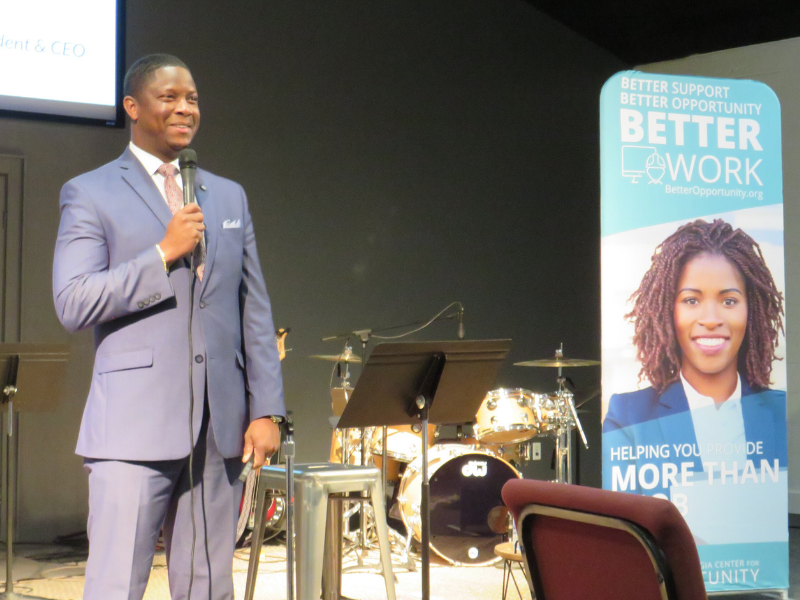
On November 4th, BETTER WORK Columbus hosted a reception to announce a new partnership with Jobs for Life to bring its proven curriculum and a nationally recognized program to help struggling people find meaningful, self-supporting work. During the event, Ryan Ray, President and CEO of Jobs for Life, shared his heart as well as the passion behind the Jobs for Life training program and the power it has to impact lives in a transformative way.

Problem:

In Columbus, 11,406 people are unemployed, despite more than 6,500 job openings. The problem is not an issue of availability but an issue of access. There are personal, educational, and systemic barriers that prevent some of our neighbors from working or thriving at their jobs. Without work, many begin to identify themselves with their circumstances which creates a vicious cycle of poverty—economically, spiritually, and emotionally.

Solution:

Our BETTER WORK Columbus team has already built a strong network of partnerships and has been using the Jobs for Life framework to recruit and train mentors. Now, we want to take this a step further by extending the network of support to Jobs for Life training sites in our community.

Our BETTER WORK Network has allied with Jobs for Life to help break the cycle of poverty and build up our communities. JFL sites are uniquely positioned to address the root causes of un- and under-employment by uniting churches, businesses, and community organizations and facilitating positive transformation within lives and communities. This model reinforces work as more than just a paycheck but a source of pride and dignity. It is designed to address the loss of identity which often accompanies unemployment.

We will join hands and work together to bring the change our community needs.

How can we work together?

It starts here! We will join hands and work together to bring the change our community needs.

If you live in the Columbus area, we need your help! You can: 

  • Champion a student through mentoring, 
  • help us with recruitment, 
  • hire a graduate, 
  • or simply celebrate with us. 


You may also choose to donate by giving online

Then send an email to kristin.barker@georgiaopportunity.org to have your gift support local Jobs for Life classes. Include your name and the subject line – “I donated to the BETTER WORK Network and Jobs for Life”.

BETTER Work Network is Growing in Columbus

BETTER Work Network is Growing in Columbus

BETTER Work Network is Growing in Columbus

A Network of Partners is Growing in Columbus

Columbus, Georgia has over 11,000 citizens identifying as unemployed, but the number of available jobs is over 6,000.  What’s the problem? Why are so many people not working?

Kristin Barker serves as the program manager for BETTER WORK Columbus, and provides insight as to why there’s limited job access in the area.

Through growing partnerships in Columbus, the BETTER WORK Network will meet the needs of people where it will have the most impact – in their neighborhoods. One of our partners, Jobs for Life, will utilize their sites to help address the underlying issues creating unemployment.

We know that satisfying work has the ability to restore dignity, build communities, and reduce crime.

We are excited to see so many people working together for the good of helping people.


The BETTER WORK Network will meet the needs of people where it will have the most impact – in their neighborhoods.