by Georgia Center for Opportunity | Feb 7, 2014

Roads Cleared, News Coverage Still Encountering Snow Related Congestion
While last week’s winter weather is in the rear view mirror, the postmortem evaluation of the government’s response continues to receive considerable coverage. The General Assembly, however, has moved right back into business as usual.
Legislation, Study Committees, and Rumors to Watch
– Education –
Senate Bill 288 moved through senate without opposition. The bill from Sen. Charlie Bethel (R-Dalton) would prohibit public schools from participating in interscholastic athletic events officiated by outside organizations, such as The Georgia High School Association, unless those third party groups release annual financial reports.
In December we learned that the GA Dept. of Education will be launching a College and Career Pathways initiative, which will require students to select a career path that will shape their high school course work. Rep. Eddie Lumsden (R-Armuchee) introduced House Bill 766, the “Work Based Learning Act”, which would permit schools – in collaboration with the Department of Labor and the Technical College System of Georgia – to award secondary credit for approved off campus work to students 16 and over.
Sen. Mike Dugan’s (R-Carrollton) Senate Bill 283 passed the Senate and moved to the House this week. The bill would authorize schools to educate students regarding “traditional winter celebrations,” and officially permit the use of “traditional greetings” like “Merry Christmas” and “Happy Hanukkah.” It’s a distressing sign of the times that a bill like this is considered necessary.
– Child Welfare –
Sen. Tommie Williams (R- Lyons) is encouraging support of “Ava’s Law” (House Bill 309 & Senate Bill 191), which would require Georgia private insurance companies to cover treatment for autism. According to the CDC, autism spectrum disorders affect 1 in 88 children. Gov. Deal’s 2015 budget included proposed funding for such coverage in the State Employee Health Plan, though neither the Governor’s proposal nor this legislation would result in coverage under Medicaid or PeachCare.
A bill to privatize most of the state’s child welfare services was introduced this week by Senator Unterman (R-Buford). The legislation, Senate Bill 350, would require the Department of Family and Children Services (DFCS) to develop a plan by January of 2015 by which it would contract with a limited number of regional lead agencies to provide the vast majority of child welfare services that are now, at least in part, offered by the state. The program would be phased in over the course of two years.
While lead agencies would be allowed to provide up to 35 percent of the services needed within a region, the law would require that they contract with other local agencies to provide the majority of services.
Contracts between the state and lead agencies would be for five years with DFCS having the ability to extend the contract for an additional three years. While DFCS would no longer be a direct service provider, it would retain responsibility for providing oversight of the contracted agencies.
As an incentive to agencies to find suitable permanent placements for children in their care, the law would fund agencies with per-child payments for a maximum of six months. After six months agencies would be required to pick up the tab for children that remain in their care. Likewise, agencies would not be eligible for per child payments for any child returning to the agency within 12 months of a permanent placement.
The reform is modeled after similar efforts in Florida and more than a dozen other states over the last couple of decades and has been driven by Georgia’s continued failures to adequately serve the children in its care.
While privatization is supported by many state leaders, including the Governor and Lt. Governor, opponents to the change say that it is being done too quickly and without considering ways to reform the system without privatization.
Evidence from Florida and other states shows that privatization can have beneficial effects, including improved safety for the children in care and a reduction in the number of children in state custody.
Yesterday, the legislation was favorably voted out of the Healthcare Delivery Subcommittee of the Senate Health and Human Services Committee. A stakeholder meeting was expected to be held today.
– Welfare Reform –
Representing an extension of a 2012 law requiring mandatory drug testing for Georgia welfare recipients, Rep. Greg Morris (R-Vidalia) has introduced House Bill 772 which would impose the same standard for receipt of Food Stamps. This will be an interesting piece of legislation to watch, as a Federal Court overturned similar legislation in Florida.
– Ethics and Government Reform –
Sen. Josh McKoon (R-Columbus), Chairman of the Senate Judiciary Committee, is part of a coalition proposing some interesting changes. Two have received attention in the past week: First is a request to require conference committee reports be filed by day’s end of the 39th day of legislative session. This seems a wise and rational move, as it would protect Georgians from having to pass a bill in order to find out what is in it. In addition, Senate Resolution 7 would allocate permanent funding that would provide for the separation of the Georgia ethics commission from the office of the Governor.
Upcoming Events
Our friends at the American Federation for Children are hosting a nonpartisan candidate training school in Atlanta on February 22nd. The training is free but requires registration to attend. For more information, please see this flyer for the event or email Brian Pleva to register.
Ironic
Despite last week’s encounter with snow, Georgia is not the state you expect to be producing Winter Olympic medalists. However, as the Sochi Games kick off today, the Peach State is indeed represented by Douglasville native Elana Meyers, who will be seeking her second Olympic metal in Bobsledding.
After last week many Georgians likely have a new found respect for those able to control a vehicle on ice at high rates of speed. Check out Meyers’ team’s story of determination and perseverance here, and be sure to tune in to cheer her on as she represents our great State.
_______________________
Thanks to Jamie Lord, our director of government affairs, and Jacob Stubbs, our legislative intern and John Jay Fellowship alumnus for their able contributions to this update.
by Georgia Center for Opportunity | Feb 7, 2014
Georgia Center for Opportunity (GCO) is pleased to see Governor Nathan Deal and U.S. Attorney Sally Yates (Northern District of Georgia) exercise their influence to encourage business leaders across the state to hire ex-offenders. They are urging employers to give ex-offenders a fair shot in the hiring process and outlining the benefits available to those who choose to hire them.
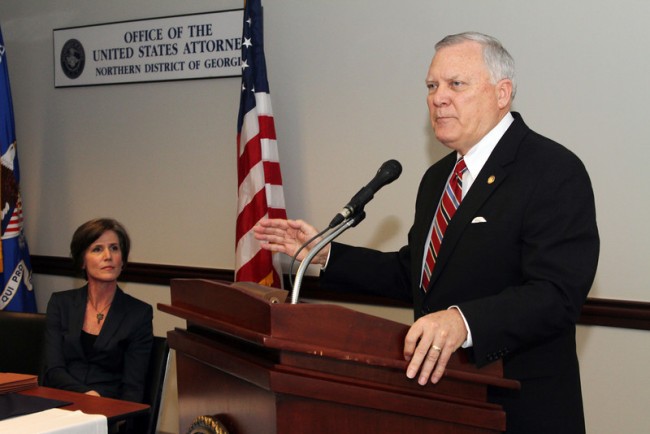
Governor Deal speaking at a Reentry Summit with U.S. Attorney Sally Yates on Feb. 5, 2014.
Image credit: Georgia.Gov, Office of the Governor.
These actions are consonant with recommendations made by GCO’s Prisoner Reentry Working Group this past December based on input from criminal justice practitioners in Georgia and a review of best practices across the country (See Increasing Employment Opportunities for Ex-Offenders).
One important recommendation made by the working group included increasing the chance that a person with a criminal record will get hired by postponing the question about an applicant’s criminal history to a point after the interview stage of the hiring process. Such an action would give the applicant an opportunity to demonstrate his or her qualifications for a job and provide an explanation for any criminal history to the employer during the interview. It also prevents an employer from automatically screening a candidate who may be the best fit for the position.
Another key recommendation made by the working group is that the state should set the example for other employers by hiring ex-offenders. This action would demonstrate that the state is serious about helping ex-offenders become employed and successfully transition back into society. We believe that the degree of success the state has in finding and maintaining qualified ex-offenders as employees will directly impact the willingness of private employers to adopt similar policies.
Read the following articles posted on February 6, 2014 in the Savannah Morning News to learn more about steps that the key state leaders are making to encourage businesses to hire ex-offenders: https://savannahnow.com/news/2014-02-06/ga-officials-urge-businesses-hire-ex-prisoners#.UvTmvLT-L1V.
by Georgia Center for Opportunity | Feb 6, 2014
By Dr. Danielle LeSure, GCO’s Director of Education Policy
Amazingly, over 600 students, parents, teachers, and school leaders crowded the Capitol in the middle of a snow storm to cheer for school choice options—charter schools, public school transfers, special needs and tax credit scholarship programs— on Tuesday, January 28.

-
- Students have their photo taken to share their support of School Choice through social media.
After touring the Capitol and visiting with legislators, students were greeted by never ending snow flurries. While waiting for the rally to start on the steps of the Capitol, Governor Nathan Deal (GA) announced the closing of all state government buildings. Georgia Center for Opportunity’s Vice President Eric Cochling approached the crowd of students that were dancing to the song “Happy” from Despicable Me to deliver the news and lead everyone in a cheer. From the streets surrounding the Capitol you could hear voices shouting “more school choice, more school choice.”

-
- Eric Cochling addresses the crowd at the rally and leads the cheers of “More school Choice!”
Though we were unable to hear from our scheduled speakers Governor Deal and actress Keshia Knight Pulliam who are strong supporters of choice, we did get to hear from those who benefit most from school choice—Georgia students. As they left, their footprints in the snow symbolized Georgia’s journey in the school choice movement. While we have many options in Georgia, there are still over 5,000 students on waiting lists for charter schools and many more students longing for a better option but private school costs are not affordable for their parents.
Georgia does not stand alone in its efforts to increase support for school choice. During the week of the rally, there were over 5,500 events nationwide celebrating school choice options. This is a record high according to an article by National School Choice Week.

- Two students showcasing the signs they prepared for the rally.
If you are or know of a parent who needs more information about choice or would like to become an advocate please visit the Georgia Parents Alliance. Together, we can continue to make a difference!
by Georgia Center for Opportunity | Feb 3, 2014
Should you have any questions or comments about the content of this update, please email Eric Cochling.
Weather Dominates Week
As the General Assembly meets today for day 14 of the session, the subject dominating the headlines is the two days of utter chaos on Georgia’s roads this week. With so many children stranded at school and commuters stranded in their cars, the official response to the snow quickly took on political dimensions.
Our 5th Annual School Choice Celebration and Rally was cut short by the weather, but not before many of our participants were able to voice their support of school choice with their legislators. Thanks to all of our partner organizations, volunteers, and participating schools for braving the weather to show their support for more school choice options in Georgia. We’d like to especially thank the Georgia Charter Schools Association, Agudath Israel of America, Americans for Prosperity, Grace Scholars, Students First, and Hennessy Transportation for their partnership in hosting the event.
Legislation, Study Committees, and Rumors to Watch
– Education –
Given the high demand for Tax Credit Scholarships, Rep. Ehrhart (R-Powder Springs), introduced House Bill 759 that would raise the cap on the program from $58 million annually to $100 million, nearly doubling the size of the program.
In other education news, supporters of Parent Trigger legislation (House Bill 123) are hoping to see it resurrected this year after gaining some traction last session but ultimately failing to make it out of the General Assembly.
Finally, whatever your thoughts about the DeKalb School Board, it does seem strange that the private organization accrediting our school districts (SACS) is, itself, not subject to transparency, especially in regard to how it makes its accreditation decisions. Those decisions impact the public interest in a major way and should be open to public scrutiny. The Attorney General is right to be pressing the case.
– Adoption and Child Welfare –
Rep. Buzz Brockway (R-Lawrenceville) introduced House Bill 524 last session with the goal of making it easier for adopted individuals to access their original birth certificates and the information about birth parents they contain. The legislation, which is being reconsidered this session, was met with opposition by those concerned that disclosing information about birth parents could discourage adoption.
House Bill 771, sponsored by Rep. Jason Spencer (R-Woodbine), would effectively lift the statute of limitations related to civil claims for damages brought by victims of childhood sexual abuse. Currently, the law requires these claims to be brought by a victim within five years of turning 18 years old. Should this bill become law, suit could be brought against a defendant at any time.
– Constitutional Convention? –
Citing a crushing federal debt burden, continued overspending, out of control federal mandates, and overreaching constitutional interpretations, Senate Resolution 736, sponsored by Sen. Cecil Staton (R-Macon), calls for a constitutional convention of the states to amend the US Constitution. Presumably, the convention would allow for the states to address the problems cited by the resolution. Of course, any convention would also open the Constitution up to mischief, so caution is in order.
– Expansion of Medical Marijuana –
Rep. Allen Peake (R-Macon) introduced House Bill 885, referred to as Haleigh’s Hope Act (warning: link is to a heartbreaking video) on Tuesday which would expand the permissible medical uses for marijuana to include the treatment of seizure disorders. Under current Georgia law, extracts made from marijuana may be used to treat cancer and glaucoma patients only. Unlike other states that have recently legalized the recreational use of marijuana, House Bill 885 specifically states that it is not intended to encourage recreational use and requires the delivery of the drug to be accomplished in the ways virtually all other drugs are delivered (i.e. via pill, liquid extract, etc.) and forbids smoking as a form of delivery.
Upcoming Events
Our friends at the American Federation for Children are hosting a nonpartisan candidate training school in Atlanta on February 22nd. The training is free but requires registration to attend. For more information, please see this flyer for the event or email Brian Pleva to register.
Thanks to Jamie Lord, our director of government affairs, and Jacob Stubbs, our legislative intern and John Jay Fellowship alumnus for their able contributions to this update.
by Georgia Center for Opportunity | Jan 27, 2014
Below is a guest blog by Dr. Eric Wearne of Georgia Gwinnett College and formerly with the Governor’s Office of Student Achievement. Dr. Wearne currently leads GCO’s College & Career Pathways working group.
*********************************
GCO’s college and career readiness working group met at Georgia Gwinnett College in Lawrenceville last week to continue the “college” aspect of its work. The group specifically focused on high remediation rates, communication between high schools and colleges regarding expectations, and issues often faced by first-generation college students. Here is a closer look at some take-aways from this meeting:
- High remediation rates. University System of Georgia (USG) institutions offer three remedial, or “learning support” courses, in reading, English, and math. Whether needing remediation in one area or more than one, Georgia students have historically enrolled in these courses at what seem like high rate. In Fall 2008 (the most recent data reported by USG), USG institutions enrolled 46,500 first-time freshmen. Of those 46,500, 11,603, or 25 percent, were required to take at least one learning support course based on USG requirements. Perhaps the numbers have improved over the past 5 years, but this surely remains a problem.
- High school – college communication. The USG actually has a set of high school curriculum requirements for entering freshmen. But even a student who earns all of the credits on this list could need learning support in multiple areas, based on placement test scores. At a high level, agencies and institutions have been communicating for years about the transition from high school to college, from USG’s high school credit requirements to the career pathways initiative to Complete College Georgia. More communication at a finer-grain level, such as between college faculty and high school teachers in specific content areas, is an area the group spent significant time discussing, and will continue to refine.
- First-generation college students. Finally, the group also explored issues related to first-generation college students. Skills like learning the diligence to wake up, go to campus, attend class, pay attention, and stay the whole time—without anyone telling the student to do so – are skills that many students are not necessarily forced to practice in high school. Many can even graduate without them. Add to this the lack of a family member with experience in building a college schedule, or navigating financial aid, and it becomes much clearer why many first-generation college students struggle on campus. Georgia Gwinnett College provides significantly more individual mentoring for students, as well as much more “intrusive” advising; the college actually attempts to find students who may be struggling, and reach out to them, rather than passively waiting for students who need help to find a campus advising or tutoring center. These efforts have borne results, as GGC has retention rates much higher than comparable institutions; rates that, in fact, sometimes rival the retention rates at Research I institutions.
These areas are part of the framework of the group’s efforts at finding practical solutions to improve the college readiness of Georgia students. Next month, the group will focus on issues specific to “career” readiness, and will work toward preliminary recommendations, and a report on the first stage of its work.



