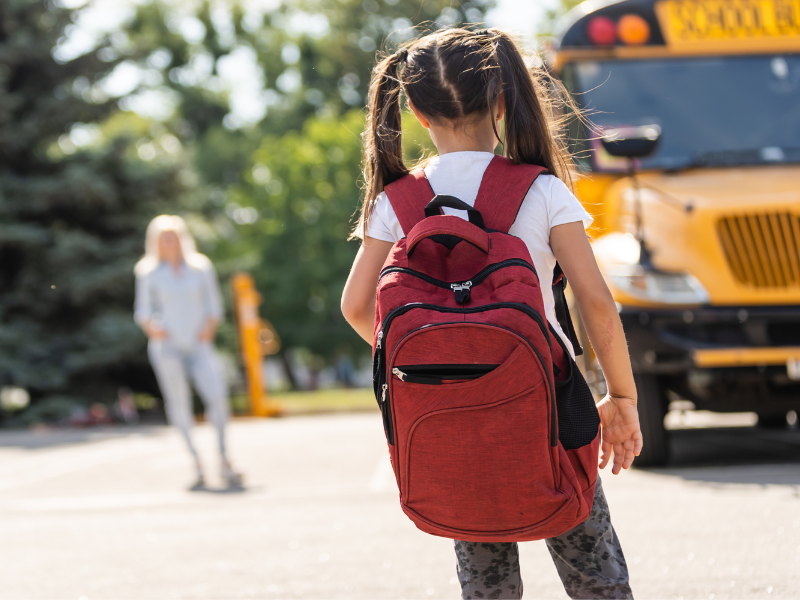
As August ushers in a new school year, nearly two million students are headed back to Georgia’s 2,300 public schools. How are the state’s schools doing when it comes to preparing kids for work and life? Here are a few key education measures that Georgia parents and communities should know about as students return to the classroom.
Skills in Reading
Results from the latest Georgia Milestones Assessment show that students are still struggling with reading proficiency. A proficient reader can analyze challenging material and think critically about it.
Just 40% of eighth graders reached a level of reading proficiency in 2025. Third graders are even further behind—only 35% were proficient in reading last year.
Achieving reading proficiency by third grade is a crucial milestone for Georgia’s students. Not only is it necessary for learning in later grades, but it’s also an indicator of future stability and economic opportunity. That’s because literacy, like math proficiency, is closely linked to high school completion and participation in the workforce.
Demographic data from the Milestones Assessment also shows that Black and Hispanic third graders are struggling the most when it comes to literacy.
State lawmakers are paying attention to these challenges, and through promising legislation (see the section on new laws below), they’re paving the way for more children to thrive in their academic development and build flourishing futures.
Enrollment Trends
Georgia public schools have enrolled 1,702,086 students in pre-kindergarten through 12th grade, according to the Georgia Department of Education’s spring 2026 enrollment count. That number marks a drop of 34,644 students from the spring of 2025.
The decline in Georgia follows a nationwide trend. The National Center for Education Statistics recently showed that K-12 enrollment in 40 states dropped by an average of 3.8%, or almost 1.5 million students, from 2019-2024. Georgia’s decrease in enrollment was slightly smaller during that time at 1.4%.
Part of the reason for this drop might be the lower birth rates across the state in the last several years. But Georgia has also taken steps to expand education opportunities, and more families are embracing new schooling options to find the best education fit for their kids. Homeschooling is on the rise, and over 20,200 families applied to Georgia’s newest school choice program, the Promise Scholarship, between March and December of 2025.
Chronic absenteeism rates tend to be higher among students from low-income families, students of color, and students with disabilities.
Fortunately, Georgia’s absenteeism rate has recently been decreasing. It dropped to 17.7% during the 2025-2026 school year. That’s down from a peak of 23.9% in 2021-2022. The rate has especially improved for grades K-5 and now stands at 13.5%. Lowering this rate even more will be key to making improvements in reading proficiency in the early grades.
Public School Spending
On average, Georgia spends $15,833 on K-12 education per student. Pre-kindergarten and K-12 education funds account for 39% of the state budget, making it Georgia’s biggest line item. In 2026, the budget included $14.2 billion for Georgia’s public schools, approximately a $900 million increase from 2025.
Despite these amounts, state funding is only a portion of overall revenue for public schools. Local taxes are the biggest source of education dollars, and a small percentage comes from federal funding.
New Reading and Math Education Laws
Georgia lawmakers passed important education-related bills during the most recent legislative session.
The Georgia Early Literacy Act of 2026 will help more children read at grade level or above by putting literacy coaches—educators with expertise in teaching reading—in all elementary schools. Students will also be required to go to kindergarten before starting first grade, and their reading skills will be tested early in their academic development.
In addition to addressing literacy, Georgia legislators passed the Math Matters Act, which calls for an increase in the amount of time children spend on math during the elementary school day, an advanced (compressed and accelerated) math track for qualifying middle and high school students, and new requirements for teacher certifications.
It’s important to note that qualified students will be automatically enrolled in the advanced classes to make sure all children have equitable access to them. This will help close racial, ethnic, gender, and socioeconomic achievement gaps among young Georgians.
Improvements to the Classroom Environment
Georgia lawmakers also recently passed a new law that will require high schools to ban personal electronic devices like phones and tablets during the school day. A similar ban is going into effect for students in elementary and middle school this year. These changes should reduce distractions and help students stay engaged in the classroom.
And in 2025, Governor Brian Kemp signed the Comprehensive School Safety & Student Well-Being Act into law. Starting with the 2026-2027 school year, every Georgia school district will have an anonymous reporting system available. Schools will also provide evidence-based training on both suicide awareness and prevention and youth violence prevention to all students in grades 6-12. Changes like these will help create a safer environment where students can focus on learning and growing.
When it comes to artificial intelligence (AI), Georgia schools are shifting from asking whether students should use it to teaching them how to use it safely and responsibly. The Georgia Department of Education is encouraging districts to adopt policies that help students engage with AI in ethical ways, think critically about the information it provides, and build the skills they’ll need to thrive in an AI-driven workforce.
Next Steps for Education in Georgia
Georgia’s education measures are more than just data. Behind the numbers are real children who will be the next generation of mothers, fathers, business owners, employees, and voters in our state. A top-notch education will give them bright, opportunity-filled futures.
Additional solutions to boost math and reading proficiency and address chronic absenteeism will not only help kids. They’ll also strengthen Georgia’s public schools and enable them to support students whose best—and sometimes only—education option is the local public school.
At the same time, Georgia leaders are continuing their work to remove financial and social barriers to quality education and to empower students and families to access the school of their choice. Prioritizing a range of options will open more doors for Georgia’s kids and give them new opportunities to flourish as they grow.