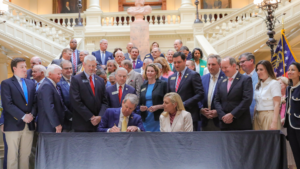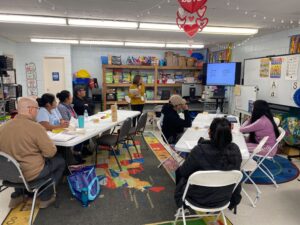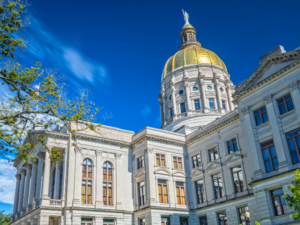
Georgia lawmakers passed bills affecting schooling, work, and family opportunities in 2025.

Georgia lawmakers wrapped up the 2025 legislative session with some big decisions that affect our state’s families, students, and workers.

Several new laws were passed to improve education, job opportunities, and access to childcare — while a few important changes didn’t quite make it through.

“The 2025 session included some key victories to improve public school classrooms, expand school choice options, and improve workforce opportunities,” said Buzz Brockway, vice president of policy for GCO. “While there were some disappointments on bills that didn’t make it across the finish line, we are pleased with the progress lawmakers made this year in promoting an agenda to allow all Georgians to flourish.”

What Passed: New Georgia Laws in 2025

These bills passed out of both the House of Representatives and the Senate and are headed to the governor for signing. 

House Bill 340: Less phone distraction, more student engagement

K-8 classrooms now face stricter limits on student cell phone use during school hours. The goal of this policy is to cut down on distractions and help kids stay engaged in the classroom.

Senate Bill 82: More support for charter schools

With this legislation, local boards of education must reconsider denied charter petitions and provide detailed explanations for their decisions. To incentivize approvals, schools receiving charters are eligible for grants of $250,000 a year for three years to help them get started.

House Bill 307 and Senate Bill 93: Helping kids read better

Two bills aimed to boost reading skills among Georgia students. HB 307 updates dyslexia screening and interventions and improves statewide coordination to help at-risk students earlier. SB 93 makes sure future teachers are trained in proven methods to teach reading. State-approved educator preparation programs must align their core curricula with the science of reading—a move that aims to enhance literacy instruction by prioritizing evidence-based methods.

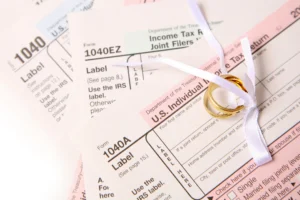
House Bill 136: Bigger tax break for child care

Families can now get a larger credit on their state taxes (up to 40% of the federal tax credit) for expenses related to child and dependent care. By allowing Georgia families to subtract more child care expenses from their annual taxes, this measure eases the financial burden on working families across the states.

House Bill 579: Simplifying licensing for businesses and trades

HB 579 makes it simpler and faster to get professional, business, or trade licenses in Georgia, reducing paperwork, red tape, and other barriers getting in the way of people looking for steady work.

Senate Bill 63: Free college prep tests for homeschoolers

SB 63 mandates that homeschool students in Georgia must have free access to take AP, SAT, and PSAT exams at their local public schools. Improving access to testing for  all students helps level the playing field for college readiness.

​​What Didn’t Pass (But Could Still Come Back) 

Despite these successes, some significant bills were left on the table when the legislative session abruptly adjourned early.

Senate Bill 207: Second chance for job-seekers with a criminal record 

This measure would have helped people with past criminal records get job licenses more easily.  A simpler, fairer process gives returning citizens better opportunities to rejoin  the workforce and build stable livelihoods and futures. However, due to legislative discord, the bill didn’t get a final vote. 

House Resolution 884: Making Georgia’s welfare programs work better 

This proposal sought to create a task force to streamline safety net and workforce development systems in Georgia. It was shelved due to disagreements, but it’s on the radar for next year’s session. Connecting welfare and workforce programs should be an immediate priority because it’s one of Georgia’s best opportunities to remove barriers to work and upward mobility for more people. 

Image Credit: Canva

Education savings accounts in Georgia empower parents to customize their child's education.

Key Points

  • Education plays a powerful role in breaking the cycle of poverty and helping children lead healthy, flourishing lives. Education savings accounts in Georgia are a solution to help more kids get the benefits of a quality education. 
  • Georgia’s education savings account program is the Promise Scholarship. Starting in fall 2025, it will give eligible families $6,500 scholarships to access the education option that best meets their child’s needs. 
  • Education savings accounts, or ESAs, in Georgia can have several positive impacts on communities, including better support for public schools, less crime, and greater upward mobility. 

Education is an essential building block for a healthy, flourishing life. It has the power to break the cycle of poverty that can persist across generations.

When children from impoverished backgrounds receive a quality education, they’re more likely to escape poverty themselves and provide better opportunities for future generations. 

Good education goes hand-in-hand with many other positive outcomes—like better jobs, higher personal income, valuable relationships, better physical health, and a longer life. 

We all want these good things for children in our communities. Education savings accounts are one solution that Georgia can use to increase opportunity and prosperity for students who need it most.

What are education savings accounts?

Education savings accounts, also called ESAs, give parents a portion of state education funding that they can use to tailor their child’s education if traditional public school isn’t a good fit.

ESA programs expand education opportunity by giving parents greater flexibility and freedom in education choices. Whether a family prefers homeschooling, private schooling, or other alternatives, ESAs let parents access the best type of education for their child’s unique needs and interests.

The Georgia Promise Scholarship helps students in low-performing public schools access education options for their needs.

Get Started With Georgia’s ESA Program: The Georgia Promise Scholarship

Georgia is getting ready to launch Promise Scholarships in the fall of 2025. If you’re interested in enrolling your child, make sure you’re signed up to hear about next steps.

Get on the List for Updates

How do ESAs work?

To create education savings accounts programs, states must first pass a law. States then take a portion of what they would have spent on the student’s public school education and put it into a state-administered account.

Parents can use these funds for a range of education expenses—tuition, tutoring, homeschooling curriculum, educational therapies, online programs, or even a combination of educational services. States require parents to complete an application process to switch to an ESA. 

What do families get from education savings accounts in Georgia?

  • Flexibility: ESAs let parents customize their kid’s education.
  • Financial Support: ESAs allow states to expand access to options that families may not be able to afford otherwise. 
  • Empowerment: Parents can take charge of their child’s education journey with confidence.
  • Diverse Options: Parents can explore various educational paths that suit their child’s needs and interests.

What is Georgia’s ESA program?

Created in 2024, Georgia’s ESA program is the Georgia Promise Scholarship. It provides state-funded scholarship accounts that give eligible families $6,500 per student for each school year.

The program will be available starting in the 2025-2026 school year, and it will be limited to students in the lowest-performing public schools.

Child raising hand in classroom

Georgia’s Promise Scholarship Explained
Find out what the program is, how it works, and which students will be eligible. 

See the Promise Scholarship FAQs

Who do education savings account help in Georgia?   

ESAs are for all kinds of students. Whether a child is struggling in school or has special learning needs, ESAs can help. Georgia’s ESA program, the Promise Scholarship, is specifically designed to help families who may not have the resources to access better opportunities. 

Students in Underperforming Schools

Thousands of Georgia kids are stuck in public schools that have received a failing grade from the Governor’s Office of Student Achievement. To help these kids in particular, the Promise Scholarship will be for students in the bottom 25% of Georgia’s public schools. With an ESA, these students can access higher-quality education options that prepare them for successful careers and fulfilling lives.  

Low-Income Students

Choosing a different school or educational path has often been a privilege for wealthier families. What about families that struggle to make ends meet? 

With an ESA, low-income families can consider schooling options that may be out of reach otherwise. The Georgia Promise Scholarship makes sure these students are helped first. Available scholarships will go to families below 400% of the federal poverty level (around $120,000/year for a family of four). Any leftover funding can then serve students above that threshold. 

Students With Special Needs

ESA programs are a lifeline for students who need support beyond what their local public school can provide. ESAs make it possible to access schools that are set up to help students who have unique learning needs and disabilities. ESA funds can also help pay for other essential resources like tutoring, therapies, and learning technologies. 

Homeschooling Families

ESAs don’t just cover school tuition. They can pay for curriculum, online programs, and supplies, giving parents the option to fully customize their child’s education. This flexibility means that ESAs can help families who want to homeschool as an alternative to public or private schools. 

What kind of impact could ESAs have on communities in Georgia? 

Since Georgia’s ESA program, the Georgia Promise Scholarship, is new, it will be a few years before we know its exact impact on our communities. But we can get an idea from other states that have ESAs, including a couple of Georgia’s neighbors.

  • Better support for public schools: In 2011, Arizona became the first state to adopt ESAs. The state soon found that the program was helping to redirect state and federal dollars back to public schools where it could be used for teacher pay and operational needs.

  • Better outcomes for low-income students: Created in 2019, Florida’s ESA program is now the largest in the country. A November 2023 study of Florida’s education system looked at the impact of growing school choice. It found students of lower socioeconomic backgrounds—including those who stayed in public schools—experienced some of the greatest benefits.

  • Better economic opportunity and healthier societies: Tennessee is still working to expand its ESA program, but a study from the Beacon Center of Tennessee found that a statewide program could have incredible social impact. Their model predicted that Tennessee could have more high school graduates, higher overall personal income, less criminal activity and fewer felons, and $2.9 billion in economic benefits.

Do parents want education savings accounts in Georgia? 

Overall, Americans are worried about the direction of public K-12 education. 

  • Half of Americans think it’s moving in the wrong direction. 
  • 82% of teachers say the state of public K-12 education has worsened in the last five years. 
  • Only 46% of school parents in Georgia think K-12 education is on the right track in the state of Georgia. 

It’s not surprising, then, that Georgia parents are open to more school choice policies: 76% of Georgia school parents say they’re in favor of an ESA program.

A majority of school parents in Georgia think it's a good idea to have education savings accounts in Georgia.

What are common concerns about education savings accounts in Georgia?

Concern: ESAs take funding away from public schools.  

Georgia communities don’t have to worry about this because state lawmakers are not using public school funding for the Georgia Promise Scholarship. Promise Scholarship funding is also not allowed to exceed 1% of public school funding. This set-up means public school funding is fully protected. 

In general, more research is showing that, when states invest in school choice programs like ESAs, public schools benefit financially and academically. They have more per-pupil funding, less budgetary pressure, and better student outcomes

Concern: ESAs favor wealthy families and don’t help kids who actually need the opportunity. 

Quality education is a building block of a healthy, flourishing life, regardless of a family’s financial situation. ESAs are a tool states can use to ensure there’s more equality when it comes to education opportunities. 

Even if an ESA program is universal—where every student is eligible—the students who gain the most opportunities are those most in need. Here in Georgia, our ESA program, the Promise Scholarship, limits eligibility to students in low-income households to make sure they get helped first. 

Concern: ESAs are just another private school voucher. 

Education savings accounts can be used for private school tuition but also for much more! Unlike private school scholarships, ESAs can be used for a wider range of education expenses—including tuition, tutoring, online programs, education therapies, curriculum, and textbooks. 

Concern: ESAs don’t help families in rural areas. 

Rural areas may not have as many schools to choose from, but thanks to the flexibility of ESAs, this doesn’t have to be a reason for states to avoid ESA programs.

Take Tanya Schlegel’s story, for example. Tanya is a mom of two kids with special needs living in rural Georgia. Despite her best efforts to work with the local public school, it just isn’t equipped to give special needs students the help they need. An ESA would give her the resources to homeschool and access specialized therapies so that her kids can have the type of education that matches their needs. 

Georgia ESAs: Quick Facts

  • Georgia is one of 16 states with an ESA program. 
  • 10 states have universal ESA programs, meaning all students are eligible. Georgia is not yet one of them. 
  • Georgia’s ESAs are worth $6,500 per student per school year.
  • 76% of school parents in Georgia support ESAs.

Interested in Georgia’s ESA program? 

Go here to sign up for updates as the Georgia Promise Scholarship gets up and running. 

Other Schooling Options in Georgia

Man sitting with his hands folded

Key Points

  • Indiana passed a scholarship program that will allow any family below 400% of the amount required to qualify for the federal free and reduced-price lunch program to access education scholarships.
  • South Carolina expanded their scholarship program with similar guidelines to those in Indiana.
  • Georgia failed to pass a transformative education scholarship program that would have positively impacted the lowest performing communities in the state.

The year isn’t even halfway over, and six states have already enacted laws that create universal educational access for all students in 2023.

In total, Iowa, Utah, Arkansas, Florida, and now South Carolina and Indiana have enacted either universal—or nearly universal—educational opportunity this year. That’s on top of Arizona and West Virginia, which did so in 2021 or 2022.

Each state has its own version of a scholarship or educational savings account that the state funds for children’s needs outside of traditional public school. For example, these types of accounts send a portion of each student’s public school dollars to allow the child to attend a private school of their family’s choice. In some cases, families who choose to homeschool their children can use the funds for educational expenses.


Indiana

Indiana is the most recent state to join that list. That state’s scholarship program will now be available to any family below 400% of the amount required to qualify for the federal free and reduced-price lunch program. That translates to a salary of around $222,000 a year for a family of four. 

Previously, requirements were in place that further limited the program, such as it only being open to families with students previously enrolled in a public school or to children in the foster care system. Under the new law, only an estimated 3.5% of Indiana’s families won’t qualify for this option.


The Georgia Center for Opportunity led a state-wide campaign to educate parents and legislators on the positive impact that choice brings to public education.

The Georgia Center for Opportunity led a state-wide campaign to educate parents and legislators on the positive impact that choice brings to public education.

South Carolina

Meanwhile, South Carolina governor Henry McMaster recently signed a bill into law that eventually expands that state’s scholarship program to families at or below 200% of F&R priced lunch as well. The program is more limited in scope than Indiana’s. It will only be available to 5,000 students the first year, 10,000 the second year, and 15,000 students the third year.

South Carolina’s program allows for the establishment of Educational Scholarship Trust Funds. Funds deposited in these accounts can be used not only for expanded school choice, but may also be used for special needs therapies, such as physical therapy, speech therapy, and occupational therapy. Tutors and transportation may also be included for families caring for special needs students. 

So, what happened in Georgia?

If the Georgia Legislative Session had passed Senate Bill 233, also known as the Georgia Promise Scholarship Act, it would have put $6,500 per student back into parents’ pockets so they could fund the best educational approaches for their children. The funds would have been eligible for use as private school tuition and public school alternatives, such as homeschooling. 

According to the Georgia Department of Education, families who qualified would have had students enrolled into the lower 25% of schools in Georgia. This amounted to roughly 400,000 students. 

SB 233 was a strong bill, passing the Senate with unanimous Republican support and going on to the House. Despite receiving no support from Senate Democrats, it’s excellent news that the bill made it so far through legislative proceedings. 

The House vote proved to be tougher, with bipartisan representatives voting against it. Rep. Mesha Mainor of Atlanta was the lone Democrat in the House to vote in favor. On its final day of session, SB 233 was only six votes short of the 91 it needed to pass. 

The good news is that the Georgia Promise Scholarship Act is eligible for reconsideration during the 2024 legislative session. 

Looking to what’s next

Public schools are not the problem. We love and support public schools—they will remain the right and best choice for the vast majority of Georgia families. But we can love, support, and move public schools forward while expanding education into new areas.

Public education is a foundational and vital part of the success of American society, but an increasing number of families are looking toward alternatives—and their choices are just as valid. We must work to deliver quality education to all students, which means finding ways to support families who take a different schooling path. While many will access their education through public schools, not all kids are a perfect fit for that system, and they cannot be left behind.

Key Points

    • The Harris Poll found that 89% of parents whose children have switched school types report that they or their child experienced a positive change as a result of the switch.
    • A silver lining of the pandemic is that parents’ eyes have been opened to the many alternative educational options available to them.
    • We are hopeful that lawmakers will pass Promise Scholarship Accounts in the upcoming legislative session.

    Did you know that one-in-five families switched the school their child attended during the pandemic?

    That 20% figure might seem remarkable given that it covers just a two-year period, from March 2020 to May 2022. That remarkable statistic is one of many findings in a national survey of more than 5,000 parents, conducted by the Harris Poll in May 2022. The poll not only documented whether parents switched schools, but their reasons for doing so and whether they ended up happy with their choice.

    On that note, the poll found that 89% of parents whose children have switched school types report that they or their child experienced a positive change as a result of the switch.

    The pandemic changed everything

    Clearly, the seismic changes brought on by the COVID-19 pandemic have prompted millions of families to switch up their approach to education. The demand for alternatives to traditional public schools is evident here in Georgia. For example, charter schools experienced a 5% increase in enrollments during the pandemic, while traditional public school enrollments dipped by 2%.

    We’re excited to see the growth of schools like DeKalb Brilliance Academy, a new charter school serving the Decatur area, and Bright Futures Academy, a private school serving students in some of the poorest zip codes in the Atlanta area. Also encouraging is the number of families continuing to homeschool even after classrooms have re-opened. A silver lining of the pandemic is that parents’ eyes have been opened to the many alternative educational options available to them.

    The bottom line is that public education should be about ensuring all students have access to a quality school. As parents exercise their rights and choose the schools that best meet the needs of their child, it is imperative that leadership in the state and country respond with legislation that supports and does not hinder the needs of students and parents. The pandemic changed everything and policymakers must respond.


    We are hopeful that lawmakers will pass Promise Scholarship Accounts in the upcoming legislative session.

    We are hopeful that lawmakers will pass Promise Scholarship Accounts in the upcoming legislative session.

    What’s next

    That’s why we are hopeful that lawmakers will pass Promise Scholarship Accounts in the upcoming legislative session. The version of the bill introduced in the last legislative session would give each student $6,000 to be used on an approved education expense, such as private school tuition, tutoring, homeschool curriculum, virtual classes, college classes, therapies (for kids with special needs), or technology.


    In The News

    The COVID-19 pandemic has been a watershed moment for expanding educational options for Georgia students. For many parents and families, the pandemic was the crisis point that showed them, in stark reality, the dire need for a full menu of educational options – whether that be a traditional public school, a public charter school, virtual educational programs or home education.

    You don t have to look far to understand why. During the worst of the pandemic and resulting school closures, many familes were forced into alternative ways of schooling for tthe first time ever. Families’ experience with how traditional public schools handled the shift to distance learning were mixed and inconsistent. Some schools and teachers excelled, ensuring students did not lose out on learning. Others threw their hands up –and the towel in — early. Kids have suffered as a result. 

    Read the full article here


    In The News

    Tuesday, March 15, was a sad day for kids in Georgia.

    That’s the day when the Georgia Senate voted down a bill to create Promise Scholarships. Eight Republicans joined all Democrats in rejecting the scholarships, which would have offered families up to $6,000 a year for approved education expenses. Another six Republicans chose to abstain from voting, knowing that doing so would kill the bill.

    Promise Scholarships would step far beyond a typical voucher by fully putting parents in the driver’s seat when it comes to their child’s education. The funds could have been used for private-school tuition, but there would have been added flexibility depending on each family’s unique needs, extending to paying for things like tutoring, specialized therapies, or homeschool co-ops.

    It’s unjust that the best interests of Georgia’s schoolchildren have once again fallen prey to politics and special-interest groups. While some lawmakers were twisting arms to get votes to pass gambling programs to benefit a handful of people, others were voting “no” on Promise Scholarships that would allow tens of thousands of kids to flourish.

    Simply put, a vote against S.B. 601 was a vote against the many Georgia families who desperately need help. Particularly as our state emerges from the COVID-19 pandemic where so many students are left behind, it’s unconscionable that we would deny this lifeline to families.

    What’s also unconscionable is why politicians would reject educational freedom given that the vast majority of Georgians want it.

    A recent poll from GeorgiaCAN found that 72% of respondents favor “expanding educational options by allowing a child’s state education dollars to follow that student to the school that best fits their needs, whether that is public, private, magnet, charter, virtual, or homeschool.” Support cut across party lines, with 79% of Republicans in favor, 78% of Independents, and 64% of Democrats.

    Do Georgians favor the idea of Promise Scholarships? That same GeorgiaCAN poll put support for Promise Scholarships at 59%. Public school parents voiced even stronger support, with 67% in favor.

    Those results are in line with other recent polling showing that between two-thirds and three-fourths of Georgians support the core ideas of educational opportunity for all students, not just those blessed with a high income or who live in the right zip code. The bottom line is that in our era of sordid political discourse and deep divides between the parties, there are few issues that garner as much bi-partisan support as educational opportunity and equity.

    One of the attributes that makes Georgia a great place to live — and a great place to relocate to from other areas of the country — is our diverse and growing set of educational options. It’s the 21st century, and our policymakers recognize that a one-size-fits-all approach no longer works, least of all when it comes to the education of our children.

    But while we’ve had important progress over the last few years, we need to keep moving forward. Traditional public schools will remain the right option for most families, but a swiftly growing number of families are choosing alternatives — public charter schools, private schools, or homeschools. As a state, our objective must be to support students and families in the educational environment that works best for them. Our priority must be funding student education, not systems of education that aren’t meeting the needs of every child in our state.

    That’s precisely why we need the flexibility provided by Promise Scholarships. Passing Promise Scholarships would have put Georgia at the forefront nationally of giving all children the opportunity for a great education. And politicians running for office this year would be wise to pay attention. For evidence, look no further than Virginia’s recent gubernatorial election, when now Gov. Glenn Youngkin swept into office on a platform of empowering parents.

    Remember, the midterm elections are just around the corner: All 56 state Senate and 180 state House seats up for grabs. Meanwhile, parents are clamoring for educational options like never before.

    The question is, will Georgia politicians listen? The answer appears to be a resounding no.

    Originally Posted In The Georgia Virtue

    Subscribe

    * indicates required

    Subscribe

    * indicates required