The Georgia Early Literacy Act is a new bill to improve literacy rates and support stronger readers.

Key Points

  • The Georgia General Assembly has passed a bill that will lay the groundwork for improving literacy rates among the state’s students.
  • Major measures in the bill include requiring literacy coaches in schools, making kindergarten mandatory, assessing students’ reading skills more often, and expanding the use of curriculums based on the science of reading.
  • By becoming stronger readers, Georgia’s students will be more successful in school and better prepared for rewarding work, financial stability, and meaningful community engagement as adults.

The Georgia Early Literacy Act of 2026 (House Bill 1193) is poised to make a powerful impact on students across the state. Legislators drafted the bill to help increase literacy rates among young Georgians and prepare them for higher levels of learning and greater success in life. 

Georgia’s literacy statistics are undeniably troubling—62% of the state’s third graders aren’t reading proficiently. Georgia’s proficiency percentage is just slightly above the average reading level in the United States. The Nation’s Report Card, which tracks how well students across the country are reading in fourth grade, recently showed that 69% of American fourth graders aren’t reading proficiently. And proficiency is a key indicator of children’s progress and readiness for more advanced work.  

Third grade also marks a critical point in a student’s academic development. Between third and fourth grade, children should be transitioning from learning to read to using reading to learn. If students fall behind in reading during this crucial period, they can start to have a hard time in other school subjects, too. This struggle often takes a big toll on children as they grow up, and it can limit economic opportunities later on. 

But with support from organizations like the Georgia Center for Opportunity (GCO), state legislators are paving the way for children to overcome challenges with literacy. This will empower them to thrive in their academic development and build flourishing lives for themselves and their families in the future.

“GCO applauds the state’s General Assembly for passing the Georgia Early Literacy Act of 2026. This important legislation helps Georgia make sure that students read proficiently so they can excel in school and reach their full potential in life.”

Buzz Brockway, Vice President of Policy, Georgia Center for Opportunity

What Are the Core Requirements in This Bill?

Policymakers have included several key measures in the new literacy bill to help the youngest Georgians become skilled readers.

  • Literacy Coaches in Every School: All schools that serve students in kindergarten through third grade will be required to hire literacy coaches—educators with expertise in teaching reading. The coaches will support teachers through lesson planning, co-teaching, and mentoring.
  • Mandatory Kindergarten Enrollment: Students will be required to attend kindergarten before starting first grade (exemptions are possible if students pass the assessment described below). The bill will also encourage families to enroll their children in school or establish a home study program beginning at age 5. These measures should strengthen children’s foundational reading skills early on.
  • First Grade Readiness Assessments: Schools will test students before they start first grade to make sure they’re academically prepared. If a kindergartener isn’t reading on grade level, the school will design a plan to help them.

  • Expanded Use of Science of Reading Curriculums: Schools will continue to expand the use of materials grounded in the science of reading, a field of research that focuses on how students develop reading skills. Teachers will no longer be able to use the older three-cueing system, which encourages students to guess words.

Have Other States Passed Similar Laws?

Yes. Mississippi, in particular, has set the standard for effective literacy legislation. Recent reforms in that state include:

  • Placing literacy coaches in the lowest-performing schools to guide reading teachers 
  • Regularly screening students in grades K-3 for challenges with reading and creating plans to help children who are struggling
  • Requiring third graders to demonstrate reading proficiency before starting fourth grade
  • Training teachers to shift to an approach based on the science of reading

As a result of the strong focus on literacy, Mississippi’s fourth grade reading proficiency scores went from 49th place in the nation in 2013 to ninth place in 2024. Georgia and many other states have taken notice of this significant improvement and have modeled legislation after Mississippi’s laws.

When Will the New Requirements Take Effect?

Governor Brian Kemp is expected to sign the Georgia Early Literacy Act once the 2026 legislative session ends. After it becomes law:

  • Schools will likely have literacy coaches on staff by the 2028-2029 school year.
  • Mandatory kindergarten enrollment and enhanced readiness assessments will go into effect for the 2027-2028 school year.
  • Every K-3 classroom will use only state-approved materials aligned with the science of reading by July 1, 2027.

What Is the Science of Reading?

The science of reading is a field of research focused on how the brain learns to read and how to teach reading. It promotes proven practices that support students of all abilities. These practices involve several essential elements:

  • Phonemic Awareness: the ability to hear and identify individual sounds in spoken words
  • Phonics: the relationship between letters and the sounds they represent
  • Fluency: the ability to read texts smoothly, accurately, and with the right expression
  • Vocabulary: an understanding of what words mean and how to say and use them correctly
  • Comprehension: the ability to understand, interpret, and analyze texts

What’s the Difference Between Reading on Grade Level and Reading Proficiently?

People often use these two phrases interchangeably, but they actually mean different things.

  • Reading on Grade Level: A student who reads on grade level can figure out words and follow a basic plot, but they might still struggle to analyze more complex texts. This is the minimum expected skill level for a child in a specific grade.

  • Reading Proficiently: A proficient reader has a higher-level skill set, including the ability to analyze more challenging material and to think critically about it. Reading proficiently makes it easier for students to use reading for learning as they develop academically.

This difference is important for understanding literacy rates in Georgia. The state’s Department of Education reports that 65% of third grade students are reading at or above grade level, but the Georgia Council on Literacy has shown that only 38% of the state’s third grade students are reading proficiently

How Can Increasing Reading Proficiency Open Doors to Opportunity?

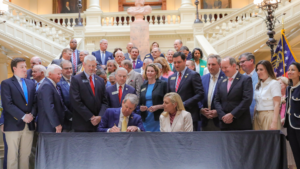
The state legislature passed the Georgia Early Literacy Act in March of 2026 with unanimous bipartisan support. The strong approval of the bill confirms that Georgia’s policymakers have made literacy a priority.

This attention to literacy will make a meaningful difference for many Georgians. Research has shown that children who aren’t proficient in reading by third grade are four times as likely to drop out of school before getting their high school diploma. And without that degree, access to higher levels of education, fulfilling jobs, and economic opportunities is more limited. For students who come from vulnerable families, struggles with reading can also make it harder to escape poverty.

Through the Literacy Act, Georgia legislators aim to remove barriers for children and encourage them to follow brighter paths to promising futures. By becoming stronger readers, Georgia’s students will be more successful in school. They’ll also learn to think more critically about the world around them. Their advanced skills will then lead young people toward more rewarding work and economic mobility as adults, and they’ll be able to positively impact their communities. The bill has the power to make all this possible, with literacy as the key that unlocks the door to these life-changing opportunities.

Additional Resources:

Literacy Bill, Cellphone Ban Among Education Bills Approved by Georgia House
Atlanta Journal-Constitution

With End of Session Near, Georgia Lawmakers Tackle Childhood Literacy
Atlanta Journal-Constitution

Assessing the Economic Gains of Eradicating Illiteracy Nationally and Regionally in the United States
Barbara Bush Foundation for Family Literacy

Your Home for GA Dyslexia Resources
Decoding Dyslexia GA

The State of Literacy in Georgia
Deloitte

Family Resources: Supporting Your Child’s Reading Development
Georgia Department of Education

The Incredible Importance of Teaching Children to Read
Georgia Municipal Association

Lawmakers Push Plan to Lift Georgia’s Lagging Literacy Rates
Georgia Recorder

Student Literacy Overhaul Poised for Georgia Governor’s Signature After Compromise
Georgia Recorder

How Education Impacts Chicago Poverty
Illinois Policy Institute

10 Ways to Support Your Child’s Literacy at Home
National Center on Improving Literacy

Unemployment Rates for People 25 Years and Older by Educational Attainment
U.S. Bureau of Labor Statistics

Top 2026 issues for Georgia lawmakers and citizens include welfare, cost of living, education, and crime.

Key Points

  • In 2026, Georgia voters will elect key political leaders who will have the ability to remove barriers and open doors to better futures for the state’s residents. 
  • Top concerns for both lawmakers and citizens include welfare reform, the cost of living, educational opportunities, and public safety. 
  • Proposed policies and reforms will help lift many Georgians above the poverty line and provide clearer pathways to upward mobility and thriving communities.

Opportunities to drive progress and hope will greet Georgians in 2026. Critical issues will dominate the legislative agenda, and top governmental positions will be up for election.

The well-being of many Georgians, their families, and their communities is at stake as pressing concerns like welfare reform, the cost of living, educational opportunities, and public safety take center stage in political discussions. These issues involve significant challenges, but policymakers are working to find promising solutions that will enable people across the state to flourish.
Electing leaders to fill key political offices

Georgians will elect new officials for the state’s top posts in 2026. The primary election will take place on May 19, and the general election is scheduled for November 3.

The roles of both the governor and lieutenant governor will be on the ballot. Georgia’s current governor, Brian Kemp, isn’t eligible to run again because he’s reached his term limit, so several candidates are competing for the position, including Lieutenant Governor Burt Jones. 

Georgians will also vote on one of the state’s U.S. senatorial positions—Senator Jon Ossoff currently holds the post. All of Georgia’s seats in the U.S. House of Representatives will be up for election as well.

These political races are pivotal because the elected officials will have the power to remove barriers and open more doors to opportunity for the state’s residents.

Reforming Georgia’s public assistance programs and creating a pathway out of poverty

The candidates running for office will likely take positions on ways to reform government assistance (welfare or safety net) programs in Georgia. This should be a top priority because about 13.5% of the state’s population is currently living in poverty

One of the main concerns about the welfare system is that it isn’t helping to lift people above the poverty line or empowering them to become self-sufficient. Instead, the complexities and regulations in the system tend to trap people in long-term cycles of poverty that affect families for generations.

To make real change, Georgia’s top lawmakers need to focus on streamlining the state’s welfare system and integrating it with workforce development programs. This strategy, called the One Door model, connects recipients of government benefits with one caseworker who not only helps them meet their immediate needs but also provides resources to support them in finding a rewarding job.

In Georgia, around 28% of prime-age (25-54) adults aren’t working, and disengagement from work is one of the primary reasons people seek public assistance. Developing a One Door strategy in Georgia will help these individuals become self-sufficient and also enable them to experience the sense of dignity and purpose meaningful work provides.

Georgia’s political leaders can take steps toward implementing a One Door model by advocating for federal authorization to do so. At the state level, they can also establish a task force to explore ways to connect and improve Georgia’s public assistance and workforce programs.

A reform called the One Door model would allow Georgia to connect more welfare recipients to meaningful work and economic opportunity. 

Making life more affordable in Georgia

Many low- and middle-income families in Georgia are struggling to cover the basic costs of living, as prices for just about everything seem to be rising. The increasing costs add extra hardship to the numerous barriers that already impact people’s well-being. But Georgia’s policymakers have opportunities to make some things more affordable for the state’s residents.

  • Housing shortages and costs: At least 94 of Georgia’s 159 counties don’t have enough housing for their residents. The shortage is driving up prices and making affordable homes hard to come by. Builders want to construct more houses, but they face restrictive regulations regarding land use and infrastructure, including roads and water lines. Local policymakers can address the issue by allowing greater flexibility in lot sizes and housing types. Doing so will bring more affordable homes to the market, and that will reduce rent and mortgage payments and free up income to cover other necessities.

  • State income taxes: Georgia’s state income tax is set to drop to 4.99% in January 2027, but some lawmakers want to eliminate it completely. For many Georgians, every dollar matters, and doing away with the tax would allow them to keep more of their income in their own pockets. State leaders are considering eliminating corporate tax breaks to offset the potential loss in government revenue from income taxes. But it’s important to note that they could also raise the sales tax to recoup the state’s lost revenue. That could leave lower-income families worse off because essential goods would cost them more.

Creating an educational system that meets the needs of every child

In 2026, Georgia lawmakers will continue their efforts to develop an educational system that honors every child’s unique situation and needs.

Several education-related bills that carried over from 2025 will likely be up for consideration in the Georgia General Assembly.

  • Senate Bills 124 and 152: These bills will expand eligibility for Promise Scholarship accounts to students with a parent who’s an active-duty military service member stationed in Georgia and to biological or adopted children of foster parents. The bills will help support more families who want to consider alternative education options for their children

  • Senate Bill 171: This bill will require Georgia’s Board of Education to develop an advanced math pathway for students in grades 3-8. The program will prepare students to take higher-level math classes in middle school and ultimately to pursue careers in science, technology, engineering, and math (STEM). The opportunity will pave the way to brighter futures and upward mobility for participating students, and particularly for young African Americans, Hispanics, and girls who haven’t traditionally received significant STEM education.

  • House Bill 917: This bill will provide open enrollment processes for students who want to transfer between local school systems or from one school to another within a school system. This will enable students to attend the school that’s the right fit for them, regardless of where they live.

Charter school funding will also be on policymakers’ radar. In 2025, the Georgia Senate created the Study Committee on Funding for Charter School Capital Improvements. The committee was tasked with reviewing current funding processes for public schools, examining the differences in capital funding between charter and public schools, and analyzing the challenges charter schools face in getting funding. Georgia’s leaders will likely use the study’s findings to make sure charter schools have equal access to capital improvement funds so they can continue to offer alternate educational options for families. 

Prioritizing neighborhood safety and reducing crime

Public safety is a top concern for Georgians, and especially for those living in impoverished communities. High crime rates lead to losses in property value, community resources, business activity, and job opportunities—all making it increasingly difficult for people to escape poverty.

Among several public safety bills, Georgia lawmakers will likely consider two that were drafted during the 2025 session.

  • Cognitive behavioral therapy (CBT) for juveniles: The first bill will enable greater use of CBT with young people who get arrested, even those who are non-violent or have minor convictions. CBT teaches participants to look at the relationship between their thoughts, feelings, and behaviors and helps them respond to challenging situations more effectively. Studies show that CBT programs can reduce recidivism by an impactful 25%. They also set participants on a path toward healing and growth, which will, in turn, help their communities flourish.

  • Support for local law enforcement agencies: The second bill will create grants for local law enforcement agencies to assist them in solving more violent crimes. Local departments can use the funds to improve investigations, enhance the technology and data systems officers use, and support victims and families. The resources will also help authorities deter future crime and boost community safety and resiliency.

Taking action to transform lives and communities

Georgia’s policymakers know that more needs to be done to break down the social and economic barriers so many people are facing, and they’re taking action. But this responsibility doesn’t lie with government leaders alone.

Georgia residents should pay close attention to the issues lawmakers discuss, but also to the needs of their families and communities. They can then use what they learn, along with their voices and votes, to create real change. 

In doing so, Georgians will bring even greater promise and prosperity to the state—making it a place where everyone has the opportunity to achieve their full potential and thrive.

Additional resources

Alliance for Opportunity applauds introduction of the House “One Door to Work” Act
Alliance for Opportunity

How do we know the One Door model works?
Alliance for Opportunity

Georgia candidates for governor should make welfare reform a top priority
Atlanta Journal-Constitution

Georgia lawmakers explore plan to eliminate state income tax
CBS News

A better way to get welfare recipients back into the labor force
City Journal

How Georgia can fix its housing shortage
Dalton Daily Citizen

The Georgia Promise Scholarship (SB 233): questions and answers
Georgia Center for Opportunity

How many adults aren’t working in Georgia communities?
Georgia Center for Opportunity

National poverty rate fails to capture the problem of poverty concentration in Georgia and beyond
Georgia Center for Opportunity

The One Door model: a solution to improve economic opportunity for safety net participants
Georgia Center for Opportunity

Reducing crime in Atlanta
Georgia Center for Opportunity

What Georgia can learn from other states about fixing welfare
Georgia Center for Opportunity

Short supply: How many more homes does Georgia need?
Georgia Public Policy Foundation

The safety net “system” that isn’t
Governing

Unlocking opportunity – how Pelican Institute brought “One Door” to Louisiana
Pelican Institute for Public Policy

Image Credit: Canva

Students zoned for 512 public schools may be eligible to receive the Georgia Promise Scholarship.

Key Points

  • The Georgia Promise Scholarship school list is now available. Families zoned for one of 512 elementary, middle, and high schools across Georgia will eligible to apply for the new Promise Scholarship program.
  • Starting in the 2025-2026 school year, the Georgia Promise Scholarship will give families up to $6,500 per student to choose the learning environment that’s best for their child.
  • Families can apply for the Georgia Promise Scholarship between March 1 and April 15, 2025. Sign up here for application tips and updates. 

There’s exciting news for Georgia families and students: 

Students zoned for one of 512 elementary, middle, and high schools across Georgia will be able to apply for Georgia’s new Promise Scholarship program to attend an educational alternative. That’s according to a list released by the Georgia Education Savings Authority (GESA), the state government entity responsible for overseeing the new program.

This program offers students a chance to access education opportunities best suited to their needs. The funds can be used for private school tuition, homeschooling expenses, tutoring, or other approved education expenses. The total amount of scholarships is capped at $141 million for the upcoming school year. That amount is estimated to cover around 22,000 students.

The first application period is now open and will run through April 15, 2025. Families can learn more at mygeorgiapromise.org.

If your student is zoned for a school on the Georgia Promise Scholarship School List, your family meets the attendance zone requirement to apply. 

See the List of Eligible Schools

If your student is zoned for a school on the Georgia Promise Scholarship School List, your family meets the attendance zone requirement to apply. 

See the List of Eligible Schools

Does your family quality for the Georgia Promise Scholarship? 

Parents can quickly determine their child’s eligibility by taking a 45-second quiz available on the GESA website.

Eligibility criteria:

To apply, students must meet the following requirements:

  1. Be zoned for at least one of the 512 eligible public schools.  
  2. Have been enrolled in a Georgia public school for two consecutive semesters, or is a rising kindergarten student. 
  3. Parents must have lived in Georgia for at least one year, with exceptions for active-duty military families. 

The program prioritizes lower-income Georgia families. If applications exceed available slots, priority goes to families with household incomes below 400% of the Federal Poverty Level (roughly $120,000 for a family of four). 

Are Promise Scholarships a stable option for the future?

Promise Scholarships are off to a strong start. Governor Brian Kemp has allocated full funding for the program in his new proposed budget, which is pending approval by the state legislature. A bill has also been introduced, sponsored by Sen. Greg Dolezal, that would broaden eligibility for Promise Scholarships, including provisions for foster families.

Opportunities like the Promise Scholarship give families a brighter future

The creation of Promise Scholarships has been a crucial step forward for Georgia families. Education is the foundation for a thriving life. For families feeling limited by their current school options, Promise Scholarships provide the hope of access to a better fit for their child’s unique needs. Whether it’s finding the right private school, funding homeschooling expenses, or other learning resources, this program empowers parents to make the best decision possible for their children.

Subscribe

* indicates required

Subscribe

* indicates required