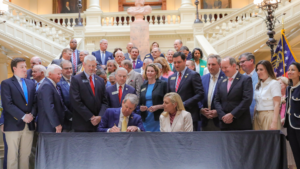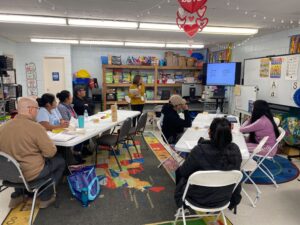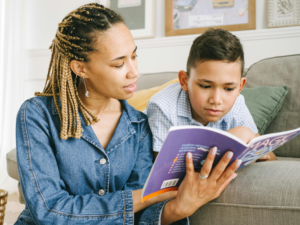
Education savings accounts in Georgia empower parents to customize their child's education.

Key Points

  • Education plays a powerful role in breaking the cycle of poverty and helping children lead healthy, flourishing lives. Education savings accounts in Georgia are a solution to help more kids get the benefits of a quality education. 
  • Georgia’s education savings account program is the Promise Scholarship. Starting in fall 2025, it will give eligible families $6,500 scholarships to access the education option that best meets their child’s needs. 
  • Education savings accounts, or ESAs, in Georgia can have several positive impacts on communities, including better support for public schools, less crime, and greater upward mobility. 

Education is an essential building block for a healthy, flourishing life. It has the power to break the cycle of poverty that can persist across generations.

When children from impoverished backgrounds receive a quality education, they’re more likely to escape poverty themselves and provide better opportunities for future generations. 

Good education goes hand-in-hand with many other positive outcomes—like better jobs, higher personal income, valuable relationships, better physical health, and a longer life. 

We all want these good things for children in our communities. Education savings accounts are one solution that Georgia can use to increase opportunity and prosperity for students who need it most.

What are education savings accounts?

Education savings accounts, also called ESAs, give parents a portion of state education funding that they can use to tailor their child’s education if traditional public school isn’t a good fit.

ESA programs expand education opportunity by giving parents greater flexibility and freedom in education choices. Whether a family prefers homeschooling, private schooling, or other alternatives, ESAs let parents access the best type of education for their child’s unique needs and interests.

The Georgia Promise Scholarship helps students in low-performing public schools access education options for their needs.

Get Started With Georgia’s ESA Program: The Georgia Promise Scholarship

Georgia is getting ready to launch Promise Scholarships in the fall of 2025. If you’re interested in enrolling your child, make sure you’re signed up to hear about next steps.

Get on the List for Updates

How do ESAs work?

To create education savings accounts programs, states must first pass a law. States then take a portion of what they would have spent on the student’s public school education and put it into a state-administered account.

Parents can use these funds for a range of education expenses—tuition, tutoring, homeschooling curriculum, educational therapies, online programs, or even a combination of educational services. States require parents to complete an application process to switch to an ESA. 

What do families get from education savings accounts in Georgia?

  • Flexibility: ESAs let parents customize their kid’s education.
  • Financial Support: ESAs allow states to expand access to options that families may not be able to afford otherwise. 
  • Empowerment: Parents can take charge of their child’s education journey with confidence.
  • Diverse Options: Parents can explore various educational paths that suit their child’s needs and interests.

What is Georgia’s ESA program?

Created in 2024, Georgia’s ESA program is the Georgia Promise Scholarship. It provides state-funded scholarship accounts that give eligible families $6,500 per student for each school year.

The program will be available starting in the 2025-2026 school year, and it will be limited to students in the lowest-performing public schools.

Child raising hand in classroom

Georgia’s Promise Scholarship Explained
Find out what the program is, how it works, and which students will be eligible. 

See the Promise Scholarship FAQs

Who do education savings account help in Georgia?   

ESAs are for all kinds of students. Whether a child is struggling in school or has special learning needs, ESAs can help. Georgia’s ESA program, the Promise Scholarship, is specifically designed to help families who may not have the resources to access better opportunities. 

Students in Underperforming Schools

Thousands of Georgia kids are stuck in public schools that have received a failing grade from the Governor’s Office of Student Achievement. To help these kids in particular, the Promise Scholarship will be for students in the bottom 25% of Georgia’s public schools. With an ESA, these students can access higher-quality education options that prepare them for successful careers and fulfilling lives.  

Low-Income Students

Choosing a different school or educational path has often been a privilege for wealthier families. What about families that struggle to make ends meet? 

With an ESA, low-income families can consider schooling options that may be out of reach otherwise. The Georgia Promise Scholarship makes sure these students are helped first. Available scholarships will go to families below 400% of the federal poverty level (around $120,000/year for a family of four). Any leftover funding can then serve students above that threshold. 

Students With Special Needs

ESA programs are a lifeline for students who need support beyond what their local public school can provide. ESAs make it possible to access schools that are set up to help students who have unique learning needs and disabilities. ESA funds can also help pay for other essential resources like tutoring, therapies, and learning technologies. 

Homeschooling Families

ESAs don’t just cover school tuition. They can pay for curriculum, online programs, and supplies, giving parents the option to fully customize their child’s education. This flexibility means that ESAs can help families who want to homeschool as an alternative to public or private schools. 

What kind of impact could ESAs have on communities in Georgia? 

Since Georgia’s ESA program, the Georgia Promise Scholarship, is new, it will be a few years before we know its exact impact on our communities. But we can get an idea from other states that have ESAs, including a couple of Georgia’s neighbors.

  • Better support for public schools: In 2011, Arizona became the first state to adopt ESAs. The state soon found that the program was helping to redirect state and federal dollars back to public schools where it could be used for teacher pay and operational needs.

  • Better outcomes for low-income students: Created in 2019, Florida’s ESA program is now the largest in the country. A November 2023 study of Florida’s education system looked at the impact of growing school choice. It found students of lower socioeconomic backgrounds—including those who stayed in public schools—experienced some of the greatest benefits.

  • Better economic opportunity and healthier societies: Tennessee is still working to expand its ESA program, but a study from the Beacon Center of Tennessee found that a statewide program could have incredible social impact. Their model predicted that Tennessee could have more high school graduates, higher overall personal income, less criminal activity and fewer felons, and $2.9 billion in economic benefits.

Do parents want education savings accounts in Georgia? 

Overall, Americans are worried about the direction of public K-12 education. 

  • Half of Americans think it’s moving in the wrong direction. 
  • 82% of teachers say the state of public K-12 education has worsened in the last five years. 
  • Only 46% of school parents in Georgia think K-12 education is on the right track in the state of Georgia. 

It’s not surprising, then, that Georgia parents are open to more school choice policies: 76% of Georgia school parents say they’re in favor of an ESA program.

A majority of school parents in Georgia think it's a good idea to have education savings accounts in Georgia.

What are common concerns about education savings accounts in Georgia?

Concern: ESAs take funding away from public schools.  

Georgia communities don’t have to worry about this because state lawmakers are not using public school funding for the Georgia Promise Scholarship. Promise Scholarship funding is also not allowed to exceed 1% of public school funding. This set-up means public school funding is fully protected. 

In general, more research is showing that, when states invest in school choice programs like ESAs, public schools benefit financially and academically. They have more per-pupil funding, less budgetary pressure, and better student outcomes

Concern: ESAs favor wealthy families and don’t help kids who actually need the opportunity. 

Quality education is a building block of a healthy, flourishing life, regardless of a family’s financial situation. ESAs are a tool states can use to ensure there’s more equality when it comes to education opportunities. 

Even if an ESA program is universal—where every student is eligible—the students who gain the most opportunities are those most in need. Here in Georgia, our ESA program, the Promise Scholarship, limits eligibility to students in low-income households to make sure they get helped first. 

Concern: ESAs are just another private school voucher. 

Education savings accounts can be used for private school tuition but also for much more! Unlike private school scholarships, ESAs can be used for a wider range of education expenses—including tuition, tutoring, online programs, education therapies, curriculum, and textbooks. 

Concern: ESAs don’t help families in rural areas. 

Rural areas may not have as many schools to choose from, but thanks to the flexibility of ESAs, this doesn’t have to be a reason for states to avoid ESA programs.

Take Tanya Schlegel’s story, for example. Tanya is a mom of two kids with special needs living in rural Georgia. Despite her best efforts to work with the local public school, it just isn’t equipped to give special needs students the help they need. An ESA would give her the resources to homeschool and access specialized therapies so that her kids can have the type of education that matches their needs. 

Georgia ESAs: Quick Facts

  • Georgia is one of 16 states with an ESA program. 
  • 10 states have universal ESA programs, meaning all students are eligible. Georgia is not yet one of them. 
  • Georgia’s ESAs are worth $6,500 per student per school year.
  • 76% of school parents in Georgia support ESAs.

Interested in Georgia’s ESA program? 

Go here to sign up for updates as the Georgia Promise Scholarship gets up and running. 

Other Schooling Options in Georgia

Mother walking students to a local public school.

Key Points

  • Public school transfers are an education option that allows parents to move their child to a public school they’re not zoned for (as long as the school has space). 
  • Georgia currently allows public school transfers within a student’s district but not outside of it. 
  • Parents must apply for a public school transfer. Scroll down to find out how to check with your local school district for availability and application deadlines.

Public school transfers explained

Public school transfers, also referred to as open enrollment for public schools, allow parents to move their student to a different public school than the one they’re zoned for. 

This is a great option for states to provide because it increases flexibility within the public school system—something parents increasingly want. The majority of Georgia students (84%) attend public school, so transfers empower more parents to choose the public school environment that’s right for their child.

Public school transfers available in Georgia

  • Allowed: Transfers within assigned school districts. Georgia offers restricted public school transfers. Families can send their child to any school within their assigned local district as long as that school has space and has been operating for at least four years. This option is known as an “intra-district transfer.” 

  • Not yet allowed: Transfers outside of assigned school districts. Another type of public school transfer, called an “inter-district transfer,” permits students to switch to a public school outside of the district they’re zoned for. This option isn’t allowed in Georgia yet. Georgia lawmakers would need to pass a bill to make it available to families.

How Georgia’s public school transfers work

Parents must contact their local school system to see which schools will accept transfers and for which grades. The Georgia Department of Education provides a database of public school contact information

Each school system is required to notify parents by July 1 about which schools have space, and many systems post this information on their websites before that date. Most districts only allow transfers at the beginning of the school year, but all can choose to accept students throughout the year. 

Parents must then apply for a transfer through their district’s website, at the district office, or at the local school. If more students apply than space is available, some school systems will make decisions on a first-come, first-served basis. Others will hold a random lottery.

Eligibility requirements

  • A student must be enrolled in a public school in Georgia. 

School options

  • Transfers open up access to other public schools within a student’s school district. 
  • Transfers don’t apply to public schools outside a student’s assigned district. They also don’t apply to non-public schools. 
  • A student who transfers to another public school may continue to attend that school until they’ve completed all grades at the school.

Cost to families

  • School systems can’t charge tuition for students transferring within their district. 
  • Transportation is the parents’ or guardians’ responsibility. 

Five application guidelines to follow:

1. Contact your local school system to see which schools accept transfers and in which grades.

2. Check your school system’s website by July 1. Each system is required to notify parents annually about which schools have space available. State law requires school systems to post this information by July 1, but it’s often available earlier, so consider checking the website as early as April or May.

3. Access the transfer application on your district’s website, at the district office, or at your local school and complete the application (note: some school systems require parents to do this in person at the district office).

4. Application periods can be as short as one to two weeks. For many districts, this application window opens in June or July. In other areas, it can open as early as January. Get in touch with your district or check its website early and often so you don’t miss any deadlines.

5. The school system will notify parents about whether their transfer request was accepted or denied. If more students apply than space is available, school systems will make decisions on a first-come, first-served basis or through a random lottery. 

How Georgia can expand public school options 

Georgia lawmakers could expand opportunities in the public school system by removing all restrictions on open enrollment and allowing both inter-district and intra-district transfers. 

Parents with children in schools across the country are widely in favor of reforms like this. Polling from June 2025 by EdChoice-Morning Consult showed that 78% of parents nationwide—regardless of their political affiliation—support open enrollment.

To set up a successful transfer program, Georgia could look to many other states’ examples. In 2025, the Reason Foundation reported that policymakers in 24 states introduced at least 54 bills that focused on open enrollment, providing more evidence of the strong interest in these policies.

Of Georgia’s neighbors, Florida offers the broadest transfer opportunities to students and their families. The state passed a law in 2016 allowing state-wide open enrollment and required all districts to participate. Through the program, students can transfer from the school they’re zoned for to any public school that has space in their grade level. These transfers allow Florida students to attend the school that’s the best fit for them. They also enable parents to send their children to schools near their jobs, which helps lift barriers to rewarding work.

South Carolina followed suit in 2025 when it passed a bill requiring school districts to implement an inter-district transfer policy once the state’s Department of Education issues guidelines. Intra-district transfers have already been allowed there for some time.

The open enrollment policies in other nearby states vary:

  • Tennessee: The state currently allows intra-district transfers.
  • Alabama: Open enrollment is limited and voluntary for school districts. 
  • North Carolina: There is no statewide policy on open enrollment.

To better position Georgia as a leader in education choice, state lawmakers are paying attention to advances in open enrollment like those in Florida and South Carolina.

In Georgia’s 2026 legislative session, the House of Representatives is considering a bill (HB 917) that would significantly expand current intra-district transfer options and also provide inter-district transfer options for Georgia students. 

If the bill becomes law, the state will be able to provide families with more educational opportunities and, ultimately, an educational system that better serves every child’s unique situation and needs.

Stanford University’s Center for Research on Education Outcomes (CREDO), charter schools, charter school, alternative education, education options, GA schools, GA education, ga learning

Key Points

  • Research shows between years 2014 and 2019, charter school students were more advanced in math and reading than their public school counterparts. 
  • Students  who experienced the greatest benefits were black and Hispanic student.
  • The data shows that charter schools have consistently performed better than public schools.

When it comes to favorable education outcomes, charter schools consistently outshine the traditional public school system. 

According to an annual report from Stanford University’s Center for Research on Education Outcomes (CREDO), between the years 2014 and 2019, charter school students were more advanced in math and reading than their public school counterparts. CREDO’s research concluded that over the course of a year, those gains equated to an extra six math learning days, and 16 extra reading days, above what public school students receive. 

In terms of performance, 83% of charter school students had stronger reading skills than their counterparts in public school. Seventy-five percent of students in charter schools had higher math performance. 

This is CREDO’s third study on charter schools since 2000. It covered 6,200 schools in 29 states. CREDO used data from standardized tests to obtain its findings.

“It’s clear that charter schools benefit Georgia families by offering a crucial alternative to a traditional public school,” said Buzz Brockway, vice president of public policy for the Georgia Center for Opportunity. “We can add this CREDO study to a growing body of research bearing this out.”


Charter schools benefit marginalized students most

According to the data in the CREDO report, marginalized students benefited the most from charter schools’ curricula and practices. Of these students, those who experienced the greatest benefits were black and Hispanic students, students enrolled in English-as-a-second-language programs, and students living in poverty. 

CREDO concluded that black charter school students experienced approximately 35 days of additional progress in reading, and for math, 29 days. These results added up to an extra month and a half of learning per school year. 

It’s crucial that those responsible for students’ wellbeing, from the family to the highest levels of government, take note of these findings. If we want to offer historically marginalized students their best possible educational opportunities, then we must consider making charter schools more accessible than ever before.


“Over time, the data shows that charter schools have consistently performed better than public schools.”

“Over time, the data shows that charter schools have consistently performed better than public schools.”

High-quality charter school networks have consistently performed better over time

Over time, the data shows that charter schools have consistently performed better than public schools. CREDO’s research team ultimately ran three studies from 2000 to 2023 to prove that an established pattern existed. With this year’s data in hand, it’s safe to say that charter schools continue to perform well, and the future is looking bright. 

Researchers at CREDO took their initial 2014-2019 time frame and expanded it to cover the years 2009 through 2023. They then compared it to national public school performance. Again, the results remained consistent, with outcomes continuing to track positively for charter school students. 

It’s also important to note the boom in charter school enrollment since 2019. According to the National Center for Education Statistics (NCES), enrollment at charter schools jumped by seven percent between fall 2019 and fall 2020 (the start of the pandemic). By the same token, public school enrollment dropped by four percent during that time. 

This increase in demand, combined with emerging data about charter school performance, indicates that we may continue to see charter schools rising in popularity well into the future. 


Georgia opted out of this year’s study. Why?

Although Georgia participated in CREDO’s previous two studies, the state opted out of this year’s study. It’s unfortunate, given that Georgia’s charter schools are improving education, graduation rates, and career opportunities for students all over the state. With additional positive data from Georgia in hand, we may have seen even further success reflected in the CREDO study.

That being said, we do have some Georgia specific data to share. The State Charter School Commission (SCSC) compared state authorized charter school growth scores to the growth scores of traditional public schools the students would otherwise attend, following the CREDO study methodology.


  • Charter school academic growth compared to local traditional schools is rising nationally. The number of state charter schools in Georgia with higher progress scores than the local traditional schools increased from 2015 to 2019, with over half outperforming in the most recent school year for which data are available 2021-2022.


  • Students of color perform better in charter schools. Nationally, the academic performance of Black and Hispanic students attending charters grew by large margins relative to their peers attending traditional public schools. In Georgia, the share of majority-minority state charter schools outperforming their local traditional school comparisons rose dramatically from 17 percent to 60 percent between 2015 and 2019.


  • Charter schools yield better academic performance for students living in poverty. From 2015 to 2019, the academic progress of charter school students living in poverty nationwide surpassed that of their peers attending traditional public schools. In 2015, Georgia had 11 state charter schools serving large populations of economically disadvantaged students, and only one had higher growth scores than the traditional local schools. However, by 2019, the number climbed to eight out of 17.


  • The instructional delivery model matters and varies by location. At the national level, student performance in fully online charter schools floundered across the five-year period compared to traditional brick-and-mortar schools. Conversely, in Georgia, virtual state charters showed significant progress during the same period. By 2021-2022, both statewide virtual charter schools outperformed their traditional brick-and-mortar counterparts in several grades.


The SCSC analysis mirrors the result of the CREDO study in all areas except one: Georgia’s virtual charter schools are performing better than virtual charter schools nationally.


Wrapping up

It’s essential that every participating state share their outcomes whenever possible. Studies like the one conducted by CREDO provide families and government entities with the compelling, factual information they need to make informed decisions. For families, that decision may mean the choice between a traditional public school and a higher-performing charter school that opens up new opportunities for their students.

For government entities, having plenty of hard data in hand to support charter schools could make it much easier for states to open up charter school access to more students. When states opt out of providing this all-important information, children ultimately suffer most.

In The News

As states like Utah and Iowa pass sweeping school choice legislation, it is important to understand no one is trying to defund public schools. The millions of American parents pleading with legislators across the country to open up educational options for their kids are not secretly hoping public schools go away. It’s a partisan myth that is dividing us on education and resulting in burnout and frustration for everyone.

I grew up riding the big yellow bus to my local public school. My kids spent most of their education in public schools. I’m thankful for public schools and the teachers who work so hard to educate and enlighten our children.

Public schools are immeasurably valuable.

It’s my respect for that value that makes me question why so many have politicized fear around educational concepts like school choice, charter schools and scholarship programs. We must face the fact that our education system is overwhelmed. There is no possible way an area public school can meet the diverse needs of every single student.

Yet that is exactly what many expect of them. We expect that public schools will be able to address the learning needs of kids with a wide array of abilities, physical and emotional needs and unique home and personal challenges. You can understand why teachers are leaving the profession in droves.

Imagine going to work with a lesson plan and knowing that five of your students will struggle because they have a diagnosed or undiagnosed learning disability, another five will have ADHD and struggle to focus and another five will be facing home issues and food insecurity. A teacher’s lesson plan is expected to get each of these different students to the same level of success. Add in that we are asking teachers to instruct or guide moral standards and you have a recipe for frustration and burnout.

But it’s not just about teachers. It’s about the kids getting a quality education. Let me be clear, quality education is not an input solely determined by great teaching but an output of what is learned. You can have the greatest teacher, but if the child isn’t learning, they aren’t receiving a quality education. Many years ago, I worked on filming a documentary on education called “Flunked.”

Then, like now, the United States was falling behind internationally, and we wanted to see if there were any schools doing something different. We traveled up and down the West Coast talking with schools that served low-income, inner-city students, schools in rural areas and others that focused on performing arts. As a young parent, it was fascinating and inspiring to see what was available.

Sadly, as I returned home, I faced a different reality for my family. The teacher assigned to my then-5-year-old daughter told my wife and I that our daughter was likely to be bored and not challenged. The local school simply couldn’t provide what she needed, and we were forced to find alternatives.

Thankfully, we had family and others who helped us collect the money necessary to get her into an option that would challenge her. Eventually, we moved and were able to get her back into a public school where she thrived.

But what about the many kids and parents who have no opportunity because they can’t afford it or live in the wrong district? Is quality education only promised to those who can pay up or live in the right ZIP code?

We are stressing public schools by expecting them to be all things to all kids and we are failing to deliver quality education. Even as school choice options become more mainstream across the country, we’re still clinging to the fear of public schools going away. Even the fear that public schools will suddenly be defunded is a myth with per-student funding actually going up over the last decade despite more options being available.

We need to look to innovation in education and stop fearing change. Keep public schools at the center while decreasing the stress on the system by creating alternatives. After all, what we all want is a great education for our kids.

Originally posted by The Atlanta Journal-Constitution

The COVID-19 pandemic has been a watershed moment for expanding educational options for Georgia students. For many parents and families, the pandemic was the crisis point that showed them, in stark reality, the dire need for a full menu of educational options – whether that be a traditional public school, a public charter school, virtual educational programs or home education.

You don t have to look far to understand why. During the worst of the pandemic and resulting school closures, many familes were forced into alternative ways of schooling for tthe first time ever. Families’ experience with how traditional public schools handled the shift to distance learning were mixed and inconsistent. Some schools and teachers excelled, ensuring students did not lose out on learning. Others threw their hands up –and the towel in — early. Kids have suffered as a result. 

Read the full article here


GIRL SCIENCE, ELECTRICAL BOARD

Educational choice is saving the state money


An updated analysis from EdChoice finds that Georgia’s two educational choice programs—the Special Needs Scholarship Program and the Qualified Education Expense Tax credit—have saved Georgia taxpayers between $605 and $1.1 billion through the 2018 fiscal year. That translates to between $4,355 and $8,013 in taxpayer savings per student participating in the programs.

Buzz - edu media statement

Georgia Center for Opportunity’s take:

 “There is a falsehood out there that if we expand access to different educational options for Georgia families we’ll end up hurting traditional public schools. Data like this from EdChoice clearly show this isn’t the case,” said Buzz Brockway, GCO’s vice president of public policy. “Our toxic political environment sets up a false dichotomy between giving families a choice in education and supporting traditional public schools. Our state can do both. In fact, if our goal is to do what’s best for students and families, then we must do both: Have properly funded and supported traditional public schools while providing options for families who need a different environment for their children to best thrive.”


We’re all familiar with the phrase “uncertain times.” We find ourselves there as a nation, as parents, as people. We’re watching history actively develop in 2020 and we don’t know what the fast-approaching school year will bring. As the government puts out its recommendations for education and local school districts develop plans for re-opening schools, many families are trying to decide what to do. 


Should I send my child back to their regular school? Should I choose the virtual option from my local school district? Should I enroll my student in a full-time virtual school outside of my school district? There are so many options!


There is also much debate. Looking at social media for any amount of time will give you all the pros and cons of sending your child to school based on medical evidence, opinions and growing concerns of the unknown, so we won’t rehash that here. However, if your child or someone in your family is immune compromised, the virtual option is a fantastic choice to avoid exposure to germs. But for others, the choice isn’t so easy.


I’ve been an educator since 2002 and have worked in a full virtual school for the past seven years. Virtual education is new but not “new.” We’ve been refining the craft for over a decade now in Georgia, so let’s address the question of “should I choose the virtual school option for my child?” from the considerations of what virtual schooling offers and what is required. Looking at it pragmatically might help you make your choice.


First off, understand that virtual school doesn’t mean “homeschool.” Traditionally, homeschooling means that families choose their own curriculum, set their own schedules, and develop their own methods for learning. Virtual schooling provides accredited curriculum, certified, highly trained teachers, and expectations that mirror most public schools. This means that if your school district is offering a virtual option or you enroll your child in a public charter virtual school, you will have to meet all the same requirements as if your child was in a brick-and-mortar school, including attendance, adherence to school policies, and state testing requirements.


What virtual schools can provide (among other things):

  • High quality teachers
  •  Access to all the classes your child needs to stay on track
  • Supportive staff including administrators and counselors
  • Some clubs and after school virtual activities
  • Occasional in-person activities for students (outside of pandemic times)


What virtual schools cannot provide:

  • Access to free meals
  • Athletics or performing arts
  • Before or after school childcare
  • Daily in-person socialization


If your child has special needs requirements or has an IEP, don’t write off the virtual school option. Public virtual schools will be able to meet those requirements and give your student the support they need. Also, many public virtual schools offer courses for gifted students, and at the secondary level, can provide AP courses and access to dual enrollment. 


Here are a few things that are required for virtual students to be successful:

      • Access to reliable internet.
      • A computer or learning device (many schools will provide these).
      • A calm learning space away from as many distractions as possible.
      • A schedule for learning that can be maintained on weekdays (with few exceptions). Keep in mind that virtual schooling does not mean flexibility to decide when your student does their work. They will have a schedule to adhere to.
      • For you as the parent to be involved also as the learning coach.
      • Patience. While some virtual schools have been doing this for a while, not all virtual teachers will be veterans. Patience is key as we all learn how to live in these “uncertain times” while providing your child with a high-quality education.


If you’re still struggling to decide what to do, research the virtual options in your area. Make sure you look for accredited schools with certified teachers. You are your child’s best advocate and the only one who can make the best choice for your student and your family. Contact your local school district or virtual school in your state with questions!


Jennifer K. Hale is an Assistant Principal at Georgia Cyber Academy High School. She is passionate about student success through high quality teaching and best practices. Originally a history teacher, she is also passionate about helping students to become active, knowledgeable citizens of our nation.


EVERY CHILD WITH ACCESS TO A QUALITY EDUCATION


A quality education is key to a child’s future success. Academic achievement paves the way to a good job, self-sufficiency, and the earned success we all want for our children. To learn more about education options in Georgia click here

Children excited as they leave school

Subscribe

* indicates required

Subscribe

* indicates required