new years resolution, 2024, year in review

Key Points

  • Research has shown that safe communities, stable relationships, and meaningful education and work are essential to making poverty escapable. 
  • In 2023, we focused on helping communities develop solutions and tools to improve public safety, jobs, education and student achievement, and family formation. 
  • Through these accomplishments in 2023, more communities are being empowered to help people imagine and pursue better futures for themselves. 

It seems like everywhere you go these days, people are struggling. You can see it on street corners, in grocery stores, in news headlines, and—most heartbreaking of all—in the eyes of the people who have lost hope.

What they need is opportunity. And that’s exactly what the mission of the Georgia Center for Opportunity (GCO) is built to deliver. As the year draws to a close, let’s take a moment to celebrate the good that has been done to alleviate poverty by removing barriers to opportunity and creating conditions that empower people to flourish and achieve their full potential.

The good news is that research consistently shows that people who experience personal safety, get a good education, find meaningful work, and have healthy, committed relationships only have a 2% chance of falling into poverty. And for those currently living in poverty, these opportunities are the way out to experience freedom and flourishing.

In 2023, GCO celebrated big wins in several key areas that foster community transformation: public safety, jobs, education, and family formation. Here are a few examples of how we’ve helped our neighbors live better and build thriving communities. 

Public safety

Thanks to our public safety research, we convened state policymakers and city leaders in Atlanta and Columbus to look at the causes of increasing violence, and provided a proven set of practical solutions for reducing crime—especially in low-income communities. At the national level, our public safety recommendations were well received in Dallas and Louisville, and an opinion piece we co-authored reached 28.7 million people through Newsweek. Soon thereafter, MSN and other media outlets amplified its reach to another 167.1 million Americans.

And given how important it is for people to live in safe communities where they feel comfortable walking around and living their lives, we also created a resource page on our website so that elected officials, law enforcement, and community leaders can easily find the best practices for addressing crime. 


Workforce

On the jobs front, our BETTER WORK program continues to help communities build local employment support systems that bring employers, nonprofits, and community partners together to help more Georgians find local jobs. We’ve also joined forces with Lyft to help people get to work and focused on solutions to the benefits cliff challenges that keep many mired in government dependency. 


Safety-net reform

This year, GCO remained on the vanguard of educating lawmakers and the public about the need for reforming the safety net. Broadly, we worked to reveal the challenges posed by benefits cliffs, which discourage people from looking for meaningful work and gaining independence. Specifically, we expanded our impact to Utah, Arkansas, and Missouri, in addition to launching a redesigned benefits cliffs website and calculator that adds Utah and West Virginia to the models.

As we educate states and businesses about the benefits cliff problem within the welfare system, we are also developing solutions that equip them to do something about it. This year, we released our first report focused on benefits cliffs solutions, which focused on fixes for the Supplemental Nutrition Assistance Program (SNAP).


Education

Our efforts to expand educational opportunity have given nearly 84,000 Georgia kids access to the schooling option that best fits their needs. And we led efforts to advance a groundbreaking school choice bill through the state senate. This means there’s strong momentum going into 2024 to expand education options for 500,000 more students stuck in Georgia’s failing schools. We also updated our Education Guide for parents and received the Lilburn Middle School Business Partner Recognition Award for partnering to deliver free relationship education classes for parents and students.

See How The Georgia Center For Opportunity Is Expanding Hope In 2024!

See How The Georgia Center For Opportunity Is Expanding Hope In 2024!


Family

For families, parents continued to graduate from our Strengthening Families Program. And GCO kicked off our Raising Highly Capable Kids (RHCK) program with a vision-casting meeting attended by more than 20 community organizations. By reaching into homes, schools, and faith-based groups, RHCK teaches parents how to raise responsible, caring kids—and turns local communities into nurturing places where healthy families help people escape poverty. An example of how RHCK brings key stakeholders together to foster thriving families is the Lilly Endowment grant that introduced the Parents First Initiative to Lawrenceville.


National and state impact

Finally, GCO had a number of important wins with far-reaching, favorable media coverage on topics we care deeply about. This means that our voice was out there advancing importance conversations about human flourishing. For example, The Wall Street Journal ran our opinion piece calling out pre- and post-COVID crime comparisons for what they really are—an excuse not to blame bad public safety policies. And RealClearPolicy ran an article on our ideas to make safety nets more successful at turning welfare into work support.

Beyond these, GCO’s views were featured in important conversations about Georgia’s position among the leading states for economic freedom and why people remain trapped in poverty when there are so many public assistance programs. And for those concerned about rising crime across the nation, the Atlanta Journal-Constitution carried our must-read piece on public safety.


Wrapping up

Of course, these are just a handful of GCO’s successes in 2023. Yet each win adds to the legacy we are building to help our neighbors enjoy meaningful and productive lives in safe, vibrant communities that value work, education, and family. We’re proud of our successes this year, and we look forward to continuing to advance common-sense policy solutions in 2024 that bring greater peace, dignity, and freedom to individuals and families across Georgia and beyond.

Man sitting with his hands folded

Key Points

  • Indiana passed a scholarship program that will allow any family below 400% of the amount required to qualify for the federal free and reduced-price lunch program to access education scholarships.
  • South Carolina expanded their scholarship program with similar guidelines to those in Indiana.
  • Georgia failed to pass a transformative education scholarship program that would have positively impacted the lowest performing communities in the state.

The year isn’t even halfway over, and six states have already enacted laws that create universal educational access for all students in 2023.

In total, Iowa, Utah, Arkansas, Florida, and now South Carolina and Indiana have enacted either universal—or nearly universal—educational opportunity this year. That’s on top of Arizona and West Virginia, which did so in 2021 or 2022.

Each state has its own version of a scholarship or educational savings account that the state funds for children’s needs outside of traditional public school. For example, these types of accounts send a portion of each student’s public school dollars to allow the child to attend a private school of their family’s choice. In some cases, families who choose to homeschool their children can use the funds for educational expenses.


Indiana

Indiana is the most recent state to join that list. That state’s scholarship program will now be available to any family below 400% of the amount required to qualify for the federal free and reduced-price lunch program. That translates to a salary of around $222,000 a year for a family of four. 

Previously, requirements were in place that further limited the program, such as it only being open to families with students previously enrolled in a public school or to children in the foster care system. Under the new law, only an estimated 3.5% of Indiana’s families won’t qualify for this option.


The Georgia Center for Opportunity led a state-wide campaign to educate parents and legislators on the positive impact that choice brings to public education.

The Georgia Center for Opportunity led a state-wide campaign to educate parents and legislators on the positive impact that choice brings to public education.

South Carolina

Meanwhile, South Carolina governor Henry McMaster recently signed a bill into law that eventually expands that state’s scholarship program to families at or below 200% of F&R priced lunch as well. The program is more limited in scope than Indiana’s. It will only be available to 5,000 students the first year, 10,000 the second year, and 15,000 students the third year.

South Carolina’s program allows for the establishment of Educational Scholarship Trust Funds. Funds deposited in these accounts can be used not only for expanded school choice, but may also be used for special needs therapies, such as physical therapy, speech therapy, and occupational therapy. Tutors and transportation may also be included for families caring for special needs students. 

So, what happened in Georgia?

If the Georgia Legislative Session had passed Senate Bill 233, also known as the Georgia Promise Scholarship Act, it would have put $6,500 per student back into parents’ pockets so they could fund the best educational approaches for their children. The funds would have been eligible for use as private school tuition and public school alternatives, such as homeschooling. 

According to the Georgia Department of Education, families who qualified would have had students enrolled into the lower 25% of schools in Georgia. This amounted to roughly 400,000 students. 

SB 233 was a strong bill, passing the Senate with unanimous Republican support and going on to the House. Despite receiving no support from Senate Democrats, it’s excellent news that the bill made it so far through legislative proceedings. 

The House vote proved to be tougher, with bipartisan representatives voting against it. Rep. Mesha Mainor of Atlanta was the lone Democrat in the House to vote in favor. On its final day of session, SB 233 was only six votes short of the 91 it needed to pass. 

The good news is that the Georgia Promise Scholarship Act is eligible for reconsideration during the 2024 legislative session. 

Looking to what’s next

Public schools are not the problem. We love and support public schools—they will remain the right and best choice for the vast majority of Georgia families. But we can love, support, and move public schools forward while expanding education into new areas.

Public education is a foundational and vital part of the success of American society, but an increasing number of families are looking toward alternatives—and their choices are just as valid. We must work to deliver quality education to all students, which means finding ways to support families who take a different schooling path. While many will access their education through public schools, not all kids are a perfect fit for that system, and they cannot be left behind.

employment rate

State unemployment rate stands at a record low

On Friday, April 15th, the U.S. Bureau of Labor Statistics released state employment numbers for Georgia. They show that our state unemployment rate stands at a record low of 3.1%, the lowest since the BLS began tracking in 1976.

The Georgia Center for Opportunity’s (GCO) take: “At 3.1%, Georgia is tied with Arkansas for the 16th lowest unemployment rate, a half point below the national unemployment rate of 3.6%,” said Erik Randolph, GCO’s director of research. “Georgia is among the 16 states that have recovered all the private employment lost due to the pandemic. According to our analysis, Georgia ranks 10th in the nation when comparing private employment to each state’s pre-pandemic private employment growth trajectory.”

“Labor force participation is still an area of weakness. Georgia’s rate ranks 26th in the nation. While Georgia’s labor force participation rate edged up from 61.9% in February to 62.1% in March, it is still below its pre-pandemic rate of 62.8%. It is also well below the states with the highest rates. Nebraska leads the nation with 69.8% participation, just 0.2 points below its pre-pandemic rate”

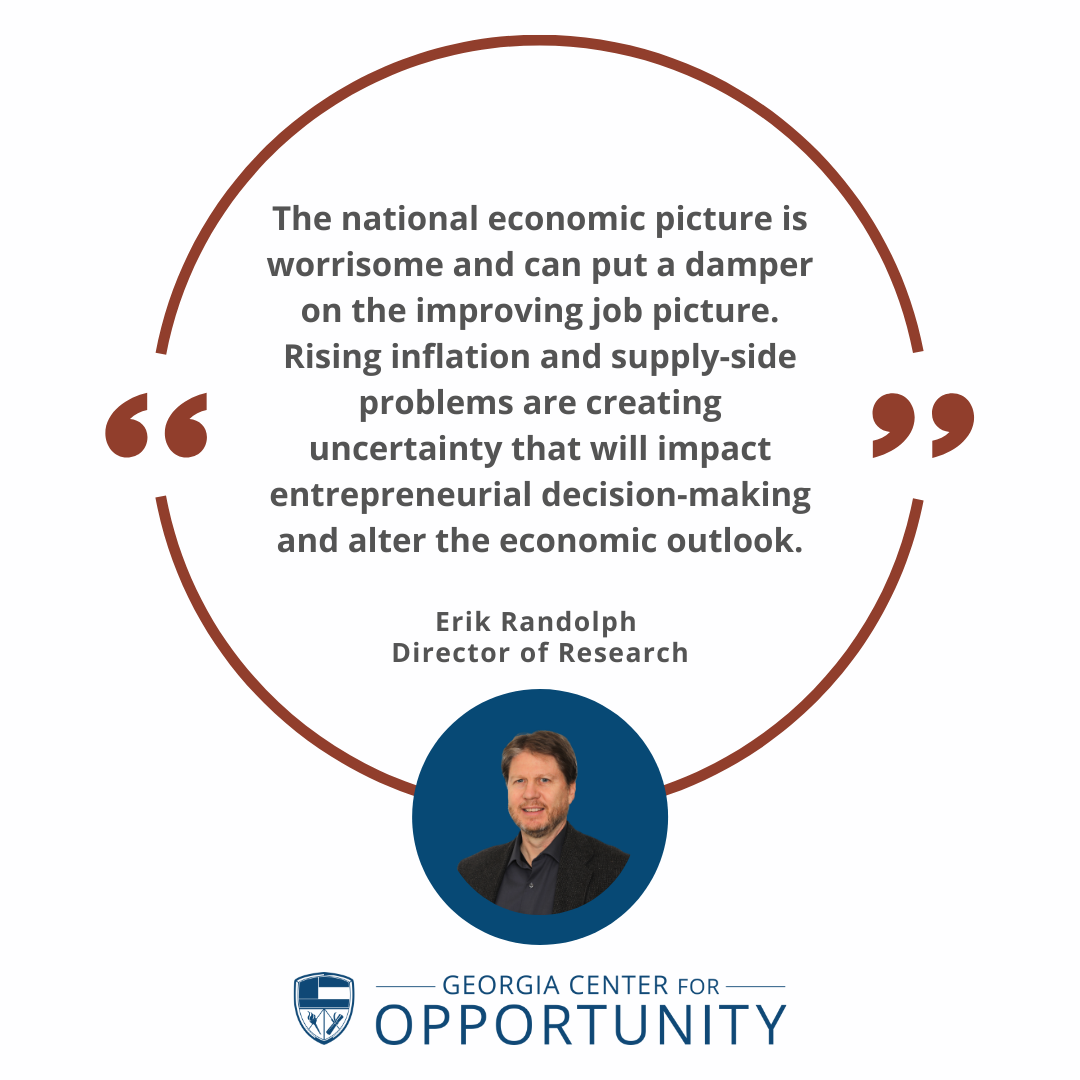
“The national economic picture is worrisome and can put a damper on the improving job picture. Rising inflation and supply-side problems are creating uncertainty that will impact entrepreneurial decision-making and alter the economic outlook. Some economic indicators are beginning to point to a possible economic slowdown. Although these prognostications are not certain, they are concerning.”

For more, read Randolph’s research report on the economic impact of the pandemic shutdowns.


statement

Freedom of Worship - Norman Rockwell 2

I recently attended a conference that included a number of participants who have thought deeply about religious freedom and have acted effectively in its defense. Naturally, everyone was talking about the high-profile legislative battle in Indiana. That got me thinking about what might and should happen in Georgia, during next year’s legislative session, when protecting religious freedom will once again be on the table.

In the unlikely event that you’ve forgotten, here’s what a typical religious freedom bill—modeled on the 1993 federal legislation that Congress passed virtually unanimously—purports to do. In the first instance, it reestablishes a standard the Supreme Court employed to deal with a number of cases under the First Amendment: if a plaintiff can show that his or her religious freedom is substantially burdened by a generally applicable law, then the government has to demonstrate that the law is intended to carry out a compelling state interest and show that it is the least restrictive means to achieve that interest. Contrary to what its opponents claimed, the law does not give anyone a license to discriminate on the basis of religion; rather, it reinstates a time-honored judicial balancing test. Judges decide whether religious freedom—our “first freedom”—or the state interest prevails. No responsible advocate of religious freedom thinks that it ought to prevail against every possible countervailing claim, that every state interest ought to give way before it. We simply insist that religious freedom is an important consideration that ought to be taken into account.

The substance of the law

In the light of what happened in Indiana, Arkansas, and here in Georgia, it seems highly unlikely that any state legislature will pass a simple and straightforward version of the 1993 federal legislation. Opponents were all too effective in tying religious freedom to discrimination, even in the absence of any evidence that the federal law or its many state counterparts had ever effectively been used to license or justify discrimination. Unfortunately, the “fix” that lawmakers adopted to respond to these objections tends to sweep much too widely, making state and local anti-discrimination rules in effect trumps against any religious freedom claim. While certainly a permissible (if, I would argue, inadvisable) declaration of a compelling state interest, it appears to leave no room for certain sorts of religious freedom claims. Thus, for example, a church or other faith-based organization might wish to engage in mission-based hiring, employing only those willing to live up to certain creedal or behavioral standards. These religious hiring rights have long been acknowledged or accommodated in law, but could be described as “discrimination” by those unsympathetic to the standards or practices at issue. Without explicit provision for them in the law, these traditional religious hiring rights could be deprived any any sort of religious freedom defense.

Then there is, of course, the wedding industry, where some practitioners have absolutely no objection to serving gays in ordinary circumstances, but cannot in good conscience provide their services to a same-sex wedding ceremony. Their critics treat their services as public accommodations, akin to restaurants and hotels, and insist that there is absolutely no difference between the photographer who is happy to do a portrait of any individual or family, but not of any wedding ceremony, and the racist hotelier or restaurateur who refuses to serve African-Americans under any circumstances. In the first instance, this argument stretches the notion of public accommodation far beyond its traditional bounds. Furthermore, while the experience of African-Americans in the Jim Crow South certainly made it clear that the traditional right of a businessperson to serve whomever he or she pleases (an aspect of freedom of association) has to give way to the norm of non-discrimination in matters of race, it is far from clear that gays who seek wedding services are similarly seriously discommoded by the few bakers, photographers, or wedding planners who have religious scruples about same-sex marriage. Common sense tells you that there is a difference between being unable to find a place to stay or eat, or having to go around the corner or to the next town to find a wedding photographer. What’s more, many wedding-related businesses are, to say the least, “closely-held.” That means that exempting them from anti-discrimination laws in this limited instance—not, to repeat, in ordinary circumstances—rests on the solid constitutional ground of the recent Supreme Court decision in the Hobby Lobby case; the Court there held that family businesses, at least, enjoyed the protection of the First Amendment and the federal RFRA. Finally, at the very least both baking and photography can be treated as arts, hence as forms of expression. It has long been the understanding that the First Amendment prohibits government (or individuals using governmental authority) from compelling people to say what is not on their minds.

There is, in other words, a reasonably strong argument that the “fix” proposed in Georgia trenches on traditional freedoms of religion, association, and expression. While no one would argue that these freedoms are or should be absolute, they should not be casually or thoughtlessly trampled in an effort to conciliate the demands of one intense constituency. I leave it to the legislative drafters to find language that affirms both compelling norms—religious freedom and non-discrimination—and finds a way to combine them coherently. Surely we are not so unreasonable and inept that we cannot come up with language that accommodates religious liberty and assures gays and lesbians that they will neither be denied service in ordinary circumstances nor be too inconvenienced In their search for wedding services. (Indeed, there are “conscience clauses” from the medical field that may offer a good model here: those who have conscientious objections to, say, abortion, can be excused from participating in a medically necessary abortion, so long as someone else stands ready to help with the procedure.)

Making the case for a reasonable religious freedom law

This year, I think advocates of religious freedom legislation were taken somewhat by surprise by the scope and character of the opposition to them. Since religious freedom had almost always been an “apple pie” issue, they may have thought that, especially in a state that is generally both conservative and religious, opposition would be either nominal or relatively easily overcome. They didn’t reckon on the vociferousness of those who frequently misrepresented the proposal, on the almost complicitous supineness (or was it alacrity?) with which the media gave them a megaphone, and on the unwillingness of the business community to protect religious liberty, not to mention the enterprises and livelihoods of their much smaller brethren. Next year promises to be worse, not only because opponents of religious freedom legislation will be emboldened by their success this year, but because it is very likely that a narrowly-divided Supreme Court will hand down a decision finding a constitutional right to same-sex marriage, raising passions even higher.

Proponents of religious freedom can’t afford merely to be reactive. We have to start right away to lay the groundwork for success in next year’s legislative session. That means making a winsome case in public for the necessity of such legislation, not simply to protect those who conscientiously dissent from same-sex marriage, but also all those—especially members of minority religions—who in carrying out their religious duties find themselves on the wrong side of an otherwise neutral law. Those in the media who cover this issue must also be educated, again in a setting where the stakes are not high and they can feel free to ask questions and engage in the give-and-take of a conversation. That also means sitting down with legislators when things are relatively calm and patiently explaining the importance of religious freedom and the nuts and bolts of protecting it. Finally, that means putting business leaders on notice that if they criticize religious freedom legislation as unwelcoming in our state, they will be pointedly asked about the business they do in countries all over the world that do not respect human rights, let alone the rights of gays and lesbians.

Once the session begins, proponents of religious freedom legislation have to be prepared immediately to answer distortions of the bill’s provisions and purpose. They also have to be prepared to call out zealots on their side, demanding the same responsible behavior of their opponents.

I remain confident that a bill can and will pass, but it is unlikely to be a cakewalk. The arguments are on our side, but critics of the legislation command the high ground in the media.

The future of religious freedom

Abraham Lincoln once said, “In this and like communities, public sentiment is everything. With public sentiment, nothing can fail; without it nothing can succeed. Consequently he who moulds public sentiment, goes deeper than he who enacts statutes or pronounces decisions.” Laws can be enacted, and then repealed. Even constitutional provisions can be repealed or reinterpreted. We cannot rest content that by the enactment of a law, we have genuinely and for the long term protected religious freedom.

More important than any law is “the culture,” by which I mean not only the arts, media, and education, but also the complex web of organizations and relationship that constitute “civil society” and the deeper sources in history and principle for public opinion. If these institutions, understandings, and “habits of the heart” do not support religious freedom, then no law purporting to protect it will stand for long.

Our long-term task is thus one of cultural restoration and reconstruction, in which politics plays only a small part. To be sure, laws and political controversies can offer so-called “teachable moments,” when lots of people are paying attention, but most of the teaching will be done in other, often more intimate and less fraught settings, like schools, churches, families, neighborhoods, and workplace relationships. And most of the teaching will not, strictly speaking, be about religious liberty.

Some have suggested that cultural and religious conservatives should be prepared for a “Benedict option,” a time of withdrawal from “the world” in order insularly to protect themselves, their families and communities, and their understanding from an inveterately hostile culture. I’m not yet prepared to urge my fellows down that path. I have more confidence that truth and nature will assert or reassert themselves. (I could make such an argument using the language of Christian theology, but would prefer in this venue not to talk about creation, evil, and God’s sovereignty.)

What we have to do is be attentive to building healthy families and communities, to be vigilant about telling the truth about ourselves and our relationships, to be open to respectful engagement with those who disagree with us, and to tell and promote stories in art, film, music, and literature that teach moral truths without being overtly “preachy.” Great art and great literature command the attention of those who encounter them. They nourish our minds and our souls. They provide the bases for fruitful conversations and friendships, even among those who happen at the moment to disagree.

This isn’t a “quick fix,” but rather the work of many lifetimes. We didn’t lose our way overnight. We won’t find our way back tomorrow.


Image Credit: https://humanitiesusa.wordpress.com/2011/05/15/norman-rockwell-freedom-of-speech-the-saturday-evening-post-c-1943/

Subscribe

* indicates required

Subscribe

* indicates required