new years resolution, 2024, year in review

Key Points

  • Research has shown that safe communities, stable relationships, and meaningful education and work are essential to making poverty escapable. 
  • In 2023, we focused on helping communities develop solutions and tools to improve public safety, jobs, education and student achievement, and family formation. 
  • Through these accomplishments in 2023, more communities are being empowered to help people imagine and pursue better futures for themselves. 

It seems like everywhere you go these days, people are struggling. You can see it on street corners, in grocery stores, in news headlines, and—most heartbreaking of all—in the eyes of the people who have lost hope.

What they need is opportunity. And that’s exactly what the mission of the Georgia Center for Opportunity (GCO) is built to deliver. As the year draws to a close, let’s take a moment to celebrate the good that has been done to alleviate poverty by removing barriers to opportunity and creating conditions that empower people to flourish and achieve their full potential.

The good news is that research consistently shows that people who experience personal safety, get a good education, find meaningful work, and have healthy, committed relationships only have a 2% chance of falling into poverty. And for those currently living in poverty, these opportunities are the way out to experience freedom and flourishing.

In 2023, GCO celebrated big wins in several key areas that foster community transformation: public safety, jobs, education, and family formation. Here are a few examples of how we’ve helped our neighbors live better and build thriving communities. 

Public safety

Thanks to our public safety research, we convened state policymakers and city leaders in Atlanta and Columbus to look at the causes of increasing violence, and provided a proven set of practical solutions for reducing crime—especially in low-income communities. At the national level, our public safety recommendations were well received in Dallas and Louisville, and an opinion piece we co-authored reached 28.7 million people through Newsweek. Soon thereafter, MSN and other media outlets amplified its reach to another 167.1 million Americans.

And given how important it is for people to live in safe communities where they feel comfortable walking around and living their lives, we also created a resource page on our website so that elected officials, law enforcement, and community leaders can easily find the best practices for addressing crime. 


Workforce

On the jobs front, our BETTER WORK program continues to help communities build local employment support systems that bring employers, nonprofits, and community partners together to help more Georgians find local jobs. We’ve also joined forces with Lyft to help people get to work and focused on solutions to the benefits cliff challenges that keep many mired in government dependency. 


Safety-net reform

This year, GCO remained on the vanguard of educating lawmakers and the public about the need for reforming the safety net. Broadly, we worked to reveal the challenges posed by benefits cliffs, which discourage people from looking for meaningful work and gaining independence. Specifically, we expanded our impact to Utah, Arkansas, and Missouri, in addition to launching a redesigned benefits cliffs website and calculator that adds Utah and West Virginia to the models.

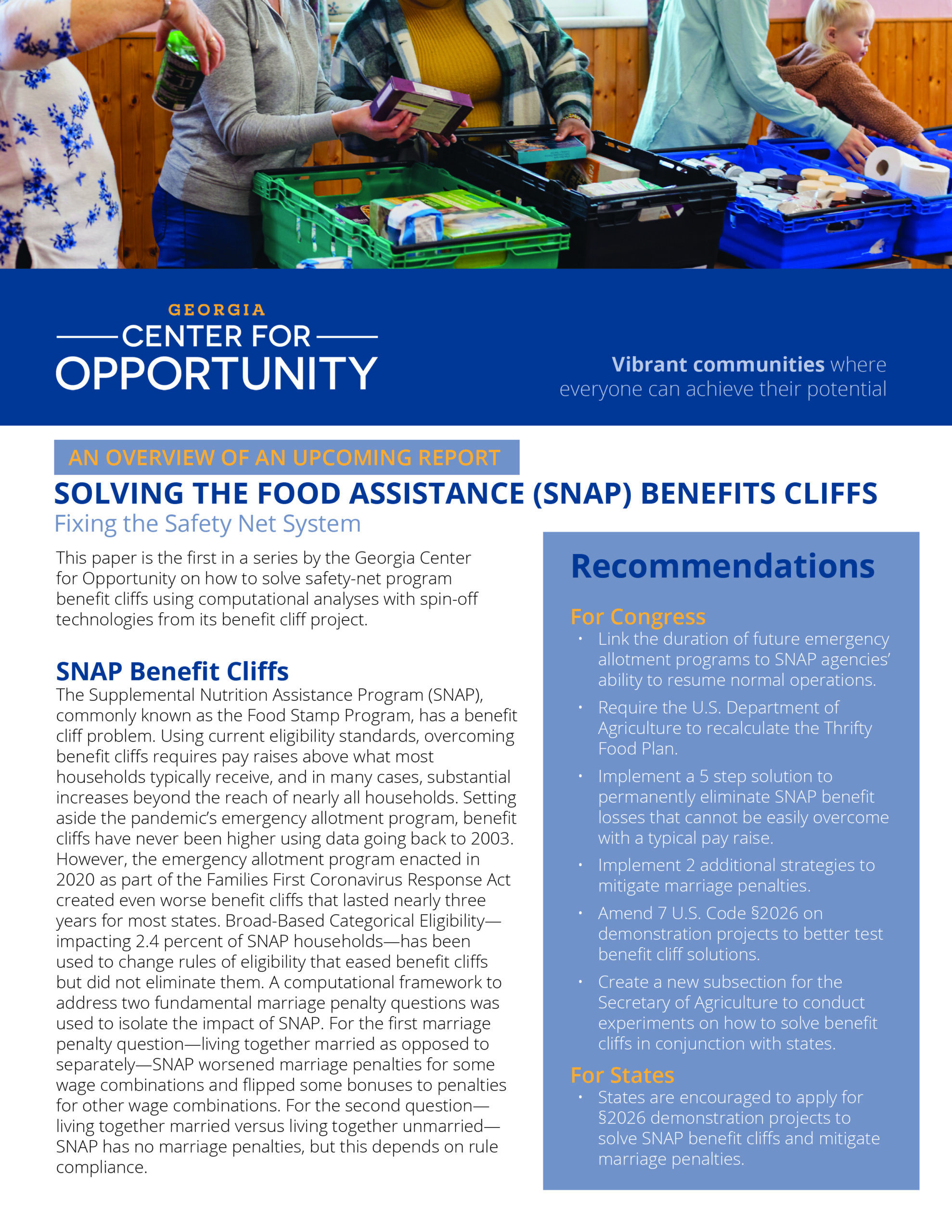
As we educate states and businesses about the benefits cliff problem within the welfare system, we are also developing solutions that equip them to do something about it. This year, we released our first report focused on benefits cliffs solutions, which focused on fixes for the Supplemental Nutrition Assistance Program (SNAP).


Education

Our efforts to expand educational opportunity have given nearly 84,000 Georgia kids access to the schooling option that best fits their needs. And we led efforts to advance a groundbreaking school choice bill through the state senate. This means there’s strong momentum going into 2024 to expand education options for 500,000 more students stuck in Georgia’s failing schools. We also updated our Education Guide for parents and received the Lilburn Middle School Business Partner Recognition Award for partnering to deliver free relationship education classes for parents and students.

See How The Georgia Center For Opportunity Is Expanding Hope In 2024!

See How The Georgia Center For Opportunity Is Expanding Hope In 2024!


Family

For families, parents continued to graduate from our Strengthening Families Program. And GCO kicked off our Raising Highly Capable Kids (RHCK) program with a vision-casting meeting attended by more than 20 community organizations. By reaching into homes, schools, and faith-based groups, RHCK teaches parents how to raise responsible, caring kids—and turns local communities into nurturing places where healthy families help people escape poverty. An example of how RHCK brings key stakeholders together to foster thriving families is the Lilly Endowment grant that introduced the Parents First Initiative to Lawrenceville.


National and state impact

Finally, GCO had a number of important wins with far-reaching, favorable media coverage on topics we care deeply about. This means that our voice was out there advancing importance conversations about human flourishing. For example, The Wall Street Journal ran our opinion piece calling out pre- and post-COVID crime comparisons for what they really are—an excuse not to blame bad public safety policies. And RealClearPolicy ran an article on our ideas to make safety nets more successful at turning welfare into work support.

Beyond these, GCO’s views were featured in important conversations about Georgia’s position among the leading states for economic freedom and why people remain trapped in poverty when there are so many public assistance programs. And for those concerned about rising crime across the nation, the Atlanta Journal-Constitution carried our must-read piece on public safety.


Wrapping up

Of course, these are just a handful of GCO’s successes in 2023. Yet each win adds to the legacy we are building to help our neighbors enjoy meaningful and productive lives in safe, vibrant communities that value work, education, and family. We’re proud of our successes this year, and we look forward to continuing to advance common-sense policy solutions in 2024 that bring greater peace, dignity, and freedom to individuals and families across Georgia and beyond.

Shopping Cart in aisle

Many Americans rely on SNAP benefits to afford food, but these same individuals and families face a trap that keeps them mired in dependency. It’s called the SNAP benefits cliff. A new report from the Georgia Center for Opportunity analyzes some possible solutions for addressing the benefits cliffs still present in safety-net programs like SNAP. 

What are benefits cliffs?

A benefits cliff is when an individual, family, or household loses more in net income and benefits from governmental assistance programs than it gains from additional earnings. This net loss is a perverse incentive that undermines the natural desire to earn more income.

At an individual level—or in the case of SNAP, at a household level—the impact has to do with the ability of the individual or household to overcome the cliff. If the household can increase its earnings (and other income) sufficiently relative to the loss in benefits and taxes, the cliff will have no impact on that specific individual or household.

Who is hurt the most by benefits cliffs?

Our computational analysis shows that it is mathematically possible for some one-member households, where the individual is disabled or elderly, to overcome a benefits cliff with a pay raise of less than 5%. However, almost all other households will require percentage income increases in the double digits or worse.

Larger families, especially those without elderly or disabled members of the household, fare much worse. For example, a family of four (where a single mom is raising three kids, for example) would require a pay raise of between 37% and 121%, assuming the family doesn’t have housing costs. For larger households with disabled or elderly members, that pay raise ranged from 30% to 109%.

Snap Benefits paper cover

 Access the Report:

SOLVING THE FOOD ASSISTANCE (SNAP) BENEFITS CLIFFS

Our comprehensive report on the SNAP Benefits Cliffs outlines the pitfalls in the current structure of the program and steps that can be made at a federal, state, and agency level.

Learn More About This Report

Running the numbers: the impact of benefits cliffs

A family of four would begin experiencing SNAP benefits cliffs when their household income exceeds $36,084. This family would lose around $462.42 in SNAP benefits each month. To overcome those lost benefits, that same family would need to earn $58,280 a year, a 61.5 percent increase in income.

What is the marriage penalty? 

Another example of benefits cliffs’ detrimental impacts lies in the marriage penalty. For instance, a couple choosing to marry would leave them worse off financially by getting married than by staying single. Instead, many couples decide to remain unmarried to avoid the financial burden of the marriage penalty. 

SNAP benefits cliffs are at a 20-year high

During the COVID-19 pandemic, the SNAP maximum allotments were raised significantly—between 45% and 51%. The Thrifty Food Plan was recalculated by the USDA, which impacted these increases. However, SNAP’s current benefits cliffs are at a 20-year high and may be the highest they’ve ever been. 

The situation is getting worse

Setting aside COVID-19 and the emergency allotment program, SNAP benefits cliffs are getting worse and, based on twenty years of data, have never been higher. This was not always the trend. The benefits cliffs cycled up to a high in 2009, slowly came down, and then leveled off for a few years. However, since the pandemic, they have all shot up to record highs.

Policy goals for improvement

We recommend approaching change from a policy perspective, and engaging Congress and the states to solve the problems with SNAP’s benefits cliffs. 

As a public policy goal, it would make sense to design a safety-net assistance program in such a manner that it minimizes potential cliffs for most cases. We believe that it should be relatively easy for individuals and households to overcome benefits cliffs by earning additional income. 

Our recommendations include: 

  • Limiting how long future emergency allotment programs last 
  • Requiring the USDA to recalculate the Thrifty Food Plan
  • Permanently eliminating benefits cliffs that a typical pay raise can’t mitigate
  • Implementing strategies to prevent marriage penalties 
  • Amending U.S. code to test potential solutions via demonstration projects
  • Opening the floor for the Secretary of Agriculture to work with states to solve benefits cliffs
  • Allowing states to conduct §2026 demonstration projects


Parents and Children
Family Portrait
Family Bond
Happy Family
Love and Togetherness
Family Time
Family Happiness
Family Unity
Multi-Generational Family
Family Love
Smiling Family
Family Fun
Joyful Family
Family Connection
Family Memories
Family Gathering
Family Affection
Close-knit Family
Family Support
Family Values

Key Points

  • Utah’s economic success and high levels of happiness are attributed to the quantity of marriages and cohabiting married parents, leading to strong family structures and economic mobility.
  • The “Family Impact Perspective” proposed by Brad Wilcox offers guidelines to strengthen marriages, encourage desired parenthood, improve family affordability, and enhance family relationships in pursuit of economic success and well-being.
  • Georgia, facing economic challenges and family-related issues, can learn from Utah’s success and consider implementing similar policies and projects to foster a “Georgia Family Miracle” and improve economic mobility rates.

No matter how you spin it, Utah has enjoyed great success in recent years. The Beehive State tops national charts economically—with particular success in economic mobility— as well as scoring highly in happiness, evaluated through emotional health ratings. 

Sociologist Brad Wilcox attributes these achievements to the quantity of marriages in the state. In Utah, adults ages 18-55 are 10% more likely to be married than other Americans (55% versus the national average of 45%) and children are 7% more likely to grow up with cohabiting married parents than their peers in other states (82% versus the national average of 75%).

What’s more, Utah enjoys some of the greatest economic mobility in the country. And according to numerous economists, this is probably due to young people living in married families. Wilcox writes that the poor children in the Salt Lake area whose lot is improving “are much more likely to be raised in a two-parent family and to be surrounded by peers from two-parent families than poor kids in other metro areas.” 

Yet Utah’s economic success has also attracted many newcomers to the state, who have driven the marriage and fertility rates down, as Wilcox explains. Across the state’s counties, from Salt Lake City to rural areas to Utah County, which boasts some of the highest population and birth rate growth, immigration has inflated population counts and decreased fertility. While the state still leads the country in fertility and marriage, there are indeed “clouds on the horizon” as national cultural norms descend upon the state. 

The “Utah Family Miracle” might be seeing its last days. 


Where do we go from here?

In a recent report with the Sutherland Institute, Wilcox promotes a “Family Impact Perspective” through which all “states laws, regulations and initiatives” might be considered. He writes that this framework would assist in the pursuit of the following targets: 

  • Strengthen marriagemeasured in terms of both the rate and stability of marriage
  • Encourage couples to have the children they wish to have 
  • Make family life affordable for ordinary working families 
  • Enable husbands, wives, children, and especially parents to maximize their time with their families
  • Increase the quality of family relationships by increasing positive and reducing negative (e.g., domestic violence) interactions in families.

 This perspective is flexible to the needs of the state and offers guidelines and signs of success for legislators and the families that they serve.

Georgia, facing economic challenges and family-related issues, can learn from Utah’s success and consider implementing similar policies and projects to foster a “Georgia Family Miracle” and improve economic mobility rates.

Georgia, facing economic challenges and family-related issues, can learn from Utah’s success and consider implementing similar policies and projects to foster a “Georgia Family Miracle” and improve economic mobility rates.

Sutherland and Wilcox’s report culminates in five policy recommendations that solidify the Family Impact Perspective. Utah already enjoys ranking as the best state in the country for families, but even there these productive steps are under consideration.

  1. State reports should consider family structure when they track other socioeconomic factors.  
  2. The “Success Sequence” proposed by the Institute for Family Studies should be worked into public school curricula and premarital education.
  3. States should provide families with young children a monthly allowance to “empower parents in their capacity to make choices about how to best care for their children.”
  4. Address families’ cost of living, considering housing, schooling, and food as issues integral to family decisions.
  5. Create a state commission on men and boys, as men everywhere increasingly fall by the wayside. 

These ideas address the biggest issues facing families in a holistic, productive manner. Georgia would do well to consider implementing similar policies and undertaking such projects. 


What’s in it for Georgia? 

A Georgia Family Miracle. 

The state has much to gain by considering what it would take to improve economic mobility rates until they rival Utah’s. Currently, Georgia lags in 12th economically and 24th for fiscal stability, and the economic mobility rate has drawn critical attention for a decade. While many factors feed into economic mobility, leading Georgians ought to encourage study into the impact of family structure and costs of living on the prospects of the youngest citizens. 

Georgia’s immigration rates are much lower than Utah’s (-2.5%, whereas 8.4% of Utah’s population are immigrants). This means Georgia might enjoy greater cultural stability, which should not be taken for granted. Rather, Georgia’s leaders ought to double down in their service to the constituency’s families and help them build happier homes where they have better relationships.

By multiple measurements, marriage in Georgia is far from the worst in the country, but there is still much work to be done if Georgians are to have the families and futures that they want. The U.S. Centers for Disease Control and Prevention reports that, in 2021, Georgia’s marriage rate was only 60% of Utah’s (at rates of 5.5% and 9.1%, respectively). Demographers have reported for years that Georgia’s divorce rate is among the highest in the U.S., and a 2020 study by the Annie E. Casey Foundation and the Georgia Family Connection Partnership found that 33.5% of Georgia’s kids live in single-parent households—not accounting for cohabiting, unmarried parents.  

The easiest ways to increase familial connection include reducing tech use in the home, making family life more affordable with an allowance, and strengthening existing marriages through close review of couple’s needs, especially men struggling to be dependable citizens and fathers.

Talk To An Expert

About The Author

David Bass

Press Manager

David Bass is a journalist and communications professional with nearly two decades of experience in the world of PR, marketing, and publications.

Georgia news, in the news, current events, Georgia happenings, GA happenings

In January, Atlanta Mayor Andre Dickens launched the “Year of the Youth” plan to combat juvenile crime rates in the city. The issue is a pressing one. Consider that in 2022, 19 of the 170 homicide victims in Atlanta were children. Deshon DuBose, a 13-year-old, is among the juvenile homicide victims already in 2023. He was gunned down while leaving Cascade Family Skating in January.

Meanwhile, Georgia Juvenile Justice Commissioner Tyrone Oliver says that around 50% of youth incarcerated in the state self-identify as gang members. Jayden Myrick, who was found guilty of murder in a 2018 robbery and fatal shooting at an Atlanta wedding, admitted under oath that he was recruited into gang life when he was just 9 or 10 years old.

Juvenile violence skyrocketed across the country in 2020, reversing decades of decline. But even before the increases, juvenile crime was reported in 2018 as 15 times higher in Fulton County than the national average.

Juvenile offending, like adult criminality, concentrates among a very small number of offenders. These juveniles are typically either associated with or being recruited into street gangs and often pressured by adults to commit serious violent offenses.

Thankfully, there are well-documented ways to reduce that kind of offending. Look to Louisville, Kentucky for a recent example of solutions.

In recent years, Louisville has experienced substantial increases in juvenile violence, with arrest rates for juvenile homicide suspects 50% higher than the national average and a majority of carjacking arrestees being under 18 in 2020 and 2021. This prompted Republican State Representative Kevin Bratcher to begin working on what would become House Bill 3, a comprehensive violent juvenile offender accountability and treatment bill. While some of House Bill 3 dealt with issues specific to Louisville, many of its provisions offer policies and best practices worth adopting in Georgia.

Most importantly, the bill required that any juvenile charged with a serious violent offense such as murder, rape, robbery, burglary in the first degree and so on, be immediately detained for a period not to exceed 48 hours. This mandatory detention serves two purposes. It not onlyprotects the public and the juvenile by disrupting the cycle of violence but it also ensures meaningful time for mental health and drug abuse evaluations and comprehensive evaluations of the risks posed by the juvenile before a judge ultimately determines long-term release conditions or pretrial detention.

They also funded a new detention center in Louisville and a myriad of treatment programs intended to get juveniles with one foot in the streets and one foot in civil society back on the right track. This includes funding cognitive behavioral therapy which is being used toeffectively get serious juvenile offenders back on a positive life course. Why fund programs in facilities and not just in the community? Treatment programs for high-risk juveniles are most effective after 200 hours of treatment.

Finally, the new law creates early intervention points for young people who showed no improvement in their diversion programs. It does so by allowing an interdisciplinary team to alter the treatment methods earlier. If parents are unwilling or refuse to comply with a child’s diversion plan, a judge has the authority to hold the parents accountable. Chronic, unexcused absences from schools are strong predictors of future juvenile delinquency.

Unresolved truancy is strongly predictive of future juvenile delinquency and even adult criminality. So, getting it right with those kids today can help a child escape being preyed on by adult gang members and prevent serious violence in the future.

We didn’t get here overnight, and the reasons for the spike in juvenile crime in Atlanta are multifaceted. But the bottom line is that policy solutions similar to those enacted this year in Kentucky can help the city move forward and create a safer community and a more just and fair system.

Josh Crawford is the director of criminal justice initiatives at the Georgia Center for Opportunity.

Read the full article here

This opinion editorial was originally published by The Atlanta Journal-Constitution on June 6, 2023. 

Election Day

Key Points 

  • The full results of the midterms are still to be decided.
  • One thing hasn’t changed — the need to expand opportunity.
  • We also see opportunities to impact our neighbors for good in a few key policy areas – education, work, and family.

Election day has come and gone, and we still have many unanswered questions about the leadership of our country. The full results of the midterms are still to be decided. What’s clear is that Georgia will once again play a key role in the results, with a runoff in the U.S. Senate campaign scheduled for Dec. 6. Once more, our state will have to endure a barrage of political ads as the nation watches to see what the results will be.

While questions are sure to persist in the days and weeks to come as we resolve political leadership, one thing hasn’t changed — the need to expand opportunity. While who holds the reins of power in Washington and Atlanta does matter, ultimately it’s in local communities where the true change happens that leads to human flourishing.

As for us at the Georgia Center for Opportunity, we are ready to take on big challenges as we close out the year and move into the next. Our community-based work of connecting people to work, education, and family training resources is still at the heart of what we do. But we also see opportunities to impact our neighbors for good in a few key policy areas. We’re focused on:

  • Education: With a better understanding of who will be leading in our state, we see a great opportunity to expand educational freedom in Georgia in 2023. This battle has lasted a long time but the nearly 500,000 kids in failing Georgia schools need us to step in and demand change.


  • Work: We also see opportunities to radically change the policies that trap people in generational cycles of government dependency. Our goal is to help thousands more of our neighbors move into work and the joy of accomplishment and pride that comes with it.


  • Family: We hope to seize the opportunity to address the penalties that are discouraging marriage in low-income communities, creating a system that destabilizes families and the support they bring to us all. 

“While who holds the reins of power in Washington and Atlanta does matter, ultimately it’s in local communities where the true change happens that leads to human flourishing.”


“While who holds the reins of power in Washington and Atlanta does matter, ultimately it’s in local communities where the true change happens that leads to human flourishing.”


Policy does matter, but real change happens in our neighborhoods and communities where real life happens. It’s in communities where we first learn to love, trust, and experience sacrifice on behalf of something beyond ourselves. And it’s in communities where we find the answers to our most pressing problems. Regardless of who leads our state and federal government, that truth will never change.


trophies for teams

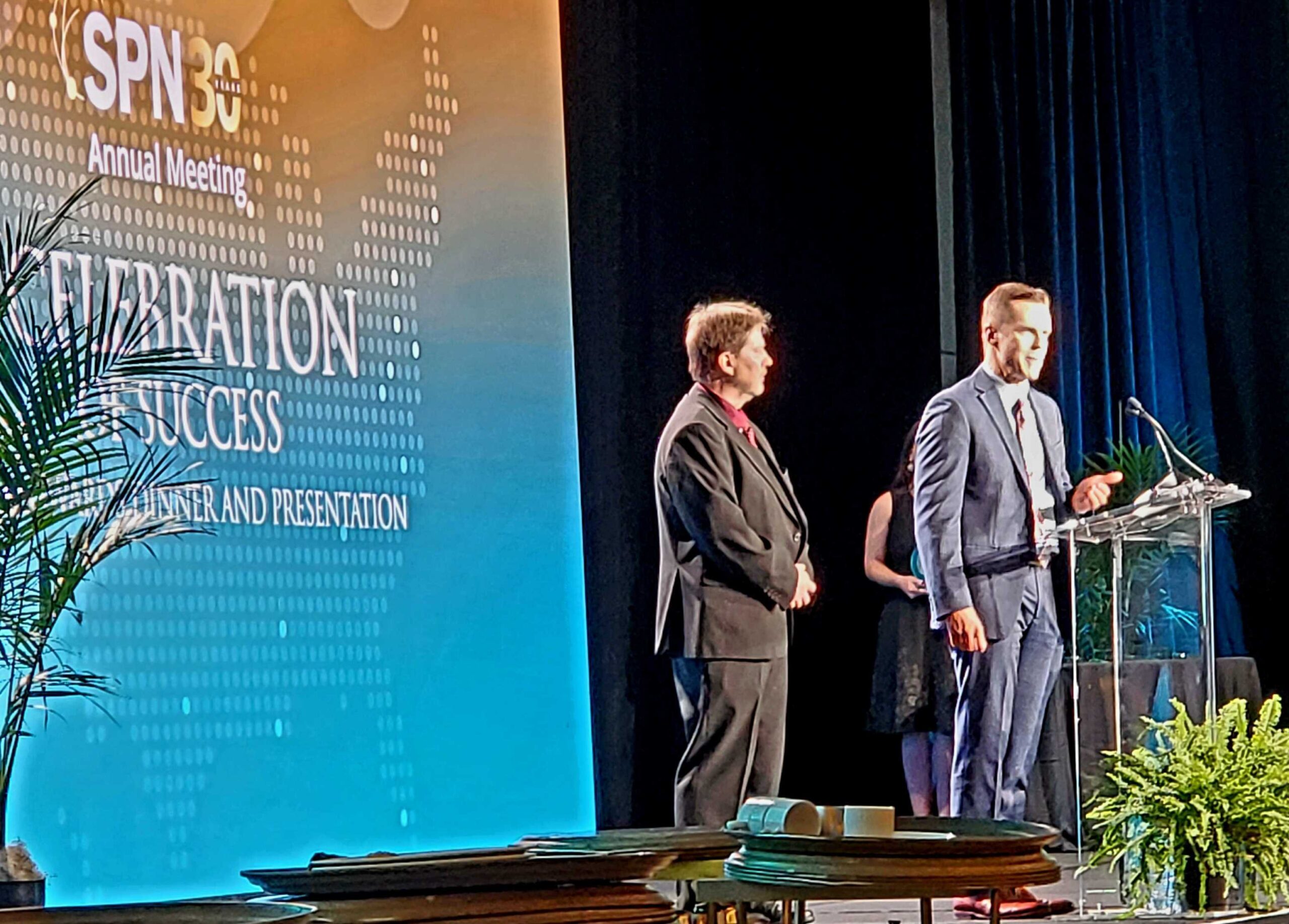
Georgia Center for Opportunity is  the winner of the Bob Williams Award for Outstanding Policy Achievement. Erik Randolph, Director of Research, lead the charge in undertaking a massive research project which highlights the harms of COVID restrictions which took place around the country. The award specifically recognizes those doing “exceptional work to create and disseminate credible policy research and ideas.”

Georgia Center for Opportunity has been one of the host organizations for the State Policy Network’s Annual Meeting which is being held this week in Atlanta, GA. This is a gathering of organizations working on a state-level to promote realistic solutions to policy. It’s also a time for our team to collaborate with like-minded people and be inspired by new ideas and tactics.


“Bob Williams Awards for Outstanding Policy Achievement recognize state think tanks doing exceptional work to help states implement solutions that expand personal freedom and opportunity for all Americans.”


SPNAM2022

“Bob Williams Awards for Outstanding Policy Achievement recognize state think tanks doing exceptional work to help states implement solutions that expand personal freedom and opportunity for all Americans.”

Subscribe

* indicates required

Subscribe

* indicates required