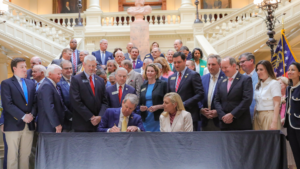
Georgia Governor Brian Kemp signs a bill into law.

Key Points


  • Georgia’s future is on the ballot in 2026 as voters elect a new governor to lead the state for the next four years. In the May 19th primary elections, Georgians picked candidates to represent each political party. They’ll choose the final winner in the general election on November 3.


  • The governor influences major issues that affect Georgians every day, like taxes, education, health care, work opportunities, and public safety.


  • Understanding the governor’s role can help voters cast their ballots for a candidate who can bring even more hope, well-being, and prosperity to people and communities across the state.


When Georgians vote for governor, they’re choosing more than a public figure. They’re electing the leader who sets the direction for everything from schools and public safety to taxes and the economy. 

While the governor can’t create laws like the legislature does, they shape daily life by deciding how the state will spend money, what bills get signed, and how certain public programs for families will operate. 

Quick Facts About Georgia’s Governor

  • Current Governor: Brian Kemp
  • Next Election Date: November 3, 2026, for the general election 
  • Term Length: Four years, with a maximum of two back-to-back terms
  • Minimum Age Requirement: 30 years old by Inauguration Day
  • Counties the Governor Serves: 159
  • State Budget the Governor Oversees: $36.6 billion

How Does the Governor Impact Everyday Lives in Georgia?

1. The governor can sign—or stop—new laws.

After a bill passes in Georgia’s House and Senate, it goes to the governor, who can sign it, veto it, or let it become law without a signature. 

If the governor vetoes a bill, Georgia’s legislators can override that action, but only with a two-thirds majority in both chambers. To avoid a veto, lawmakers usually aim to pass legislation that reflects the governor’s policy priorities.

In 2026, Georgia’s legislature passed bills that created pathways for kids to take advanced math classes in earlier grades and to improve their reading skills. The bills aligned with Governor Kemp’s goal of increasing opportunities for Georgia students, and he signed them into law right after the legislative session ended.

Georgia Governor Brian Kemp signs 2026 bills to support literacy, math education, and K-12 public schools.

On May 5, 2026, Governor Brian Kemp signed nine bills to support reading, math education, and K-12 schools in Georgia.
Photo Credit: Office of the Governor Photo Gallery

2. The governor helps decide where the money goes.

Every year, Georgia’s governor proposes a state budget that outlines how taxpayer dollars should be spent. Because the budget reflects the programs and services that will receive funding, it reveals the governor’s top priorities for the state. 

The legislature revises and passes the budget, but the governor still has a final influential role. Before signing the budget into law, the governor can use a line-item veto to remove parts of the budget they don’t agree with while leaving the rest as is. 

In May 2026, Governor Kemp signed House Bill 974, the state budget bill for the fiscal year starting July 1. The $36.6 billion budget directs most funding toward education, health care services, public safety, and economic growth—a clear signal of what the governor cares about. Before signing, Governor Kemp used his line-item veto authority, removing some expenses to keep the budget in balance after approving income tax cuts.

3. The governor chooses the leaders behind key family services.

Government policies aren’t implemented in one big speech or one dramatic vote. Instead, they’re carried out every day by state agencies, boards, and commissions.

The governor appoints many of the heads of those administrative offices. They oversee daily operations in workforce development, child and family services, public safety, licensing, education administration, and programs that help low-income Georgians.

The governor steers welfare (safety net) policies, for example, by appointing the members of the Board of Human Services. The members establish the state’s goals for welfare programs like the Supplemental Nutrition Assistance Program (SNAP).

4. The governor sets the policy agenda.

The governor has a powerful microphone: the annual “State of the State” address. At the beginning of the legislative session, the governor uses this speech to outline their priorities and encourage lawmakers to act on specific policies. 

And when the governor elevates an issue—whether it’s education, workforce development, public safety, or taxes—it usually moves quickly from a policy idea to serious legislative action. 

In his 2026 State of the State address, Governor Kemp proposed decreasing the state income tax to 4.99% to help Georgians keep more of what they earn. The legislature followed up by passing House Bill 463, which the governor signed into law.

5. The governor leads during emergencies.

The governor uses executive orders and emergency powers to quickly mobilize state resources when storms, wildfires, public safety threats, or other emergencies hit. 

In April 2026, Governor Kemp declared a state of emergency for 91 counties in response to South Georgia wildfires and empowered state agencies to help affected residents and their families.

FAQs: The Georgia Governor’s Race in 2026 and the Election Process

How Is Georgia’s Governor Elected?

Georgians elect their governor through a direct popular vote. Unlike presidential elections, there isn’t an electoral college that casts deciding votes.

During primary elections, voters pick final candidates from each political party. Contenders have to earn at least 50% of the votes in the primary to win, so run-off elections are possible. 

The same requirement applies in the general election. If no candidate earns more than half the votes, the top two competitors head to a run-off.

Who Can Run for Governor?

A candidate must:

  • Be at least 30 years old by the time they take office
  • Have lived in Georgia for at least six years before the election
  • Have been a U.S. citizen for at least 15 years

How Long Can a Governor Serve?

Georgia governors have four-year terms and can serve up to two back-to-back terms. Former governors can run again after sitting out for at least one term.

What Happens if a Governor Leaves Office Early?

The lieutenant governor is next in line for the job and serves until the next general election.

Which Political Parties Have Georgia’s Governors Belonged to Historically?

Georgians have elected Republican governors since 2003. Before then, Democratic governors had held the office continuously since 1872.

Timeline of political party affiliations of past Georgia governors from 1971 to 2026.

Source: Former Governors in Georgia, National Governors Association

What Issues Are Candidates Talking About in 2026?

The rising cost of living is one of the biggest concerns for Georgia families—and it’s become a major focus in the 2026 governor’s race. Key affordability issues include:

  • Income Taxes: Some candidates are proposing plans to further reduce or eliminate the state income tax so Georgians can keep more money in their own pockets. 
  • Property Taxes: As housing costs continue to rise, contenders are thinking about freezing property taxes or increasing exemptions to ease the burden on homeowners. 
  • Housing Shortages: Candidates are debating how much the state should get involved in local land-use regulations to spur construction of more homes, especially those at lower prices.
  • Health Care: Gubernatorial hopefuls are proposing options to address Georgians’ health care concerns, including expanding Medicaid and reducing the cost of health insurance.

Beyond affordability, candidates are focusing on several other issues affecting families and communities across Georgia:

Welfare Reform: Contenders are thinking about how to lead the state in making big changes to welfare programs, including: 

Education: To give Georgia’s children better pathways to academic success, candidates are debating on more school choice vouchers, increased public school funding, and new early childhood education options. 

Public Safety: Competitors are prioritizing safety and security for Georgia communities by looking at ways to tackle gang activity, reform the juvenile justice system, and reduce repeat offenses. 

Why Does Understanding the Governor’s Role Matter?

Candidates know that more needs to be done to break down the economic and social barriers so many people are facing, and they’re making plans to take action if elected. But policymakers aren’t the only ones responsible.

Understanding the governor’s vital role and what they’ll do to meet the daily needs of Georgia families and neighborhoods can help voters guide meaningful change. By casting their ballots, Georgians can bring even more promise and prosperity to the state—making it a place where everyone has the chance to achieve their full potential and thrive.

Additional Resources

2026 Polls: Georgia Governor
270 to Win

Keeping Vulnerable Americans on Track: One Door out of Poverty and into Opportunity
Alliance for Opportunity

What States Can Expect with the New SNAP Match: Options to Reduce State Error Rates
Alliance for Opportunity

Georgia Candidates for Governor Should Make Welfare Reform a Top Priority
Atlanta Journal-Constitution

Georgia Gubernatorial Election, 2026
Ballotpedia

Governor of Georgia
Ballotpedia

Lieutenant Governor of Georgia
Ballotpedia

Georgia 2026 Election: Here’s Who Will Be on the Ballot During May’s Governor, Senate Primaries
CBS News

Understanding Welfare Work Requirements: New Eligibility Rules for SNAP and Medicaid
Georgia Center for Opportunity

Organization of the Executive Branch
Georgia Public Broadcasting

What Does a Governor Do?
Georgia Public Broadcasting

Short Supply: How Many More Homes Does Georgia Need?
Georgia Public Policy Foundation

10 Races for Governor to Watch in 2026
NBC News

Governor’s Office
State of Georgia

Lieutenant Governor’s Office
State of Georgia

The Three Branches of Georgia’s State Government
State of Georgia

Image Credits: Canva; Governor’s Photographer, Georgia Office of the Governor

Georgia lawmakers have crafted bills that will expand opportunities for students to take advanced math classes and pursue meaningful careers.

Key Points

  • Both chambers of the Georgia General Assembly have drafted bills that will create opportunities for students to take advanced math classes earlier in their academic development.
  • Among other measures, the bills will require automatic enrollment for qualified students to make sure all children have equitable access to the advanced classes. This will help close racial, ethnic, gender, and socioeconomic achievement gaps among young Georgians.
  • Research shows that students who pass Algebra I by ninth grade are more likely to graduate from high school. They’re also more likely to succeed in college, accept meaningful jobs, and become financially stable.

Legislators in the Georgia General Assembly have drafted a pair of bills that are set to transform the way math is taught in the state. If the bills become law, they’ll open doors for students to receive a high-quality math education and ultimately shape the direction of their lives.

The Senate’s Quality Basic Education Act (SB 171) will require Georgia’s Board of Education to develop an advanced math pathway for children in grades 3-8. This compressed and accelerated math track will prepare students to take high school-level math classes like Algebra I in middle school and, if desired, to pursue careers in science, technology, engineering, and math (STEM). 

The House of Representatives’ Math Matters Act (HB 1030) will bring detailed updates to the way math is taught in Georgia schools, including the adoption of new math standards, increases in the amount of time spent on math during the school day, and new requirements for teacher certifications. It shares SB 171’s goal of preparing students to take advanced math classes and setting them up for greater success after graduation.

The bills are based in part on recommendations from the Georgia Center for Opportunity (GCO), with additional support from ExcelinEd and GeorgiaCAN. The opportunities they create will pave the way to fulfilling jobs, economic opportunity, and brighter futures for participating students, and especially for young African Americans, Latinos, and girls, who haven’t traditionally received significant STEM education.

“GCO has helped lead the charge in crafting these bills to bring more opportunity to all of Georgia’s students. A strong math education will empower young Georgians to reach their full potential and flourish in their careers and lives.”

Buzz Brockway, Vice President of Policy, Georgia Center for Opportunity

What Are the Key Elements of These Bills?

The two bills are similar in several ways. They differ just slightly in how they’ll require schools to prepare students for advanced math classes.

School Requirements

  • Per SB 171, all local school systems will offer an advanced math pathway in grades 6-8, and they’ll be able (but not required) to offer it as early as third grade.
  • Per HB 1030, schools will provide at least an hour of core math classes every day starting in grades 4 and 5.

Automatic Enrollment
School districts will automatically enroll students in advanced math courses if they meet the program’s qualifications. 

  • Parents or guardians will have the option to withdraw their child from the classes if they think the standard math track is a better fit for their child.
  • Parents of students who don’t qualify for the advanced math classes will still be able to enroll their child if the student’s score on the previous year’s math assessment is above a certain level.

Additional Assistance for Teachers 
The bills enable local school systems to provide extra training and resources to teachers so they can help students build positive mindsets around math and excel in the classes.

Supportive Student Services
The bills grant school systems the ability to offer tutoring or bridge programs to support students in the faster-paced courses.

Annual Reporting
Georgia’s Department of Education will publish annual reports on student demographics, enrollment, and test scores to make sure the advanced math curriculum is meeting its equity and achievement goals.

How Will Students Qualify for the Program?

Students who receive high scores on statewide end-of-grade math assessments will be eligible for the advanced classes during the following school year.

What Types of Classes Will Students Take as Part of the New Program?

Students on the advanced math track will be able to complete high school-level math classes—usually Algebra I—by the time they finish eighth grade. They’ll then be ready to tackle subjects like calculus in high school.

When Will the Advanced Math Courses Be Available?

The advanced classes should be available during the 2027-2028 school year.

What Impact Will Automatic Enrollment Have?

Automatic enrollment supports equitable access to the program by removing barriers like possible teacher bias, a student’s lack of confidence, or participation fees. In the past, obstacles like these have sometimes prevented qualified but traditionally underserved students from setting foot on advanced academic pathways.

Barriers to early educational opportunity are still being reflected in the composition of our nation’s workforce. For example, a recent report from the National Science Foundation revealed that the nation’s STEM workers were:

  • 62.9% white 
  • 14.8% Hispanic
  • 9.5% Asian American
  • 8.2% Black
  • 4.3% multi-racial 
  • 0.3% American Indian or Alaska Native

And just 18% of working women in the United States held a STEM job, per the report. 

Opening doors to all students and exposing them to challenging math coursework early in their academic development can help close racial, ethnic, gender, and socioeconomic achievement gaps and pave the way for young people’s future success and upward mobility. 

How Can Advanced Math Classes Build Bridges to Opportunity?

Research indicates that students who pass Algebra I by ninth grade are twice as likely to graduate from high school. They’re also more likely to succeed in college and then accept meaningful jobs in STEM fields, which are critical to the nation’s economic success. And outside of work, the essential skills math teaches—analytical, logical, and problem-solving skills—will empower young people to serve as engaged members of their communities.

The advanced math track will give young Georgians the chance to experience the sense of dignity and purpose that comes from rewarding work—both academic and professional. And for students who are part of vulnerable families, this opportunity sets the stage for them to break out of generational cycles of poverty and to achieve their full potential. Their success will then ripple out, transforming their future families, workplaces, and neighborhoods.

Additional Resources

Indicator: Successful Completion of Algebra I by 9th Grade
Education-to-Workforce Indicator Framework

Math Policy
ExcelinEd

From Gatekeeper to Gateway: Creating More Paths to Algebra I Success
National Math Improvement Project

The STEM Labor Force: Scientists, Engineers, and Skilled Technical Workers
National Science Foundation

Employment in STEM Occupations
U.S. Bureau of Labor Statistics

2024 Black Students and STEM Report
YouScience and Black Girls Do STEM

Image Credit: Canva

Georgia lawmakers passed bills affecting schooling, work, and family opportunities in 2025.

Georgia lawmakers wrapped up the 2025 legislative session with some big decisions that affect our state’s families, students, and workers.

Several new laws were passed to improve education, job opportunities, and access to childcare — while a few important changes didn’t quite make it through.

“The 2025 session included some key victories to improve public school classrooms, expand school choice options, and improve workforce opportunities,” said Buzz Brockway, vice president of policy for GCO. “While there were some disappointments on bills that didn’t make it across the finish line, we are pleased with the progress lawmakers made this year in promoting an agenda to allow all Georgians to flourish.”

What Passed: New Georgia Laws in 2025

These bills passed out of both the House of Representatives and the Senate and are headed to the governor for signing. 

House Bill 340: Less phone distraction, more student engagement

K-8 classrooms now face stricter limits on student cell phone use during school hours. The goal of this policy is to cut down on distractions and help kids stay engaged in the classroom.

Senate Bill 82: More support for charter schools

With this legislation, local boards of education must reconsider denied charter petitions and provide detailed explanations for their decisions. To incentivize approvals, schools receiving charters are eligible for grants of $250,000 a year for three years to help them get started.

House Bill 307 and Senate Bill 93: Helping kids read better

Two bills aimed to boost reading skills among Georgia students. HB 307 updates dyslexia screening and interventions and improves statewide coordination to help at-risk students earlier. SB 93 makes sure future teachers are trained in proven methods to teach reading. State-approved educator preparation programs must align their core curricula with the science of reading—a move that aims to enhance literacy instruction by prioritizing evidence-based methods.

House Bill 136: Bigger tax break for child care

Families can now get a larger credit on their state taxes (up to 40% of the federal tax credit) for expenses related to child and dependent care. By allowing Georgia families to subtract more child care expenses from their annual taxes, this measure eases the financial burden on working families across the states.

House Bill 579: Simplifying licensing for businesses and trades

HB 579 makes it simpler and faster to get professional, business, or trade licenses in Georgia, reducing paperwork, red tape, and other barriers getting in the way of people looking for steady work.

Senate Bill 63: Free college prep tests for homeschoolers

SB 63 mandates that homeschool students in Georgia must have free access to take AP, SAT, and PSAT exams at their local public schools. Improving access to testing for  all students helps level the playing field for college readiness.

​​What Didn’t Pass (But Could Still Come Back) 

Despite these successes, some significant bills were left on the table when the legislative session abruptly adjourned early.

Senate Bill 207: Second chance for job-seekers with a criminal record 

This measure would have helped people with past criminal records get job licenses more easily.  A simpler, fairer process gives returning citizens better opportunities to rejoin  the workforce and build stable livelihoods and futures. However, due to legislative discord, the bill didn’t get a final vote. 

House Resolution 884: Making Georgia’s welfare programs work better 

This proposal sought to create a task force to streamline safety net and workforce development systems in Georgia. It was shelved due to disagreements, but it’s on the radar for next year’s session. Connecting welfare and workforce programs should be an immediate priority because it’s one of Georgia’s best opportunities to remove barriers to work and upward mobility for more people. 

Image Credit: Canva

Media statement, in the news, Georgia news, ga news

Georgia Gov. Brian Kemp used a significant portion of his State of the State address today to urge lawmakers to expand educational opportunity in the new session. Kemp said:

Many members in both chambers have worked hard on this important issue and I want to thank and applaud them for their efforts.
Some prefer the term school choice or educational freedom, some call them vouchers.

In my opinion, what each of those terms or slogans fail to mention is the child. At the end of the day, our first and foremost consideration should be the future of that student.

Our job is not to decide for each family, but to support them in making the best choice for their child.

This week, as we begin the second year of another biennial of the General Assembly, I believe we have run out of “next years.”

I firmly believe we can take an all-of-the-above approach to education… whether it’s public, private, homeschooling, charter, or otherwise.

It is time for all parties to get around a table and agree on the best path forward to provide our kids the best educational opportunities we can – because that’s what we were elected to do.

To that end, my office and I look forward to working with the members and leadership of both chambers to get a bill passed and signed into law this session.

The Georgia Center for Opportunity’s (GCO) take: “Gov. Kemp is exactly right — the time for educational opportunity is now, and Promise Scholarships are the best step forward to accomplish it,” said Buzz Brockway, vice president of public policy for GCO. “With the governor, we applaud the courageous lawmakers who have championed Promise Scholarships in the House and Senate, and we encourage those who are still holding out on their support to consider what’s best for children, not what’s best for a system. We look forward to working with the governor and legislative leaders to make Promise Scholarships a reality this session.”

Mesha Mainor, education, party switch, ga politics

Key Points

  • Mainor’s party switch shows her dedication to expanding educational options.
  • There is a growing national movement in favor of educational opportunity, with several states enacting universal access to education.
  • Parents show public support for school choice, especially within minority communities, and Mainor’s recognition of the urgent need for better educational options in her district says she’s listening to her constituents.

Our state and nation would be far better off if there were more principled lawmakers like Rep. Mesha Mainor around.

Mainor recently made national headlines by announcing her change in party affiliation from Democrat to Republican. A prominent Georgia Democrat and sitting state senator has already vowed to ensure she is defeated in next year’s primary election. Partisanship aside, one of Mainor’s primary reasons for switching was due to her support for expanding educational options to all students.

Mainor was the only Democrat to vote in favor of Georgia’s Promise Scholarships Act earlier this year. The measure would have put $6,500 per student back into parents’ pockets so they could fund the best educational approaches for their children, including private school tuition. The bill was targeted so that students in some of the poorest performing public school districts across the state would have access.

The measure passed the Senate with unanimous Republican support but fell short in the House with a number of Republicans breaking with their party to oppose the measure. Thankfully, the bill is alive for the upcoming 2024 session.

Mainor is a prime example of a lawmaker putting the best interests of her constituents first — especially her constituents who are impoverished and reside in zip codes with limited educational options. This type of integrity is rare in politics and policy making these days.

But her decision doesn’t stand in a silo. It is reflective of a growing national movement in favor of educational opportunity. Half a dozen states have already enacted universal — or near universal — access to educational opportunity in 2023 alone. Lawmakers across the U.S. are recognizing the growing national consensus around this issue. 

The most recent evidence is a new poll showing that 71% of Americans support the concept of “school choice,” which is defined as giving taxpayer dollars back to parents to empower them to choose the right school for their child. The COVID-19 pandemic was a catalyst for even stronger public support, with backing for school choice growing seven percentage points between now and the beginning of the pandemic.

Crucially, 73% of African Americans and 71% of Hispanics support school choice. This is a reality Mainor has recognized in her own district, which is predominantly minority — she sees the desperate need these families have for an educational lifeline.

“In my district in particular, we have schools with 3% reading proficiency, 3% have obtained math proficiency by the eighth grade,” Mainor told Fox News Digital. “And so to say that this is just how it is and that the kid needs to just suffer these consequences, I don’t agree with that. And I don’t think that all parents agree with that either.”

Perhaps more revealing is the fact that the poll found widespread support for school choice even among Democrats — to the tune of 66%.

It’s a shame that Mainor was forced from her political party in large part because she refused to toe the line on what should be a bipartisan issue — and an issue that clearly is viewed as bipartisan among the electorate in general.

A poll found widespread support for school choice even among Democrats — to the tune of 66%.

A poll found widespread support for school choice even among Democrats — to the tune of 66%.

It’s an issue that helps students like Aiden, a young man with special needs who wasn’t getting the specialized education he needed in local public schools in Cobb County. The answer came through a specialized private school in Atlanta. Or the story of Hudson, another student with special needs whose life was transformed by access to an alternative education option.

We commend Mainor for her bravery and integrity as we build a future where every child has access to an excellent education.

Talk To An Expert

About The Author

David Bass

Press Manager

David Bass is a journalist and communications professional with nearly two decades of experience in the world of PR, marketing, and publications.

Man sitting with his hands folded

Key Points

  • Indiana passed a scholarship program that will allow any family below 400% of the amount required to qualify for the federal free and reduced-price lunch program to access education scholarships.
  • South Carolina expanded their scholarship program with similar guidelines to those in Indiana.
  • Georgia failed to pass a transformative education scholarship program that would have positively impacted the lowest performing communities in the state.

The year isn’t even halfway over, and six states have already enacted laws that create universal educational access for all students in 2023.

In total, Iowa, Utah, Arkansas, Florida, and now South Carolina and Indiana have enacted either universal—or nearly universal—educational opportunity this year. That’s on top of Arizona and West Virginia, which did so in 2021 or 2022.

Each state has its own version of a scholarship or educational savings account that the state funds for children’s needs outside of traditional public school. For example, these types of accounts send a portion of each student’s public school dollars to allow the child to attend a private school of their family’s choice. In some cases, families who choose to homeschool their children can use the funds for educational expenses.


Indiana

Indiana is the most recent state to join that list. That state’s scholarship program will now be available to any family below 400% of the amount required to qualify for the federal free and reduced-price lunch program. That translates to a salary of around $222,000 a year for a family of four. 

Previously, requirements were in place that further limited the program, such as it only being open to families with students previously enrolled in a public school or to children in the foster care system. Under the new law, only an estimated 3.5% of Indiana’s families won’t qualify for this option.


The Georgia Center for Opportunity led a state-wide campaign to educate parents and legislators on the positive impact that choice brings to public education.

The Georgia Center for Opportunity led a state-wide campaign to educate parents and legislators on the positive impact that choice brings to public education.

South Carolina

Meanwhile, South Carolina governor Henry McMaster recently signed a bill into law that eventually expands that state’s scholarship program to families at or below 200% of F&R priced lunch as well. The program is more limited in scope than Indiana’s. It will only be available to 5,000 students the first year, 10,000 the second year, and 15,000 students the third year.

South Carolina’s program allows for the establishment of Educational Scholarship Trust Funds. Funds deposited in these accounts can be used not only for expanded school choice, but may also be used for special needs therapies, such as physical therapy, speech therapy, and occupational therapy. Tutors and transportation may also be included for families caring for special needs students. 

So, what happened in Georgia?

If the Georgia Legislative Session had passed Senate Bill 233, also known as the Georgia Promise Scholarship Act, it would have put $6,500 per student back into parents’ pockets so they could fund the best educational approaches for their children. The funds would have been eligible for use as private school tuition and public school alternatives, such as homeschooling. 

According to the Georgia Department of Education, families who qualified would have had students enrolled into the lower 25% of schools in Georgia. This amounted to roughly 400,000 students. 

SB 233 was a strong bill, passing the Senate with unanimous Republican support and going on to the House. Despite receiving no support from Senate Democrats, it’s excellent news that the bill made it so far through legislative proceedings. 

The House vote proved to be tougher, with bipartisan representatives voting against it. Rep. Mesha Mainor of Atlanta was the lone Democrat in the House to vote in favor. On its final day of session, SB 233 was only six votes short of the 91 it needed to pass. 

The good news is that the Georgia Promise Scholarship Act is eligible for reconsideration during the 2024 legislative session. 

Looking to what’s next

Public schools are not the problem. We love and support public schools—they will remain the right and best choice for the vast majority of Georgia families. But we can love, support, and move public schools forward while expanding education into new areas.

Public education is a foundational and vital part of the success of American society, but an increasing number of families are looking toward alternatives—and their choices are just as valid. We must work to deliver quality education to all students, which means finding ways to support families who take a different schooling path. While many will access their education through public schools, not all kids are a perfect fit for that system, and they cannot be left behind.

education outcomes 2023

We have much to celebrate as the 2023 Georgia legislative session comes to a close. At the same time, there is still much work to be done. That’s what this blog post is all about. First, we’ll take a look at recent victories in the area of education during the session. Then, we’ll talk about the road ahead—what still needs to be accomplished for the good of Georgia’s schoolchildren and families.

The Georgia Center for Opportunity team serves as an important source of information to lawmakers on the impact new laws can have on communities around Georgia, particularly the poor and underrepresented.

School literacy bills

A bright spot in the 2023 legislative session was the passage of two literacy bills that will improve reading and writing skills among Georgia’s kids. According to the Georgia Department of Education, only 64% of Georgia’s third-graders read at or above grade level. These bills will pave the way for our children to enjoy greater literacy, which will impact their educational and professional future.

Here is more about the two bills:

House Bill 538: The Georgia Early Literacy Act requires the state Board of Education to “approve high-quality instructional materials to be used for teaching students in kindergarten through third grade.” This will give Georgia an opportunity to raise the bar on literacy education for public school students in every community. 

Senate Bill 211: This legislation establishes the Georgia Council on Literacy. The Council will work with local school systems to develop a five-year plan to improve reading and writing among Georgia’s students. Coupled with state-approved instructional materials, we have renewed hope for seeing significant improvements in literacy over the next few years.


School safety

The next bill passage regards school safety, which is always an incredibly important topic, but which has received heightened attention in recent months. Here’s a look at the coming changes.

    • House Bill 147: The Safe Schools Act requires local school districts to develop safety plans and submit those plans to the Georgia Emergency Management and Homeland Security Agency (GEMA/HS). Because of the heightened threats on schools these days, having districts work with the experts at GEMA/HS will increase the safety of our children.

 It’s important to act quickly, and act together, for the benefit of our kids.

 It’s important to act quickly, and act together, for the benefit of our kids.

School accreditation

Finally, let’s go over the school accreditation bill that passed during this year’s session. 

    • Senate Bill 204: This legislation puts parameters on what K-12 school accreditation organizations can consider when they evaluate school districts. The bill is designed to address concerns that these organizations were limiting local elected school boards’ important discussions and debates.


Bad news from the 2023 Georgia legislative session

Now for the bad news. Despite passing in the Senate and making significant gains in the House, the Promise Scholarship bill (SB 233) didn’t get enough votes to pass on the last day of session. This delay has forced 500,000+ kids in failing public schools to wait yet another year for this critical education option.

Georgia’s General Assembly missed opportunities to adopt three other good education reforms. We’ll address each, but first, we’ll cover what happened to SB 233. 


What happened to promise scholarships?

The Georgia Promise Scholarship Act, SB 233, would have given parents $6,500 per year, per student to find the right education options for their kids. This would have opened up many non-traditional options, including private school, for families who want alternatives to the public school route. Eligibility would have been narrowed to around 400,000 kids stuck in the bottom 25% of public schools, based on the Georgia Department of Education’s evaluation.

    • The Promise Scholarship bill passed the Senate with unanimous support from Republican senators but, sadly, received no support from Democratic senators. It went all the way to the House of Representatives for a vote. The fact that the bill made it that far in the legislative process is good news.
    • On the last day of session, SB 233 received 85 votes in the House—six votes short of the 91 needed for passage. Sixteen Republican representatives voted against the bill. All but one Democratic representative voted against SB 233: the brave Rep. Mesha Mainor (Atlanta), who voted for the bill on behalf of her constituents’ interests.
    • Thankfully, SB 233 is still on the table for the 2024 legislative session. In the meantime, Georgia students stuck in underperforming schools will be forced to wait another year for this education option to be considered.

The ugly: Public school transfers, charter school management, and tax credit scholarships

As promised, let’s look at three other important opportunities the Georgia Legislature missed during the 2023 session. None of the following bills gained the traction they needed, depriving Georgia families and children of important or increased educational opportunities for at least one more year. 

    • Senate Bill 147 would have allowed students to transfer to attend better public schools, even if it was in a different school district. Other states like Arizona, Florida, and Indiana have seen success with similar laws. The bill never gained any traction, but can be considered again next year.
    • House Bill 318 would have streamlined the oversight of state- and locally-authorized charter schools. The bill passed the House and Senate with bipartisan support, but late amendments to the bill delayed the process. The Legislature adjourned for the session without the opportunity to agree to the Senate changes.
    • House Bill 54 would have increased the cap on Georgia’s Tax Credit Scholarship program from $120 million to $130 million. After going through changes in the House, the bill passed that chamber and moved on to the Senate. In a raucous Senate Committee meeting, the Tax Credit Scholarship portion of the bill was amended several times with unfriendly amendments, and ultimately, the bill died. Fortunately, the program is still operating under the existing cap of $120 million, giving Student Scholarship Organizations the opportunity to continue serving many Georgia students.

Looking toward 2024

While Georgia made important strides forward in school literacy, safety, and accreditation for 2023, there’s still much to be desired when it comes to opportunities for students and their families. It’s our mission to continue championing the value of bills like SB 233. Putting school funding into the hands of parents who wish to depart from the state’s status quo only makes sense; families’ tax dollars should support whatever educational path they choose. 

Likewise, school choice and tax credit scholarships should be open to a wider demographic of families statewide. It’s important to act quickly, and act together, for the benefit of our kids. As we look forward to the next legislative session, we’ll do everything we can to champion positive change.


Education media statement header

🚨Breaking News: Promise Scholarships pass in the Senate and head to the House

Promise Scholarships would give parents $6,000 per student per year to find the right education option for their kids.

Georgia Center for Opportunity’s (GCO) take: “Parents across the country are demanding more educational options in the wake of the COVID-19 pandemic. Now is not the time for more lip-service or half-hearted efforts to help students reverse learning loss,” said Buzz Brockway, vice president of public policy for GCO. “Georgia families need more opportunities and they need them now. Promise Scholarships would empower students to excel in their education. With S.B. 233 now headed to the House, we encourage lawmakers in that chamber to do right by Georgia families and make Promise Scholarships a reality. It’s well past time and we can’t afford to delay any longer.”


SB233 Passes Senate


Learn more about education in Georgia for Every Kid. Click here.

SB233 Passes Senate

Learn more about education in Georgia for Every Kid. Click here.

Subscribe

* indicates required

Subscribe

* indicates required