Georgia prison spending has increased, even as prison populations have declined.

Key Points

  • The nation’s prison population has declined in many states, including in Georgia, but a new report shows that prison reforms to decrease the number of inmates haven’t translated into meaningful taxpayer savings.
  • Departments of Corrections budgets are actually increasing throughout the country, but prison costs still account for no more than about 5% of most states’ total budgets.
  • Instead of focusing on state prison budgets and costs per inmate, policymakers need to consider the total cost of crime—both monetary and social—that a community pays and how to reduce it.

Prison reform debates often focus on reducing prison populations to save taxpayers money. But is that actually possible?

In a new report for the Manhattan Institute, Joshua Crawford, a Public Safety Fellow at the Georgia Center for Opportunity (GCO), argues that marginally decreasing prison populations doesn’t yield the taxpayer savings policymakers have long touted. Crawford also shows that continuing to focus mainly on cost savings instead of on other measures to reduce crime and recidivism may lead to unintended fiscal and social consequences for states, including Georgia.

To understand this argument, it’s essential to first understand the landscape of state prison populations and the associated costs of incarcerating an individual.

Understanding prison populations and associated costs

State prison populations decreased by 24% overall between 2010 and 2023, with 43 out of 50 states experiencing a decline. But despite those significant decreases, Departments of Corrections budgets haven’t followed suit. 

In fact, Crawford’s report shows there is little to no relationship between changes in prison populations and changes in corrections spending. 

Departments of Corrections budgets are actually increasing, but corrections costs still account for no more than about 5% of most states’ total budgets. 

Nevertheless, many policymakers and advocates continue to argue that cutting prison populations will save money. So where is the disconnect between the numbers and the messaging? 

Most often, the total cost per inmate per year is calculated by dividing the total costs of the prison system by the number of incarcerated people, but this is a misleading figure. Many of the more costly parts of a Department of Corrections budget (e.g., staff salaries, utility bills) are long-run or fixed costs that don’t vary with marginal changes in a prison’s population. To get a more accurate estimate of possible savings, it’s more important to consider short-run costs, like food and toiletries, which can vary immediately with a change in a prison’s population.

Interpreting the numbers for Georgia prisons

Georgia is one of the 43 states that, on average, saw a decrease in their prison populations between 2010 and 2023. The state experienced an 11.7% decrease in the number of inmates during that time. 

Georgia falls in line with overall national trends year over year. The figure below illustrates the decrease in both Georgia’s and the nation’s number of incarcerated people. The biggest departure was in 2019, when Georgia seemingly had a sharp increase, but that increase was actually minimal at just 2.2%.

And like most states in recent years, Georgia saw a rebound in the number of inmates after the COVID-19 pandemic, when more people were released to help alleviate stress on prison systems.
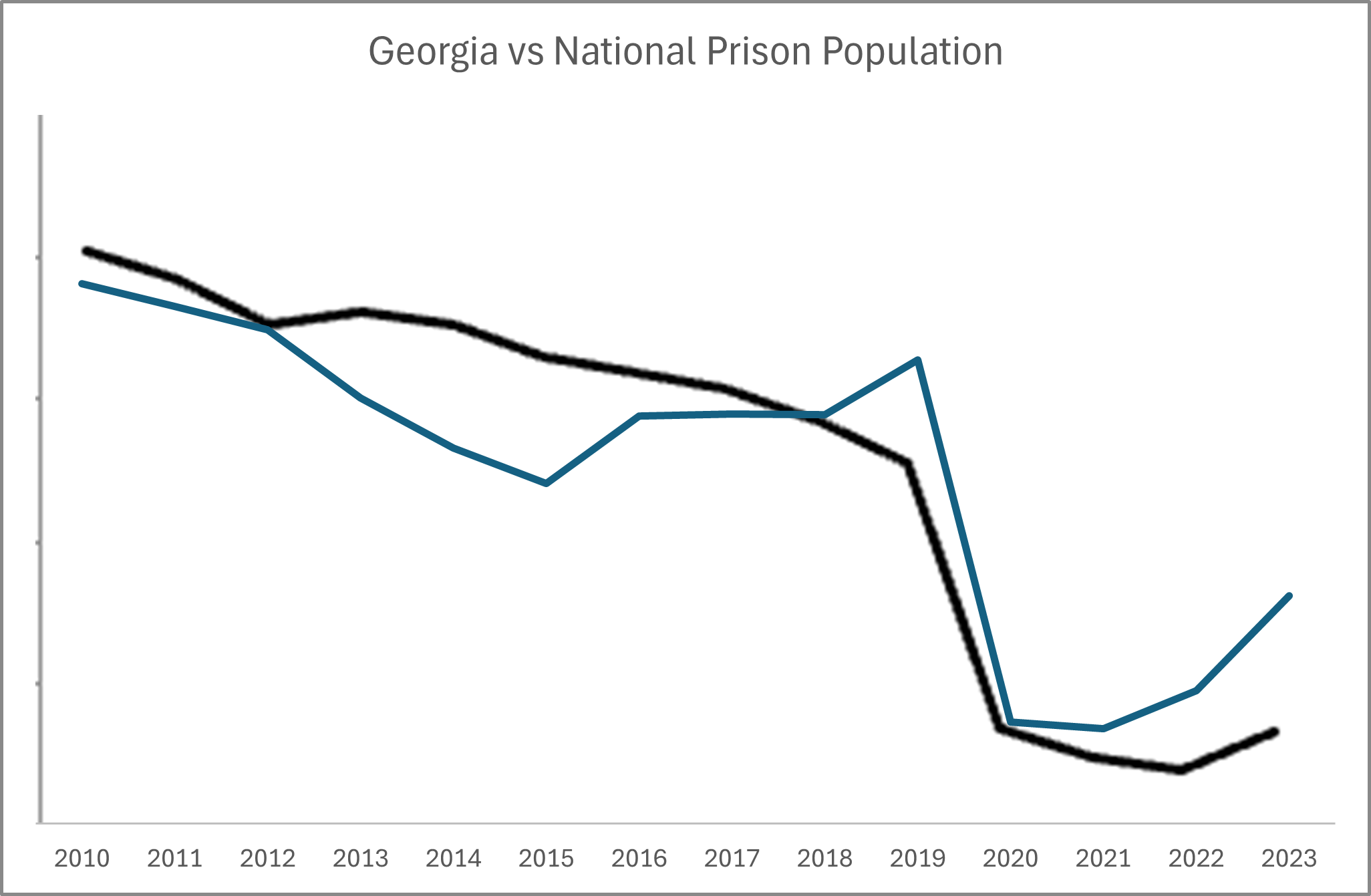
Georgia's prison population decreased between 2010 and 2023, in line with national trends.

Black Line = National Trend, Blue Line = Georgia Trend

The data for Georgia also reinforces the lack of a relationship between the change in the number of inmates and the change in corrections spending. The table below reveals that even though Georgia’s prison population decreased from 2010 to 2023, corrections spending increased 23.6% during that time.
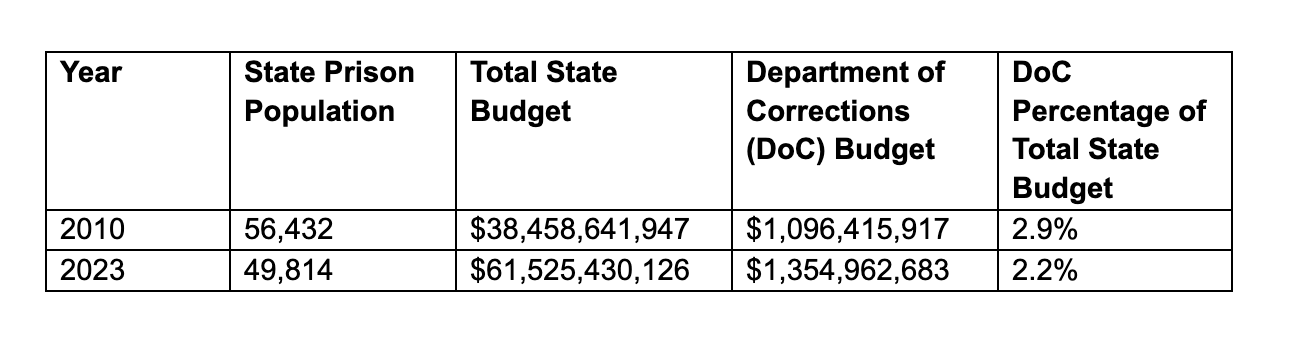
Georgia's prison population decreased from 2010 to 2023, but prison spending went up during that time.

Data from 2019 further reinforces this absence of a relationship. During that year, Georgia saw a very slight increase of 1,169 people in its prison population, but the state spent $21,430 less on corrections that year compared to 2018.

A better focus for Georgia policymakers

Instead of focusing on state prison budgets and costs per inmate, policymakers need to consider the total cost of crime—both monetary and social—that a community pays and how to reduce it. 

Crime itself costs our nation anywhere from $2.6 trillion to $5.76 trillion each year, with violent crime accounting for 85% of those costs. A single homicide can cost upwards of $9 million in government resources and lost potential earnings of victims. This doesn’t account for the financial burdens it can put on families and communities. 

In addition to the monetary cost of crime, communities pay a significant social price—and none more so than high-crime, impoverished areas. Effective public safety measures are foundational to upward mobility. Without them, these communities will continue to see the loss of businesses, local resources, and community connections that help people flourish.

With this in mind, policymakers and advocates should refocus criminal justice efforts toward reforms proven to reduce crime and recidivism. Improvements on both of these fronts generate cost savings of their own, in addition to saving lives and lowering fear of personal harm.

Best practice criminal justice reforms fall into eight solution categories that could spark meaningful change:

  • Addressing community disrepair
  • Investing in a well-trained police force
  • Building trust by protecting victims
  • Addressing gang violence
  • Addressing the low number of homicide detectives and low clearance rates
  • Ensuring appropriate sentencing
  • Implementing cognitive behavioral therapy for juvenile offenders
  • Evaluating and updating re-entry programs

In Georgia, policymakers and advocates should consider these specific efforts to reduce crime and recidivism:

  • Implementing reforms to help law enforcement close non-fatal shooting cases (e.g., the Firearm Assault Shoot Team in Denver, Colorado)
  • Broadening cognitive behavioral therapy offerings for juvenile offenders, which has shown promising results in juvenile recidivism rates
  • Prioritizing data collection and evaluation to help guide future programs and reforms
  • Helping communities through a holistic approach that includes job training and opportunities, affordable housing, and family programs

In addition to the above policy suggestions, GCO has prepared in-depth reports focusing on reducing crime in two major Georgia cities—Atlanta and Columbus.

As Crawford says of potential criminal justice reforms in Georgia, “lawmakers should focus conversations about criminal justice where they belong: on protecting the public and creating a fair and just system that values the lives, liberty, and property of Georgia families.” In doing so, policymakers can transform entire communities by making them safer for the people who live there.

Image Credit: Canva

Georgia news, in the news, current events, Georgia happenings, GA happenings

Joshua Crawford in The Baltimore Sun
Originally published July 3, 2025

By the mid-1990s, Boston was in a constant state of tumult. While homicides had been high since 1980, the six years from 1989-1995 would prove to be among the city’s deadliest, with 710 murders — 75 more than the preceding six-year period. Racial strife and police abuses riled the city after the 1989 murder of Carol Stuart — a pregnant white woman from the suburbs — whose murder was blamed on a young Black man by her husband, the actual killer.

For the foreseeable future, Boston was to be a place of violence, chaos and disorder. Only, that’s not what happened. Thanks to a team composed of the Boston Police Department, researchers from Harvard University and local religious leaders, an innovative approach called “Operation Ceasefire” dramatically reduced violent crime in the city. Over the next four years, youth homicides decreased in the city by 63%, and Boston has become one of the safest large cities in the country.

Governments and the media hailed that initial decrease as the “Boston Miracle.” Nearly three decades later, similar reductions in Baltimore deserve the same praise — if not more.

Baltimore has struggled with crime, especially drugs and violent crime, in both reality and in the imaginations of the American people for decades. Routinely in the top of the “most violent” or “least safe” city rankings, Baltimore has only had fewer than 200 murders three times since 1970.

In line with national trends, murder totals began increasing in the 1960s and then decreasing in the 1990s through 2014. Then, also in line with national trends, murder rose sharply in 2015 and remained elevated. Baltimore did not have fewer than 300 murders again until 2023, when a mix of best practices produced one of the most impressive declines in deadly violence in the nation’s recent history. Murder declined nearly 22% in 2023, and then another almost 23% in 2024 — erasing all of the post-2014 increases. Through May 1, 2025, homicides were down another 31%, putting Baltimore on pace for its fourth sub-200 murder year since 1970, and the city’s lowest total since the mid-1960s.

What happened?

Read the full article here.

Joshua Crawford is the Director of Criminal Justice Initiatives at the Georgia Center for Opportunity and the author of “Kids and Community Violence: Costs, Consequences, and Solutions” in the edited volume Doing Right by Kids.

The Safer Kentucky Act focuses on lowering crime and fear in Louisville, as well as other vulnerable neighborhoods across Kentucky.

Key Points

  • The Safer Kentucky Act (House Bill 5) is a package of crime-related bills passed by the Kentucky Legislature in 2024. The legislation includes six GCO-recommended solutions for restoring community safety. 
  • The bill lowers crime by addressing gang-related violence, updating carjacking laws, facilitating successful reentry programs, and more. 
  • The Safer Kentucky Act is good news for impoverished communities and at-risk populations, which tend to bear the brunt of increasing violence. These public safety reforms will give communities hope and solutions to break cycles of violence and poverty and have better opportunities close to home.

Kentucky is home to one of the most challenging public safety environments in the country. Even so, the state has made positive changes, thanks to crime reduction policies that have increased police funding and established much-needed programs. Louisville, for example, finished 2023 with a 4% reduction in fatal shootings and an 8% reduction in nonfatal shootings. These were the lowest totals in both categories in four years. 

But more needs to be done to ensure residents are free to move about their neighborhoods without fear of personal harm. The urgency has increased, given that homicides in Louisville exploded again in March 2024.

A new law, passed by the Kentucky Legislature in 2024, offers hope for lowering violence and fear in Louisville and across the state. The Safer Kentucky Act (House Bill 5) includes six policy reforms, drawing from GCO’s public safety research, that will restore safety and better opportunities to Kentucky communities. 

What is the Safer Kentucky Act? 

The Safer Kentucky Act is an omnibus crime bill, which is a type of legislation that combines several proposed policy reforms into a single bill. In the case of the Safer Kentucky Act, all the individual provisions touch on some aspect of public safety. 

Proposed reforms cover everything from homelessness to repeat violent offenders. Among these reforms are a handful of changes directly focused on reducing crime and relieving communities of the fear and loss associated with increasing violence.

Higher violent crime rates rob communities of precious lives and lower the quality of life in the most vulnerable neighborhoods. 

Higher violent crime rates rob communities of precious lives and lower the quality of life in the most vulnerable neighborhoods. 

Six Ways the Safer Kentucky Act Addresses Crime

Establishes strategies to lower gang-related violence

Group Violence Intervention (GVI), also known as focused deterrence, is a gang violence reduction strategy, and when implemented properly, it can have substantial impact. 

  • GVI uses an approach known as “call-ins.” Call-ins bring in groups of active gang members to deliver simultaneous messages of enforcement, resources for gang members to better their lives, and community moral voices expressing the unacceptability of the violence.
  • Louisville, KY, has operated a GVI program for a few years, but an interpretation of state law prevents probationers and parolees in gangs from being compelled to attend call-ins. Despite GVI strategies existing across the country, Kentucky is the only state with this participation issue. House Bill 5 clarifies state law to allow this kind of program participation.

Updates state law to discourage carjackings

Kentucky has no state law specifically addressing carjacking. When someone commits a carjacking in Kentucky, they face one of two consequences. They may be transferred to federal court and charged with the federal crime of carjacking. Or they could be charged in state court with a combination of assault and robbery. 

  • The absence of a state carjacking law leads to insufficient punishment for too many carjackers. It also makes tracking and data collection around carjacking more difficult. 
  • The data that is available suggests carjackings have risen significantly since 2020.
  • Passing the Safer Kentucky Act would, for the first time, create a state-level carjacking statute that enables communities to appropriately deal with and discourage carjackings.

Improves parent and guardian involvement in juvenile proceedings 

Building on the parental accountability measures in House Bill 3 (passed in 2023), the Safer Kentucky Act contains a provision that would require one parent or guardian to attend proceedings involving their children or child in their custody. 

By requiring parents to at least be present at their children’s hearings, the idea is that they may be more involved and invested in the child’s success. While there are few good answers in this area, these parent-focused participatory measures can help make a difference on the margins.

Adds life in prison for repeat violent offenders

KRS 532 is Kentucky’s most narrow violent offender statute. It includes what most people would consider the worst of the worst offenses—murder, manslaughter, serious assaults, rapes, robbery, burglary, and so on. 

The Safer Kentucky Act establishes a new “three strikes law” for violations of KRS 532. Conviction of a third offense would result in life imprisonment. 

This measure would ensure that the most violent repeat offenders are appropriately punished. Several studies have found that these types of laws reduce crime, so this change will likely help Kentucky lower crime in the future.

Brings witness intimidation laws into the 21st century 

House Bill 5 would amend Kentucky’s current statute related to intimidating a participant in the legal process. It expands the statute to include harassing communications (as defined in KRS 525.080), making it easier to prosecute and punish anyone who uses electronic mediums like social media to attempt to intimidate and dissuade witnesses in criminal cases.

Makes sure re-entry works

Our criminal justice system has several purposes, but one of the most important is helping convicts rejoin civil society once they’ve completed their sentences. 

Kentucky operates several re-entry programs based on best practices around the country. But do these programs actually reduce re-arrest, re-convictions, and re-incarceration? Right now, we don’t know. 

The Safer Kentucky Act would require regular evaluations of re-entry programs—a practice that would ensure effective programs get the support they deserve. It would also reallocate funding away from programs that aren’t reducing recidivism and put it toward new, innovative approaches.

Who would the Safer Kentucky Act help? 

Low-Income Families and Communities

The effects of crime disproportionately concentrate in our poorest and most vulnerable communities, keeping them locked in cycles of violence, poverty, and despair. The Safer Kentucky Act is a key step to restoring community safety. When public safety thrives, neighborhoods become homes for the education options, work opportunities, and healthy relationships that lift people out of poverty. 

At-Risk Youth and Juvenile Offenders

We know that parental involvement makes a difference in how children’s lives turn out. The Safer Kentucky Act gives juvenile offenders the opportunity to benefit from their parents’ presence as they navigate the criminal justice system and paths for rehabilitation. 

Former Inmates 

Former prisoners who are re-entering society have the best chance for a fresh start when states invest in reentry programs that have a track record of success. The Safer Kentucky Act will improve the support that ex-offenders receive through the criminal justice system. Ultimately, this empowers them to build stable, meaningful, and independent lives after serving their sentences. 

Law Enforcement 

The Safer Kentucky Act would give local law enforcement better methods to deal with small populations who tend to be responsible for the majority of crime. The bill also improves the justice system’s ability to help non-violent offenders and ex-offenders get back on a healthy, stable path. 

Additional Resources

GCO’s Public Safety Resource Page

As Juvenile Crime Skyrockets to Record Levels, States Seek to Crack Down (Daily Caller)

Getting serious about teen violence in Washington, D.C.: Louisville, Kentucky, provides a solution (The Washington Times)

New crime dashboard will report ‘real-time gun violence’ to expand transparency in Louisville (Wave)

How to Turn Back the Tide of Violent Crime (Washington Examiner)

Murder Is Actually Going Down—Wherever They’re Paying Cops More and Targeting Gangs (Newsweek)

Victims Matter (Josh Crawford on The Blue View Podcast)

Georgia news, in the news, current events, Georgia happenings, GA happenings

By Joshua Crawford,  Director of Criminal Justice Initiatives


What a difference a year makes.

Around this time last year, the Council of the District of Columbia overrode Mayor Muriel Bowser’s veto of a criminal code reform bill that, among other things, lowered penalties for carjacking, robbery, and burglary.

At the time of the bill’s passage, Washington was already in the midst of a dramatic increase in carjackings that began in June 2020. From January 2018 until May 2020, the city averaged 12.3 carjackings a month. That number increased to 39.7 carjackings a month between June 2020 and January 2023, when the council overrode the mayor’s veto.

And, for the record, carjackings in the district have not been restricted to “that” part of town. In August 2022, Washington Commanders running back Brian Robinson Jr. was shot in the leg during an attempted carjacking in broad daylight.

When she vetoed the criminal code reform bill, Bowser, a Democrat, said, “This bill does not make us safer. … Any time there’s a policy that reduces penalties, I think it sends the wrong message.” No one would doubt the mayor’s progressive credentials, but the D.C. Council had her sounding like former U.S. Attorney General Ed Meese, who served during the Reagan administration.


Read the full article here


Georgia news, in the news, current events, Georgia happenings, GA happenings

In this opinion editorial published in The Washington Times, Joshua Crawford highlights the escalating crime crisis in Washington, D.C., particularly focusing on a significant surge in violent crimes, including a staggering 104% increase in carjackings from the previous year. Crawford points out that a majority of carjacking arrestees in the city are under 18, with many being repeat offenders associated with or recruited by street gangs. The author suggests that Washington can learn from Louisville, Kentucky’s successful efforts to address teen violence. In Louisville, Republican state Rep. Kevin Bratcher spearheaded House Bill 3, a comprehensive measure aimed at holding violent juvenile offenders accountable and providing treatment. The bill mandates immediate detention for juveniles charged with serious violent offenses, offering a disruptive intervention in the cycle of violence. It also allocates funds for a new detention center and treatment programs, including cognitive behavioral therapy.

Read the full opinion editorial in The Washington Times.


Best practices for reducing crime can empower California to build safer communities through policy.

Key Points

  • There has been a concerning increase in violent crime and homicide rates in California.
  • Cities like San Francisco and Oakland have been adversely affected by rising crime, leading to economic challenges, a decline in safety perception, and demands for action from various community groups.
  • Over the years policies and decisions at both the state and local levels are believed to have contributed to the rise in crime. These include changes in sentencing laws, budget reallocations, and the election of progressive district attorneys. However, there is still great potential for political repercussions and the need for innovative solutions to address crime.

A recent headline from the satirical news website The Babylon Bee read “California Achieves World’s First Crime Rate Of Zero After Legalizing All Crime.” That piece reads in part:

“This is a great moment for our state,” Governor Gavin Newsom said. “No other state in the nation’s history has successfully brought the crime rate down to nothing. California is once again leading the way! Now, please, for the safety of your loved ones, don’t venture out of your homes at night. Or at least carry an air horn. Whatever. I don’t care.”

Analysts point to the state’s legalization of all criminal acts as the catalyst for reaching a zero crime rate. “It was a bold but revolutionary move,” said Professor Kyle Ray of the California Crime Institute. “California has effectively eliminated all crime from existence simply by making every unlawful or despicable act completely acceptable. Murder, assault, robbery — these are yesterday’s terms. Californians are now truly free to express themselves however they choose. Zero crime!”

Unfortunately, sometimes life comes a little too close to imitating art. In California’s case, de-carceration, de-prosecution, and de-policing has led to a toxic mix that has eroded public safety in the Golden State.

While crime began to crest in many states in 2022, the 2022 Crime in California report shows:

  • State-wide violent crime was up 6.1% compared to 2021.
  • Property crime was up 6.2% over the same time period.
  • The homicide rate increased 23.9% in the five years since 2017. 
  • By contrast, the rates for overall arrests and homicide arrests declined in 2022.


San Francisco and Oakland: California Beacons of Opportunity Turned Cautionary Tales 

Two Bay-area cities—San Francisco and Oakland—exemplify California’s public safety decline.

In San Francisco, a destination once regarded as the booming tech hub of the world, rising violent crime, homelessness, and open-air drug markets have led to massive exits from businesses large and small. In fact, the number of fleeing businesses is so large that several media and advocacy groups have developed databases of all the companies leaving. 

This trend has severely damaged the city’s reputation. A recent Gallup poll found that only 52% of Americans thought San Francisco was safe—down from 70% in 2006. It has also opened San Francisco up to the negative impact that crime has on economic opportunity. As multiple studies have found, violent crime robs communities of job growth and economic mobility—an outcome that tends to hurt disadvantaged communities and low-income residents the most. 

Across the Golden Gate Bridge in Oakland, CA, residents have become so tired of unabated violent crime that the local NAACP chapter joined Black religious leaders in calling on city leadership to declare a “state of emergency” over the impact of surging violence on minority communities. They specifically called out “failed leadership, including the movement to defund the police,” as well as the failure to “prosecute people who murder and commit life threatening serious crimes.” 

Bad ideas in Oakland have contributed to a cycle of violence that has trapped low-income residents in places they feel unsafe. The NAACP chapter there is demanding accountability, both of the offenders and of the politicians who placate them. In the first six months of 2023, crime is up 26% overall in Oakland,  according to the Oakland Police Department.


How Did California Get Into This Crime Crisis?

How did California get here? A brew of bad policies at the state and local levels over the last decade appears to have finally come to a head. 

  • Beginning in 2011, in response to a lawsuit about prison crowding, the California legislature passed AB 109, “Public Safety Realignment,” which made most property and drug offenses ineligible for state prison sentences and eliminated state parole supervision in most instances in favor of less intensive county options.


  •  Then, in 2014, voters approved Proposition 47,  “The Public Safety and Rehabilitation Act,” which made all types of theft under $950 and some drug crimes misdemeanors.


  • In 2016, voters approved Proposition 57, “The Public Safety and Rehabilitation Act of 2016” which created a system of earned early release that applied to many inmates, including those convicted of rape, gang, and gun crimes.


  • Finally, in 2020, in an effort to slow the spread of COVID-19 in state prisons, Governor Newsom released more than 10,000 inmates back onto the street, many of whom had violent and serious convictions.

At the local level, both San Francisco and Oakland reduced or repurposed portions of their police department budgets amid calls to “defund” the police. In 2020, San Francisco diverted $120 million from the police department and sheriff’s office budgets over the next two years. In Oakland, the city council repurposed $17 million away from the police department in favor of doubling the budget of a civilian crime prevention entity.

And then there are the elected District Attorneys. In San Francisco, progressive defense attorney Chesa Boudin was elected in 2020, along with a wave of other progressive prosecutors around the country with large financial backing. In addition to not prosecuting a host of lower-level crimes, Boudin quickly announced he would not pursue enhanced penalties for gang members. Crime rose dramatically, and Boudin was recalled in 2022.

Shortly after the Boudin recall, Oakland elected district attorney Pamela Price, who promised to discontinue use of those same enhanced penalties and favor probation over incarceration. She is currently facing the potential of her own recall effort.


“MY SON IS DEFINITELY WORTH THAT FIGHT”

The tragic story of Christian Gwynn who was fatally shot as a result of violence is a wake-up call to the need for change in policies that will reduce urban violence.

“MY SON IS DEFINITELY WORTH THAT FIGHT”

Rising Crime Doesn’t Have to be the New Norm in California—or Anywhere Else

Now there is mounting fear of even greater political blowback. But political implications aside, it doesn’t have to be this way.

We recently published our first analysis of a city and state’s public safety infrastructure. While this initial report looks at Atlanta, GA, the implications extend to cities and states across the country. Blue and red cities in blue and red states have been innovating and implementing best practices to reduce crime and violence, and these steps are helping several communities restore safety, hope, and opportunity. 

For more on how cities and states can get back on the right track, check out the report and recommendations here.

Schedule An Interview

About The Author

Josh Crawford

Director of Criminal Justice Initiatives

Josh Crawford is a native of Massachusetts. He went to Penn State for his undergraduate degree and then finished law school in Boston. After a brief stint in Sacramento, California, working in the county district attorney’s office, Josh moved to Kentucky to help start the Pegasus Institute, a nonpartisan organization designed to promote opportunity. In addition to serving as executive director of the organization, Josh had a special focus on criminal justice policy.

“By focusing on public safety and order, we can restore hope and opportunity to rural communities.”

Georgia news, in the news, current events, Georgia happenings, GA happenings

In many circles across the country, Boston is heralded as the model of violent crime reduction. Home to the “Boston Miracle” in the 1990s, many of the nation’s best practices in policing originated in this city and then spread across the country over the last two decades.

Read the full article here


Georgia news, in the news, current events, Georgia happenings, GA happenings

In January, Atlanta Mayor Andre Dickens launched the “Year of the Youth” plan to combat juvenile crime rates in the city. The issue is a pressing one. Consider that in 2022, 19 of the 170 homicide victims in Atlanta were children. Deshon DuBose, a 13-year-old, is among the juvenile homicide victims already in 2023. He was gunned down while leaving Cascade Family Skating in January.

Meanwhile, Georgia Juvenile Justice Commissioner Tyrone Oliver says that around 50% of youth incarcerated in the state self-identify as gang members. Jayden Myrick, who was found guilty of murder in a 2018 robbery and fatal shooting at an Atlanta wedding, admitted under oath that he was recruited into gang life when he was just 9 or 10 years old.

Juvenile violence skyrocketed across the country in 2020, reversing decades of decline. But even before the increases, juvenile crime was reported in 2018 as 15 times higher in Fulton County than the national average.

Juvenile offending, like adult criminality, concentrates among a very small number of offenders. These juveniles are typically either associated with or being recruited into street gangs and often pressured by adults to commit serious violent offenses.

Thankfully, there are well-documented ways to reduce that kind of offending. Look to Louisville, Kentucky for a recent example of solutions.

In recent years, Louisville has experienced substantial increases in juvenile violence, with arrest rates for juvenile homicide suspects 50% higher than the national average and a majority of carjacking arrestees being under 18 in 2020 and 2021. This prompted Republican State Representative Kevin Bratcher to begin working on what would become House Bill 3, a comprehensive violent juvenile offender accountability and treatment bill. While some of House Bill 3 dealt with issues specific to Louisville, many of its provisions offer policies and best practices worth adopting in Georgia.

Most importantly, the bill required that any juvenile charged with a serious violent offense such as murder, rape, robbery, burglary in the first degree and so on, be immediately detained for a period not to exceed 48 hours. This mandatory detention serves two purposes. It not onlyprotects the public and the juvenile by disrupting the cycle of violence but it also ensures meaningful time for mental health and drug abuse evaluations and comprehensive evaluations of the risks posed by the juvenile before a judge ultimately determines long-term release conditions or pretrial detention.

They also funded a new detention center in Louisville and a myriad of treatment programs intended to get juveniles with one foot in the streets and one foot in civil society back on the right track. This includes funding cognitive behavioral therapy which is being used toeffectively get serious juvenile offenders back on a positive life course. Why fund programs in facilities and not just in the community? Treatment programs for high-risk juveniles are most effective after 200 hours of treatment.

Finally, the new law creates early intervention points for young people who showed no improvement in their diversion programs. It does so by allowing an interdisciplinary team to alter the treatment methods earlier. If parents are unwilling or refuse to comply with a child’s diversion plan, a judge has the authority to hold the parents accountable. Chronic, unexcused absences from schools are strong predictors of future juvenile delinquency.

Unresolved truancy is strongly predictive of future juvenile delinquency and even adult criminality. So, getting it right with those kids today can help a child escape being preyed on by adult gang members and prevent serious violence in the future.

We didn’t get here overnight, and the reasons for the spike in juvenile crime in Atlanta are multifaceted. But the bottom line is that policy solutions similar to those enacted this year in Kentucky can help the city move forward and create a safer community and a more just and fair system.

Josh Crawford is the director of criminal justice initiatives at the Georgia Center for Opportunity.

Read the full article here

This opinion editorial was originally published by The Atlanta Journal-Constitution on June 6, 2023. 

In The News

n February, Memphis Police Chief C.J. Davis addressed the city council and told the story of an 11-year-old boy who had been arrested nine times and amassed 19 charges including multiple robbery, carjacking, and weapons charges. While this child may be particularly young, he is representative of a major issue facing Memphis – an increase in juvenile crime. 

In November of last year, the Memphis Shelby County Crime Commission issued a report that found a 42% increase in juvenile arrestees and concluded that in 2022 juveniles were charged with 151 aggravated assault charges, 124 carjacking charges, and 96 aggravated robberies. Memphis is not alone in this kind of surge, though. After decades of decline, serious juvenile violence began dramatically increasing in 2020. 

Juvenile offending, like adult criminality, concentrates among a very small number of offenders. These juveniles are typically either associated with or being recruited into street gangs and often pressured by adults to commit serious violent offenses.  

Thankfully, there are well-documented ways to reduce that kind of offending. Look to Louisville, Kentucky for a recent example of solutions.  

Read the full article here


Subscribe

* indicates required

Subscribe

* indicates required