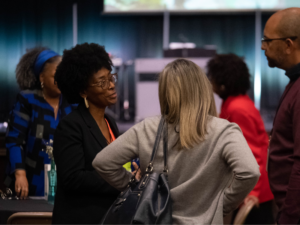
First graduating class of Jobs for Life and BETTER WORK Columbus partnership
Jobs for Life and BETTER WORK are joining forces to get help lift people out of poverty
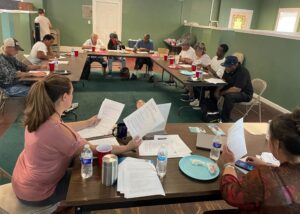
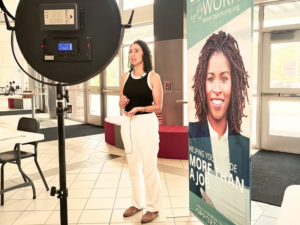
On July 7th the first group 11 men and women graduated from the Better Work Jobs for Life class at the Asbury UMC training site. This course was the first of its kind in partnership between Jobs for Life and BETTER WORK Columbus.The goal was to give men and women a stronger foundation in life skills so they can go on to be reliable employees for local businesses.
“The Jobs for Life job-readiness training course helps men and women understand their dignity and God-given identity and gifts, develop character, and foster a supportive community that will equip them for work, life, and their overall goals. This method, combined with soft skills training, has proven to enable unemployed and underemployed men and women to find and keep meaningful employment.”
The Columbus community came together to support this group of students overcome their circumstances, and we are excited to see this partnership become a staple of the BETTER WORK program.
Key Points
Frankie made an unexpected choice when she turned down a $70,000 a year job opportunity while living in hotel housing.
Oftentimes people on safety net services make rational choices to stay on these services because the system would punish them before they have a firm place to land.
Frankie, in a place of crisis, was unwilling to gamble with a stable choice despite a potentially great job opportunity.
Our safety net services must be reworked to address these “cliffs” and rebuilt to encourage and support the move into the workforce.
The thought of someone turning down a well-paying job to stay on welfare seems absurd. But that’s the exact scenario Frankie Johnson faced. It’s a real world example of the way benefit cliffs hurt people. Thankfully, Frankie found the BETTER WORK program and is on a new path to success.
An unexpected journey in life
Frankie Johnson, a Washington, D.C. native, grew up in a middle-class neighborhood and spent time serving her community. Through her community service work, she connected with many individuals who were victims of domestic violence, sexual assault, job loss, and poverty. By the time she’d reached her teens, Frankie knew she found fulfillment in working alongside others to improve their lives.
At age 14, Frankie became pregnant with her first child, Evelyn. She gave birth just before her 15th birthday. She went on to get an internship through Job Corps, then earn her high school diploma. After graduation, she attended California College of the Arts in San Francisco, where she planned to study photography and 3D installation.
But leaving Evelyn in Maryland with her parents while she studied in California proved to be too difficult a separation for Frankie. She moved to New York instead, which allowed her to see her daughter more often.
At age 18, Frankie married a member of the military who was six years her senior. His deployments and resulting war-related trauma proved to be difficult on the family and the couple’s marriage. For the next six years, they lived in Texas and the Midwest before returning to Maryland. Steadily, the situation with Frankie’s husband deteriorated.
Despite the trouble at home, Frankie was a high achiever, building a career in human resources and working for firms such as Monumental Sports and the Nick Cannon Foundation. She worked as a high-end event planner, where she regularly brushed elbows with celebrities and influencers.
When the family returned to Maryland, Frankie found herself heading up events for women who were victims of domestic violence. Meanwhile, at home, she was living in an abusive environment herself.
“At home, I never knew what was going to become of my peace or if he was going to get triggered,” Frankie says. “I was serving in the community as a social worker. I put on events for women, took them on yacht parties, and tried to boost their self-esteem. No one knew I was suffering so much.”
Finally, the situation in Frankie’s home came to a head, and she fled to Atlanta with her children. Her uncle lived in the city, and she planned to make a fresh start there.
But that fresh start didn’t come quickly or easily.
Seeking safety in Atlanta
Without a job or a place to live, Frankie was forced to seek out government assistance and transitional housing in Gwinnett County for her family.
“This was my first time being on the opposite side of transitional housing and understanding what the women who would talk to me [in the past] were going through,” she says. “It was strange to see the scarce resources, and to see women locked out of their hotels because the projects or community partners ran out of funding.”
Transitional housing in hotels and apartments can cost women $500 or more per week, and according to Frankie, the living conditions are unsafe and unsanitary. Worse, residents got a chilly reception from their case workers when they raised concerns.
“The water makes your skin itchy, and there are roaches coming up out of the sink and the drains,” Frankie says. “We were told we needed to boil our water to use it. It comes [out of the faucets] brown, and we had brown rashes on our bodies.”
While Frankie’s family was living in transitional housing, she experienced relentless prejudice, racism, and ridicule.
“I had people come to my hotel, and ask me if I was a prostitute because my daughter said we were living in a hotel at school,” she says. “Someone from [the Department of Family and Children Services] came to my apartment and asked if I left my children [alone] at nighttime. He asked me if I was a stripper.”
Forced to choose between assistance and higher income
While Frankie was waiting for available childcare and a pathway to affordable housing, she was forced to turn down a job placement that would have paid $70,000 per year. While she needed employment, she also needed the support from the government program. That was her ticket to a home she could afford, but she wouldn’t qualify if she took a new job that raised her income past eligibility requirements.
“I never thought it would come to this,” she says. “I hadn’t prepared financially; I spent through my savings because I was waiting on childcare.”
Frankie found herself trapped on what we call the Benefits Cliff — torn between taking steps toward a more secure future, but ultimately forced into making decisions that trapped her into long-term dependence on government benefits. Individuals and families who make over a certain amount of income per year are automatically struck from the list, and are no longer qualified for affordable housing, food support, or other government assistance.
“They want to see your pay stubs, your bank statements. They want to make sure you’re poor,” Frankie says. “If you have a car, they want to know what kind of car you’re driving and if you have insurance. They want to make sure there’s no possible way you can work a job.”
“If there are no daycare facilities within a 30-mile radius of where you place me in my hotel and I don’t have a car to take my child a city over, I’m not going to be able to get a job,” she added. “Who’s going to watch my child all day?”
Families in these transitional programs often find themselves stuck paying high bills while they await affordable housing. Frankie was forced to pay more than $2,000 per month for the hotel she and her children stayed in. Financially, staying put made no sense, but Frankie held on in hopes that affordable housing would come through.
Leaving transitional housing puts parents at risk of losing their children to CPS, particularly if they’re perceived as living out of their vehicle. On the other hand, getting a higher-paying job disqualifies them from further government and charitable support.
“It’s like a loophole to keep you destitute,” Frankie says.
Dreams for a brighter future
After three months in transitional housing, Frankie was able to connect with BETTER WORK Gwinnett. Her case worker, Luisa, formed a close connection with her, encouraging her and checking in on her as she prepared for a fresh start.
“We lost our jobs during the pandemic,” Frankie says, “and that was the time when we needed encouragement and to find our way again — laugh again. Ms. Lusia provided a lot of that. She called me every day just to check on me.”
After experiencing the frustration, humiliation, and helplessness of transitional housing herself — including witnessing another mother abandon her children when her time at the hotel was up — Frankie wants to help other women in similar circumstances. She hopes to go to law school to provide legal aid to other families who have suffered at the mercy of the system.
“We need to get them their GEDs and diplomas. Start them off as home health aides, CPAs, LPNs, RNs, physician’s assistants, or doctors,” Frankie says, “But no one’s willing to help. They just want to enable their programs to get money for housing us. After that, you’re out on the street like a dog.”
As for Frankie, she’s working with Luisa to get back into the human resources field, and considering a move to a more affordable city in south Alabama.
“I’m not going to sit and wait for anyone to take care of me,” she says. “For the women who don’t have options, I’m going to school to fight for them.”
Key Points
All young people — not just those who come from rich families — deserve to know this “secret to success”: get an education, work hard, get married, and then have children.
No matter the challenges young people face, there is a path to build a bright future — through the Success Sequence.
Institute for Family Studies has shared 3 powerful videos that show the face and opportunity brought by the Success Sequence.
The Success Sequence and its impact
“The choice of having children too early is one you’ll have to play catch up with for the rest of your life.”
“I wish that I had made some different decisions when I was young. Think before you act. Definitely be intentional about the decisions you’re making at that age, because they do have a lasting effect on your life.”
“Having to get food donated to us was the bottom of my life.”
The basic premise of this campaign is simple: All young people — not just those who come from rich families — deserve to know this “secret to success”: get an education, work hard, get married, and then have children.
As you know, the Success Sequence is a powerful and proven way for even the most disadvantaged men and women to avoid poverty and to have a shot at the stable, happy family life they really want.
The Success Sequence: His Story
Part One: Men
The numbers prove it all
Statistics show that 97% of young people who follow these steps are not poor later in life, and fully 85% of them enter the middle class.
Can it really be that simple? That’s what’s so great about the Success Sequence: The answer is simple, but the key is to get the information to young people at the right time.
No matter the challenges young people face, there is a path to build a bright future — through the Success Sequence.
It’s organizations like the Georgia Center for Opportunity that are bringing the truth of the Success Sequence to young people every day. Whether it’s GCO’s work to expand educational options for all students, bring career opportunities to the impoverished, or bringing relationship enrichment classes to local communities, we are on the front lines. The Institute for Family Studies recognizes this.
The Success Sequence: Her Story
Part Two: Women
“The Success Sequence is only effective as a concept if it’s shared in practical ways with young people,” said Brad Wilcox, senior fellow at the Institute for Family Studies. “On-the-ground organizations like the Georgia Center for Opportunity play a key role in this. Our young people deserve to know about their potential to take hold of the American Dream.”
Please share these important videos on social media, with your friends and family, and with young people in your life who need to hear this important message. We need to spread the word on the Success Sequence so that other young people don’t face the same struggles in life faced by Scott, Stephanie, and Caylie and Carlos.
The Success Sequence: Their Story
Part Three: Cohabitation
Key Points
BETTER WORK Columbus is launching a new service allowing us to assist clients on-site.
BETTER WORK provides connections to local resources and work opportunities.
Listening and responding to the needs of our community is how BETTER WORK better serves those in need.
Client assistance just got a little bit better
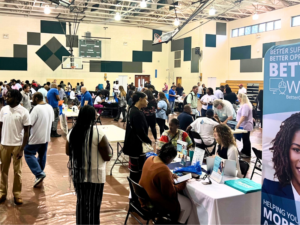
BETTER WORK Columbus is now able to assist clients on-site. We enjoy assisting our non-profit partners and helping them connect clients with employment. This is a new dimension of our work and is proving to be very helpful to non-profit organizations in Columbus and the surrounding area. Our non-profit partners who are focused on providing resources like housing, food, or assistance with utilities know that their clients also need the stability that comes with work. Meeting their clients on-site is a way for BETTER WORK to allow them to focus on their lane while we leverage our existing resources to help with the employment connection.
“Home for Good is partnering with BETTER WORK Columbus to help formerly homeless clients obtain and sustain employment so they can end their cycle of poverty,” said Terry Gallops, Home for Good Director. “Kristin Barker, BETTER WORK Program Manager, has been very successful in fulfilling this need by helping our clients as they complete applications and establish contact with potential employers. We are exceptionally pleased with the success of the BETTER WORK program, and several of our clients now have substantial employment!”
For Latesha, finding work was more than a paycheck. It helped her start a life journey that had meaning and purpose.
Meeting the need
Kristin recently shared why this is so important. “We enjoy meeting people where they are and where the need exists. It is in these spaces where we can learn more from each other and connect in new ways that will make all groups and all people in our community more successful. It’s a pleasure to help people like James who are looking for an opportunity to improve their lives by earning a steady income.”
If you are a non-profit and would like to take advantage of the support and tools that BETTER WORK has to offer, send an email to kristin.barker@georgiaopportunity.org and start a conversation today!
Key Takeaways:
Welfare cliffs and marriage penalties are discouraging people from work and forming families.
The cliffs and penalties may mean that our clients are locked into poverty for much longer than they would be otherwise and despite our best efforts.
GCO has created a platform that allows anyone to see when a particular family can expect to experience benefit cliffs as they earn more money through work.
If you work in a nonprofit serving the poor, you need to know that the government benefits your clients receive are likely discouraging them from working or forming a family, two things that research shows could lift them out of poverty the fastest.
This is an especially tough problem for nonprofits, like GCO, that work to get their clients into good-paying jobs and strengthen their family relationships.
What’s going on?
These disincentives to work are often called “welfare cliffs” and the disincentives to family formation are called “marriage penalties.” Essentially, “cliffs” are generated any time a person receiving government benefits gets a raise at work that causes them to lose more in benefits than they will earn in additional income from the raise. These same individuals can face a similar financial penalty IF they decide to marry. In many cases, they will lose more in benefits than their spouse is able to provide in new income to the household.
While you would think (hope?) cliffs and penalties are rare, they are not. Instead, they are baked into the structure of nearly all welfare programs and many of the cliffs are severe. It’s also important to know that welfare recipients don’t face a single cliff or a single penalty, but they face cliffs and penalties at a number of different points as they have additional income from working or through marriage.
Why does it matter?
For nonprofit leaders, the cliffs and penalties may mean that our clients are locked into poverty for much longer than they would be otherwise and despite our best efforts. For workforce development nonprofits, cliffs could be the underlying reason why your clients don’t pick up additional work hours when they are offered or seem less than excited when they are offered a good promotion. In extreme cases, clients may quit jobs that seemed like a perfect fit simply because they panic when they learn they may lose a major benefit – like housing or childcare.
For nonprofits trying to help strengthen family relationships, marriage penalties may be driving behavior that is otherwise inexplicable, like seemingly happy couples refusing to marry or live in the same home. These dynamics can lead to stress for the couples affected and to a sense that a parent (usually the father) has abandoned the family when, if the system would allow it, he would be in the home. In these cases, children pay the biggest price.
What can you do about it?
Fortunately, we have created a platform that allows anyone to see when a particular family can expect to experience benefit cliffs as they earn more money through work. For nonprofits working with these families, you now have a tool (available for 10 states, with two more on the way) that will allow you to help your clients plan for the future. In some cases, knowing when cliffs are likely to happen will allow your clients to seek a larger raise that will help them bypass or leapfrog a cliff. In other cases, maybe the answer is seeking additional training or certifications that will get your client into a different payscale entirely – one that avoids the cliffs.
In the coming weeks, we will be adding a tool that will allow users to see the impact of penalties on couples who decide to marry. We will also be incorporating a solutions tool that will allow anyone to see how reforming our government benefit programs can actually eliminate cliffs and penalties entirely, giving recipients every reason to pursue work and form stable households.
For GCO, it is this last point – reforming the system – that remains the ultimate goal. In the meantime, we are looking for ways to mitigate the harm caused by the welfare system, so that as many people as possible can escape the system and break cycles of poverty now.
The Success Sequence provides an outline of how to reverse the cycle of poverty in our communities. GCO uses this as a framework for much of our work.
From Survival to Stability: How Latesha Jackson Built a Better Life
Latesha Jackson from Columbus, GA is a mother, student and Hiring Well Doing Good success story.
Key Points:
A shift in mindset changed everything. Through the BETTER WORK program, Latesha Jackson embraced a growth mindset that helped her move from feeling stuck to continually pursuing new opportunities.
Persistence led to major milestones. She earned her bachelor’s degree in 2024, built a stable career, and quickly received a promotion to her current role.
Success now extends beyond her career. Latesha’s stability and healthy lifestyle have helped her become the role model she always wanted to be for her daughters and grandchildren.
Latesha Jackson, a Columbus native and mother of four, grew up in the Chattahoochee Valley and still lives in her hometown. Latesha was raised primarily by her mother in low-income neighborhoods throughout the city. Her mom was a housekeeper who worked in a hotel and later for a judge across the Chattahoochee River in Phenix City. Latesha spent each available weekend and break with her father in Phenix City. Her parents’ dedication to their work, she recalled, would inspire her to challenge herself.
“I was the only one of my siblings to graduate high school,”
Graduating from high school was a huge family milestone. “I was the only one of my siblings to graduate high school,” Latesha proudly mentioned. “I never wanted to disappoint my father, so I worked hard every day.” After high school, she went to work and used the income to help her mom pay the bills.
At 19, Latesha decided to start life on her own. A year and a half later, she gave birth to her oldest daughter. With three more children to follow, Latesha thought she’d put college in the rear-view mirror.
Changing Course Through BETTER WORK
For years, Latesha lived in what she describes as “survival mode.” As a single mother, life often involved working whatever job she could find while trying to keep her family afloat.
But today, Latesha describes her life very differently. “Today, I am at peace,” she said. “Five years ago, I was in chaos.”
Her journey toward that peace began when she participated in the Georgia Center for Opportunity’s (GCO) BETTER WORK program, which is designed to help people access job skills, local resources, and employers so they can pursue meaningful careers that sustain their families.
“I happened to walk into the local Habitat [for Humanity] office to pay my mortgage, and the woman there was handing out flyers for this program called BETTER WORK,” Latesha recalled. “She said ‘you might want to call these people to check it out.’” Latesha was frustrated with her current position and work environment—she wanted to find a job that felt satisfying, paid well, and offered good benefits. “I called … the Georgia Center for Opportunity immediately,” she remembered.
But after attending her first BETTER WORK class, Latesha’s life was suddenly disrupted when she was rear-ended by another vehicle on her way to work. Although she was still able to attend the BETTER WORK classes, life became a daily struggle between handling insurance claims and medical appointments.
2018 was a difficult year for Latesha. Due to injuries and time off of work, she had almost no income that year. Even after she was cleared to go back to work, she still had no vehicle, and reliable transportation to work was hard to come by. She had to look for a new job again, closer to home.
Through all the change and adversity, Latesha’s children were her constant inspiration. “With how I grew up, the things that I’ve lived through and witnessed … I don’t want my kids to go through that,” she said.
“If you are a single parent with small kids, you won’t be able to work”
Developing a New Way of Thinking
When Latesha first connected with BETTER WORK, she was searching for better job opportunities. What she discovered was something deeper: mentorship, encouragement, and practical tools that helped her move forward.
She learned how to build relationships, navigate interviews, and connect with employers. But the most important lesson Latesha learned from Kristin Barker, GCO’s Vice President of Workforce Solutions, went beyond job skills.
“A lot of what Kristin taught me helped me along the way,” Latesha said, but “I learned about the growth mindset and started learning more about myself.”
Before embracing that mindset, Latesha was used to living day-to-day, focused on getting through each challenge as it came. BETTER WORK helped her begin to see that her situation wasn’t permanent and that she could grow, adapt, and make intentional choices to build a different future.
Inspired to pursue new opportunities, Latesha began working toward a goal she’d once set aside—earning a college degree. In the fall of 2024, she graduated with her bachelor’s degree in business management.
Kristin, who worked closely with Latesha throughout the class, says her perseverance stood out from the beginning. “Latesha has always had determination,” Kristin said. “Seeing her graduate with her degree and build stability for her family has been incredible.”
Choosing Health and Stability
Latesha also made a commitment to change her lifestyle—a decision shaped by what she learned from BETTER WORK about confronting the physical and emotional barriers that can keep you from moving forward.
She began walking two to three miles each day and focused on improving her nutrition. The results were dramatic: she lost more than 70 pounds and brought both her cholesterol and blood pressure into healthy ranges.
Her motivation was simple.
“I want to be here for my children and my grandchildren.”
Becoming the Example
Today, Latesha is proud of the life she’s built. Her daughters are flourishing in their own careers and educational paths, and she now has four grandchildren. Watching her family succeed reminds her how far she’s come. The biggest change in her life is perspective—which she learned about in the BETTER WORK class.
“I used to feel stuck,” she said. “Now I want to stay unstuck. I always want to keep growing.”
And the advice that carried her through some of the hardest seasons of her life still guides her today:
“Pray and take everything one day at a time.”
“pray and take everything
one day at a time.”
“Never doubt that a small group of thoughtful, committed citizens can change the world. Indeed, it is the only thing that ever has.”
— Margaret Mead
As we reflect on 2021 and think about what we want for the new year ahead, I thought that it would be beneficial to share what I see families are missing, and might consider starting now and continuing into 2022.
Care for ourselves and others. Let’s all agree that we should move from being a spectator to being an active player. Recent headlines reflect our youth need us to show up for them – unfortunately some of us are missing the boat. Begin by taking care of yourself. You can start with simple tasks like walking and/or drinking more water.
We need to care for others by volunteering within our own neighborhoods. It’s been my personal experience many public libraries need volunteers, or maybe you can donate to your local food bank. We need everyone to be involved in changing the landscape of what is around us.
The Success Sequence provides an outline of how to reverse the cycle of poverty in our communities. GCO uses this as a framework for much of our work.
Community makes us stronger
Community. When our family relationships are stronger our community is better and our state is better. Change always starts with us.
For example, have you ever noticed when people first move into a new neighborhood they make the effort to keep their lawns manicured? But then, it never fails there is THAT one house whose yard is in disarray. That house can make the value of all the other homes lower because it is not well kept. However, instead of complaining about the neighbor’s inadequacies, see how you can help. Is there a young person who can mow the lawn? This is beneficial because you are teaching a child how to help others and the neighbor gets their lawn mowed. Now the neighbor and teen are connected into the community. Plus, the neighborhood is more aesthetically pleasing to the eye, which brings home values back to where they should be. Everyone wins! Being a part of a community makes us feel as though we are a part of something greater than ourselves.
Collaboration. Think about how you can add value to a local organization utilizing your gifts and talents. Believe it or not, this is why you were given your gifts!
At Georgia Center for Opportunity, we collaborate with a community of folks in the areas of education, employment, and family. Read more about our work and how its “Not for self but for others” at foropportunity.org.
A belief in working together is key
BETTER WORK Columbus is connected with groups and organizations across the Chattahoochee Valley. These groups include both the Chattahoochee Valley Poverty Reduction Coalition (CVPRC) and the Mayor’s Commission on Reentry. A belief in working together in the local community as the key to eliminating poverty in our city is the common thread binding these groups together. More specifically, the CVPRC holds a shared vision to reduce the poverty rate in the Chattahoochee Valley by 50% over the next 10 years.
BETTER WORK Program Manager, Kristin Barker, plays a leadership role in both of these groups. As forthcoming chair of the Reentry Commission, she works to identify key people in our community and bring them together to address the needs and concerns that impact individuals who are justice-involved. This is necessary to further the mission of preventing recidivism by strengthening cooperation and collaboration between law enforcement agencies, corrections and supervision entities, resource agencies, social service and non-profit organizations, faith-based non-profit organizations, community members, and other private and public stakeholders. Embedded in the group’s purpose is a focus on finding key people in the community and bringing them together to address the needs and concerns that impact individuals who are justice-involved.
The Success Sequence provides an outline of how to reverse the cycle of poverty in our communities. GCO uses this as a framework for much of our work.
Local Connections and National Partnerships
It is these local connections and national partnerships like Jobs for Life that will allow Columbus to discover the high-impact strategies needed to support families in poverty and connect them with resources that will move them toward self-sufficiency.
Last month, I had the honor of participating in the Heritage Foundation’s annual Antipoverty Forum, where scholars and practitioners discussed the state of poverty in the country and the local efforts to confront the issue.
The discussion this year centered on the Biden Administration’s Build Back Better (BBB) bill that is now making its way through Congress and the ways in which the bill would undermine work by using much of its $2.4 trillion to expand safety net benefits and create new entitlements, all while eliminating work requirements.
Despite unemployment numbers dropping nearly to pre-pandemic lows in most states, what is not widely understood is that labor force participation (the number of people who are able to work and are actively looking for work) is much lower than when the pandemic began. Some 4-5 million people have effectively dropped out of the workforce – at least for now – despite record job openings (10.4 million in September).
While the drop in workforce numbers is partially explained by fear of COVID and mothers forced to stay home with children, much of it can only be explained as being caused by increased benefits (and the elimination of many requirements for qualifying), rescue-related payments and, now, monthly child tax credit payments. The BBB bill is very likely to make these trends and others, like inflation, worse.
Although we’re concerned that people are choosing not to work and agree that more money coming from Washington, DC, will make matters worse, my remarks reflected our concern at GCO about why worklessness harms the individual. Work is not merely about earning money; it has intrinsic value.
The Success Sequence provides an outline of how to reverse the cycle of poverty in our communities. GCO uses this as a framework for much of our work.
Championing a return to normalcy and healthy social interaction
Work provides each of us with an outlet for our God-given talents and creativity. It allows us to serve others and contribute to other individuals’ well-being in exchange for having our own needs met. More than that, it provides us with social capital and a network of colleagues and friends who can help us when we need it. Much research has also shown that worklessness leads to poor mental and physical health and can contribute to increased drug and alcohol abuse – the 100,000+ overdose deaths during the pandemic representing the latest example.
As our government wrestles with how to deal with the pandemic and sets its priorities, it should avoid anything that discourages employment and causes more isolation. For individual and societal health on every front, the government should be championing a return to normalcy and healthy social interaction – including at work – that allows the American people to be resilient during times of crisis.
Building a stronger network of resources
On November 4th, BETTER WORK Columbus hosted a reception to announce a new partnership with Jobs for Life to bring its proven curriculum and a nationally recognized program to help struggling people find meaningful, self-supporting work. During the event, Ryan Ray, President and CEO of Jobs for Life, shared his heart as well as the passion behind the Jobs for Life training program and the power it has to impact lives in a transformative way.
Problem:
In Columbus, 11,406 people are unemployed, despite more than 6,500 job openings. The problem is not an issue of availability but an issue of access. There are personal, educational, and systemic barriers that prevent some of our neighbors from working or thriving at their jobs. Without work, many begin to identify themselves with their circumstances which creates a vicious cycle of poverty—economically, spiritually, and emotionally.
Solution:
Our BETTER WORK Columbus team has already built a strong network of partnerships and has been using the Jobs for Life framework to recruit and train mentors. Now, we want to take this a step further by extending the network of support to Jobs for Life training sites in our community.
Our BETTER WORK Network has allied with Jobs for Life to help break the cycle of poverty and build up our communities. JFL sites are uniquely positioned to address the root causes of un- and under-employment by uniting churches, businesses, and community organizations and facilitating positive transformation within lives and communities. This model reinforces work as more than just a paycheck but a source of pride and dignity. It is designed to address the loss of identity which often accompanies unemployment.
We will join hands and work together to bring the change our community needs.
How can we work together?
It starts here! We will join hands and work together to bring the change our community needs.
If you live in the Columbus area, we need your help! You can:
Then send an email to kristin.barker@georgiaopportunity.org to have your gift support local Jobs for Life classes. Include your name and the subject line – “I donated to the BETTER WORK Network and Jobs for Life”.