turkey

The Farm Bureau Released A Report That The Cost of Thanksgiving Dinner Was Going Up Significantly.


 What is happening

  • Many people are gathering for the first time in nearly 2 years for Thanksgiving.
  • A recent Farm Bureau report shows the impact of Inflation and other factors that are leading to a 14% increase in the cost of Thanksgiving dinner.
  • GCO’s work in our community is shedding a light on the impact higher prices is having on many communities and social support efforts.

Why it matters

  • The hardest hit will be those already facing food insecurity.
  • Inflation impacts those already living in the margins far more than it hurts many of the decision-makers
  • Family is a vital component to a flourishing life and can be undermined by creating a financial burden for family gatherings.

My family and I are headed home to the mid-west this Thanksgiving to see my extended family and 95-year-old mother. The pandemic kept us away from each other, and my children are really looking forward to catching up with mom and their cousins. We have a lot to be thankful for and I am extremely grateful for my parents and siblings and the love we have for each other.  Family matters so much and the Eckstein’s are blessed in abundance. 

I note a Farm Bureau report this week that estimates the cost of that Thanksgiving dinner to again be on the rise—up 14% from last year. Of course, last year we were in the heart of the pandemic and we hadn’t yet felt the supply chain crush brought on by lockdowns and the employment market. As a result, demand and prices were low. 

The Success Sequence provides an outline of how to reverse the cycle of poverty in our communities. GCO uses this as a framework for much of our work.

Given our families blessings, we don’t feel the impact of these swings as much as some of the people we work with at GCO. We work in coalitions with partners focusing on food security, housing, and mental health. We bring our expertise in employment, education, and family relationships to make those within the partnership more effective, allowing them to have greater impact. We see a lot of families that would be impacted by even a small increase in price. It can seem hard sometimes for those blessed like us to believe that the Farm Bureau’s estimate of just under $6 for a group of 10 to eat that Thanksgiving dinner is unaffordable to some. But we can assure you that is the case. Inflation impacts the poor disproportionately and we are witnessing its devastating impacts on families daily.

Our prayer for those families—and for you and your family— is that this holiday will be a time of peace, an opportunity to be grateful for all families big and small and the communities they live in.

In Georgia there has been a reduction in the rate of ex-offenders returning to prison. In the most recent report from the Georgia Department of Corrections, 25.3 percent of those released from all facilities (private, state, inmate boot camps, county, transition centers) in state FY 2018 were reconvicted for a felony after three years. That number dropped from 27.7 percent previously.  In the last few years, the growing number of ex-offenders returning to a life in prison has become a more widely recognized issue among policymakers and organizations. We believe the percentage is slowly dropping due to the Second Chance program, and organizations like GCO working to help ex-offenders find stable employment, and the elimination of policy barriers that keep this population from working. 

Even so, recidivism rates are still too high. Each number—each piece of data—is a person seeking direction and purpose to succeed and be self-sustaining. Not to mention, in a time when federal spending is high and inflation is growing, recidivism is a very costly issue for taxpayers. 

It’s a common misconception government assistance programs fill the gap for this population as they reenter society. The key to mitigating the usage of assistance programs and aid in breaking the cycle of poverty and crime for many is stable employment. This might sound elementary at first, but as we move deeper into this idea you’ll see it is common sense.  

The Success Sequence provides an outline of how to reverse the cycle of poverty in our communities. GCO uses this as a framework for much of our work.


  1. Jobs provide financial support

We all have bills to pay. A job provides a paycheck. However, let’s not get lost in the dollar signs. A job is more than a paycheck, too. A job is long-term financial security. Having a job allows people to plan for the future and set new life goals, essentially helping to define a person’s purpose. In a 2000 study by Christopher Uggen titled “Work as a Turning Point in the Life Course of Criminals: A Duration Model of Age, Employment, and Recidivism,” he found those over the age of 27 with a job were less likely to return to criminal activity. 

  1. Jobs provide purpose

Plain and simple, we all have the inherent need to be needed. Work allows each one of us to use our talents and gifts for positive impact. Fulfilling work allows us to play a part in a community, whether that is a community of coworkers or the actual community we live in. Every job, no matter how big or how small, has intrinsic value. A job helps us to develop daily structure, meet goals, and take our place within society. It’s not easy to go from being told when to eat and sleep to freedom. Jobs help create boundaries and play a part to keep our daily activities moving forward in a positive direction. 

In 2005, a study called  “Ex-Offender Employment Programs and Recidivism: A Meta-Analysis” found “having a legitimate job lessens the chances of reoffending following release from prison and that recidivism is less likely among those with higher wages and higher quality jobs.”

When people have a sense of purpose, they become more committed, responsible, creative thinkers. They become healthier and more passionate about serving in a way that helps others. 


  1. Jobs provide dignity

People generally obtain a large portion of their self-worth from their work. At the end of the day, no matter who we are we want to be treated with respect and equality. These are usually derived from our place of employment.

Without a job people are economically vulnerable to the cost of living and the economy’s fluctuation. Having a job and a sense of self-worth also helps reduce mental health issues among those who have spent time incarcerated. 

Those who end up in U.S. prisons are perhaps among the lowest skilled adults in society, and have a number of personal problems (health and behavioral) that render many of them difficult to employ.” 

Relationships with coworkers often provide the social structure and friendships needed for people to ease back into society and reduce the feeling of isolation.Through employment former inmates are able to receive the mental health and medical health support needed to integrate back into society in a dignified way. 


Wrapping up

GCO has dedicated much of its time and manpower to working with policymakers to reduce the barriers formerly incarcerated people face when looking for employment. To learn more about what we’re doing click here


Examining the SNAP Benefit Cliff

On July 12, 2021, Eric Randolph, GCO’s Director of Research, testified before the U.S. House Agriculture Subcommittee on Nutrition, Oversight, and Department Operations about how welfare programs often hurt the very people they are supposed to help.

In this video, you will see how benefits cliffs are complicated and often have unintended consequences that harm families, inhibit upward mobility, and dehumanize people trapped in generational poverty. And you will learn more about GCO’s Benefits Cliff Model helps hard-working individuals improve their circumstances with better opportunities to thrive and become productive members of their communities.


On July 12, 2021, GCO’s Director of Research, Erik Randolph, joined 3 others in providing testimony and answering questions on Benefit Cliffs.

depressed man

“I don’t know what I’m going to do if I don’t find a better job; I might have to go back [to prison].”

Two months out of prison, Ray (name changed for anonymity) was explaining to me that he had reached the end of his rope. He had been struggling to find work that paid enough so that he could simply afford the basics. His part-time, minimum-wage job, just wasn’t cutting it. But, at least it was something.

Ray had the added complication of having to take custody of his son shortly after being released, meaning another mouth to feed when he could barely feed himself.

During his most desperate days after leaving prison, Ray said he was blessed to have the help of local church ministries who provided temporary housing for him and his son at a local extended stay hotel. He called GCO because that assistance was running out. He needed more help so he could remain at the extended stay but, more than that, Ray knew he had to solve the job problem to have any hope of getting off the hamster wheel he was on.

“I’m “clean” and have no intention of going back to that life.”

With a record that included drug and property crimes, Ray worried he might not have a shot at a better job. “But I’m willing to do any job that pays enough,” he assured me.

With those details in hand, our team started looking for the resources Ray needed and found some great opportunities for him and his son. There was a local church ministry offering help with additional days in the extended stay motel, there was the local restaurant eager to interview Ray for a better-paying job.

In the end, help came from a place Ray least expected it: the extended stay motel owner himself.

After hearing Ray’s story and observing him on the motel property, he offered Ray a job as a maintenance technician, a position that also included room and board on the motel property – an answer to Ray’s prayer for better pay and housing stability for him and his son.


The Success Sequence provides an outline of how to reverse the cycle of poverty in our communities. GCO uses this as a framework for much of our work.

Like Ray, you might be surprised the motel owner stepped in to help the way he did, but you shouldn’t be. Many times, our local business owners bridge the gap for those in need in big and small ways – from helping support the nonprofits that serve emergency needs to, like the motel owner did for Ray, helping directly.

Too often, it’s business owners who get the negative press and little credit for the good they do. In reality, as Ray’s story reminds us, they are a huge part of the solution to poverty – both in the jobs they provide through their risk-taking and in their philanthropy made possible through the profits they generate.

Is this the end of Ray’s story? I don’t think so. Ray seems to have a drive that’s going to keep him reaching for better opportunities and, of course, if we can help him, we’ll be here to do that.

The point is that Ray’s story isn’t unique. For those reaching out and seeking help – for housing, for work, for food – there are often caring community members willing to help.

And sometimes that help comes from the place you least expect it.

If you or someone you know is struggling to find employment in Gwinnett or is looking for help to meet their basic needs, please visit www.betterworkgwinnett.org to find resources or to be connected to one of our “guaranteed-interview” employment partners.


You’ve probably heard that if you give a man a fish, he’ll eat for a day—but if you teach him to fish, he’ll eat for a lifetime. And while the Georgia Center for Opportunity’s (GCO) mission to alleviate poverty by removing barriers to human flourishing is grounded in the three core areas of family, jobs, and education, we know from years of experience that helping people secure meaningful work—teaching them to fish—is key to breaking the chains of generational poverty and building thriving communities. Work is about more than a job. It’s a key pathway to human dignity.

How did we learn this?   

In our early years—even before we changed our name to GCO—we were working closely with Neighborhood Planning Unit 5 (NPU-V) in downtown Atlanta. Here, the initial focus was on reforming the criminal justice system because nearly one-in-three men in this community had been incarcerated. 

As returning citizens most of these men were wholly unprepared to return to their communities. And with few-to-no job skills, they faced enormous challenges in finding—and holding onto—work. Not surprisingly, this set them up to return to a life of crime, with a high likelihood of going back to prison.

Given this devastating cycle of recidivism, GCO saw the need to work with community leaders, criminal reform experts, and state legislators to help former prisoners successfully re-enter society and learn how to become productive members of society. We also worked on public policy reforms to make it easier for returning citizens to obtain work:

    • Access to a driver’s license
    • Access to occupational licensing despite a felony conviction
    • Rehabilitation certification
    • Protections for employers who hire returning citizens

We modeled our approach off a sister organization in the United Kingdom called the Centre for Social Justice. Led by former Member of Parliament Iain Duncan Smith, this award-winning organization worked with gangs and achieved success with legislators to enact social welfare policy reforms to help people reach their full potential. 

And since research showed that holding a job for at least six months reduced the rate of recidivism by more than two-thirds, we developed relationships with key leaders in the executive, legislative and judicial branches of state government—as well as with local nonprofit, business and community leaders—to reduce recidivism by developing our ground-breaking BETTER WORK program in Gwinnett County and in Columbus.

The Success Sequence provides an outline of how to reverse the cycle of poverty in our communities. GCO uses this as a framework for much of our work.

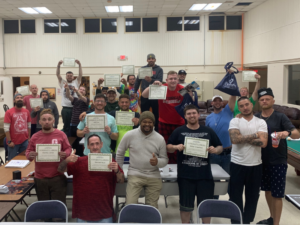
The heart of BETTER WORK is collaborating closely with local businesses to hire ex-prisoners, offer job training and employment support, and do something good not only for the company, but the community as well. And since our first event in Atlanta in 2017—involving leading employers like Georgia Pacific, Uber and Tip Top Poultry—BETTER WORK events have expanded to other communities in Gwinnett County, Columbus, and beyond.

Beyond helping people find good jobs with employers in local communities, we continue to advocate on policy issues that keep people out of the legitimate job market, including child support challenges, relief from fees and penalties incurred while incarcerated, occupational licensing hurdles, and civil asset forfeiture.

And we continue to build coalitions of nonprofits, faith groups, and businesses to teach folks how to fish so that they are not reliant on government handouts. As always, our mission is to help people support themselves—and provide for their families in ways that break the cycle of poverty and create new trajectories that lead to individual and community transformation.


A celebration of fathers.

Since Father’s Day is upon us, I am sure many of you are thinking about the presence or lack thereof your father in your life.  Hopefully some of you are thinking about the father that you are or want to become. No matter where you land, take it from an adult woman in her 50s that my dad still plays an important role in my life. He has long gone from this world—he passed in July 1997—but he impacts my decisions daily. He was an impact in my dating decisions, in my choice of who I married, and his influence continues to this day to guide me.

I am sure I sound like a daddy’s girl—and for the record I am! No one had a dad more special than mine. My dad was the type of man everyone loved. Whenever you asked him how he was doing, he would yell out “MAGNIFICENT!” I am the youngest of three girls. Everyone knew that I was his favorite. We both were the youngest of our siblings so we had a special bond. It wasn’t that my dad was a huge talker—in fact he was quite low key. However, he taught us a lot by his actions. He was a hard worker, he went to church regularly, and he was an entrepreneur.   He loved Christmas and loved family. It is no coincidence that I married a man that is a lot like him and is also a great dad too!


A family sitting on the floor together

FROM THE BLOG

ORIGINS OF THE GEORGIA CENTER FOR OPPORTUNITY

WHY WE CHOOSE TO FOCUS ON HEALTHY FAMILIES

As a root cause for poverty, we knew we had to focus on building healthy families if we wanted to help individuals flourish—and strengthen our communities and state.

Read The Full Blog

A father’s impact cannot be understated

The reason that this is so important is because it speaks volumes about the man when he can still impact his daughter even when she is older. I suppose that remembrance can go both ways: While my dad has a positive impact on me, other women are living out the consequences of their dad not being present in their life. Research tells us that father-absent girls display a host of outcomes including increased sexual promiscuity, higher rates of teen pregnancy, and unhealthy relationships.

As we move into another year of celebrating fathers it is always great to remember the value a healthy relationship with your father can bring. While we know not all people have access to a father like I had, it is still something we can and should strive for. The stability and value of fathers is why we have a day to recognize them. We celebrate the role because we recognize the significance  of it.

This is just another reason why I love working at the Georgia Center for Opportunity. We help those who do not have that foundation. We have workshops that help to give you a baseline of what is really important in life. You can reach us across all social media and maybe you would like to go one step further and let us know how your dad is still influencing your life.  I would love to hear about him! 


As an organization whose mission is to alleviate poverty in communities across Georgia, we are sometimes asked why we choose to focus on healthy families. After all, some of the most contentious flash points in our culture today center on the divergent views Americans hold about the definition of marriage and the role of family in society. 

This is why many groups working on poverty alleviation sidestep the crucial role that family plays as the bedrock of society and instead focus on resolving the presenting symptoms of poverty—as important as they are—rather than the root causes.    

But back in 2005, the Georgia Center for Opportunity (GCO) was asked to participate in a healthy marriage initiative. In considering our involvement, we looked at the research on stable, intact, two-parent households and saw that this type of family structure is optimal when looking at a wide variety of social metrics—including poverty alleviation. 

And while there’s no doubt that single parents often do a great job raising children who become highly productive members of society, the data clearly show superior outcomes for children who come from loving, low-conflict, two-parent households—and that this family structure is key to dismantling generational poverty and building thriving communities. 

The bottom line is that while poverty can still be experienced in the context of two-parent households, it’s less likely to happen than in single-parent households. And as a root cause for poverty, we knew we had to focus on building healthy families if we wanted to help individuals flourish—and strengthen our communities and state.  

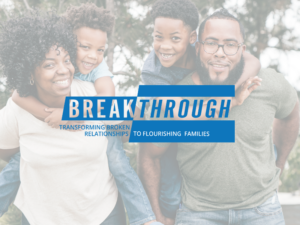
This is why GCO has invested heavily over the years in programs that offer relationship education to men and women. And this is why we have worked hard to build coalitions of nonprofits, faith groups, and local businesses to go into communities and lovingly address factors that destabilize marriage and family like divorce, out-of-wedlock births, and domestic violence.

The Success Sequence provides an outline of how to reverse the cycle of poverty in our communities. GCO uses this as a framework for much of our work.

Learn more about the impact GCO is making on families within our state. 

To this end—thanks to a federal grant from the Bush Administration—we were able to offer training to help couples overcome barriers and strengthen their relationships. Through this healthy marriage initiative, we certified 1,000 trainers to go out into their communities and teach more than 5,000 couples how to improve the quality of their relationship and stabilize their families.  

Today, GCO continues to move forward with a holistic and comprehensive solution to poverty that takes aim at its root cause—family instability. And while we continue to offer relationship education, we have expanded our focus beyond romantic relations with our Healthy @ series that works with churches, schools and businesses to examine healthy relationships in other areas of life, including education and work. 

Our goal at GCO has always been to remove barriers to human flourishing. And as we know through the PERMA model that an underlying barrier to overcoming poverty is improving the quality of relationships. 

By focusing on healthy families, GCO helps people recognize and regulate their emotions, learn how to effectively communicate with family members, identify unhealthy behaviors and relationships, and establish appropriate boundaries. More than anything else, learning these skills changes the trajectory of individual lives. And this is how generational poverty is defeated and communities are transformed—one life at a time.


Subscribe

* indicates required

Subscribe

* indicates required