HomePostTopic: Nonprofit organization

Nonprofit organization

Georgia law expands protections for donors' privacy and confidence that their gift will be used as intended.

Key Points

  • Georgia lawmakers passed two new bills in 2024 that strengthen protections for charitable giving in Georgia. 
  • The Donor Intent Protection Act allows donors to file a legal complaint if their gift is misused. 
  • The Personal Privacy Protection Act protects individuals from having their personal information publicly disclosed by the government when they volunteer for or financially support a cause. 

Guest post by Megan Schmidt, senior director of government affairs at Philanthropy Roundtable

There are over 64,000 nonprofit organizations in Georgia, and in 2021 Georgia donors gave $9.4 billion to charity, according to the IRS. These generous donations to charitable organizations are about to get important protections under two bills passed by the state legislature in 2024.

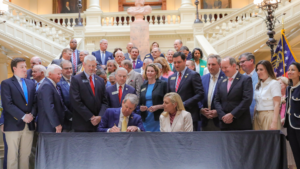
Gov. Brian Kemp signed the Donor Intent Protection Act and the Personal Privacy Protection Act into law. Both pieces of legislation offer donors and charities new avenues to ensure the proper use of donations, while safeguarding donors’ right to privacy in giving.

The two bills offer legal protections for donors and nonprofits to ensure charitable giving can continue freely and effectively in the state. When donors are free to give where and how they choose without fear of their information being unfairly released or their donations being misused, charitable organizations are better suited to help those who need their support.

The Donor Intent Protection Act

Sponsored by Sen. Bill Cowsert (R), the Donor Intent Protection Act passed the legislature on a strong bi-partisan vote, co-sponsored by Sen. John F. Kennedy (R) and Rep. Matt Reeves (R).

The Donor Intent Protection Act provides a legal pathway for donors to enforce written endowment agreements. Donors may give to a charitable endowment with specific written instructions for how they would like their gift used or invested.

Prior to this bill, when a charity agreed, accepted the gift and then violated the agreement, donors had no legal standing or recourse to enforce their written agreement. But under the Donor Intent Protection Act, donors now have the ability to file a legal complaint in court if their gift is misused.

This protection encourages giving and benefits donors, charities, and the many individuals served by nonprofit organizations in Georgia. It also bolsters levels of trust between donors and charities by adding an extra layer of protection for donor intent. Donors can give freely and generously without concern their mutually agreed upon instructions will be violated.

The Personal Privacy Protection Act

The second bill, the Personal Privacy Protection Act, also earned bipartisan support and protects individuals who volunteer or give to causes they care about from having their personal information publicly disclosed by the government.

The ability for donors to give privately to causes they believe in is a First Amendment right that historically has been upheld. In the 2021 Americans for Prosperity Foundation v. Bonta decision, the U.S. Supreme Court upheld donor privacy and concluded that California’s bulk collection of nonprofit donor information was unconstitutional.

Georgia donors should be able to give privately to causes they care about without fear of retaliation or public exposure. Whatever their motivation for privacy, this bill is aligned with the U.S Supreme Court decision and makes any unlawful disclosure of this information a misdemeanor under the law. This also provides protection for nonprofits from being forced to release their donor and member lists to government agencies and officials.

Laws Like These Encourage Generosity in Helping Our Neighbors and Communities

Donors give to nonprofits whose cause and mission they support. With the enactment of these two bills, Georgians can continue donating generously without fear their wishes will be violated or their identity disclosed.

The Donor Intent Protection Act is now law in three states and the Personal Privacy Protection Act is now law in 19 states. The protections offered by both bills will encourage donors to remain generous with their resources more than they might otherwise be.

Donors in states without these protections face uncertainty when they give because they don’t have the reassurance their identity is protected or that the court will grant them legal standing in the case of a violation.

Georgia is primed to move forward with a healthy charitable giving environment with the passage of these two bills so communities in need around the state can benefit from the generosity of Georgians.

SCALE THIS CONTENT To properly fit into the middle of this box but adjusting the spacing in DIVI.

Insert the same content here to work on mobile and tablet.

teamwork, people, hands, business partner, corporate business, nonprofit business

Key Points

  • Our BETTER WORK program harnesses the transformative power of local partnerships to get more people hired and build prosperous, stable communities.

  • Four standout collaborators—Essendant, Neighborhood Cooperative Ministries, D.P. Jones Electrical, and Chattahoochee Valley Episcopal Ministries (CVEM)—are showing how business and nonprofit involvement can fuel economic opportunity and serve the holistic needs of those working to escape poverty.

  • Together, GCO and our partners are dedicated to more than building better work. We’re building environments where everyone has a chance to reach their full potential.

In the tapestry of a thriving community, threads of collaboration weave a narrative of hope and opportunity for those who need it most. The collective efforts of local organizations, community leaders, and neighbors form the foundation upon which individuals facing challenges can build a brighter future. 

In the pursuit of creating a more prosperous and stable community, the Georgia Center for Opportunity’s (GCO) BETTER WORK program has harnessed the transformative power of partnerships. Among these alliances, four standout collaborators—Essendant, Neighborhood Cooperative Ministries, D.P. Jones Electrical, and Chattahoochee Valley Episcopal Ministries (CVEM)—exemplify how synergy between businesses and nonprofits makes it possible for communities to experience greater transformation and well-being. 

Essendant: A Distributor with a Difference

Type of Business: Distinguished distribution company based in Suwanee, Georgia.

Partnership History: Has been an employer partner in GCO’s BETTER WORK Gwinnett (BWG) program since August 2022. 

Their Impact: Essendant’s involvement is not merely transactional—it represents a commitment to community growth and development. By actively participating in the BETTER WORK program, Essendant contributes to the creation of a more vibrant and economically stable community. 

  • Their commitment to the program is evident in their proactive approach, going above and beyond in reaching out and interviewing every candidate referred by GCO.
  • Their consistency in communication has been a cornerstone of their partnership. By keeping us updated on the progress of candidates, they ensure a transparent and collaborative process.
  • Three individuals referred by BWG have been employed at Essendant for over three months, highlighting the tangible impact of this partnership on local employment opportunities.

Neighborhood Cooperative Ministries: Nurturing Communities, Transforming Lives

Type of Business: Nonprofit organization in Norcross, Georgia.

Partnership History: Has been a community partner since the inception of GCO’s BETTER WORK program. 

Their Impact: NCM has stood as an unwavering partner, embodying values of compassion, faithfulness, and trustworthiness that align seamlessly with the BETTER WORK initiative’s people-centric approach. Their impact extends well beyond the professional realm, delving into the core of individual needs. 

  • Their comprehensive support system—encompassing financial aid, shelter, and food resources—plays a pivotal role in empowering candidates referred by the BETTER WORK program. 
  • NCM’s commitment to addressing the holistic needs of individuals creates an environment where securing employment becomes a stepping stone toward self-sufficiency.
  • Together, BETTER WORK and NCM orchestrate various initiatives, with NCM hosting job events that connect job seekers with potential employers. NCM’s clients benefit from the invaluable support provided by the BETTER WORK program, including job coaching, resume assistance, and essential career advice.

“Through these partnerships, GCO and our collaborators are doing so much more than building better work. We are tirelessly constructing a better future for all, fostering an environment where individuals can reach their full potential and proving that this approach is possible for any community seeking hope and opportunity.”

“Through these partnerships, GCO and our collaborators are doing so much more than building better work. We are tirelessly constructing a better future for all, fostering an environment where individuals can reach their full potential and proving that this approach is possible for any community seeking hope and opportunity.”

D.P. Jones Electrical: Illuminating Opportunities

Type of Business: Family-owned and operated business established in 1939. 

Partnership History: Recent addition to the employer partner network for BETTER WORK Columbus. 

Their Impact: D.P. Jones Electrical brings with them a legacy of customer satisfaction and an eagerness to give back to the community. 

  • Their commitment to offering opportunities is exemplified by the employment of a BETTER WORK candidate who was initially feeling defeated in his job search.

  • The collaborative efforts between the candidate, the BETTER WORK team, and D.P. Jones Electrical resulted in permanent full-time employment. Edward Russel, the newest member of the D.P. Jones’ team, expresses his appreciation for working in a company that values him and shares his family values.

  • The company’s commitment to on-the-job training provides individuals like Edward with the chance to learn a trade while supporting their families.

Chattahoochee Valley Episcopal Ministries (CVEM): Empowering Communities in Times of Need

Type of Business: A non-profit outreach ministry in Columbus, GA

Partnership History: Community partner with BETTER WORK Columbus

Their Impact: CVEM stands as a beacon of support for individuals facing great need or crisis. 

  • Collaborating with BETTER WORK Columbus, CVEM addresses concerns related to housing, medical expenses, household furnishings, education, and job-related expenses. 
  • Their flexibility and responsiveness empower individuals to succeed as they position themselves for better job opportunities and futures.

Partnerships Unlock the Life-Changing Power of Work

It’s through local partnerships that we are able to help more people achieve a better life through the power of work. Partners like Essendant, Neighborhood Cooperative Ministries, D.P. Jones Electrical, and Chattahoochee Valley Episcopal Ministries are a few of the shining examples that illustrate the positive outcomes that come from strategic alliances. 

Through these partnerships, GCO and our collaborators are doing so much more than building better work. We are tirelessly constructing a better future for all, fostering an environment where individuals can reach their full potential and proving that this approach is possible for any community seeking hope and opportunity. 

Learn More About Partnering with BETTER WORK

If you are connected to a business or nonprofit organization interested in collaborating with our local BETTER WORK chapters, go here to learn more and contact us:

Georgia news, in the news, current events, Georgia happenings, GA happenings

A few years ago, Neighborhood Cooperative Ministries (NCM) acquired a complex to further the mission of helping neighbors who sincerely want to break their cycle of poverty and regain financial independence. To remind the community of its expanded facilities and partnerships with other nonprofits, NCM invited the community to an event called Tacos + Tours.

Read the full article here


mother and baby

Key Takeaways:

  • Welfare cliffs and marriage penalties are discouraging people from work and forming families.
  • The cliffs and penalties may mean that our clients are locked into poverty for much longer than they would be otherwise and despite our best efforts.
  • GCO has created a platform that allows anyone to see when a particular family can expect to experience benefit cliffs as they earn more money through work. 

Important Link: BenefitsCliff.org


If you work in a nonprofit serving the poor, you need to know that the government benefits your clients receive are likely discouraging them from working or forming a family, two things that research shows could lift them out of poverty the fastest. 

This is an especially tough problem for nonprofits, like GCO, that work to get their clients into good-paying jobs and strengthen their family relationships.

What’s going on?

These disincentives to work are often called “welfare cliffs” and the disincentives to family formation are called “marriage penalties.” Essentially, “cliffs” are generated any time a person receiving government benefits gets a raise at work that causes them to lose more in benefits than they will earn in additional income from the raise. These same individuals can face a similar financial penalty IF they decide to marry. In many cases, they will lose more in benefits than their spouse is able to provide in new income to the household.

While you would think (hope?) cliffs and penalties are rare, they are not. Instead, they are baked into the structure of nearly all welfare programs and many of the cliffs are severe. It’s also important to know that welfare recipients don’t face a single cliff or a single penalty, but they face cliffs and penalties at a number of different points as they have additional income from working or through marriage.

Why does it matter?

For nonprofit leaders, the cliffs and penalties may mean that our clients are locked into poverty for much longer than they would be otherwise and despite our best efforts. For workforce development nonprofits, cliffs could be the underlying reason why your clients don’t pick up additional work hours when they are offered or seem less than excited when they are offered a good promotion. In extreme cases, clients may quit jobs that seemed like a perfect fit simply because they panic when they learn they may lose a major benefit – like housing or childcare.

For nonprofits trying to help strengthen family relationships, marriage penalties may be driving behavior that is otherwise inexplicable, like seemingly happy couples refusing to marry or live in the same home. These dynamics can lead to stress for the couples affected and to a sense that a parent (usually the father) has abandoned the family when, if the system would allow it, he would be in the home. In these cases, children pay the biggest price.

What can you do about it?

Fortunately, we have created a platform that allows anyone to see when a particular family can expect to experience benefit cliffs as they earn more money through work. For nonprofits working with these families, you now have a tool (available for 10 states, with two more on the way) that will allow you to help your clients plan for the future. In some cases, knowing when cliffs are likely to happen will allow your clients to seek a larger raise that will help them bypass or leapfrog a cliff. In other cases, maybe the answer is seeking additional training or certifications that will get your client into a different payscale entirely – one that avoids the cliffs.

In the coming weeks, we will be adding a tool that will allow users to see the impact of penalties on couples who decide to marry. We will also be incorporating a solutions tool that will allow anyone to see how reforming our government benefit programs can actually eliminate cliffs and penalties entirely, giving recipients every reason to pursue work and form stable households.

For GCO, it is this last point – reforming the system – that remains the ultimate goal. In the meantime, we are looking for ways to mitigate the harm caused by the welfare system, so that as many people as possible can escape the system and break cycles of poverty now.


The Success Sequence provides an outline of how to reverse the cycle of poverty in our communities. GCO uses this as a framework for much of our work.

Circles in Columbus

A focus on the contributions of the African American family

BETTER WORK Columbus delivers Marketing Yourself training to clients of our non-profit partners upon request. This training gives students insight into the perspective of an employer and what matters to them during the hiring process. They leave this training more hopeful and with a new understanding of steps they can take to communicate well when they are looking for work. If you have clients who are preparing to look for better work opportunities in the Columbus area, they will benefit from this training. Send an email to kristin.barker@georgiaopportunity.org to schedule a training for your organization. 

Barbara Moushon, Circles Coordinator at Open Door Community House shares below why this program is helpful to Circles Leaders in training.

“We are very grateful for the Marketing Yourself training brought to our Circles Group here at Open Door Community House. Our group was very engaged with this presentation and they appreciated the information Kristin and Inez shared. They are still talking about this training. The topic of ‘What Employers Want’ explained to our group why it is so important to stop and really reflect when preparing for an interview. This information explained that the interviewee needs to analyze why an employer would want to select them.  The concept of knowing themselves and what they really want before going into an interview was a powerful message. Our clients understood that they need to spend a little time in self-reflection prior to seeking a job.” –Barbara Moushon


We could all use a good laugh right now, right?

We’re excited to announce that  comedian and inspirational speaker Michael Jr. will be joining us as a keynote speaker for Breakthrough Online 2020.

Known as one of today’s most gifted comedians, Michael Jr. brings laughter and understanding to audiences all over the world. Michael has spent a significant portion of his career making laughter commonplace in uncommon places such as homeless shelters and prisons. 


Now, Michael Jr. tours the country using comedy to inspire audiences to activate their purpose and live a life fulfilled.


Megan and teacher at table

Breakthrough is a way for you to share your work, explore new ideas, and connect with other organizations that are making an impact in our communities. This collaboration of ideas is why the Georgia Center for Opportunity exists and we are excited to have you join us.

Register Now

Also joining us to speak at Breakthrough: Gov. Brian Kemp

Impressive line-up of panels

We all could use a good dose of inspiration, now more than ever. That’s exactly what you’ll get with our breakout sessions:

  • Education: The challenge of virtual learning in the COVID-19 era
  • Employment: Job creation through community collaboratives
  • Family: Personal wellness during the pandemic
  • Development: Nonprofit fundraising in 2020


Register today: Thursday, November 5, 8:30am to 4:00pm EST
We’re excited to offer Breakthrough in a new virtual format as we continue to partner together for a better Georgia. Join us!

Register Now

Subscribe

* indicates required

Subscribe

* indicates required