This op-ed was originally published in the Savannah Morning News on March 26th. Check out the original post here.  

By Randy Hicks

Once again, it’s an election year. And as in the past, we’ll probably hear a lot of talk about the state of education in Georgia. But what does it really mean to have an excellent education for K-12 students? What constitutes real education reform that will prepare Georgia’s children for the jobs of the future and bring the benefits of competition to education?

Most basically, it’s a mistake to measure the quality of education by the amount spent on education. Instead, the quality of education must be measured by results. And that starts with two goals: First, finding the right school setting for each child. Two, ensuring that parents can take advantage of choice and place their child in that setting.

Every child is different. That’s why families should have a variety of educational options for their child. The goal of real education reform—of enhancing choice in education—is to ensure that families have high-quality options. Of course, this includes traditional public schools, but it also includes public charter schools (where Georgia’s programs are growing in popularity); private schools (including for children with special needs and those who benefit from the Georgia Tax Credit Scholarship program); online education, homeschooling, and hybrid education options. Parents can then select the option or options that help their child learn and grow the best.

Fortunately, Georgians already favor choice in education. Now, as the campaign season is intensifying, the Legislature can prove their dedication to our kids by taking real steps towards education reform this year. For instance, lawmakers can raise the arbitrary cap on the tax credit scholarship program, as two bills propose to do. More parents want these scholarships, and more people want to give to make them a reality for Georgia’s children. The Legislature shouldn’t stand in the way. Special needs children, children with disabilities, and others can benefit from expanded scholarship programs based on choice.

As the legislative session winds down and the campaign season begins, I hope that voters will take the time to inform themselves on education issues and ask the candidates where they stand and why, rather than simply being satisfied with proposals for higher spending for public K-12 schools. A vibrant education system in Georgia will include high-performing public schools all across the state, but it will include independent schools as well. Each sector should be committed to excellence, and parents should have the option of choosing the educational settings that are right for their child.

Seven years ago, Gov. Nathan Deal called on Georgians to “be frugal and wise. Let us restore the confidence of our citizens in a government that is limited and efficient.” His words ring true with a spirit of promoting true education reform which contributes to both of the Governor’s goals – frugality and efficiency. Public education, too, will benefit from the competition that true choice brings, and the results will benefit both Georgia’s children and Georgia’s taxpayers. The competition that comes from true choice for parents will improve all schools, making education in Georgia not only more frugal and efficient but also much more effective.

And that is the point of true education reform: more choice, and better schools, for everyone. Let’s keep that in mind and keep education reform a priority in this political year.

News | For Immediate Release

April 2, 2018

Georgia Center for Opportunity Lauds Approval of Tax Credit Scholarship Expansion 

ATLANTA – On the final day of Georgia’s 2018 legislative session, lawmakers gave final approval to a bill expanding the state’s wildly popular tax credit scholarship program. House Bill 217, championed by State Representative John Carson, lifts the program’s current cap of $58 million to $100 million over a span of ten years. 

The Georgia Center for Opportunity (GCO) had been a staunch advocate for the original bill, which first passed in 2009. Since its adoption, the program has increasingly suffered from over-demand, both from donors who were unable to give to the initiative and students who were unable to take advantage of the scholarship due to an arbitrary cap on the program.

GCO President and CEO Randy Hicks applauded lawmakers for taking a “bold stand for Georgia’s students.”

“For too long, too many kids have been waiting in line for the opportunity to attend a school that better fits their needs,” Hicks said. “By passing an expansion of the tax credit scholarship program, the Georgia General Assembly has set a standard of prioritizing students and providing hope to thousands of families for years to come.”

According to state law, the amount given per scholarship must not exceed the average state and local per-pupil expenditures. In 2017, that amount stood at $9,468, though the average scholarship awarded in 2015 was reported to be $3,425. 

“By raising the state cap another $42 million, you’re creating a potential situation where over 5,000 families at least can take advantage of this program, though it will likely be much more,” Hicks added. “That’s more than a number, it represents lives that will be changed for the better thanks to the passage of HB 217.”

House Bill 217 now goes to Governor Nathan Deal’s desk for signature. 

###

For more information, contact Christy Riggins at christy.riggins@georgiaopportunity.org or 770-242-0001.

Republicans included a non-binding referendum question in yesterday’s Primary Election ballot asking if voters support school choice, and 75 percent of voters declared their support for the concept of education dollars following the student.

The question was direct, clear, and as comprehensive as limited space would allow:

“Should Georgia empower parents with the right to use the tax dollars allocated for the education of their children, allowing them the freedom to choose among public, private, virtual and home schools?”

While these primary ballot questions are non-binding, they are a very effective way for a party to test support for an issue among their actual primary voters, not the “likely voters” approximated in poll samples.

These primary voters are the voters who will be especially important to those hoping to succeed Governor Nathan Deal in 2018 (here’s looking at you, Casey Cagle!).

Again, seventy-five percent of Republican primary voters said “yes” to school choice at the ballot. This overwhelming level of support for the ballot question is even more interesting when we consider that:

  • More voters voted for school choice than voted in the U.S. Senate race–the race at the very top of the ballot. The question was a “down ballot” question, where there there is usually a significant drop-off of votes from the votes cast at the top of the ticket.
  • The Georgia Association of Educators, the de facto teacher’s union in the state, long feared by politicians, publicly opposed and lobbied against the measure.
  • The question won a majority of support in every one of Georgia’s 159 counties–rural, urban, big, small, wealthy, poor–it didn’t matter. School choice won everywhere.

Will Georgia Republican elected officials start listening to these voters, or continue to ignore them?

In recent years, legislators have been somewhere between skittish and unenthusiastic (to put it kindly) about considering school choice legislation. No less than ten education choice bills were introduced in the last two-year legislative cycle and all but one was killed by leadership and committee chairmen, and none received a vote on the House or Senate floor.

Why? Largely out of a perception that teachers will be against it, Superintendents will be against it, school boards will be against it. But does the education establishment represent those they serve? Apparently not.

Now that the voters have spoken, clearly and specifically, how will legislators respond? Will they listen to the people who elected them? Legislators have the opportunity to make good policy good politics — they can give kids the educational opportunities they need and deserve, while giving primary voters what they support and demand.

How will these state leaders respond to their district voters’ support for real school choice?

  • Lt. Governor (and 2018 Gubernatorial hopeful) Casey Cagle:  Hall County–75%
  • Speaker David Ralston:  Fannin County–76%, Gilmer County–74%
  • Rep. Brooks Coleman, Chairman of House Education Committee:  Gwinnett County–77%
  • Same goes for Senate President Pro Tem David Shafer, also of Gwinnett
  • Senator Lindsey Tippins, Chairman of Senate Education Committee:  Cobb County–72%
  • Senate Majority Leader Bill Cowsert: Clarke County–74%

2017 could be a big year for education. The Governor plans to move forward with plans to update the funding formula, providing more resources and flexibility to school districts. Will the Governor and leaders of the legislature listen to the people and include school choice in those reforms? If not, if they once again cower in fear of the education establishment and teachers’ unions, they may just have their base to answer to.

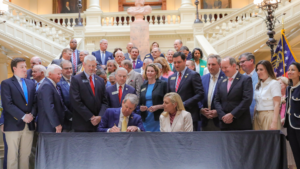
On April 27th, Governor Deal signed into law the most recent round of criminal justice reforms in Georgia. Senate Bill 367 enacts many of the recommendations of the state’s Council on Criminal Justice Reform.

Among the reforms are a number that will improve the ability of returning citizens to obtain employment, a key to reducing recidivism, including:

– Allowing first-time offenders to meaningfully shield their criminal record under the state’s First Offender Act,

– Providing greater access to occupational licensing, provided that the offense was not reasonably related to the license being sought,

– Reinstating driver’s licenses for those convicted of drug-related offenses that did not involve a motor vehicle,

– Expanding funding for Parental Accountability Courts that are problem-solving courts designed to reduce incarceration and constructively encourage parents to support their children. See our 2015 report on PACs here.

GCO is pleased that the reforms included recommendations we first made in 2013.

Happy Employee

It’s official. Governor Nathan Deal signed an executive order on February 23rd to “ban the box” on applications for state employment in Georgia. This order will remove the question about felony convictions from the initial job application and postpone it to a later point in the hiring process. This policy is intended to provide those with a criminal record a fair shot at showing employers why they are the best candidate for a job without being automatically screened from the hiring process simply because they have a felony conviction.

The Governor laid out specific hiring practices that government entities of the State of Georgia shall follow:

  1. Prohibit the use of a criminal record as an automatic bar to employment.
  2. Prevent the use of an application form that inappropriately excludes and discriminates against qualified job applicants.
  3. Promote the accurate use and interpretation of a criminal record.
  4. Provide qualified applicants with the opportunity to discuss any inaccuracies, contest the content and relevance of a criminal record, and provide information that demonstrates rehabilitation.
  5. Require initial disclosure on applications for sensitive governmental positions in which a criminal history would be an immediate disqualification.

Georgia is joining thirteen other states who have implemented a fair hiring policy and is the first state in the South to do so. This policy will help to remove a barrier to employment for those with a criminal record by opening up more job opportunities for which motivated returning citizens may be qualified. The state is setting the example for how county, city, and private employers could aid people leaving prison in the reintegration process by giving them a fair shot at jobs for which they are good candidates.

Georgia Center for Opportunity (GCO) applauds the important step taken by the Governor to “ban the box” as well as the efforts of all those who have been involved in working to increase employment opportunities for returning citizens in Georgia. In December 2013, GCO published a report recommending that the state “ban the box” and set the example for private employers by hiring and maintaining qualified returning citizens as employees. This recent executive order is the first step in seeing this fulfilled.

In addition, GCO is pleased to see several other recommendations from our December 2013 report currently being considered by the General Assembly or state agencies. These recommendations include offering a State Work Opportunity Tax Credit to incentivize employers to hire returning citizens, lifting professional license restrictions for those with felony convictions, and ensuring identification is secured prior to a person’s release from prison.

As Georgia continues to take positive steps forward in removing barriers to opportunity among those involved with the criminal justice system, the public should begin to see more examples of returning citizens who are not only making it in society, but flourishing.

Successful reentry for those coming home from prison is a concept that is not easily defined.

Most often, success is defined in terms of low recidivism – that is, fewer people who return to prison within three years of their release. However, simply measuring successful reentry in terms of recidivism does not present a complete picture of what it means to successfully reintegrate. There is much more to it than a person simply not ending up back in prison. To gain a more complete picture of what it means to successfully reintegrate into society – into a community, a family, and a faith – it is helpful to a look at a real-life example of someone who has done it.

Tony Kitchens - Reentry Celebration

Meet Tony Kitchens – a husband, father, son, and brother – who spent 12 years behind bars in Georgia during the 1970s and 1980s. Today, Tony is an Evangelism Catalyst with the North American Mission Board (NAMB) and has consulted with the Governor’s Office of Transition, Support, and Reentry (GOTSR).

He is celebrating thirty years of successful reintegration this January 2015 – a journey which he says is still continuing to this day.

In honor of Tony’s thirty years of successful reintegration, Walker Faith and Character Based Prison in Northwest Georgia held a Reentry Celebration for him on January 9, 2015. The celebration provided the opportunity for family, friends, coworkers, non-profit leaders, Department of Corrections (DOC) staff, the residents of Walker and the Governor’s Office to recognize Tony for his successful journey of navigating reentry to reintegration; it also provided Tony a wonderful opportunity to give current inmates a picture of what is possible for their lives.

Tony and Inmate

Tony – who was once an inmate at Walker State Prison – brings a unique perspective that carries a lot of weight among the men at Walker. He has the ability to address them as one who was once in their shoes; one who mopped the same floors they now mop and slept in the same cells they sleep in.

The Reentry Celebration took place in the prison cafeteria – a large space filled with hundreds of inmates dressed in white uniforms and nearly fifty guests. Above the stage hung large banners with seals from various state agencies, along with canvases painted by the inmates that included the seal of Walker Faith and Character Based Prison, the North American Mission Board LoveLoud logo, and a creative rendering of a line Tony is often heard quoting:

“I keep the penitentiary in my rear view and what lies ahead in my pre-view.”

Prison in My Rearview

A quartet comprised of inmates from Walker opened the celebration by singing the national anthem. The performance astounded everyone, including Jay Neal, Executive Director of the Governor’s Office of Transition, Support, and Reentry (GOTSR), who commented that Super Bowls do not have performers who sing as well as they did. This performance was followed by an introduction of the speakers and a powerful recitation of the “Brothers Creed” in which hundreds of inmates pledged to live exemplary lives of character while in prison and once they are released into the community.

Jay Neal followed as the first of a several speakers who would present at the event. Neal spoke about the first step required for successful reintegration, which is having accountability in one’s life. He reflected on his own experience as a young man and learning the need to have accountability in place before entering the pastorate. He encouraged the inmates in attendance to take this same measure in their own lives, as it is an important aspect of living a life of good character.

Accountable, Possible, Sustainable

The next speaker, Tony Lowden, a pastor and Project Coordinator for the Prison In-Reach Grant for the Georgia Prisoner Reentry Initiative (GA-PRI), built upon the principle of accountability and spoke about possibility. He recalled the biblical figure David and his calling to be a king, explaining that David had to first experience time hiding from his enemies in the Adullam Cave before he ascended to the throne. He paralleled this experience to inmates’ time in prison, calling it their “Adullam Cave,” and encouraged them to dream of being who they are meant to be – leaders of their families and communities.

Following Mr. Lowden, one of the inmates from the quartet sung R. Kelly’s “I Believe I Can Fly,” while another played the piano. The performance inspired the entire room and several shouts of approval could be heard from among the hundreds of inmates sitting in attendance.

Tony's Family

Brenda McGowan, Southeast Regional Director for Prison Fellowship, came on deck third and highlighted the importance of sustainability for successful reintegration. Touching on the life of Chuck Colson and Tony Kitchens, a Colson scholar, she discussed how a transformed life is the only way a person can face the difficulties of reintegration without losing hope.

Last of all, Tony Kitchens delivered the keynote address which tied the entire message together. He drove home the point that reentry is a destination whereas reintegration is a journey. He compared reintegration to the game of baseball and explained that it is not ultimately about hitting a home run; rather, it is a day-by-day process that is slow and much more like advancing from one base to the next. First base is becoming accountable, second base is seeing and believing what is possible, and third base is sustaining that vision through a spiritual transformation of the mind and heart.

“Reentry is a destination whereas reintegration is a journey.”

Grandfather Clock

Upon finishing, Tony received a standing ovation. He was presented with a personal letter from Governor Nathan Deal commending him for his excellent example for returning citizens and Georgians at large. Tony was also presented with a beautifully crafted grandfather clock that a group of inmates made out of recycled material from Walker prison – an excellent representation of Tony’s life in the way he has “redeemed the time” and used his gifts well in the community. The clock reads, “Celebrating 30 Years Free” on the front glass pane.

It was clear that the inmates at Walker were glad to see someone who is overcoming the collateral consequences of incarceration. Tony’s life serves as a powerful testimony to the redemption that is possible for returning citizens, and his message gives them hope that they can experience the same.


Governor Deal

Governor Nathan Deal

Georgia is receiving national attention as the state recently received four competitive federal grants from the Bureau of Justice Assistance (BJA) to implement its Prisoner Reentry Initiative (GA-PRI). Georgia is the only state to have received all four grants at one time – a testament to the smart framework that the state has developed to bring about significant reductions in recidivism.

The Governor’s Office of Transition, Support and Reentry (GOTSR) developed the GA-PRI Framework with the assistance of the Center for Justice Innovation last fall and began taking steps to implement it at five pilot sites around the state. GOTSR took these steps knowing that additional funding would be necessary to successfully carry out this initiative.

The office applied for the BJA grants around the beginning of summer with the hopes that it would receive the funding necessary to hire the right staff, provide evidence-based training and implementation, improve information sharing and measuring outcomes, and establish quality assurance mechanisms.

Jay Neal, executive director of GOTSR, explained that the office applied for the grants with the expectation that each one would fund a different component of the initiative and build on each other. This created a package deal that would enable the state to fully implement the GA-PRI framework without duplicating funds. This smart strategy appealed to BJA, who awarded the office each grant for which it applied.

The four grants that Georgia received for this initiative include:


Smart Supervision Grant Department of Corrections; Governor’s Office of Transition, Support and Reentry $750,000
Statewide Recidivism Reduction Grant Department of Corrections; Governor’s Office of Transition, Support and Reentry $3,000,000
Justice Information Sharing Solutions Grant Criminal Justice Coordinating Council $498,234
Justice Reinvestment: Maximizing State Reforms Grant Department of Corrections; Governor’s Office of Transition, Support and Reentry $1,750,000


Now that the state has received these grants, the next challenge will be to put all of its planning into action. This implementation phase will be critical to the success of prisoner reentry reform in Georgia, and the state understands that it will take collaboration among all stakeholders in the community for it to be successful, including businesses, churches, educational institutions, non-profits, and others.

GOTSR will be presenting its three year implementation strategy at the Justice Reinvestment National Summit in San Diego (November 17-19, 2014) where hundreds of people from over 30 states will be represented. These states will be looking at Georgia to see how well the state can implement its new reentry framework to reduce recidivism.

Georgia’s goal is to see a decrease in recidivism by seven percent in two years, and by 11 percent over five years.

Jay Neal

Jay Neal, Executive Director of the Governor’s Office of Transition, Support and Reentry

The momentum for reform is strong right now in Georgia, but the true test of the state’s commitment to preparing citizens for successful reintegration will have to be seen in the coming years as the inevitable difficulties of implementation arise.

For now, the state’s leaders seem prepared to face those challenges as they arise. There is a prevailing optimism that can be heard in government boardrooms and local reentry coalitions around the state, especially as people recount the incredible progress that has been made in Georgia over the last four years in the area of criminal justice reform.


Image credit:  The Atlanta Journal-Constitution (featured image), The Wall Street Journal, and The Polk Fish Wrap

Subscribe

* indicates required

Subscribe

* indicates required