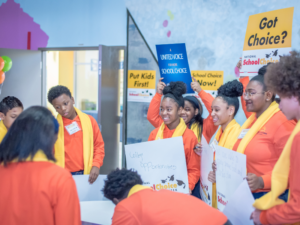
Over the past year, Georgia Center for Opportunity has hosted a series of luncheons aimed at encouraging local educators and business leaders to think outside of the traditional education reform box. Past keynote speakers have shared ways educators can work within their schools to become “cage-busting” leaders, and how business professionals can form coalitions to support quality education.

DSC_0044

In this same vein, GCO recently had the pleasure to host Sajan George, the founder and CEO of Matchbook Learning. Sajan not only introduced the unique Matchbook blended-learning model, but he also shared ways his “turnaround” methodology can be applied to even the most underperforming schools in Georgia.

What is different about Matchbook Learning?

For students at a Matchbook school, grades are virtually irrelevant. Instead, the emphasis is placed on instructional levels of learning. Rather than go through curriculums associated with the grade they are in (i.e., 3rd grade), students begin lessons based on their skill level, which may be higher or lower than the actual grade they are in (e.g., they may be at a 1st or 4th grade level). Students advance from their individual starting points based on their ability to master a skill at a pace that is independent of other students’ progress in the classroom. This concept is commonly referred to as competency-based education.

By using online learning platforms, Matchbook Learning has created a revolutionary learning system that does not just treat the symptoms of failing schools, but addresses the root cause of failure. Far too often schools focus on one-size-fits all instruction and traditional seat-time to improve student outcomes. However, what is truly needed is the ability to customize learning paths to meet students where they are. This system has already proven its ability to propel struggling students to new heights academically by not overwhelming them with instruction far beyond their ability and by allowing them to progress at their own pace.

What is special about Matchbook Learning is that is does not just give struggling students the autonomy to work independently, it also frees up teachers to work with students on a more engaged level.  Through the online platform, teachers always know where their students are in their learning and can arrange their classes with ease to provide more help to students who need it.

Matchbook has already scaled turnaround success in classrooms, schools, and school systems in places like Detroit, MI and Newark, NJ.

DSC_0083

Can the Matchbook model turnaround Georgia?

To apply these turnaround methods in Georgia, Sajan noted that a more innovative vision of education is needed across the state. One possible starting point, however, could be Gov. Deal’s proposed recovery schools districts. Looking to the Matchbook Learning system as a best practice for these would-be state charter schools could provide the much needed guidance to transform low-performing schools into student-centered learning environments.

Through collaboration with innovators such as Sajan George, Georgia Center for Opportunity continues to remove barriers to quality education by promoting solutions that have been proven to work. Considering models like that of Matchbook Learning are a much needed step in the right direction for giving Georgia a real chance to prosper.

Below is a guest blog by Dr. Eric Wearne of Georgia Gwinnett College and formerly with the Governor’s Office of Student Achievement. Dr. Wearne currently leads GCO’s College & Career Pathways working group.

**********************************

aurorak12_org_-e1397744747248

In its 2013 Report Card, Digital Learning Now, a project of the Foundation for Excellence in Education, argued:

State policy can remove barriers to innovative approaches or it can stifle them with restrictions, red tape, and reinforcement of traditional, unsustainable approaches. It can accelerate reform or it can further entrench the status quo. Without changing state policy, innovative tools and models will fail to scale.

According to the Report Card, however, the news is good:

“states are rising to the challenge of supporting next generation models of learning. In 2013, states debated more than 450 digital learning bills with 132 signed into law. This builds on a record year in 2012 when state lawmakers introduced nearly 700 bills and signed 152 into law.”

To explore these issues specifically, Georgia Center for Opportunity’s College and Career Readiness Working Group heard from Sam Rauschenberg, Deputy Director of the Governor’s Office of Student Achievement, who facilitated the Task Force, and Carla Youmans, Instructional Technology Specialist at South Forsyth High School in Forsyth County, who is coordinating a new hybrid program at that school.

The Governor’s Digital Task Force

In 2012, Governor Deal created a task force to look into online learning in Georgia.  The Governor’s Digital Learning Task Force met over the course of 2012-13, and provided recommendations to Governor Deal in December of last year.  The Task Force’s recommendations fall into three categories:

  • Infrastructure
  • Digital Content and Courses
  • Blended and Competency-Based Learning

The state has already started to implement some of the Task Force’s recommendations on infrastructure.  For example, the FY15 budget includes $3.9 million to connect school systems to the University System’s PeachNet.  The AFY14 and FY15 budgets also include $14 million in bond funds to the Georgia Department of Education for district and school grants for equipment required to receive and use added bandwidth (edge devices, LAN, wireless, etc.), and $25 million in general funds to the One Georgia Authority for grants to support extension of high-speed internet access in schools.

Still, opportunities exist in the areas of digital content and courses, and experimenting with new models for blended and competency-based learning.  For example the state, via the Georgia Department of Education, currently provides teachers with access to lesson and video content online. However, to maximize teachers’ use of the materials and the potentially transformative power of online learning, much more can be done.  The working group discussed the concept of course choice, as has been adopted in Louisiana, and the idea of opening online schools developed in one school system to students from any other school system.  Conceptually, the competition should make for improved products and services, all for the purpose of better serving Georgia children.  The Governor’s Task Force report alludes to barriers that could make online learning easier and higher-quality.  Enabling competition and other market-based approaches would help do that.

South Forsyth High School Hybrid

One school in Georgia that is experimenting within current structures is South Forsyth High School.  South Forsyth is preparing to offer a hybrid schedule to a select group of students next year.  Mondays are “synchronous”: students will sign on to their class websites when school starts, teachers will teach them online for a portion of the class period, and then students will work independently at home for the rest of the period.  Then students will check in again when their next class starts.  Tuesdays, Wednesdays, and Thursdays, students come to campus and attend class as all other SFHS students do.  Fridays are “asynchronous”: students receive their assignments online, but are free to complete them at their own speed.  If a students’ grade drops below a certain level, however, that student is obligated to come in and meet individually (or in very small groups) with the teacher.  The implications of this kind of system are many: struggling students can be identified and also given individual help more easily, and within the normal time constraints of a school week; students receive the kind of practice in self-regulation they will need in college; etc.

South Forsyth’s arrangement may not work for every school or every student, and digital learning overall is still in its infancy – we simply don’t yet know the best methods or all the possibilities involved with online learning.  But as one task force member argued, we don’t necessarily need one 100 percent solution to improve student achievement and to increase opportunities; we could be successful with 100 one percent solutions.  The Governor’s Task Force and South Forsyth High School’s hybrid program play important parts in state and local experimentation that can lead to better outcomes for Georgia students.

Governor Deal signed the criminal justice reform bill, SB 365, into law this past Sunday at Antioch Baptist Church in Gainesville.

This special morning service marked an important milestone for prisoner reentry reform in Georgia and is a testament to the extensive collaboration that has taken place over the last year from the state level down to the community level.

Governor-Deal-Antioch-Baptist-Church-e1397570941706

The state has zeroed-in on criminal justice reform for three years now, passing important legislation to improve adult sentencing (2012 and 2013), juvenile justice (2013), and prisoner reentry (2014). The first two reforms were projected to save the state $264 million over a five-year-period, as an increasing number of non-violent offenders are released from prison and placed under community supervision. This move allows expensive prison beds to be reserved for those who pose the greatest threat to society, while providing those with drug addictions and mental health issues the opportunity to receive needed treatment in the community.

Already, the outcome of these reforms has been significant – the state’s prison population has dropped from 57,295 to 53,000 offenders in just two short years, saving the state an estimated $21,000 per inmate per year.

The Governor is hopeful that we will see the same sort of progress made in the realm of prisoner reentry as SB 365 takes effect. This bill makes three important reforms that will assist ex-offenders in obtaining employment:

  1. It mandates that private background check agencies update their criminal history information on a monthly basis and permanently delete any records that have been restricted or of persons who have been exonerated (absolved from guilt);
  2. It provides employers a certain level of protection from negligent liability hiring by exercising due care in hiring ex-offenders who have received a Program and Treatment Completion Certificate or a pardon;
  3. It gives judges discretion in determining whether an offender’s license should be suspended or not for a non-driving-related drug offense.

The success of this reform will be measured with a decreased recidivism rate and increased employment rate among offenders returning to their communities.

Georgia Center for Opportunity is proud to have played a role in influencing the recommendations made by the Georgia Council of Criminal Justice Reform to the state legislature in January 2014, which ultimately made their way into SB 365. GCO has been researching this issue over the past year-and-a-half and believes the state is taking the right approach in working to provide offenders greater access to job opportunities.

Hopefully new bills introduced in subsequent legislative sessions will implement the remaining recommendations made by the Criminal Justice Reform Council on ways to improve the reintegration of offenders in Georgia.

Read more about the signing of this important reform in the Gainesville Times, posted April 14, 2014: https://www.gainesvilletimes.com/section/6/article/98202/ .

gco-capitol-update-header-green-box

Given two rounds of severe winter weather and the rush to early primary elections, the 2013-2014 session of the Georgia General Assembly seemed to fly by.  In case you were unable to keep up with the session, this edition of the Capitol Update offers a summary of some of the important legislation that survived to see the Governor’s desk, and some that did not.Legislative Recap

Bills sent to the Governor:

  • HB 60: This bill allows land owners/lessees in places such as bars and churches the final decision as to whether properly licensed citizens may carry concealed firearms on their premises, and removes restrictions on non-secure government buildings and public housing. This bill replaced HB 875.
  • HB 251: This bill prevents the sell of “e-cigarette” products to minors.
  • HB 697: This bill allows for the HOPE scholarship fund to cover 100% of tuition for students who have maintained satisfactory academic progress at a Georgia technical college.
  • HB 702: This bill allows for privately funded monuments containing the Ten Commandments, a portion of the Declaration of Independence, and a portion of the Georgia Constitution to be placed on the grounds of the State Capitol.
  • HB 714: This bill prevents contracted workers with the state government-school janitors, bus drivers, etc.-from receiving unemployment benefits during summer breaks.
  • HB 766: The “Work Based Learning Act” would permit schools – in collaboration with the Department of Labor and the Technical College System of Georgia – to award secondary credit for approved off campus work to students age 16 and over.
  • HB 772: This bill requires that adult applicants for and recipients of food stamps or benefits under TANF (Temporary Assistance to Needy Families) submit to drug testing if a state caseworker from the Department of Family and Children Services determines that there is a “reasonable suspicion” of drug abuse. Eligibility of children under both programs is not affected by this legislation.
  • HB 990: This bill would require legislative approval for any future expansion of Medicaid in Georgia.
  • HB 1080: This bill would allow for the placement of a privately funded monument dedicated to the Rev. Martin Luther King Jr. to be placed on the grounds of the State Capitol.
  • SB 98: Prevents coverage for abortions under qualified health plans offered within the state, including any exchanges created by the Affordable Care Act. This bill was amended to allow for consideration of an abortion if the mother’s life is at stake.
  • SB 281: This bill mandates that state employees and teachers be offered a high-deductible insurance option in the State Health Benefit Plan.
  • SB 365: This bill focuses on lowering barriers to employment for those returning from prison.  The legislation contains many of the recommendations from our Prisoner Reentry Working Group.

Bills that Failed:

  • HB 707: This bill prevents the State Insurance Commissioner from enforcing provisions in the Affordable Care Act (ACA), local and state agencies and governments from spending money attached to the ACA, and prevents the University of Georgia from operating the navigator program that assists people who are seeking coverage under the ACA.
  • HB 885: This bill allows for the usage of medical cannabis derivatives for the treatment of patients who suffer from severe seizure disorders and encourages research on additional medical uses of cannabis. Despite many attempts at attaching this bill to other legislation, HB 885 was not passed.
  • HB 886: This bill would require the governing body of Charter Schools to hold a minimum of two public hearings to review their budget before its adoption each year.
  • HB 897: This bill would eliminate obsolete provisions, and update and clarify other provisions relating to elementary and secondary education. It is noteworthy that aspects of this legislation (Section 36) would directly impact the approval process for homeschooling. After Sen. Tippins and the Senate Education Committee drastically altered the content of this bill in relation to charter schools, the House and Senate leadership were engaged in a battle over the status of this bill.
  • SB 167: This bill calls for the creation of an advisory council to review Common Core Standards and propose changes that are “in the best interest of students, their parents, teachers, and taxpayers.” Following this bill’s “unfavorable recommendation” by the House Education Committee, Sen. Ligon attempted to add this bill to HB 897. All three amendments that would have imported this bill into HB 897 failed on the Senate Floor.
  • SB 350: This bill would begin a process of privatizing child welfare services through contracts with community-based providers.  Following the favorable recommendation of a more watered-down version of this bill by the House Judiciary Committee, Sen. Unterman attempted to attach this bill to other legislation. Shortly before Sine Die, Gov. Deal appointed the “Child Welfare Reform Commission” to further study this issue.
  • SB 397: This bill, known as Ava’s Law, mandates that state healthcare plans provide coverage children with autism. Following action in the Senate Health and Human Services Committee, this bill was attached to HB 885-the Medical Marijuana Bill-and renamed the “Children’s Care Act.” Despite Sen. Unterman’s attempts to attach this bill to other legislation, SB 397 was caught in the battle between the House and the Senate and did not pass this year.

_____________________________________________________________________________ Thanks to Eric Cochling, our VP of Policy Advancement, Jamie Lord, our director of government affairs, and Jacob Stubbs, our legislative intern and John Jay Fellowship alumnus for their able contributions to this update.

gco-capitol-update-header green box

Roads Cleared, News Coverage Still Encountering Snow Related Congestion

While last week’s winter weather is in the rear view mirror, the postmortem evaluation of the government’s response continues to receive considerable coverage.   The General Assembly, however, has moved right back into business as usual.


Legislation, Study Committees, and Rumors to Watch

– Education –

Senate Bill 288 moved through senate without opposition. The bill from Sen. Charlie Bethel (R-Dalton) would prohibit public schools from participating in interscholastic athletic events officiated by outside organizations, such as The Georgia High School Association, unless those third party groups release annual financial reports.


In December we learned that the GA Dept. of Education will be launching a College and Career Pathways initiative, which will require students to select a career path that will shape their high school course work.  Rep. Eddie Lumsden (R-Armuchee) introduced House Bill 766, the “Work Based Learning Act”, which would permit schools – in collaboration with the Department of Labor and the Technical College System of Georgia – to award secondary credit for approved off campus work to students 16 and over.


Sen. Mike Dugan’s (R-Carrollton) Senate Bill 283 passed the Senate and moved to the House this week.  The bill would authorize schools to educate students regarding “traditional winter celebrations,” and officially permit the use of “traditional greetings” like “Merry Christmas” and “Happy Hanukkah.” It’s a distressing sign of the times that a bill like this is considered necessary.


– Child Welfare –

Sen. Tommie Williams (R- Lyons) is encouraging support of  “Ava’s Law” (House Bill 309 & Senate Bill 191), which would require Georgia private insurance companies to cover treatment for autism.  According to the CDC, autism spectrum disorders affect 1 in 88 children.  Gov. Deal’s 2015 budget included proposed funding for such coverage in the State Employee Health Plan, though neither the Governor’s proposal nor this legislation would result in coverage under Medicaid or PeachCare.


A bill to privatize most of the state’s child welfare services was introduced this week by Senator Unterman (R-Buford). The legislation, Senate Bill 350, would require the Department of Family and Children Services (DFCS) to develop a plan by January of 2015 by which it would contract with a limited number of regional lead agencies to provide the vast majority of child welfare services that are now, at least in part, offered by the state. The program would be phased in over the course of two years.

While lead agencies would be allowed to provide up to 35 percent of the services needed within a region, the law would require that they contract with other local agencies to provide the majority of services.

Contracts between the state and lead agencies would be for five years with DFCS having the ability to extend the contract for an additional three years. While DFCS would no longer be a direct service provider, it would retain responsibility for providing oversight of the contracted agencies.

As an incentive to agencies to find suitable permanent placements for children in their care, the law would fund agencies with per-child payments for a maximum of six months. After six months agencies would be required to pick up the tab for children that remain in their care. Likewise, agencies would not be eligible for per child payments for any child returning to the agency within 12 months of a permanent placement.

The reform is modeled after similar efforts in Florida and more than a dozen other states over the last couple of decades and has been driven by Georgia’s continued failures to adequately serve the children in its care.

While privatization is supported by many state leaders, including the Governor and Lt. Governor, opponents to the change say that it is being done too quickly and without considering ways to reform the system without privatization.

Evidence from Florida and other states shows that privatization can have beneficial effects, including improved safety for the children in care and a reduction in the number of children in state custody.

Yesterday, the legislation was favorably voted out of the Healthcare Delivery Subcommittee of the Senate Health and Human Services Committee. A stakeholder meeting was expected to be held today.


– Welfare Reform –

 Representing an extension of a 2012 law requiring mandatory drug testing for Georgia welfare recipients, Rep. Greg Morris (R-Vidalia) has introduced House Bill 772 which would impose the same standard for receipt of Food Stamps. This will be an interesting piece of legislation to watch, as a Federal Court overturned  similar legislation in Florida.


– Ethics and Government Reform –

 Sen. Josh McKoon (R-Columbus), Chairman of the Senate Judiciary Committee, is part of a coalition proposing some interesting changes. Two have received attention in the past week: First is a request to require conference committee reports be filed by day’s end of the 39th day of legislative session. This seems a wise and rational move, as it would protect Georgians from having to pass a bill in order to find out what is in it.  In addition, Senate Resolution 7 would allocate permanent funding that would provide for the separation of the Georgia ethics commission from the office of the Governor.


Upcoming Events

Our friends at the American Federation for Children are hosting a nonpartisan candidate training school in Atlanta on February 22nd. The training is free but requires registration to attend. For more information, please see this flyer for the event or email Brian Pleva to register.


Ironic

Despite last week’s encounter with snow, Georgia is not the state you expect to be producing Winter Olympic medalists.  However, as the Sochi Games kick off today, the Peach State is indeed represented by Douglasville native Elana Meyers, who will be seeking her second Olympic metal in Bobsledding.

After last week many Georgians likely have a new found respect for those able to control a vehicle on ice at high rates of speed.  Check out Meyers’ team’s story of determination and perseverance here, and be sure to tune in to cheer her on as she represents our great State.

_______________________

Thanks to Jamie Lord, our director of government affairs, and Jacob Stubbs, our legislative intern and John Jay Fellowship alumnus for their able contributions to this update.

Georgia Center for Opportunity (GCO) is pleased to see Governor Nathan Deal and U.S. Attorney Sally Yates (Northern District of Georgia) exercise their influence to encourage business leaders across the state to hire ex-offenders. They are urging employers to give ex-offenders a fair shot in the hiring process and outlining the benefits available to those who choose to hire them.

Governor Deal speaking at a Reentry Summit with U.S. Attorney Sally Yates on Feb. 5, 2014. Image credit: Georgia.Gov, Office of the Governor.

Governor Deal speaking at a Reentry Summit with U.S. Attorney Sally Yates on Feb. 5, 2014.
Image credit: Georgia.Gov, Office of the Governor.

These actions are consonant with recommendations made by GCO’s  Prisoner Reentry Working Group this past December based on input from criminal justice practitioners in Georgia and a review of best practices across the country (See Increasing Employment Opportunities for Ex-Offenders).

One important recommendation made by the working group included increasing the chance that a person with a criminal record will get hired by postponing the question about an applicant’s criminal history to a point after the interview stage of the hiring process. Such an action would give the applicant an opportunity to demonstrate his or her qualifications for a job and provide an explanation for any criminal history to the employer during the interview. It also prevents an employer from automatically screening a candidate who may be the best fit for the position.

Another key recommendation made by the working group is that the state should set the example for other employers by hiring ex-offenders. This action would demonstrate that the state is serious about helping ex-offenders become employed and successfully transition back into society. We believe that the degree of success the state has in finding and maintaining qualified ex-offenders as employees will directly impact the willingness of private employers to adopt similar policies.

Read the following articles posted on February 6, 2014 in the Savannah Morning News to learn more about steps that the key state leaders are making to encourage businesses to hire ex-offenders: https://savannahnow.com/news/2014-02-06/ga-officials-urge-businesses-hire-ex-prisoners#.UvTmvLT-L1V.

Below is the first edition of our Capitol Update newsletter for 2014. If you’d like to receive future editions in your inbox, sign up here.

*************************

2014 Session Begins

By: Eric Cochling, VP of Public Policy
Georgia Center for Opportunity

Welcome to the first edition of our Capitol Update for 2014. As we have done for several years, we will be sending out regular updates to let you know what’s happening under the gold dome (good, bad or otherwise) during the 2014 session of the Georgia General Assembly. Should you have any questions or comments about the content of these updates, please email Eric Cochling.

New Year, Election Near

The 152nd session of the Georgia General Assembly started on Monday. Since this is an election year, the session promises to be a short one as members of the Assembly look to campaign and raise money, things they cannot legally do while in session.

If this week has been any indication, activity will be fast and furious until the end of session, which is expected to end in mid-March this year. It doesn’t help the sense of urgency that the state is on the verge of moving our primary election from July to May. Legislation moving the primary election made its way through both houses of the General Assembly this week and is now on the way to the Governor for his signature.

With the elections looming and based on conversations we have had with lawmakers, we also expect the legislature to steer clear of politically divisive legislation. That said, “politically divisive” is in the eye of the beholder and you can never be certain what bills will generate controversy. It is safe to say that all legislators hope to leave this session, in particular, having made as few of their constituents mad as possible.

Legislation, Study Committees, and Rumors to Watch

Education

This week, Governor Deal proposed a $42.3 billion budget – more than half of which is coming from the federal government!! – that includes $547 million in additional funding for Georgia’s public school system to fund teacher pay increases and adding back days to the school calendar.

In other news, House Resolution 486, sponsored by Rep. Tom Taylor (R-Dunwoody) would amend the Georgia Constitution to allow municipalities created in 2005 or later (and contiguous municipalities) to form city school systems.

In the category of  “Finally!,”  Rep. Ed Setzler (R-Acworth) says that he is planning to introduce legislation to address some of the problems created by Georgia’s zero-tolerance law relative to weapons on school property. It would be great if accidentally leaving a pocket knife in your car didn’t result in a criminal record.

Criminal Justice Reform

Georgia’s Criminal Justice Reform Council released its third set of recommendations in three years on January 10th, this time focusing on reforming aspects of prisoner reentry. GCO testified before the council in November and we are happy to see that many of the recommendations from our Prisoner Reentry Working Group were included in the council’s report.

The council’s official recommendations include the following:

  • Each prisoner should have a Transition Accountability Plan initiated at the time they enter prison and consistently used during incarceration that will determine the best path to successful reentry;
  • State corrections agencies should work more closely with private agencies and returning citizens to locate and secure sustainable, safe, and affordable housing;
  • The food stamp ban on offenders convicted of a drug-related felony should be lifted, provided that they maintain a certificate of program completion issued by the Department of Corrections showing that they are in good standing and in compliance;
  • Judges should be allowed to modify driver’s license restrictions for those convicted of minor drug offenses not involving a vehicle so that they are able to operate a vehicle;
  • In hiring for state employment, job candidates should not be asked about criminal history until the interview stage.
  • Negligent hiring liability protection should be provided for companies willing to hire ex-offenders under certain conditions.

It is very likely that we will see these recommendations included in a criminal justice reform bill this session. We will keep you posted.

Marriage and Family

It’s difficult to deny the harm that no-fault divorce causes to children. It’s also difficult to know exactly what needs to be done to help protect kids from unecessary divorce. House Bill 684, sponsored by Rep. Jason Spencer (R-Woodbine), offers at least part of the answer.

This legislation would only affect couples with minor children, where the grounds for divorce are irreconcilable differences (no-fault). In those cases, the legislation would require divorcing parents to take an eight-hour course that explains how divorce will impact everyone involved, especially the children. It would also require a “discernment period” of 320 days before a court could grant the divorce. The waiting period could be waived in cases involving abuse, neglect, or abandonment and, importantly, the existence of abuse, neglect, or abandonment could be proven to a judge outside of the public eye and public record.

The thinking is that during the discernment period, tensions could cool and the couple could experience life apart – before making it permanent – so that they could see how their divorce would impact their children over the course of the year (including birthdays, holidays, etc.). While not a silver bullet to solve the marriage and divorce crisis in the country, this is certainly a good way to encourage couples with children to stay together.

Visit Allies for Family Life and look for “Children’s Hope for Family Act” for more information.

Child Welfare

According to this report, it appears that Georgia is moving quickly to obtain a federal waiver that would allow the state more flexibility in how it spends federal foster care dollars. Governor Deal has indicated that the new flexibility would be used to create new public/private partnerships that would allow private agencies to take a lead role in providing foster care and other child protection services. The Casey Family Foundation has praised the use of waivers and privatization in other states where it has been a success and called for extending the availability of waivers to the states beyond this year.

Our team continues to serve on the Governor’s Office of Children and Families CSEC Task Force, which is making real strides in raising awareness of child sex trafficking in Georgia and finding effective ways to rescue and serve victims, while reducing demand. The subgroup on which we serve recently developed a certification program for businesses that commit to fighting child sex trafficking called Champions for Safe Children. We are now in the process of delivering trainings for interested companies around the metro area. Next up: developing similar certification programs for cities and neighborhoods.

Upcoming Event

Please join us for our 4th annual School Choice Celebration & Rally on Tuesday, January 28th, from noon to 2pm at the Georgia State Capitol. Our special guest will be Keshia Knight Pulliam (Cosby Show and House of Payne). Registration is encouraged.

Funny

The General Assembly has been around a while and like any old institution it has developed its own language. James Salzer at the AJC put this glossary together to help us outsiders keep track of what’s happening.

Thanks to Jamie Lord, our director of government affairs, and Jacob Stubbs, our legislative intern and John Jay Fellowship alumnus for their able contributions to this update.

The 2016 legislative session came to a close about half past midnight on the morning of March 25th. After 40 legislative days of battling over policy priorities, members of the House and Senate ended the year with cheering and tossing torn paper like confetti in the chambers.

Georgia passed a version of the ABLE Act, modeled after the federal version which passed in 2014. The new law provides for tax-free savings accounts to cover qualified disability expenses such as housing, education, or transportation, while also not affecting a disabled person’s eligibility for social security or food assistance benefits.

Tax credits for rural health care:
Modeled after the successful Tax Credit Scholarship Program, which provides education choice to more than 13,000 students, a new tax credit was created to help provide healthcare in rural Georgia. The new law allows individuals and corporations to receive a credit for donating to a rural health care organization, defined as a nonprofit that must treat patients who are indigent or on Medicaid or Medicare, and must be located in a rural county. Credits are capped at $50 million in the first year (2017), $60 million in year two, and $70 million in year three.

After three years of trying, the General Assembly passed one of their top priorities: a Religious Freedom bill. The bill mirrored language from the federal Religious Freedom Restoration Act, which was signed by President Bill Clinton and adopted by dozens of states, requiring government to prove a “compelling governmental interest” before it interferes with a person’s exercise of religion. It also included a clause saying it could not be used to allow discrimination already banned by state or federal law. However, Georgia’s business community weighed in, asking Governor Deal for a veto, with threats of relocating if it were to become law. Ultimately, Governor Deal vetoed the bill, saying it was unnecessary and did not reflect Georgia as a “warm, friendly and loving people.”

A new law was created with the intention of helping children in the foster care system (or helping them to avoid it altogether). The law prioritizing placing children with family members or kinship caregivers for a short time, when it is in their best interest. It also gives a legal framework for families to grant Power of Attorney to these relatives or caregivers who are temporarily caring for the children.

Governor Deal announced during his State of the State address in January that he was holding off the pursuit of his large education reform package until 2017 to give the legislature and the education community more time to fully vet the proposal. This signaled that it would be a lighter year than usual for education legislation. However, a few bills were introduced and fewer still saw final passage.

PASSED:
All teachers (and other state employees) saw a 3% raise included in the budget.
A bill passed (but has not yet been signed by the Governor) that reduces the percentage of student achievement that factors into a teacher’s evaluation from 50% to 30% and reduces the number of in-classroom observations for some teachers. HB 364l could also make Georgia the only state in the nation with statewide testing in grades 1-12. The Governor has until Tuesday, May 2nd to sign or veto the bill.

DID NOT PASS:
A bill to create a new tax credit scholarship program for low/middle income children.
A bill, called “Junior GI”, to give children of military families scholarships for use during K-12 years.
A bill to give children eligible for the Georgia Special Needs Scholarship more flexibility in how they use their scholarship dollars.

Subscribe

* indicates required

Subscribe

* indicates required