Key Points

  • In 2026, Georgia voters will elect key political leaders who will have the ability to remove barriers and open doors to better futures for the state’s residents. 
  • Top concerns for both lawmakers and citizens include welfare reform, the cost of living, educational opportunities, and public safety. 
  • Proposed policies and reforms will help lift many Georgians above the poverty line and provide clearer pathways to upward mobility and thriving communities.

Opportunities to drive progress and hope will greet Georgians in 2026. Critical issues will dominate the legislative agenda, and top governmental positions will be up for election.

The well-being of many Georgians, their families, and their communities is at stake as pressing concerns like welfare reform, the cost of living, educational opportunities, and public safety take center stage in political discussions. These issues involve significant challenges, but policymakers are working to find promising solutions that will enable people across the state to flourish.

Electing leaders to fill key political offices

Georgians will elect new officials for the state’s top posts in 2026. The primary election will take place on May 19, and the general election is scheduled for November 3.

The roles of both the governor and lieutenant governor will be on the ballot. Georgia’s current governor, Brian Kemp, isn’t eligible to run again because he’s reached his term limit, so several candidates are competing for the position, including Lieutenant Governor Burt Jones. 

Georgians will also vote on one of the state’s U.S. senatorial positions—Senator Jon Ossoff currently holds the post. All of Georgia’s seats in the U.S. House of Representatives will be up for election as well.

These political races are pivotal because the elected officials will have the power to remove barriers and open more doors to opportunity for the state’s residents.

Reforming Georgia’s public assistance programs and creating a pathway out of poverty

The candidates running for office will likely take positions on ways to reform government assistance (welfare or safety net) programs in Georgia. This should be a top priority because about 13.5% of the state’s population is currently living in poverty

One of the main concerns about the welfare system is that it isn’t helping to lift people above the poverty line or empowering them to become self-sufficient. Instead, the complexities and regulations in the system tend to trap people in long-term cycles of poverty that affect families for generations.

To make real change, Georgia’s top lawmakers need to focus on streamlining the state’s welfare system and integrating it with workforce development programs. This strategy, called the One Door model, connects recipients of government benefits with one caseworker who not only helps them meet their immediate needs but also provides resources to support them in finding a rewarding job.

In Georgia, around 28% of prime-age (25-54) adults aren’t working, and disengagement from work is one of the primary reasons people seek public assistance. Developing a One Door strategy in Georgia will help these individuals become self-sufficient and also enable them to experience the sense of dignity and purpose meaningful work provides.

Georgia’s political leaders can take steps toward implementing a One Door model by advocating for federal authorization to do so. At the state level, they can also establish a task force to explore ways to connect and improve Georgia’s public assistance and workforce programs.

A reform called the One Door model would allow Georgia to connect more welfare recipients to meaningful work and economic opportunity. 

Making life more affordable in Georgia

Many low- and middle-income families in Georgia are struggling to cover the basic costs of living, as prices for just about everything seem to be rising. The increasing costs add extra hardship to the numerous barriers that already impact people’s well-being. But Georgia’s policymakers have opportunities to make some things more affordable for the state’s residents.

  • Housing shortages and costs: At least 94 of Georgia’s 159 counties don’t have enough housing for their residents. The shortage is driving up prices and making affordable homes hard to come by. Builders want to construct more houses, but they face restrictive regulations regarding land use and infrastructure, including roads and water lines. Local policymakers can address the issue by allowing greater flexibility in lot sizes and housing types. Doing so will bring more affordable homes to the market, and that will reduce rent and mortgage payments and free up income to cover other necessities.
  • State income taxes: Georgia’s state income tax is set to drop to 4.99% in January 2027, but some lawmakers want to eliminate it completely. For many Georgians, every dollar matters, and doing away with the tax would allow them to keep more of their income in their own pockets. State leaders are considering eliminating corporate tax breaks to offset the potential loss in government revenue from income taxes. But it’s important to note that they could also raise the sales tax to recoup the state’s lost revenue. That could leave lower-income families worse off because essential goods would cost them more.

Creating an educational system that meets the needs of every child

In 2026, Georgia lawmakers will continue their efforts to develop an educational system that honors every child’s unique situation and needs.

Several education-related bills that carried over from 2025 will likely be up for consideration in the Georgia General Assembly.

  • Senate Bills 124 and 152: These bills will expand eligibility for Promise Scholarship accounts to students with a parent who’s an active-duty military service member stationed in Georgia and to biological or adopted children of foster parents. The bills will help support more families who want to consider alternative education options for their children
  • Senate Bill 171: This bill will require Georgia’s Board of Education to develop an advanced math pathway for students in grades 3-8. The program will prepare students to take higher-level math classes in middle school and ultimately to pursue careers in science, technology, engineering, and math (STEM). The opportunity will pave the way to brighter futures and upward mobility for participating students, and particularly for young African Americans, Hispanics, and girls who haven’t traditionally received significant STEM education.
  • House Bill 917: This bill will provide open enrollment processes for students who want to transfer between local school systems or from one school to another within a school system. This will enable students to attend the school that’s the right fit for them, regardless of where they live.

Charter school funding will also be on policymakers’ radar. In 2025, the Georgia Senate created the Study Committee on Funding for Charter School Capital Improvements. The committee was tasked with reviewing current funding processes for public schools, examining the differences in capital funding between charter and public schools, and analyzing the challenges charter schools face in getting funding. Georgia’s leaders will likely use the study’s findings to make sure charter schools have equal access to capital improvement funds so they can continue to offer alternate educational options for families. 

Prioritizing neighborhood safety and reducing crime

Public safety is a top concern for Georgians, and especially for those living in impoverished communities. High crime rates lead to losses in property value, community resources, business activity, and job opportunities—all making it increasingly difficult for people to escape poverty.

Among several public safety bills, Georgia lawmakers will likely consider two that were drafted during the 2025 session.

  • Cognitive behavioral therapy (CBT) for juveniles: The first bill will enable greater use of CBT with young people who get arrested, even those who are non-violent or have minor convictions. CBT teaches participants to look at the relationship between their thoughts, feelings, and behaviors and helps them respond to challenging situations more effectively. Studies show that CBT programs can reduce recidivism by an impactful 25%. They also set participants on a path toward healing and growth, which will, in turn, help their communities flourish.
  • Support for local law enforcement agencies: The second bill will create grants for local law enforcement agencies to assist them in solving more violent crimes. Local departments can use the funds to improve investigations, enhance the technology and data systems officers use, and support victims and families. The resources will also help authorities deter future crime and boost community safety and resiliency.

Taking action to transform lives and communities

Georgia’s policymakers know that more needs to be done to break down the social and economic barriers so many people are facing, and they’re taking action. But this responsibility doesn’t lie with government leaders alone.

Georgia residents should pay close attention to the issues lawmakers discuss, but also to the needs of their families and communities. They can then use what they learn, along with their voices and votes, to create real change. 

In doing so, Georgians will bring even greater promise and prosperity to the state—making it a place where everyone has the opportunity to achieve their full potential and thrive.

Additional resources

In their pitch to voters, the 2026 candidates for Georgia governor have mentioned they are likely to address tax reform, health care, jobs, immigration, child care and housing issues.

But none have mentioned a priority that is not only connected to those issues but has a significant impact on the well-being of millions of Georgia families — welfare reform. And with new federal work requirements set to take effect, policymakers will no longer be able to overlook Georgia’s public assistance programs.

With more than 1 million Georgians struggling to make ends meet, reforms to the safety net should be a top priority for Georgia’s next leader.

These low-income residents turn to Georgia’s safety net programs for help, including Medicaid for health insurance, the Supplemental Nutrition Assistance Program for food support and Section 8 for housing assistance.

System fails to move people out of poverty

Both Republicans and Democrats agree these programs are a critical support system for disadvantaged communities.

But disagreement tends to emerge over whether welfare truly serves these people — helping them move from reliance on public assistance to independence and a more fulfilling life.

On that measure, welfare is failing — and its shortfall should capture the attention of Georgia’s next governor.

Not only does Georgia’s welfare system — like nearly all states’ — fail at its stated goal of moving people out of poverty, but it also compels recipients to stay dependent, keeping them in a cycle of poverty that so often defines generations of low-income Americans.

Welfare discourages recipients from getting married before having children and from working — troubling given those factors align with two of the three indicators in the Success Sequence, a series of life milestones that research has shown are the keys to happier lives, stable families and upward mobility (the other factor is obtaining a high school degree).

Georgia’s next governor would do well to recognize that the implications of this flawed system extend beyond just welfare recipients. It has a significant impact on the state’s budget and economy.


Low labor participation rate is a warning

Social safety net programs, particularly Medicaid, are often the biggest expenses in a state’s budget. While the federal government partially funds welfare programs, the states are responsible for a significant share of the costs and are responsible for managing the system. With these high costs, policymakers should assess whether the billions spent on welfare is moving people out of poverty or keeping them on the economic sidelines.

And then there’s the direct impact on Georgia’s workforce. Georgia’s labor force participation rate, or the number of working-age people employed or looking for a job, is 60.6%. Or put another way, nearly 40% of Georgians, many of them prime-age men, who can work are choosing not to.

A low labor force participation rate is a warning sign for the state’s economic health. Every nondisabled Georgian who opts out of work isn’t just losing income — our state loses tax revenue, businesses lose workers and communities lose engaged citizens who are the foundation of thriving neighborhoods.

Georgia’s next governor should ask, then, why the state’s welfare programs fail to connect beneficiaries to resources they need to help them find a stable job. Unemployment is one of the primary reasons individuals seek assistance in the first place.

And yet when someone in Georgia turns to the welfare system for support, they are not connected to work. Workforce development programs exist, but they oddly operate separately than the social safety net.


Follow other states in integrating workforce aims with welfare

Fortunately, policymakers in Georgia have a road map to turn to called “One Door to Work,” which integrates workforce development with welfare. Under this policy, people who access the safety net for help are connected to one caseworker who not only helps them meet their immediate needs but connects them with resources to find a job. Utah passed this reform in the 1990s and now boasts the lowest numbers of people on Medicaid and food stamps — along with consistently low unemployment rates.

Louisiana passed One Door legislation in June. Mississippi created a task force to explore the reform. And Arkansas also recently approved an audit of its workforce and safety net programs to identify needed changes. Georgia should follow the lead of its southern neighbors to the West.

Welfare reform isn’t a second-tier issue. It’s central to sustaining Georgia’s current trajectory as a leader in economic opportunity. Georgia’s One Door gives the next governor a way to strengthen families, expand the workforce and set the state on a path to growth.

Read the full article here.

Buzz Brockway is the vice president of public policy at the Georgia Center for Opportunity.

Key Points

  • In 2025, Georgia and many other states have opportunities to address barriers to economic and social mobility.
  • Key areas include reforming the safety net to encourage work, expanding education opportunity, and adopting policies that lead to safer communities.
  • These efforts emphasize empowering families, incentivizing work, and fostering safer neighborhoods, demonstrating the crucial role of community-driven solutions in breaking cycles of poverty.

Crime, social and family instability, lack of quality education, and disengagement from work have all contributed to the sense that better futures are slipping out of reach for everyday Americans.

As these challenges persist, leaders and communities are taking notice of how typical government interventions fall short of meeting communities’ long-term needs. 

Georgia and many other states have incredible opportunities in 2025 to pursue better solutions that tear down social and economic barriers. Looking to the year ahead, here are a few key opportunities for supporting vibrant communities and flourishing lives in Georgia and beyond.

Elected leaders are looking more closely at barriers to work in the welfare system 

With the incoming presidential administration, there’s renewed interest in improving government efficiency. GCO has recommended that addressing the barriers to work in our safety net would be one of the best places to start. 

Congress began considering major safety net reforms in 2024 but ran out of time to pass any meaningful policy changes before the end of the year. In 2025, incoming officials have a fresh opportunity to pursue One Door reforms that would allow states to streamline their safety net and work programs. With these reforms, states could reduce systemic barriers that discourage individuals from growing careers and families. 

GCO and several of our partner organizations are continuing to educate federal lawmakers on how work-focused reforms can support social and economic mobility for safety net recipients. 

But states don’t have to wait solely on federal action to start improving their welfare programs. In 2025, GCO is working alongside several states to help them pursue safety net audits. This process is a first step to identifying inefficiencies and incentives that discourage people from work. It also helps states see where recipients face benefits cliffs—the sudden and often unexpected loss of assistance that occurs with slight increases in wages and leaves recipients financially worse off despite earning more.

In Louisiana, for example, the collaborative efforts of GCO and our partners have guided the state government in identifying ways to enhance their social safety net system. Similarly, our initiatives have inspired lawmakers in Arkansas to push for legislation aimed at evaluating and strengthening the state’s workforce and social services infrastructure.

BETTER WORK is empowering community-based pathways to employment 

While we work to remove policy barriers to employment, our BETTER WORK program is harnessing the power of community to help Georgians connect to immediate job opportunities in their own neighborhoods. 

The program’s success in Gwinnett and Columbus counties has shown how employment not only provides income but also restores dignity and purpose. BETTER WORK is set to grow in Gwinnett and Columbus in 2025, and we have begun to collaborate with partners in additional communities that want to use our BETTER WORK model to build their own local efforts to support economic and social mobility. 

A person in a job interview

“Everyone wants to feel that their life matters to someone, that there’s a reason for their existence beyond just getting through each day. Work provides that sense of purpose. It offers us an opportunity to contribute to something bigger than ourselves, connecting us with others who share our values and goals. Through our work, we become part of a collective effort, united in a common purpose.”

— Kristin Barker, Vice President of Workforce Solutions at GCO

Families are getting a new education option with the Promise Scholarship 

The Promise Scholarship Program is launching this year, offering families in underperforming school districts the chance to access quality education. Families can use $6,500 scholarships to pursue alternative education options, unlocking opportunities for thousands of Georgia children.

Gov. Brian Kemp’s new budget includes full funding for the program. Once appropriated by the Georgia General Assembly, this funding could help an estimated 22,000 kids who meet the eligibility criteria. 

We’re also encouraging lawmakers to adopt better funding formulas to ensure Georgia’s public charter schools can access high-quality facilities. Charter schools have an essential role in addressing diverse educational needs, and improving their infrastructure will ensure more students can thrive.

The Georgia Promise Scholarship helps students in low-performing public schools access education options for their needs.

“Adding Promise Scholarships to the menu of Georgia’s schooling options is a positive step toward an education system that honors every child’s unique situation and prevents a lack of quality education from limiting children’s futures. We look forward to working with the Governor and Legislature to see the program fully funded and implemented.”

— Buzz Brockway, Vice President of Policy for GCO

Legislative sessions hold opportunities for policymakers to strengthen public safety

Public safety is the first step to stability and prosperity in our communities. In the 2024 election, voters made it clear that they want elected leaders to take public safety seriously.

The 2025 legislative sessions offer elected officials the opportunity to focus on ensuring police departments are properly funded, sentences for violent offenders are sufficiently severe, and programming in prisons focuses on helping offenders become productive members of society upon release.

GCO is working with Georgia lawmakers to advance a crime reduction package based on our recommendations for restoring community safety in Atlanta. Our public safety expertise is also aiding leaders in Kentucky as they consider a bill to improve data reporting and reduce recidivism in their criminal justice system. 

Voting preferences in the 2024 election confirm that better public safety is a priority for Americans.

“In the 2024 election cycle, voters once again affirmed they want safe communities, less crime, and criminals held accountable. Though rates of certain violent crimes have fallen in recent years, it’s important to think about this decline as a response to positive policy change. Policymakers cannot take their eye off the ball now.”

— Josh Crawford, Director of Criminal Justice Initiatives

Communities are getting support to empower strong families

Empowering parents is at the core of our mission. The Raising Highly Capable Kids (RHCK) program equips parents with tools to nurture strong family connections, fostering children’s academic and personal success.

With expansion plans for 2025, we’re excited to bring this life-changing program to even more parents across Georgia, ensuring future generations thrive in stable and supportive environments.

“Empowering parents strengthens the bond between parent and child,” noted Joyce Mayberry, GCO’s Vice President of Family. “When parents feel confident and equipped, they can create a stable and nurturing home environment. This type of environment not only supports children’s well-being but also fosters academic success. Together, these efforts can transform the trajectory of a family’s future. Strong parenting within the home radiates outward, positively impacting neighborhoods, schools, and ultimately building stronger, more resilient communities.”

Two-parent households Income inequality Social mobility Poverty reduction Marriage Economic well-being Single mothers Single fathers Education outcomes Behavioral tendencies American Dream Economic security Social challenges Family structure Economic performance Government intervention Grassroots change Cultural change Fathers

“When parents feel confident and equipped, they can create a stable and nurturing home environment. This type of environment not only supports children’s well-being but also fosters academic success. Strong parenting within the home radiates outward, positively impacting neighborhoods, schools, and ultimately building stronger, more resilient communities.”

— Joyce Mayberry, Vice President of Family

Key Points

  • As Americans become more skeptical of the American Dream, an important issue to address is the link between poverty and violent crime.
  • Research has found that violent crime negatively affects property values, employment, and outcomes for childrengoes here.
  • Providing a safe environment is a core government responsibility, and it’s essential for lowering fear, improving economic mobility, and building healthy communities. 

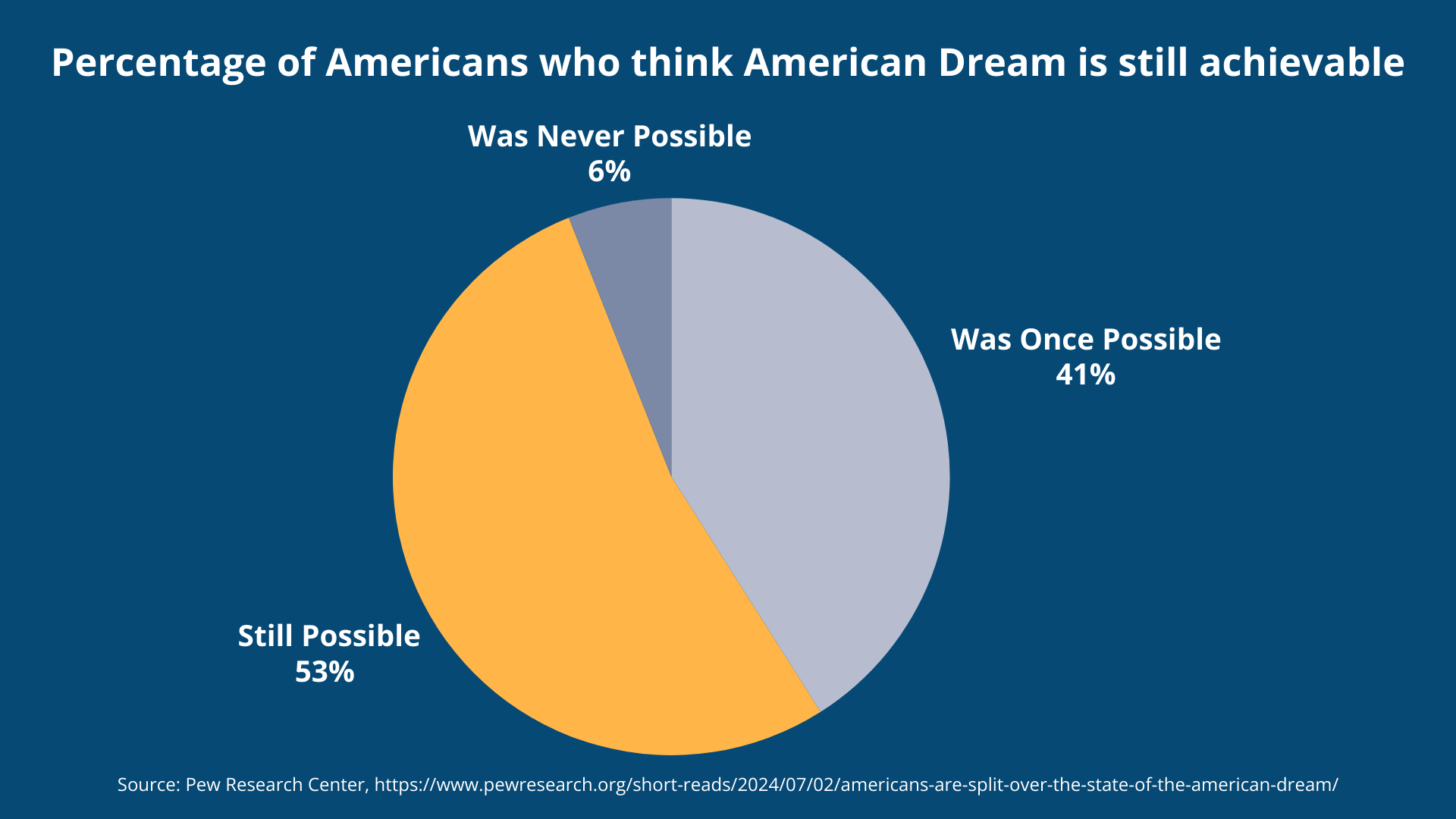
A recent Pew Research Center poll examined American attitudes about the attainability of the American dream. Overall, 53% of respondents believed the American dream was still possible. 

Responses were remarkably consistent across race and differed only slightly by party affiliation (56% for Republicans, 50% for Democrats). 

Age was the factor where more drastic differences of opinion started to emerge. The younger the cohort, the lower the percentage of respondents who felt the American dream was still possible. 

  • Age 65+: 68% believed the American dream was still possible. 
  • Age 50-64: 61% thought the American dream was still possible. 
  • Age 30-49: 43% felt the American dream was still possible. 
  • Age 18-29: Just 39% agreed the American dream was still possible.  

Among the youngest groups, a larger percentage—48% of 30 to 49-year-olds and 51% of 18 to 29-year-olds—thought the American dream was once possible but no longer was. 

The current attainability of the American dream is subject to much debate, not fleshed out here. One factor that deserves more attention is the role of public safety in shaping communities where people have opportunities for a better life for themselves and future generations.  

Of all the barriers to opportunity, violence is one of the most vicious because it can single-handedly upend all the building blocks of a flourishing life—family stability, access to quality education, and work opportunities. And a disproportionate amount of this suffering is borne by our poorest and most vulnerable communities. 

Nearly 50% of According to Pew Research polling, Americans think the American Dream is no possible.

The impact of crime on children

Future generations have a harder time getting ahead in life. 

It’s clear from the data that nearly half of children raised in the poorest households—the bottom 20% of incomes—end up in that bottom 20% as adults. A tremendous number of factors contribute to this cycle of poverty—from the flaws in government safety net programs to the affordability of housing to improving educational options and outcomes.

Then there’s the link between poverty and crime. One of the most visceral and heartbreaking things that impacts a child’s upward mobility is growing up in a community with a high rate of violence.

According to the Annie E. Casey Foundation, about 3.6 million kids live in communities their parents deem to be “unsafe.”

The level of violent crime in a county negatively affects the level of upward economic mobility among individuals raised in low-income families. Opportunities decline because high rates of violence reduce productivity among crime victims, depress economic activity, reduce home values, and drive out residents who can leave. 

In communities struggling with poverty, violent crime can lead to worse outcomes for kids.

According to the Annie E. Casey Foundation, about 3.6 million kids live in communities their parents deem to be “unsafe.”

The impact of crime on local economies

Communities become economically unhealthy. 

A relationship between poverty and crime also manifests itself in the effects that violence has on employment. Several studies have demonstrated that direct victimization is associated with more unemployment and less productivity at work. 

  • A study of violent trauma patients found a positive association between victimization and unemployment. 
  • Another study found that, following the homicide of a family member, employment went down 27% among surviving family members. 
  • In a sample of parents whose children had been murdered, more than 50% of the parents perceived themselves as nonproductive at their jobs in the four months after the murder.

High rates of violent crime don’t just impact victims. Rising crime has been negatively associated with business activity, resulting in downsizing and discouraging new businesses from entering the marketplace.

Neighborhoods then lose out on opportunities for jobs and affordable access to food, household items, and other essential goods and services. 

One large analysis looked at the impact of gun violence on the economic health of neighborhoods in six cities: Baton Rouge, LA; Minneapolis, MN; Oakland, CA; Rochester, NY; San Francisco, CA; and Washington, DC. The findings were remarkably consistent. An increase in gun violence in a census tract reduced the growth rate of new retail and service establishments by 4% in Minneapolis, Oakland, San Francisco, and Washington, DC. 

In Minneapolis, each additional gun homicide in a census tract in a given year was associated with 80 fewer jobs the next year; in Oakland, a gun homicide was associated with 10 fewer jobs the next year. 

Local business displays %22open%22 sign.

“Local and state governments must focus on reducing violent crime, not just as necessary to protect human life but also because doing so is a prerequisite to real economic opportunity in poor communities.”

Josh Crawford, GCO Director of Criminal Justice Initiatives

The impact of crime on neighborhoods

Communities stop becoming places that people want to call home.

Studies have also found that increases in gun violence hurt property values.

  • In Minneapolis: Each additional gun homicide resulted in a $22,000 decrease in average home values in Minneapolis census tracts.
  • In Oakland: Each additional gun homicide resulted in a $24,621 decrease in Oakland census tracts.
  • In Los Angeles: A separate study found that increases in violent crime in a neighborhood in a given year yielded decreases in property values in that neighborhood the following year. 

And those who can leave communities with high rates of violence, do. One estimate found that, for every homicide, 70 residents move out of a neighborhood.

Finally, increased violent crime often, justifiably, leads to more incarceration. But communities with higher rates of incarcerated parent-aged men often have weaker social institutions and are more unstable. 

To have vibrant communities and flourishing lives, public safety must take priority.

Improving economic conditions and opportunities for any community, but especially low-income neighborhoods, is incredibly difficult without first reducing violence.

One of the most recent examples is the great crime decline of the 1990s, which dramatically improved the most desperate neighborhoods and improved life among their residents. 

It doesn’t have to be this way. Decades of policy innovation, evaluation, and replication have taught us how to make communities safer and break the interconnected cycles of poverty and crime.

The most effective methods include:

  • Focusing law enforcement efforts on criminal street gangs
  • Punishing violent recidivists appropriately
  • Reducing the presence of abandoned buildings in crime hot spots

People have a deep need to feel safe and secure in the places where they live, work, and go about their day-to-day lives. Providing a safe environment is government’s first responsibility to its people.

When it comes to public safety, making good policy choices changes lives—not only by reducing physical harm but also by transforming neighborhoods into places where the American Dream can still be found.

Visit our public safety resource page to learn more about policy solutions and see recommendations for specific cities. 

Georgia state legislature, 2024 session

Key Points

  • As Georgia lawmakers convene for the 2024 legislative session, multiple bills are on the table that could break down barriers in poor and disadvantaged communities.

  • A key issue to track: education opportunity. Lawmakers have a chance to enact several options, including Georgia Promise Scholarships (SB 233), expansion of the Tax Credit Scholarship Program, and public school transfers. 

  • Other bills to know include job licensing reforms to expand work opportunities for people with criminal records (SB 157) and a reform to better connect welfare and work support in Georgia (HB 738)

Georgia lawmakers are back in Atlanta for what could prove to be the most impactful legislative session in years. Georgia’s legislature is considering multiple bills that could break down barriers facing poor and disadvantaged communities.

The timetable is short. The session will end by March 28, so time is of the essence if our elected officials are going to improve the quality of life for the people they serve. Below is a list of a few bills our team is watching and working on to lift up vulnerable and low-income communities across Georgia. 

Our hope for the 2024 session: Give more Georgians better pathways out of poverty and into opportunity 

“During the 2024 session, we hope to see tremendous progress on expanding school choice through passage of Senate Bill 233, the Promise Scholarship bill,” said GCO’s vice president of public policy, Buzz Brockway. “In addition, we hope to see an increase in the cap on Georgia’s Tax Credit Scholarship program, which would also expand private school options parents have.”

“We also will be working on seeing SB 157 passed into law,” Brockway added. “This bill will create a pathway for people with a criminal record many years in the past to obtain an occupational license, opening up opportunities for many people to earn a living and support their family. Finally, we hope to make progress on reforming how Georgia delivers workforce and safety-net programs, placing people on a pathway toward self-sufficiency.”

Education: Expanding schooling options to help families find the best fit for their kids 

  • SB 233, Promise Scholarships: Would make $6,500 per student available for parents to direct toward the best educational opportunities for their children. The funds would be available for use for private school tuition and public school alternatives, such as homeschooling. The scholarships would only be available to students enrolled in the lower 25% of schools in Georgia, amounting to around 400,000 students. Status: The Georgia Senate passed the bill in 2023 but it fell short in the House by a 85-89 margin. However, it is eligible for reconsideration this session. In his recent State of the State address, Gov. Brian Kemp gave full-throated support to getting Promise Scholarships passed this year. To learn more, view our primer on Promise Scholarships.
  • SB 147, public school district transfers: Would allow students to transfer to a different public school within their district or a different district. This would provide much needed support for the majority of families who chose to continue sending their students to public schools in Georgia. Status: The Senate tabled this bill in 2023 but it is eligible for consideration this year.
  • HB 54 and HB 101, Tax Credit Scholarship cap increase: Would raise the cap on the Tax Credit Scholarship from $120 million to $130 million. Through this program, businesses and individuals can donate toward private school scholarships for K-12 students enrolled in public schools. In return, they receive a dollar-for-dollar state income tax credit. In 2022, lawmakers raised the cap from $100 million to $120 million, but demand continues to increase, making another jump necessary. Status: The measures weren’t considered in 2023 but they are eligible for reconsideration this year.
  • HB 318, improve charter school laws: This measure would reestablish the Office of Charter School Compliance under the State Charter Schools Commission. Currently, two entities oversee charter schools in Georgia: The State Charter School Commission oversees state authorized charter schools, while the Georgia Department of Education oversees charters authorized by local boards of education. This creates confusion and differences in application of laws and rules governing charter school laws. HB 318 would bring oversight of all charters under one roof, providing more resources and uniformed application of laws and rules regarding charters. Status: Both chambers passed this bill in 2023 but the Senate amended it and the House did not reconsider the changes. The bill is eligible to be considered this year.

Safety-net reform: Connecting our welfare system to work support

  • One Door task force bill in Georgia, HB 738: Our nation’s welfare system is a fragmented hodgepodge of programs. The dozens of programs that make up the system have different and, at times, competing goals, inconsistent rules, and overlapping groups of recipients. At the same time, there is often a disconnect between safety-net programs and welfare-to-work initiatives. The end result is that people stay mired in generational poverty rather than receiving a helping hand to live a better life. In this environment, the GCO team is on the vanguard of educating about safety-net reform. A key way we are doing so in Georgia is by pushing forward this legislation to create a One Door task force in the state. The task force would study how to integrate the safety net with workforce development, in line with the successful One Door approach in Utah. Other states, including West Virginia and Louisiana, are weighing similar proposals. So why not here in Georgia? Status: The bill was introduced in the House in 2023 and is now moving through committee this year.

SCALE THIS CONTENT To properly fit into the middle of this box but adjusting the spacing in DIVI.

Insert the same content here to work on mobile and tablet.

Occupational licensing and public safety: Increasing personal safety and job opportunities in local communities 

  • Senate Bill 157, appeals process for justice involved individuals: Would create a preclearance process in licensing of individuals with criminal records who make an application to or are investigated by certain licensing boards and commissions. Often, returning citizens from the criminal justice system face huge barriers in finding work, and we know that attachment to work is a significant determinant of an individual not ending up back behind prison walls. Status: This measure was added to the House Rules calendar last year but didn’t receive any attention.

  • House Bill 212, Niche-Beauty Services Opportunity Act: Would offer barbers and cosmetologists the opportunity to provide services like blow-dry styling, braiding, threading, and the application of cosmetics without requiring licensure by the State Board of Cosmetology and Barbers. Occupational licensing is needed in some industries and job categories due to public health and safety concerns, but the laws on the books today in many cases are an unnecessary roadblock to employment for workers. Status: The House tabled the bill last session but it is eligible for consideration this year.

  • House Bill 334: Expungement: Would revise Georgia’s requirement that criminal history records be disclosed in certain situations. Known as expungement, this is an important step for individuals who have served their time and need to reintegrate into the workforce. Status: The bill was amended onto Senate Bill 157 but never came to a vote.

To stay informed on these issues and ways to get involved in your community, sign up for our monthly newsletter.


Subscribe

* indicates required

Subscribe

* indicates required