Media statement, in the news, Georgia news, ga news

Georgia Gov. Brian Kemp used a significant portion of his State of the State address today to urge lawmakers to expand educational opportunity in the new session. Kemp said:

Many members in both chambers have worked hard on this important issue and I want to thank and applaud them for their efforts.
Some prefer the term school choice or educational freedom, some call them vouchers.

In my opinion, what each of those terms or slogans fail to mention is the child. At the end of the day, our first and foremost consideration should be the future of that student.

Our job is not to decide for each family, but to support them in making the best choice for their child.

This week, as we begin the second year of another biennial of the General Assembly, I believe we have run out of “next years.”

I firmly believe we can take an all-of-the-above approach to education… whether it’s public, private, homeschooling, charter, or otherwise.

It is time for all parties to get around a table and agree on the best path forward to provide our kids the best educational opportunities we can – because that’s what we were elected to do.

To that end, my office and I look forward to working with the members and leadership of both chambers to get a bill passed and signed into law this session.

The Georgia Center for Opportunity’s (GCO) take: “Gov. Kemp is exactly right — the time for educational opportunity is now, and Promise Scholarships are the best step forward to accomplish it,” said Buzz Brockway, vice president of public policy for GCO. “With the governor, we applaud the courageous lawmakers who have championed Promise Scholarships in the House and Senate, and we encourage those who are still holding out on their support to consider what’s best for children, not what’s best for a system. We look forward to working with the governor and legislative leaders to make Promise Scholarships a reality this session.”

Georgia news, in the news, current events, Georgia happenings, GA happenings

n a recent announcement, Georgia Governor Brian Kemp revealed that the state will distribute over $83.5 million in federal COVID-19 relief funds as grants for 118 public safety projects across Georgia.

The aim of these grants is to bolster law enforcement staffing, support initiatives to reduce violent crime, invest in technology and equipment, and address personnel shortages stemming from the pandemic.

Kemp emphasized the significance of the grants in a statement following the decision. “Public safety has always been a top priority of my administration and will continue to be,” he said.

He further highlighted the need to provide resources for law enforcement agencies to combat surging crime.

Read the full article here


Media statement, in the news, Georgia news, ga news

Today, Georgia Gov. Brian Kemp announced preliminary grant awards totaling more than $83.5 million for 118 community safety projects, including for addressing staffing shortages for law enforcement.

The Georgia Center for Opportunity’s (GCO) take: “We commend Gov. Kemp and the legislature for continuing their commitment to public safety, especially in an environment where we continue to see high crime rates in cities across the state,” said Josh Crawford, director of criminal justice initiatives for GCO. “Ensuring safe communities requires involvement from all of us, including partnerships between state and local officials.”

Crawford recently wrote an op-ed for the Atlanta Journal-Constitution on a path forward in reducing Atlanta’s juvenile crime rate. Read it here.

community people

Key Points

  • Addressing gang violence is an important way to bring down Georgia’s crime rate
  • Improving public safety and reducing crime in Georgia are key to growing economic opportunity 

  • Governor Kemp should add re-entry programs to his crime-solving agenda

By Josh Crawford, Director of Criminal Justice Initiatives


When Governor Kemp delivered his state of the State address on Wednesday, January 25, he tackled head-on one of the worries that’s become top-of-mind for everyone in Georgia: public safety and gang violence. Governor Kemp led by saying “[w]e will also continue to take violent offenders out of our communities. For far too many Georgians, the safety of their families and homes is put at risk by the unchecked crimes of street gangs.” Kemp’s comments come on the heels of Atlanta experiencing its third straight year of increased homicide in 2023.

The protection of public safety is the most essential function of government and safe communities are preconditions for economic opportunity and prosperity. While crime control is predominately the responsibility of local government, state government has an important role to play, as well. 


Addressing gang violence is an important way to bring down Georgia’s crime rate

Governor Kemp is right to focus on gangs. Studies routinely find that gang members offend at rates much higher than non-gang affiliated at-risk youth and the general public. Typically, less than one percent of a city’s population belong to gangs or street groups (less formal and hierarchical gangs), but those individuals are responsible for more than 50 percent of a city’s homicides. 

It would also be wrong to think of gangs as just an Atlanta problem. In July 2021, Governor Kemp announced the largest gang bust in Georgia history, which occurred in Augusta-Richmond County. It included indictments of 77 members of the mostly-white Ghost Face Gangsters for a range of crimes, including attempted murder, drug trafficking, and assaults on police officers.

One of the specific proposals the Governor mentioned was increasing the penalties for recruiting a child into a gang. This is particularly relevant as the country deals with a nationwide increase in juvenile violence. But in testimony last year by Dallas Chief of Police Eddie Garcia, which he gave before the U.S. Senate Judiciary Committee on behalf of the Major Cities Chiefs Association, Garcia explained that the juveniles involved in serious violence are often pressured by adults who sometimes literally put the gun in their hand.

So, to be successful, efforts to reduce juvenile crime must also focus on the adults who perpetuate the cycle and recruit these children into gangs. In Kentucky, for example, after a 2018 comprehensive anti-gang law passed, recruitment of a juvenile into a gang by an adult became a Class C felony (5-10 years in prison) for the first offense and a Class B felony (10-20 years in prison) for a second or subsequent offense. 

Together, we can get Georgia back on track.

Together, we can get Georgia back on track.

Improving public safety and reducing crime in Georgia are key to growing economic opportunity 

Reducing violent crime will not only save lives, but restoring public order will improve economic opportunity and mobility in our poorest communities. Increases in violent crime reduce economic mobility and hamper private sector job growth. One study found that changes in the rates of violent crime substantially impacted the economic mobility of children raised in low-income families. As crime went up during childhood and adolescence, their level of economic mobility went down. 

Another study found that increases in violent crime cause existing businesses to downsize and discourage new businesses from entering the marketplace. When businesses avoid or flee communities because of crime, residents in those areas lose opportunities for jobs and income, and they have fewer options to affordably access goods and services needed for basic well-being. So, reducing crime is crucial to long term prosperity for both individuals and communities. 


Governor Kemp should add re-entry programs to his crime-solving agenda 

Not included in the Governor’s speech but worth the legislature’s consideration are efforts to reduce recidivism through re-entry programming. Ninety-five percent of inmates will re-enter civil society at some point, and we desperately need them to come back better. As of 2019—the last year of available data—23.7 percent of inmates will be re-convicted of a felony within three years of release. That’s down from a high of 28.4 percent in 2016, but still far too high. Reducing recidivism means less crime and fewer victims, and while successful re-entry programs are rare, there are some that work very well. As Georgia looks to become a leader in public safety and crime reduction, one of our biggest opportunities lies in how we support re-entry. 

The rate of violence Georgians are currently experiencing is unacceptable, but the solutions are abundant and hopeful. Key to our success is reliance on what we know works and partnerships between state and local government, as well as the community. Together, we can get Georgia back on track.


School children

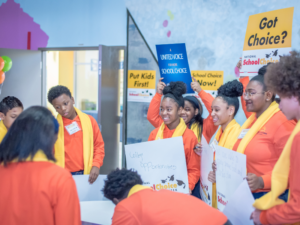
Georgia Gov. Brian Kemp has issued a proclamation declaring January 22-28 as National School Choice Week.

The Georgia Center for Opportunity’s (GCO) take: “Parents are demanding more options in education, spurred on by the seismic changes we’ve seen in K-12 schools during the pandemic,” said Buzz Brockway, executive vice president of public policy for GCO. “On this front, we’re proud that Georgia is leading the charge on expanding educational opportunity for every child, not just for those from families with the right income or who live in the right zip code. This legislative session, Georgia lawmakers must build on the progress we’ve made in recent years by approving Education Scholarship Accounts to ensure educational access for all.”


Helping Marginalized Students Access Quality Education

Mountain Area Christian Academy recently celebrated the passage of the Georgia Special Needs Scholarship Expansion bill, also known as SB 47. After Governor Kemp signed SB 47 into law, Mountain Area Christian Academy hosted the Georgia Center for Opportunity, our partner organizations, and the two sponsors of the bill (state Senator Steve Gooch and state Representative Will Wade) to simply say “Thank you.”

SB 47 increases both funding and access to a quality education for students with special needs. The new law helps schools like Mountain Area Christian Academy address exceptional students according to their needs.

I don’t have to tell you how much this pandemic has damaged students’ educational outcomes—particularly for those with special needs—but what I will tell you is that we will not stop fighting for all students.

At the Georgia Center for Opportunity, we believe that this bill is an important first step as we move to help more marginalized communities access quality educational options statewide.


The Special Needs Scholarship expansion opens doors to kids not able to access education opportunities. This is a vital first step in efforts to insure that ALL our kids have access to quality education.

Mom and special needs son

Students are missing the magic that happens in a classroom that cannot be replicated on a Zoom call

When the pandemic came home to DeKalb County in March 2020, Jennifer Sheran and her husband never expected that it would touch off a year-long stint of trials.

It all began with the public school system’s transition to online learning. A virtual classroom worked fine for Jennifer’s two older children, but her youngest son, 10-year-old Joey, has Down syndrome. Online learning is entirely unworkable for him due to his special needs.

For example, DeKalb is following a normal bell schedule but staying engaged on Zoom for hours on end is not working. Morning classes will sometimes go well, but by lunchtime Joey is tuned out. It is impossible to get him back online after the lunch break for specials, such as music and art, and Jennifer cannot stay tied up until 2:30pm every day. She has seen academic and social regression for her son as he has little to no interaction with peers.

Additionally, his academic growth is limited due to repetitive practice of current skills on worksheets with no new individual instruction to learn new concepts in language arts or math. As a highly visual and experiential learner, he is missing the magic that happens in a classroom that cannot be replicated on a Zoom call.

“It’s day-by-day and minute-by-minute,” Jennifer shares. “One class he is engaged and on task, and the next minute he is hiding under the bed or taking his shirt off.”

Adding fuel to the fire, Jennifer’s 25-year career in PR and corporate communications hit a speed bump in July when she lost her full-time job. Her income was a significant part of the household budget.

Normally, Jennifer would have launched a job search immediately, but the demands of online learning for Joey meant that she could only pick up a few freelance projects to try and bridge a small part of the gap in their family budget.

Today, nearly a year after DeKalb schools went virtual, Jennifer is getting so desperate that she and her husband have decided to list their home in Dunwoody and move south to Henry County, where public schools have been open for in-person instruction since September.

We’re expanding opportunities and giving new hope to children across the state. All students deserve access to high quality education options. 

Good news on the horizon

Another layer of challenges hit when Jennifer’s mother had a stroke and is now in rehab. With her father already suffering from COPD and advanced kidney disease, the Sherans will be selling their home and moving in with her parents to be caregivers until they can make the permanent move to Henry County.

All schools continue to have their doors shut to in-person learning, Jennifer shares that the special needs community “is getting completely overlooked.”

“In other states and even elsewhere in Georgia, school districts make accommodations, understanding that special-needs students have a need to return back to classrooms earlier than others,” she said.

There is good news on the horizon for families like Jennifer’s: Georgia Governor Brian Kemp recently allocated $10 million in federal emergency relief dollars specifically to reimburse parents of students with special needs for education expenses incurred during the pandemic.

In Jennifer’s case, the funds would be crucial to help hire tutoring help so that she can find more work to make ends meet.

“One-size-fits-all won’t work here,” she said. “We can’t allow our special-needs students to fall even further behind. They will be more dependent on society as they transition to adults. These children are capable of so much if we give them the support they need.”

We could all use a good laugh right now, right?

We’re excited to announce that  comedian and inspirational speaker Michael Jr. will be joining us as a keynote speaker for Breakthrough Online 2020.

Known as one of today’s most gifted comedians, Michael Jr. brings laughter and understanding to audiences all over the world. Michael has spent a significant portion of his career making laughter commonplace in uncommon places such as homeless shelters and prisons. 


Now, Michael Jr. tours the country using comedy to inspire audiences to activate their purpose and live a life fulfilled.


Megan and teacher at table

Breakthrough is a way for you to share your work, explore new ideas, and connect with other organizations that are making an impact in our communities. This collaboration of ideas is why the Georgia Center for Opportunity exists and we are excited to have you join us.

Register Now

Also joining us to speak at Breakthrough: Gov. Brian Kemp

Impressive line-up of panels

We all could use a good dose of inspiration, now more than ever. That’s exactly what you’ll get with our breakout sessions:

  • Education: The challenge of virtual learning in the COVID-19 era
  • Employment: Job creation through community collaboratives
  • Family: Personal wellness during the pandemic
  • Development: Nonprofit fundraising in 2020


Register today: Thursday, November 5, 8:30am to 4:00pm EST
We’re excited to offer Breakthrough in a new virtual format as we continue to partner together for a better Georgia. Join us!

Register Now

Subscribe

* indicates required

Subscribe

* indicates required