Media statement, in the news, Georgia news, ga news

PEACHTREE CORNERS, GA—The Georgia Center for Opportunity (GCO) offers its full support to the Stronger Workforce for America Act of 2026 and commends Congressman Tim Walberg, Chair of the House Committee on Education and Workforce, for introducing this significant legislation to reauthorize the Workforce Innovation and Opportunity Act.

GCO is a nonprofit, nonpartisan organization that focuses on ensuring access to quality education, fulfilling work, and healthy family lives through research, policy analysis, and community initiatives. We advance solutions that increase opportunity and give Georgia families a durable path out of poverty. We are also a founding member of the Alliance for Opportunity, a multi-state coalition focused on improving state-administered public assistance and workforce programs to help Americans achieve lasting opportunity and stability.

The Stronger Workforce for America Act aligns with our work and includes an invaluable option for state flexibility, the Make America Skilled Again Grants. These grants would allow 10 states to implement the One Door to Work model, which would empower them to integrate their safety net and workforce systems.

Utah has had this authority for nearly 30 years, after being grandfathered into the strategy. This has enabled Utah to provide its citizens with both support to meet their immediate needs and a clearer path into the workforce and toward self-sufficiency.

The results of Utah’s One Door policy are impressive. For example, the state has outpaced the national labor force participation (LFP) rate, or the number of working-age people employed or looking for a job, by an average of 5.3%. As of late 2025, Utah’s LFP rate was approximately 67.6%, one of the highest in the nation.

In contrast, Georgia’s LFP rate is 60.6%. Put another way, nearly 40% of Georgians, many of them prime-age men, who can work are choosing not to.

Eric Cochling, GCO’s Chief Program Officer and General Counsel, emphasized the detrimental impact of these statistics and the critical importance of work for a flourishing life:

“A good job offers more than just a paycheck. It provides purpose and stability and is one of the most durable ways to empower people to break the cycle of poverty.”

He also stressed the need for reform: “If we truly want to expand opportunity in Georgia and across the country, individual workforce and safety net programs must start functioning as a true system—one that’s designed to support human dignity and flourishing. The Stronger Workforce for America Act is a much-needed step in the right direction.”

Georgia policymakers are paying attention to the success of Utah’s integrated welfare and workforce system and are seeking opportunities like the Make America Skilled Again Grants to implement similar reforms that benefit both Georgians and the state economy.

As Buzz Brockway, GCO’s Vice President of Public Policy, said:

“The ability to link workforce and safety net systems is key to boosting Georgia’s current trajectory as a leader in economic opportunity. The Make America Skilled Again Grants included in the Stronger Workforce for America Act would give Georgia’s leaders a powerful way to strengthen families, expand the workforce, and set the state on a path to more rapid growth.”

Randy Hicks, GCO’s President and CEO, added:

“Every state deserves the ability to design an integrated system that enables people to thrive. Right now, every wasted hour navigating disconnected programs is an hour that could have been spent building a better future. This bill ensures that states can rethink the status quo and create pathways to opportunity for every citizen.”

Through the changes it proposes, the Stronger Workforce for America Act of 2026 is poised to make meaningful welfare and workforce reforms possible in Georgia, and GCO strongly urges its enactment.

###

Georgia Center for Opportunity (GCO) is independent, non-partisan, and solutions-focused. Our team is dedicated to creating durable paths out of poverty for families in Georgia and beyond. To achieve our mission, we research ways to help remove barriers to opportunity and promote our solutions to policymakers and the public so that public policy and civil society can effectively and innovatively strengthen family stability, economic mobility, and child opportunity in the communities where lives are lived. 

Send media inquiries to:

Rebecca PrimisGeorgia Center for Opportunity
RebeccaP@foropportunity.org 

press release, news, The press release prominently features the company logo and headline, with visible text detailing the announcement.

PEACHTREE CORNERS, GA—Georgia’s prison population has shrunk in recent years, but a new Manhattan Institute report written by Joshua Crawford, a Public Safety Fellow at the Georgia Center for Opportunity, shows that the decreasing number of inmates hasn’t translated to meaningful savings or improvements in public safety for Georgians.

Instead, the report reveals that corrections spending has risen as Georgia’s prison population has declined. The number of incarcerated Georgians dropped by 11.7% between 2010 and 2023, but corrections spending increased by 23.6% over the same period. The trends in Georgia are consistent with those in almost every other state—incarceration rates are falling while corrections budgets are growing. 

The data confirms that reducing the number of people in prison isn’t the answer to decreasing the state budget in Georgia or elsewhere. 

As Crawford says, “Georgia lawmakers should focus conversations about criminal justice where they belong: on protecting the public and creating a fair and just system that values the lives, liberty, and property of Georgia families. Those are things lawmakers can meaningfully impact immediately, while criminal justice budgets are more complex and fixed.”

At a glance: facts on the prison population and corrections spending in Georgia

  • In 2023, 49,814 people were incarcerated in Georgia.
  • From 2010-2023, Georgia’s prison population decreased by 6,618 people, or 11.7%.
  • From 2010-2023, Georgia’s corrections spending increased by $258,546,766, or 23.6%.
  • In fiscal year 2023, Georgia’s Department of Corrections budget was $1,354,962,683, or 2.2% of the state’s total budget.

A closer look at Georgia’s inmate numbers and corrections spending

The number of people in Georgia’s prisons decreased by 6,618 to 49,814 from 2010-2023, but corrections spending in Georgia increased by $258,546,766 during the same time frame.

Notably, Crawford points out most individuals in Georgia’s prisons are violent and repeat offenders, and the majority have had five or more prior arrests before incarceration. Because these offenders pose higher public safety risks and drive most of the system’s costs, reducing inmates at the margins does little to generate savings. 

Even with the growth in spending, Georgia’s overall Department of Corrections budget in fiscal year 2023 was $1,354,962,683, just 2.2% of the state’s total budget. The vast majority of state dollars went toward other initiatives that help Georgians prosper, including education, public welfare, healthcare, and highways.

Regarding corrections spending, Crawford explained that “because prison budgets are driven by fixed costs like payroll, maintenance, and facilities, modest reductions in the number of inmates don’t free up meaningful savings. Unless states close prisons or dramatically cut staffing, costs remain largely unchanged.”

Reshaping the conversation on criminal justice policy

Long-standing arguments continue about reducing the prison population as a way to decrease Georgia’s overall spending. But the data shows that policymakers need to focus instead on building a more effective criminal justice system that addresses the true costs of crime and helps Georgians flourish.

One crime was committed every 2 minutes and 33 seconds in Georgia in 2024. The effects of this criminal activity are devastating for local communities. Violent crime, in particular, takes a huge toll on property values, employment, economic opportunities, and people’s upward mobility.

Ensuring safety is a core government responsibility, and it’s the first step in creating more prosperous communities throughout Georgia. Public safety is essential to improving economic opportunities, building healthy relationships among neighbors, and enabling Georgians to thrive.

With effective reforms, policymakers can make safety a reality for Georgia’s residents, breaking the interconnected cycles of poverty and crime and transforming communities for generations to come.

About the Georgia Center for Opportunity

The Georgia Center for Opportunity is a nonprofit organization that works to remove barriers to ensure that every person—no matter their race, past mistakes, or the circumstances of their birth—has access to safe communities, a quality education, fulfilling work, and a healthy family life. 

###

Georgia Center for Opportunity (GCO) is independent, non-partisan, and solutions-focused. Our team is dedicated to creating opportunities for a quality education, fulfilling work, and a healthy family life for all Georgians. To achieve our mission, we research ways to help remove barriers to opportunity in each of these pathways, promote our solutions to policymakers and the public, and help effective and innovative social enterprises deliver results in their communities.

Send media inquiries to:

Rebecca Primis
Vice President of CommunicationsGeorgia Center for Opportunityrebeccap@foropportunity.org


Media statement, in the news, Georgia news, ga news

Kentucky state lawmakers voted Friday to override a veto from Gov. Andy Beshear of House Bill 5, the Safer Kentucky Act. The new law will lower crime by addressing gang-related violence, updating carjacking laws, facilitating successful reentry programs, and more.

The Center for Opportunity’s take: “Although all of Kentucky will benefit from this new law, the positives will be concentrated in poor and low-income communities, where the impacts of crime are felt disproportionately,” said Josh Crawford, director of criminal justice initiatives for the Center for Opportunity. “We can’t even begin to discuss the best ways to economically revitalize an area until we address the crime problem. Safe streets lead to thriving communities. The Safer Kentucky Act is a crucial step forward in achieving this end.”

For more on the Safer Kentucky Act, click here.

    Media statement, in the news, Georgia news, ga news

    Georgia Gov. Brian Kemp used a significant portion of his State of the State address today to urge lawmakers to expand educational opportunity in the new session. Kemp said:

    Many members in both chambers have worked hard on this important issue and I want to thank and applaud them for their efforts.
    Some prefer the term school choice or educational freedom, some call them vouchers.

    In my opinion, what each of those terms or slogans fail to mention is the child. At the end of the day, our first and foremost consideration should be the future of that student.

    Our job is not to decide for each family, but to support them in making the best choice for their child.

    This week, as we begin the second year of another biennial of the General Assembly, I believe we have run out of “next years.”

    I firmly believe we can take an all-of-the-above approach to education… whether it’s public, private, homeschooling, charter, or otherwise.

    It is time for all parties to get around a table and agree on the best path forward to provide our kids the best educational opportunities we can – because that’s what we were elected to do.

    To that end, my office and I look forward to working with the members and leadership of both chambers to get a bill passed and signed into law this session.

    The Georgia Center for Opportunity’s (GCO) take: “Gov. Kemp is exactly right — the time for educational opportunity is now, and Promise Scholarships are the best step forward to accomplish it,” said Buzz Brockway, vice president of public policy for GCO. “With the governor, we applaud the courageous lawmakers who have championed Promise Scholarships in the House and Senate, and we encourage those who are still holding out on their support to consider what’s best for children, not what’s best for a system. We look forward to working with the governor and legislative leaders to make Promise Scholarships a reality this session.”

    Columbus Cityscape

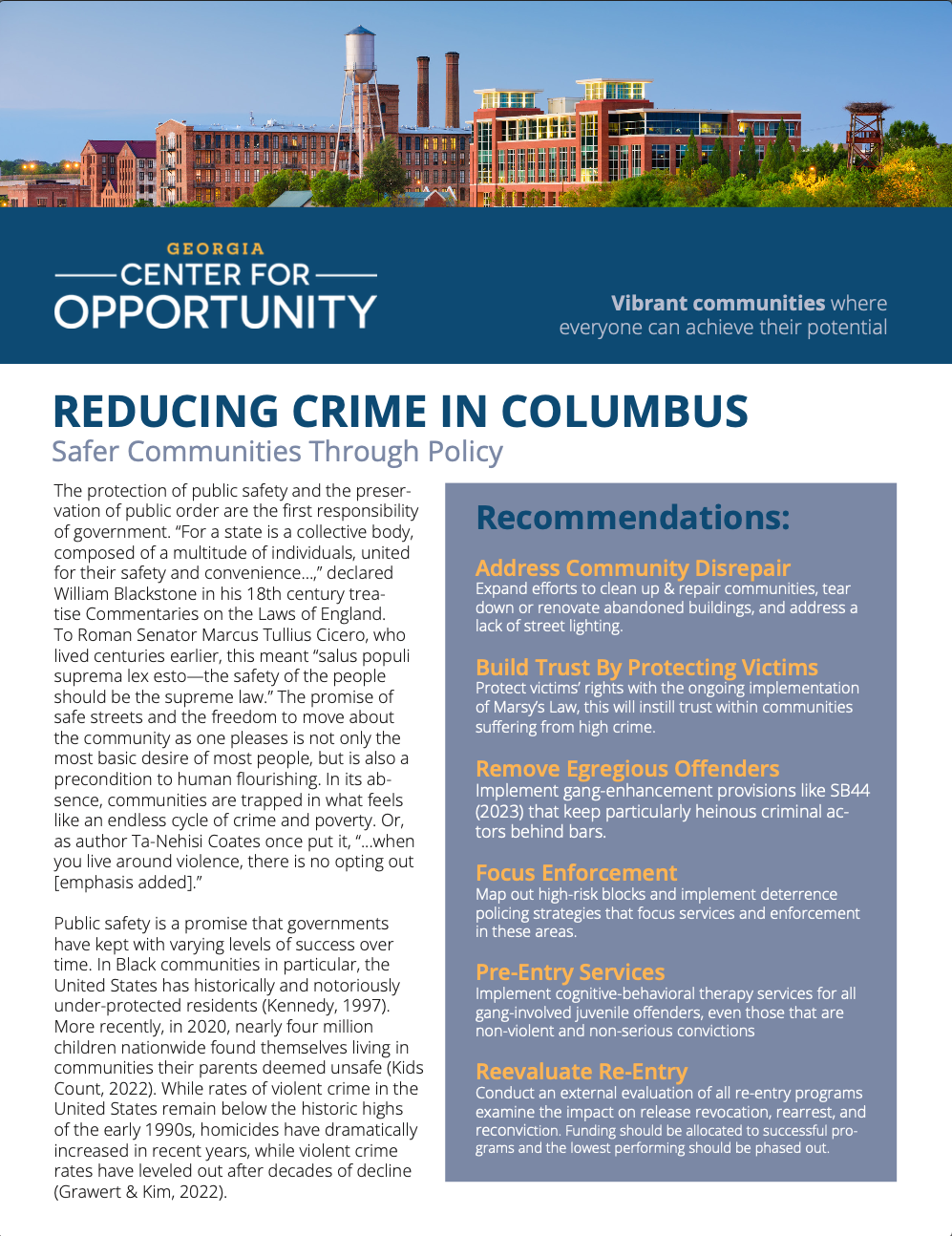
    Violent crime is on the rise in Columbus, Georgia. What are the reasons, and can anything be done to stop it? Those questions are the topic of a new report from the Georgia Center for Opportunity (GCO) focused on Columbus’ recent spike in crime and ideas on how to mitigate it.

    Titled “Reducing Crime in Columbus: Safer Communities Through Policy,” the report is authored by Josh Crawford, Director of Criminal Justice Initiatives at GCO.

    Cover of the Columbus Crime Report

    Access the Report:

    Reducing Crime in Columbus

    Our Columbus Crime Report details six practical solutions that city leaders can use to reduce crime in Columbus and restore safety, hope, and opportunity to the broader community. 

    Learn More About This Report

    Reducing Crime in Columbus: Safer Communities through Policy

    “Since 2017, crime has been on the rise in Columbus. And it’s only gotten worse during the COVID-19 pandemic,” Crawford said. “It’s imperative that city and community leaders come together to solve this problem. Our new report provides the groundwork.”

    Quick Facts on Crime in Columbus

    • Columbus saw one of its most violent years with 59 murders in 2021.
    • The city’s population is on the decline, correlated to the rise in violent crime.
    • A decrease in Columbus police has gone hand-in-hand with the crime spike.
    • Attempted murder convicts in Columbus who were released in 2022 only served 35% of their time.

    “The human cost of this violence is dramatic, cutting lives short and leaving behind grieving families and fractured communities,” Crawford said. “The toll of violent crime goes beyond the physical cost to those directly impacted and includes financial costs to victims and taxpayers, the loss of productive years, and decreased economic mobility and growth in communities afflicted with high rates of crime.”

    Six Policy Recommendations to Reduce Crime

    Fixing the Columbus crime problem is about focusing on the most violent offenders. By addressing gang-related violence and solving more homicide investigations, Columbus can restore community safety, improve trust with city officials and law enforcement, and expand upward mobility and opportunity for residents.

    Crawford suggests:

    • Addressing disrepair in Columbus’ communities by expanding cleanup efforts, tearing down or renovating abandoned buildings, and installing adequate street lighting.
    • Building trust between community residents and law enforcement and social services, particularly through protecting the rights of victims.
    • Removing egregious offenders from communities by implementing gang-enhancement provisions such as SB44 (2023) that keep these individuals incarcerated.
    • Improving and requiring pre-entry cognitive behavioral therapy services for all juvenile offenders, no matter how non-violent their offenses.
    • Reevaluating reentry programs through an external third party, examining the impact on revocation, rearrest, and reconviction.

    Schedule An Interview

    About The Author

    Josh Crawford

    Director of Criminal Justice Initiatives

    Josh Crawford is a native of Massachusetts. He went to Penn State for his undergraduate degree and then finished law school in Boston. After a brief stint in Sacramento, California, working in the county district attorney’s office, Josh moved to Kentucky to help start the Pegasus Institute, a nonpartisan organization designed to promote opportunity. In addition to serving as executive director of the organization, Josh had a special focus on criminal justice policy.

    “By focusing on public safety and order, we can restore hope and opportunity to rural communities.”

    Subscribe

    * indicates required

    Subscribe

    * indicates required