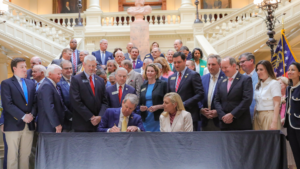
Georgia Governor Brian Kemp signs a bill into law.

Key Points

  • Georgia’s future is on the ballot in 2026 as voters elect a new governor to lead the state for the next four years. In the May 19th primary elections, Georgians picked candidates to represent each political party. They’ll choose the final winner in the general election on November 3.

  • The governor influences major issues that affect Georgians every day, like taxes, education, health care, work opportunities, and public safety.

  • Understanding the governor’s role can help voters cast their ballots for a candidate who can bring even more hope, well-being, and prosperity to people and communities across the state.

When Georgians vote for governor, they’re choosing more than a public figure. They’re electing the leader who sets the direction for everything from schools and public safety to taxes and the economy. 

While the governor can’t create laws like the legislature does, they shape daily life by deciding how the state will spend money, what bills get signed, and how certain public programs for families will operate. 

Quick Facts About Georgia’s Governor

  • Current Governor: Brian Kemp
  • Next Election Date: November 3, 2026, for the general election 
  • Term Length: Four years, with a maximum of two back-to-back terms
  • Minimum Age Requirement: 30 years old by Inauguration Day
  • Counties the Governor Serves: 159
  • State Budget the Governor Oversees: $36.6 billion

How Does the Governor Impact Everyday Lives in Georgia?

1. The governor can sign—or stop—new laws.

After a bill passes in Georgia’s House and Senate, it goes to the governor, who can sign it, veto it, or let it become law without a signature. 

If the governor vetoes a bill, Georgia’s legislators can override that action, but only with a two-thirds majority in both chambers. To avoid a veto, lawmakers usually aim to pass legislation that reflects the governor’s policy priorities.

In 2026, Georgia’s legislature passed bills that created pathways for kids to take advanced math classes in earlier grades and to improve their reading skills. The bills aligned with Governor Kemp’s goal of increasing opportunities for Georgia students, and he signed them into law right after the legislative session ended.

Georgia Governor Brian Kemp signs 2026 bills to support literacy, math education, and K-12 public schools.

On May 5, 2026, Governor Brian Kemp signed nine bills to support reading, math education, and K-12 schools in Georgia.
Photo Credit: Office of the Governor Photo Gallery

2. The governor helps decide where the money goes.

Every year, Georgia’s governor proposes a state budget that outlines how taxpayer dollars should be spent. Because the budget reflects the programs and services that will receive funding, it reveals the governor’s top priorities for the state. 

The legislature revises and passes the budget, but the governor still has a final influential role. Before signing the budget into law, the governor can use a line-item veto to remove parts of the budget they don’t agree with while leaving the rest as is. 

In May 2026, Governor Kemp signed House Bill 974, the state budget bill for the fiscal year starting July 1. The $36.6 billion budget directs most funding toward education, health care services, public safety, and economic growth—a clear signal of what the governor cares about. Before signing, Governor Kemp used his line-item veto authority, removing some expenses to keep the budget in balance after approving income tax cuts.

3. The governor chooses the leaders behind key family services.

Government policies aren’t implemented in one big speech or one dramatic vote. Instead, they’re carried out every day by state agencies, boards, and commissions.

The governor appoints many of the heads of those administrative offices. They oversee daily operations in workforce development, child and family services, public safety, licensing, education administration, and programs that help low-income Georgians.

The governor steers welfare (safety net) policies, for example, by appointing the members of the Board of Human Services. The members establish the state’s goals for welfare programs like the Supplemental Nutrition Assistance Program (SNAP).

4. The governor sets the policy agenda.

The governor has a powerful microphone: the annual “State of the State” address. At the beginning of the legislative session, the governor uses this speech to outline their priorities and encourage lawmakers to act on specific policies. 

And when the governor elevates an issue—whether it’s education, workforce development, public safety, or taxes—it usually moves quickly from a policy idea to serious legislative action. 

In his 2026 State of the State address, Governor Kemp proposed decreasing the state income tax to 4.99% to help Georgians keep more of what they earn. The legislature followed up by passing House Bill 463, which the governor signed into law.

5. The governor leads during emergencies.

The governor uses executive orders and emergency powers to quickly mobilize state resources when storms, wildfires, public safety threats, or other emergencies hit. 

In April 2026, Governor Kemp declared a state of emergency for 91 counties in response to South Georgia wildfires and empowered state agencies to help affected residents and their families.

FAQs: The Georgia Governor’s Race in 2026 and the Election Process

How Is Georgia’s Governor Elected?

Georgians elect their governor through a direct popular vote. Unlike presidential elections, there isn’t an electoral college that casts deciding votes.

During primary elections, voters pick final candidates from each political party. Contenders have to earn at least 50% of the votes in the primary to win, so run-off elections are possible. 

The same requirement applies in the general election. If no candidate earns more than half the votes, the top two competitors head to a run-off.

Who Can Run for Governor?

A candidate must:

  • Be at least 30 years old by the time they take office
  • Have lived in Georgia for at least six years before the election
  • Have been a U.S. citizen for at least 15 years

How Long Can a Governor Serve?

Georgia governors have four-year terms and can serve up to two back-to-back terms. Former governors can run again after sitting out for at least one term.

What Happens if a Governor Leaves Office Early?

The lieutenant governor is next in line for the job and serves until the next general election.

Which Political Parties Have Georgia’s Governors Belonged to Historically?

Georgians have elected Republican governors since 2003. Before then, Democratic governors had held the office continuously since 1872.

Timeline of political party affiliations of past Georgia governors from 1971 to 2026.

Source: Former Governors in Georgia, National Governors Association

What Issues Are Candidates Talking About in 2026?

The rising cost of living is one of the biggest concerns for Georgia families—and it’s become a major focus in the 2026 governor’s race. Key affordability issues include:

  • Income Taxes: Some candidates are proposing plans to further reduce or eliminate the state income tax so Georgians can keep more money in their own pockets. 
  • Property Taxes: As housing costs continue to rise, contenders are thinking about freezing property taxes or increasing exemptions to ease the burden on homeowners. 
  • Housing Shortages: Candidates are debating how much the state should get involved in local land-use regulations to spur construction of more homes, especially those at lower prices.
  • Health Care: Gubernatorial hopefuls are proposing options to address Georgians’ health care concerns, including expanding Medicaid and reducing the cost of health insurance.

Beyond affordability, candidates are focusing on several other issues affecting families and communities across Georgia:

Welfare Reform: Contenders are thinking about how to lead the state in making big changes to welfare programs, including: 

Education: To give Georgia’s children better pathways to academic success, candidates are debating on more school choice vouchers, increased public school funding, and new early childhood education options. 

Public Safety: Competitors are prioritizing safety and security for Georgia communities by looking at ways to tackle gang activity, reform the juvenile justice system, and reduce repeat offenses. 

Why Does Understanding the Governor’s Role Matter?

Candidates know that more needs to be done to break down the economic and social barriers so many people are facing, and they’re making plans to take action if elected. But policymakers aren’t the only ones responsible.

Understanding the governor’s vital role and what they’ll do to meet the daily needs of Georgia families and neighborhoods can help voters guide meaningful change. By casting their ballots, Georgians can bring even more promise and prosperity to the state—making it a place where everyone has the chance to achieve their full potential and thrive.

Additional Resources

2026 Polls: Georgia Governor
270 to Win

Keeping Vulnerable Americans on Track: One Door out of Poverty and into Opportunity
Alliance for Opportunity

What States Can Expect with the New SNAP Match: Options to Reduce State Error Rates
Alliance for Opportunity

Georgia Candidates for Governor Should Make Welfare Reform a Top Priority
Atlanta Journal-Constitution

Georgia Gubernatorial Election, 2026
Ballotpedia

Governor of Georgia
Ballotpedia

Lieutenant Governor of Georgia
Ballotpedia

Georgia 2026 Election: Here’s Who Will Be on the Ballot During May’s Governor, Senate Primaries
CBS News

Understanding Welfare Work Requirements: New Eligibility Rules for SNAP and Medicaid
Georgia Center for Opportunity

Organization of the Executive Branch
Georgia Public Broadcasting

What Does a Governor Do?
Georgia Public Broadcasting

Short Supply: How Many More Homes Does Georgia Need?
Georgia Public Policy Foundation

10 Races for Governor to Watch in 2026
NBC News

Governor’s Office
State of Georgia

Lieutenant Governor’s Office
State of Georgia

The Three Branches of Georgia’s State Government
State of Georgia

Image Credits: Canva; Governor’s Photographer, Georgia Office of the Governor

An empty street and closed businesses illustrate the real-life impact of crime on poverty in a community.

Key Points

  • As Americans become more skeptical of the American Dream, an important issue to address is the link between poverty and violent crime. 
  • Research has found that violent crime negatively affects property values, employment, and outcomes for children. 
  • Providing a safe environment is a core government responsibility, and it’s essential for lowering fear, improving economic mobility, and building healthy communities. 

A recent Pew Research Center poll examined American attitudes about the attainability of the American dream. Overall, 53% of respondents believed the American dream was still possible. 

Responses were remarkably consistent across race and differed only slightly by party affiliation (56% for Republicans, 50% for Democrats). 

Age was the factor where more drastic differences of opinion started to emerge. The younger the cohort, the lower the percentage of respondents who felt the American dream was still possible. 

  • Age 65+: 68% believed the American dream was still possible. 
  • Age 50-64: 61% thought the American dream was still possible. 
  • Age 30-49: 43% felt the American dream was still possible. 
  • Age 18-29: Just 39% agreed the American dream was still possible.  

Among the youngest groups, a larger percentage—48% of 30 to 49-year-olds and 51% of 18 to 29-year-olds—thought the American dream was once possible but no longer was. 

The current attainability of the American dream is subject to much debate, not fleshed out here. One factor that deserves more attention is the role of public safety in shaping communities where people have opportunities for a better life for themselves and future generations.  

Of all the barriers to opportunity, violence is one of the most vicious because it can single-handedly upend all the building blocks of a flourishing life—family stability, access to quality education, and work opportunities. And a disproportionate amount of this suffering is borne by our poorest and most vulnerable communities. 

Nearly 50% of According to Pew Research polling, Americans think the American Dream is no possible.

The impact of crime on children

Future generations have a harder time getting ahead in life. 

It’s clear from the data that nearly half of children raised in the poorest households—the bottom 20% of incomes—end up in that bottom 20% as adults. A tremendous number of factors contribute to this cycle of poverty—from the flaws in government safety net programs to the affordability of housing to improving educational options and outcomes.

Then there’s the link between poverty and crime. One of the most visceral and heartbreaking things that impacts a child’s upward mobility is growing up in a community with a high rate of violence.

According to the Annie E. Casey Foundation, about 3.6 million kids live in communities their parents deem to be “unsafe.”

The level of violent crime in a county negatively affects the level of upward economic mobility among individuals raised in low-income families. Opportunities decline because high rates of violence reduce productivity among crime victims, depress economic activity, reduce home values, and drive out residents who can leave. 

In communities struggling with poverty, violent crime can lead to worse outcomes for kids.

According to the Annie E. Casey Foundation, about 3.6 million kids live in communities their parents deem to be “unsafe.”

In communities struggling with poverty, violent crime can lead to worse outcomes for kids.

According to the Annie E. Casey Foundation, about 3.6 million kids live in communities their parents deem to be “unsafe.”

The impact of crime on local economies

Communities become economically unhealthy. 

A relationship between poverty and crime also manifests itself in the effects that violence has on employment. Several studies have demonstrated that direct victimization is associated with more unemployment and less productivity at work. 

  • A study of violent trauma patients found a positive association between victimization and unemployment. 
  • Another study found that, following the homicide of a family member, employment went down 27% among surviving family members. 
  • In a sample of parents whose children had been murdered, more than 50% of the parents perceived themselves as nonproductive at their jobs in the four months after the murder.

High rates of violent crime don’t just impact victims. Rising crime has been negatively associated with business activity, resulting in downsizing and discouraging new businesses from entering the marketplace.

Neighborhoods then lose out on opportunities for jobs and affordable access to food, household items, and other essential goods and services. 

One large analysis looked at the impact of gun violence on the economic health of neighborhoods in six cities: Baton Rouge, LA; Minneapolis, MN; Oakland, CA; Rochester, NY; San Francisco, CA; and Washington, DC. The findings were remarkably consistent. An increase in gun violence in a census tract reduced the growth rate of new retail and service establishments by 4% in Minneapolis, Oakland, San Francisco, and Washington, DC. 

In Minneapolis, each additional gun homicide in a census tract in a given year was associated with 80 fewer jobs the next year; in Oakland, a gun homicide was associated with 10 fewer jobs the next year. 

Local business displays %22open%22 sign.

“Local and state governments must focus on reducing violent crime, not just as necessary to protect human life but also because doing so is a prerequisite to real economic opportunity in poor communities.”

Josh Crawford, GCO Director of Criminal Justice Initiatives

Local business displays %22open%22 sign.

“Local and state governments must focus on reducing violent crime, not just as necessary to protect human life but also because doing so is a prerequisite to real economic opportunity in poor communities.”

Josh Crawford, GCO Director of Criminal Justice Initiatives

The impact of crime on neighborhoods

Communities stop becoming places that people want to call home.

Studies have also found that increases in gun violence hurt property values.

  • In Minneapolis: Each additional gun homicide resulted in a $22,000 decrease in average home values in Minneapolis census tracts.
  • In Oakland: Each additional gun homicide resulted in a $24,621 decrease in Oakland census tracts.
  • In Los Angeles: A separate study found that increases in violent crime in a neighborhood in a given year yielded decreases in property values in that neighborhood the following year. 

And those who can leave communities with high rates of violence, do. One estimate found that, for every homicide, 70 residents move out of a neighborhood.

Finally, increased violent crime often, justifiably, leads to more incarceration. But communities with higher rates of incarcerated parent-aged men often have weaker social institutions and are more unstable. 

To have vibrant communities and flourishing lives, public safety must take priority.

Improving economic conditions and opportunities for any community, but especially low-income neighborhoods, is incredibly difficult without first reducing violence.

One of the most recent examples is the great crime decline of the 1990s, which dramatically improved the most desperate neighborhoods and improved life among their residents. 

It doesn’t have to be this way. Decades of policy innovation, evaluation, and replication have taught us how to make communities safer and break the interconnected cycles of poverty and crime.

The most effective methods include:

  • Focusing law enforcement efforts on criminal street gangs
  • Punishing violent recidivists appropriately
  • Reducing the presence of abandoned buildings in crime hot spots

People have a deep need to feel safe and secure in the places where they live, work, and go about their day-to-day lives. Providing a safe environment is government’s first responsibility to its people.

When it comes to public safety, making good policy choices changes lives—not only by reducing physical harm but also by transforming neighborhoods into places where the American Dream can still be found.

Visit our public safety resource page to learn more about policy solutions and see recommendations for specific cities. 

Georgia news, in the news, current events, Georgia happenings, GA happenings

In this opinion editorial published in The Washington Times, Joshua Crawford highlights the escalating crime crisis in Washington, D.C., particularly focusing on a significant surge in violent crimes, including a staggering 104% increase in carjackings from the previous year. Crawford points out that a majority of carjacking arrestees in the city are under 18, with many being repeat offenders associated with or recruited by street gangs. The author suggests that Washington can learn from Louisville, Kentucky’s successful efforts to address teen violence. In Louisville, Republican state Rep. Kevin Bratcher spearheaded House Bill 3, a comprehensive measure aimed at holding violent juvenile offenders accountable and providing treatment. The bill mandates immediate detention for juveniles charged with serious violent offenses, offering a disruptive intervention in the cycle of violence. It also allocates funds for a new detention center and treatment programs, including cognitive behavioral therapy.

Read the full opinion editorial in The Washington Times.


Mesha Mainor, education, party switch, ga politics

Key Points

  • Mainor’s party switch shows her dedication to expanding educational options.
  • There is a growing national movement in favor of educational opportunity, with several states enacting universal access to education.
  • Parents show public support for school choice, especially within minority communities, and Mainor’s recognition of the urgent need for better educational options in her district says she’s listening to her constituents.

Our state and nation would be far better off if there were more principled lawmakers like Rep. Mesha Mainor around.

Mainor recently made national headlines by announcing her change in party affiliation from Democrat to Republican. A prominent Georgia Democrat and sitting state senator has already vowed to ensure she is defeated in next year’s primary election. Partisanship aside, one of Mainor’s primary reasons for switching was due to her support for expanding educational options to all students.

Mainor was the only Democrat to vote in favor of Georgia’s Promise Scholarships Act earlier this year. The measure would have put $6,500 per student back into parents’ pockets so they could fund the best educational approaches for their children, including private school tuition. The bill was targeted so that students in some of the poorest performing public school districts across the state would have access.

The measure passed the Senate with unanimous Republican support but fell short in the House with a number of Republicans breaking with their party to oppose the measure. Thankfully, the bill is alive for the upcoming 2024 session.

Mainor is a prime example of a lawmaker putting the best interests of her constituents first — especially her constituents who are impoverished and reside in zip codes with limited educational options. This type of integrity is rare in politics and policy making these days.

But her decision doesn’t stand in a silo. It is reflective of a growing national movement in favor of educational opportunity. Half a dozen states have already enacted universal — or near universal — access to educational opportunity in 2023 alone. Lawmakers across the U.S. are recognizing the growing national consensus around this issue. 

The most recent evidence is a new poll showing that 71% of Americans support the concept of “school choice,” which is defined as giving taxpayer dollars back to parents to empower them to choose the right school for their child. The COVID-19 pandemic was a catalyst for even stronger public support, with backing for school choice growing seven percentage points between now and the beginning of the pandemic.

Crucially, 73% of African Americans and 71% of Hispanics support school choice. This is a reality Mainor has recognized in her own district, which is predominantly minority — she sees the desperate need these families have for an educational lifeline.

“In my district in particular, we have schools with 3% reading proficiency, 3% have obtained math proficiency by the eighth grade,” Mainor told Fox News Digital. “And so to say that this is just how it is and that the kid needs to just suffer these consequences, I don’t agree with that. And I don’t think that all parents agree with that either.”

Perhaps more revealing is the fact that the poll found widespread support for school choice even among Democrats — to the tune of 66%.

It’s a shame that Mainor was forced from her political party in large part because she refused to toe the line on what should be a bipartisan issue — and an issue that clearly is viewed as bipartisan among the electorate in general.

A poll found widespread support for school choice even among Democrats — to the tune of 66%.

A poll found widespread support for school choice even among Democrats — to the tune of 66%.

It’s an issue that helps students like Aiden, a young man with special needs who wasn’t getting the specialized education he needed in local public schools in Cobb County. The answer came through a specialized private school in Atlanta. Or the story of Hudson, another student with special needs whose life was transformed by access to an alternative education option.

We commend Mainor for her bravery and integrity as we build a future where every child has access to an excellent education.

Talk To An Expert

About The Author

David Bass

Press Manager

David Bass is a journalist and communications professional with nearly two decades of experience in the world of PR, marketing, and publications.

Georgia news, in the news, current events, Georgia happenings, GA happenings

In January, Atlanta Mayor Andre Dickens launched the “Year of the Youth” plan to combat juvenile crime rates in the city. The issue is a pressing one. Consider that in 2022, 19 of the 170 homicide victims in Atlanta were children. Deshon DuBose, a 13-year-old, is among the juvenile homicide victims already in 2023. He was gunned down while leaving Cascade Family Skating in January.

Meanwhile, Georgia Juvenile Justice Commissioner Tyrone Oliver says that around 50% of youth incarcerated in the state self-identify as gang members. Jayden Myrick, who was found guilty of murder in a 2018 robbery and fatal shooting at an Atlanta wedding, admitted under oath that he was recruited into gang life when he was just 9 or 10 years old.

Juvenile violence skyrocketed across the country in 2020, reversing decades of decline. But even before the increases, juvenile crime was reported in 2018 as 15 times higher in Fulton County than the national average.

Juvenile offending, like adult criminality, concentrates among a very small number of offenders. These juveniles are typically either associated with or being recruited into street gangs and often pressured by adults to commit serious violent offenses.

Thankfully, there are well-documented ways to reduce that kind of offending. Look to Louisville, Kentucky for a recent example of solutions.

In recent years, Louisville has experienced substantial increases in juvenile violence, with arrest rates for juvenile homicide suspects 50% higher than the national average and a majority of carjacking arrestees being under 18 in 2020 and 2021. This prompted Republican State Representative Kevin Bratcher to begin working on what would become House Bill 3, a comprehensive violent juvenile offender accountability and treatment bill. While some of House Bill 3 dealt with issues specific to Louisville, many of its provisions offer policies and best practices worth adopting in Georgia.

Most importantly, the bill required that any juvenile charged with a serious violent offense such as murder, rape, robbery, burglary in the first degree and so on, be immediately detained for a period not to exceed 48 hours. This mandatory detention serves two purposes. It not onlyprotects the public and the juvenile by disrupting the cycle of violence but it also ensures meaningful time for mental health and drug abuse evaluations and comprehensive evaluations of the risks posed by the juvenile before a judge ultimately determines long-term release conditions or pretrial detention.

They also funded a new detention center in Louisville and a myriad of treatment programs intended to get juveniles with one foot in the streets and one foot in civil society back on the right track. This includes funding cognitive behavioral therapy which is being used toeffectively get serious juvenile offenders back on a positive life course. Why fund programs in facilities and not just in the community? Treatment programs for high-risk juveniles are most effective after 200 hours of treatment.

Finally, the new law creates early intervention points for young people who showed no improvement in their diversion programs. It does so by allowing an interdisciplinary team to alter the treatment methods earlier. If parents are unwilling or refuse to comply with a child’s diversion plan, a judge has the authority to hold the parents accountable. Chronic, unexcused absences from schools are strong predictors of future juvenile delinquency.

Unresolved truancy is strongly predictive of future juvenile delinquency and even adult criminality. So, getting it right with those kids today can help a child escape being preyed on by adult gang members and prevent serious violence in the future.

We didn’t get here overnight, and the reasons for the spike in juvenile crime in Atlanta are multifaceted. But the bottom line is that policy solutions similar to those enacted this year in Kentucky can help the city move forward and create a safer community and a more just and fair system.

Josh Crawford is the director of criminal justice initiatives at the Georgia Center for Opportunity.

Read the full article here

This opinion editorial was originally published by The Atlanta Journal-Constitution on June 6, 2023. 

Man sitting with his hands folded

Key Points

  • Indiana passed a scholarship program that will allow any family below 400% of the amount required to qualify for the federal free and reduced-price lunch program to access education scholarships.
  • South Carolina expanded their scholarship program with similar guidelines to those in Indiana.
  • Georgia failed to pass a transformative education scholarship program that would have positively impacted the lowest performing communities in the state.

The year isn’t even halfway over, and six states have already enacted laws that create universal educational access for all students in 2023.

In total, Iowa, Utah, Arkansas, Florida, and now South Carolina and Indiana have enacted either universal—or nearly universal—educational opportunity this year. That’s on top of Arizona and West Virginia, which did so in 2021 or 2022.

Each state has its own version of a scholarship or educational savings account that the state funds for children’s needs outside of traditional public school. For example, these types of accounts send a portion of each student’s public school dollars to allow the child to attend a private school of their family’s choice. In some cases, families who choose to homeschool their children can use the funds for educational expenses.


Indiana

Indiana is the most recent state to join that list. That state’s scholarship program will now be available to any family below 400% of the amount required to qualify for the federal free and reduced-price lunch program. That translates to a salary of around $222,000 a year for a family of four. 

Previously, requirements were in place that further limited the program, such as it only being open to families with students previously enrolled in a public school or to children in the foster care system. Under the new law, only an estimated 3.5% of Indiana’s families won’t qualify for this option.


The Georgia Center for Opportunity led a state-wide campaign to educate parents and legislators on the positive impact that choice brings to public education.

The Georgia Center for Opportunity led a state-wide campaign to educate parents and legislators on the positive impact that choice brings to public education.

South Carolina

Meanwhile, South Carolina governor Henry McMaster recently signed a bill into law that eventually expands that state’s scholarship program to families at or below 200% of F&R priced lunch as well. The program is more limited in scope than Indiana’s. It will only be available to 5,000 students the first year, 10,000 the second year, and 15,000 students the third year.

South Carolina’s program allows for the establishment of Educational Scholarship Trust Funds. Funds deposited in these accounts can be used not only for expanded school choice, but may also be used for special needs therapies, such as physical therapy, speech therapy, and occupational therapy. Tutors and transportation may also be included for families caring for special needs students. 

So, what happened in Georgia?

If the Georgia Legislative Session had passed Senate Bill 233, also known as the Georgia Promise Scholarship Act, it would have put $6,500 per student back into parents’ pockets so they could fund the best educational approaches for their children. The funds would have been eligible for use as private school tuition and public school alternatives, such as homeschooling. 

According to the Georgia Department of Education, families who qualified would have had students enrolled into the lower 25% of schools in Georgia. This amounted to roughly 400,000 students. 

SB 233 was a strong bill, passing the Senate with unanimous Republican support and going on to the House. Despite receiving no support from Senate Democrats, it’s excellent news that the bill made it so far through legislative proceedings. 

The House vote proved to be tougher, with bipartisan representatives voting against it. Rep. Mesha Mainor of Atlanta was the lone Democrat in the House to vote in favor. On its final day of session, SB 233 was only six votes short of the 91 it needed to pass. 

The good news is that the Georgia Promise Scholarship Act is eligible for reconsideration during the 2024 legislative session. 

Looking to what’s next

Public schools are not the problem. We love and support public schools—they will remain the right and best choice for the vast majority of Georgia families. But we can love, support, and move public schools forward while expanding education into new areas.

Public education is a foundational and vital part of the success of American society, but an increasing number of families are looking toward alternatives—and their choices are just as valid. We must work to deliver quality education to all students, which means finding ways to support families who take a different schooling path. While many will access their education through public schools, not all kids are a perfect fit for that system, and they cannot be left behind.

Subscribe

* indicates required

Subscribe

* indicates required