Man in handcuffs

Watch a recording of the event here.

Georgia Center for Opportunity was privileged to partner with the American Enterprise Institute (AEI) in co-hosting an event on the issue of prisoner reentry at AEI’s headquarters in Washington, D.C. on Tuesday, July 28th.

The event featured two panels: The first consisting of non-profits leaders who have faced challenges and successes in helping former prisoners successfully reintegrate into society, and the second featuring government leaders who have similarly faced challenges and successes in working to reform the criminal justice system itself.

GCO’s Executive Vice President and General Counsel, Eric Cochling, moderated the first panel that featured four non-profit leaders, including Craig DeRoche of Justice Fellowship, Harriet McDonald of The Doe Fund, Bryan Kelley of Prison Entrepreneurship Program, and Harold Dean Trulear of Healing Communities. The panelists discussed such themes as the importance for Americans to view prisoners and people with a criminal record as a valuable asset to society, the importance of work and its role in promoting human dignity and successful reintegration, the necessity for returning citizens to experience a change in attitudes and values to avoid recidivating, and the role of the community in embracing returning citizens and “walking with” them in their journey.

The second panel was moderated by Robert Doar, Morgridge Fellow in Poverty Studies at AEI, and featured three government leaders: Georgia’s own Jay Neal, former state representative and current executive director of the Governor’s Office of Transition, Support and Reentry, Gary Mohr, commissioner of the Ohio Department of Rehabilitation and Correction, and Chauncey Parker, special policy advisor in the Manhattan District Attorney’s Office. This panel highlighted specific approaches that states have taken to improve prisoner reentry as a means of promoting public safety, including instilling the mindset that reentry begins at the point of arrest, basing decisions on data instead of knee-jerk reactions, facilitating better connections between family members and incarcerated loved ones, and instilling the importance of viewing offenders as human beings among the criminal justice workforce.

Watch the event and gain a better understanding of how effective collaboration between families, faith communities, service providers, and the government, as well as a changed perception of the ones they are serving, is essential for promoting successful reintegration among returning citizens.


This week GCO’s Eric Cochling spoke at a “2014 Legislative Roundup” event hosted by the Georgia Public Policy Foundation, their summary is included below:

Good enough on some levels but not good enough across-the-board.

That was their analysis of the 2014 General Assembly from Eric Cochling and Kyle Wingfield at our sold-out policy breakfast on Wednesday, March 26.  Cochling is vice president of public policy at the Georgia Center for Opportunity and Wingfield is the conservative voice on The Atlanta Journal-Constitution editorial pages.

“You saw a lot of excitement about certain ideas whether it was welfare reform or new school choice concepts coming through that made it through a chamber with vast majorities voting in favor of it but then it goes on to die in the other chamber,” Cochling said.  “I would characterize the session as some positive things happened but many missed opportunities for a truly conservative policy movement forward.”

“Thirty-seven constitutional amendments were introduced and two will be on the ballot this fall,” Wingfield said.  “Several would have been very good and would represent great progress for Georgia.  They are not going to be there and the prospects of getting them on the ballot I would argue will only get worse in future years.”

Issues discussed in this YouTube video include criminal justice reform, federal balanced budget constitutional amendment initiatives, child welfare and foster care, transportation investment, tax credit scholarships and school choice, state income tax and pension reform, and Medicaid expansion and improved access to health care for all Georgians.

This content is courtesy of the Georgia Public Policy Foundation, and can be seen in its original form HERE.

Georgia State Capitol image via Wikipedia

Georgia State Capitol image via Wikipedia

By Jacob Stubbs, GCO Legislative Intern

While I was a government major as an undergraduate, I had never really encountered anything close to actual politics. This is not necessarily a bad thing, for I was quite interested in the philosophical systems that underlie the beliefs that shape political action. With this focus, I did not take the general classes over political parties, the legislative branch, etc.

Following my time as an undergraduate, I served as a Fellow at the John Jay Institute where I read more political theory and continued to discuss the philosophy that underlies political science. When GCO approved my internship, I was quite nervous about actually encountering practical applications of political science. My professional mentors were all in agreement that this internship would be a great experience for me to finally be able to come down from the clouds and actually apply what I had been learning in a practical way.

When I started work at the Capitol, I realized that, despite my reading and research for the previous few weeks, my impression of how the political system worked was rather off base. For example, I was not aware of the amount of lobbyists that I would encounter. Reflecting on this with Eric Cochling, GCO’s Vice President of Policy Advancement, I was told that there were about 1000 lobbyists currently registered in the state of Georgia. Certainly, I would not have initially guessed this.

Though I did not expect to hear politicians talking about Plato’s Just City in Speech and its anti-utopian warnings, I was still a little surprised at how practical the discussions actually were. It makes sense that any discussion of Plato or Aristotle or virtue ethics would be out of place when you’re trying to determine how much money the state should allocate toward education expenditures. That being said, there have been certain “theoretical” discussions in some of the committee meetings I’ve attended thus far, such as issues of federalism, private property, and the extent of free speech. Furthermore, even deeper theoretical issues such as personal autonomy and privacy, have begun to make an appearance. Sorting through these issues on a more practical level has been refreshingly instructive in furthering my political education.

In terms of the legislative process, I have been quite amazed at how democratic everything actually is. Average citizens can come to committee hearings and register to give testimony as to how the bill at hand would affect them and their life. In one recent committee hearing, I heard concerns voiced from people whose case led to the bill’s introduction, as well as parents and various professional organizations who would be affected by the provisions in the bill. While I am sure that there is a certain forum for this in Washington, the fact that my family or neighbors can step into one of these committees to give their opinion on the legislation truly shows that state politics influences our everyday lives more than we may think.

The range of the General Assembly’s influence is not a bad thing, in my opinion. Recently, I asked a lobbyist if he had ever considered working in Washington. He expressed his love of state politics and assured me that the state politicians are intensely concerned with bettering the lives and situations of their constituents, not winning some political argument or jockeying for a better committee appointment. This lobbyist’s impressions helped reassure me that I was not naïve in my assessment of the political climate under the Gold Dome. While there may be some intense disagreements about the best ways to go about healthcare and other policy concerns, these disagreements reflect a care for the common man and a love for the particular. Certainly, the national political scene can quickly leave one jaded; however, my experience under the Gold Dome thus far has reinvigorated my interest in politics and my faith in the political process.

______________________________

Jacob Stubbs is a Georgia native who graduated from Berry College in May 2013 with a double major in Government and Philosophy. He has recently completed a fellowship at the John Jay Institute in Philadelphia, PA, and is currently serving as the legislative intern at Georgia Center for Opportunity. Following his time at GCO, Jacob is hoping to seek further graduate education in either political science or philosophy.


Below is the first edition of our Capitol Update newsletter for 2014. If you’d like to receive future editions in your inbox, sign up here.

*************************

2014 Session Begins

By: Eric Cochling, VP of Public Policy
Georgia Center for Opportunity

Welcome to the first edition of our Capitol Update for 2014. As we have done for several years, we will be sending out regular updates to let you know what’s happening under the gold dome (good, bad or otherwise) during the 2014 session of the Georgia General Assembly. Should you have any questions or comments about the content of these updates, please email Eric Cochling.

New Year, Election Near

The 152nd session of the Georgia General Assembly started on Monday. Since this is an election year, the session promises to be a short one as members of the Assembly look to campaign and raise money, things they cannot legally do while in session.

If this week has been any indication, activity will be fast and furious until the end of session, which is expected to end in mid-March this year. It doesn’t help the sense of urgency that the state is on the verge of moving our primary election from July to May. Legislation moving the primary election made its way through both houses of the General Assembly this week and is now on the way to the Governor for his signature.

With the elections looming and based on conversations we have had with lawmakers, we also expect the legislature to steer clear of politically divisive legislation. That said, “politically divisive” is in the eye of the beholder and you can never be certain what bills will generate controversy. It is safe to say that all legislators hope to leave this session, in particular, having made as few of their constituents mad as possible.

Legislation, Study Committees, and Rumors to Watch

Education

This week, Governor Deal proposed a $42.3 billion budget – more than half of which is coming from the federal government!! – that includes $547 million in additional funding for Georgia’s public school system to fund teacher pay increases and adding back days to the school calendar.

In other news, House Resolution 486, sponsored by Rep. Tom Taylor (R-Dunwoody) would amend the Georgia Constitution to allow municipalities created in 2005 or later (and contiguous municipalities) to form city school systems.

In the category of  “Finally!,”  Rep. Ed Setzler (R-Acworth) says that he is planning to introduce legislation to address some of the problems created by Georgia’s zero-tolerance law relative to weapons on school property. It would be great if accidentally leaving a pocket knife in your car didn’t result in a criminal record.

Criminal Justice Reform

Georgia’s Criminal Justice Reform Council released its third set of recommendations in three years on January 10th, this time focusing on reforming aspects of prisoner reentry. GCO testified before the council in November and we are happy to see that many of the recommendations from our Prisoner Reentry Working Group were included in the council’s report.

The council’s official recommendations include the following:

  • Each prisoner should have a Transition Accountability Plan initiated at the time they enter prison and consistently used during incarceration that will determine the best path to successful reentry;
  • State corrections agencies should work more closely with private agencies and returning citizens to locate and secure sustainable, safe, and affordable housing;
  • The food stamp ban on offenders convicted of a drug-related felony should be lifted, provided that they maintain a certificate of program completion issued by the Department of Corrections showing that they are in good standing and in compliance;
  • Judges should be allowed to modify driver’s license restrictions for those convicted of minor drug offenses not involving a vehicle so that they are able to operate a vehicle;
  • In hiring for state employment, job candidates should not be asked about criminal history until the interview stage.
  • Negligent hiring liability protection should be provided for companies willing to hire ex-offenders under certain conditions.

It is very likely that we will see these recommendations included in a criminal justice reform bill this session. We will keep you posted.

Marriage and Family

It’s difficult to deny the harm that no-fault divorce causes to children. It’s also difficult to know exactly what needs to be done to help protect kids from unecessary divorce. House Bill 684, sponsored by Rep. Jason Spencer (R-Woodbine), offers at least part of the answer.

This legislation would only affect couples with minor children, where the grounds for divorce are irreconcilable differences (no-fault). In those cases, the legislation would require divorcing parents to take an eight-hour course that explains how divorce will impact everyone involved, especially the children. It would also require a “discernment period” of 320 days before a court could grant the divorce. The waiting period could be waived in cases involving abuse, neglect, or abandonment and, importantly, the existence of abuse, neglect, or abandonment could be proven to a judge outside of the public eye and public record.

The thinking is that during the discernment period, tensions could cool and the couple could experience life apart – before making it permanent – so that they could see how their divorce would impact their children over the course of the year (including birthdays, holidays, etc.). While not a silver bullet to solve the marriage and divorce crisis in the country, this is certainly a good way to encourage couples with children to stay together.

Visit Allies for Family Life and look for “Children’s Hope for Family Act” for more information.

Child Welfare

According to this report, it appears that Georgia is moving quickly to obtain a federal waiver that would allow the state more flexibility in how it spends federal foster care dollars. Governor Deal has indicated that the new flexibility would be used to create new public/private partnerships that would allow private agencies to take a lead role in providing foster care and other child protection services. The Casey Family Foundation has praised the use of waivers and privatization in other states where it has been a success and called for extending the availability of waivers to the states beyond this year.

Our team continues to serve on the Governor’s Office of Children and Families CSEC Task Force, which is making real strides in raising awareness of child sex trafficking in Georgia and finding effective ways to rescue and serve victims, while reducing demand. The subgroup on which we serve recently developed a certification program for businesses that commit to fighting child sex trafficking called Champions for Safe Children. We are now in the process of delivering trainings for interested companies around the metro area. Next up: developing similar certification programs for cities and neighborhoods.

Upcoming Event

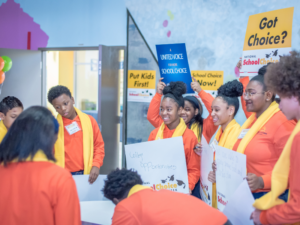
Please join us for our 4th annual School Choice Celebration & Rally on Tuesday, January 28th, from noon to 2pm at the Georgia State Capitol. Our special guest will be Keshia Knight Pulliam (Cosby Show and House of Payne). Registration is encouraged.

Funny

The General Assembly has been around a while and like any old institution it has developed its own language. James Salzer at the AJC put this glossary together to help us outsiders keep track of what’s happening.

Thanks to Jamie Lord, our director of government affairs, and Jacob Stubbs, our legislative intern and John Jay Fellowship alumnus for their able contributions to this update.

Subscribe

* indicates required

Subscribe

* indicates required