The cost of gifts, meals, and trips to see family and friends have gone up, inflation, debt, low-income

Key Points

  • The blog underscores the significant impact of inflation on Christmas expenses, encompassing gifts, meals, and travel, affecting Americans, particularly those from lower economic classes, hindering their enjoyment of the holiday’s relational aspects.
  • Emphasizing a recent inflation surge due to pandemic-related factors, the post characterizes it as an “inflation tax” disproportionately affecting the poorest Americans, creating challenges in accessing opportunities crucial for a meaningful life.
  • Supported by statistical evidence, the blog reveals the financial hardships caused by inflation, with the average American household spending $11,434 more annually since January 2021, particularly impacting the poor who face significant debt obstacles. 

This year, inflation is threatening to put a dent in Christmas festivities. The cost of gifts, meals, and trips to see family and friends have gone up, to name a few common items. And Americans are noticing.

The pinch is particularly painful for those from the lower classes. Putting aside the greater cost of material items, a more expensive holiday means that those who are struggling will have a more challenging time enjoying the relational aspects of the holiday, including being with family while celebrating treasured traditions and connecting around meals.

What’s clear from these data points is that America’s recent burst of high inflation—which soared to a 40-year high in the aftermath of pandemic-related shutdowns, supply chain disruptions, and government stimulus overspending—has driven up the cost of goods and services and inflicted an “inflation tax” that disproportionately hits the poorest Americans the hardest.

At the Georgia Center for Opportunity, our mission is built around promoting human flourishing—especially for those on the margins. The high cost of Christmas this year matters because it reflects the reality that high inflation reduces people’s ability to access the opportunities that shape a meaningful life.


By the numbers: Inflation’s effect on household budgets

Just how bad is it this year? Nationally, a recent report found that the average American household now spends $11,434 more annually to maintain the same standard of living they enjoyed in January 2021. Worse, they’re using credit cards to finance everyday purchases—running up debt and leaving very little extra for the holidays. 

For the poor, debt can become an insurmountable obstacle to moving up the economic ladder. Low-income households spend around 26% of their income each month on debt, compared to around 4% for wealthy households (even though wealthy households carry far more debt on average).

 On a personal level, this decreased purchasing power means that more families teetering on the economic edge are struggling to put food on the table during the normal year—let alone for special meals around the holidays. A recent survey found that 50% of Americans say Santa will be less generous this Christmas due to inflation—and that one in three won’t be getting presents this year.

Even for those who plan to spend money this holiday season, 28% say it will be less than last year. And nearly 20% will apply for new credit cards to finance their purchases—despite the fact that nearly 25% still carry holiday debt from last year.

So how expensive are traditional items that Americans associate with the holidays in 2023? PNC Bank’s Christmas Price Index (CPI) shows the overall cost for Christmas festivities has gone up nearly 20% since 2021. For example, Christmas breakfast classics like bacon and eggs are up 24% and 41%, respectively, since 2021, while Christmas dinner pork chops are up 20%.

Gas prices are up 55% over the same time period, making transportation to and from work even more difficult for the poor. Meanwhile, the price to buy a used car has jumped by 22%.

Even home energy costs have risen so much that some families must decide between heating their homes and buying presents. Since September 2021, the cost to heat homes and keep lights on has risen 20% for electricity and 18% for gas.


It is a complex problem caused by a myriad of systems and choices but the implications are substantial. Inflation is having a catastrophic impact on those living in poverty. We discuss what is causing it and what we must do to address it.

It is a complex problem caused by a myriad of systems and choices but the implications are substantial. Inflation is having a catastrophic impact on those living in poverty. We discuss what is causing it and what we must do to address it.

Finding joy in the season

A recent Financial Times–Michigan Ross poll found that 82% of Americans say that price increases are their biggest source of financial stress. So even as the jobless rate improves and inflation cools, many consumers simply aren’t feeling it. And this translates into pessimism about the economy as we move into the 2023 holiday shopping season.

It doesn’t have to be that way. During the holiday season, the GCO message of giving hope and opportunity to those who most need it couldn’t be more needed. It’s painful to realize how much many of our neighbors are struggling with the high cost of inflation. But it’s a great invitation for communities to come together and offer support in ways the government can’t.

We can make the biggest difference by starting small and close to home.
Media statement, in the news, Georgia news, ga news

The latest Consumer Price Index released today by the U.S. Bureau of Labor Statistics shows that in the past month, the Federal Reserve successfully achieved its inflation target by meeting a 2% increase in prices on a seasonally adjusted monthly basis. This signifies a step towards maintaining economic stability and balance. But there are still storm clouds on the horizon.

The Georgia Center for Opportunity’s (GCO) take: “While this is positive news, a concerning trend has emerged since the onset of the pandemic,” said Erik Randolph, GCO’s director of research. “Overall, goods cost 18.2% more today than they did before the start of the pandemic due to rampant inflation. Simply put, everyday essentials are far less affordable in 2023 than they were three or four years ago. That hits the impoverished and low-income Americans the hardest. At the federal level, there appears to be a lack of substantive discussion regarding measures to restore the diminished purchasing power of consumers. That is concerning.”

    In The News

    Today, the U.S. Bureau of Labor Statistics announced that in April the Consumer Price Index (CPI) rose by 0.4%, not seasonally adjusted. Year over year, the CPI has gone up 4.9% in the last 12 months.

    The Georgia Center for Opportunity’s (GCO) take: “Not only has the federal government abandoned restoring purchasing power, they do not appear even capable of bringing inflation down to the Federal Reserve’s inflation rate target of 2%,” said Erik Randolph, GCO’s director of research. “Devaluing the dollar means that Americans must have comparable wage inflation just to keep with prices. That’s worse for Americans living on fixed incomes, the working class, and the poor.”


    inflation

    Key Points

    • September CPI numbers show inflation is still on the rise. 
    • Core inflation hit a 40 year high.
    • Local communities are the key to paving the way for economic success. 

    In September, President Joe Biden prematurely declared victory over inflation as he held a celebration event over the party-line passage of the Inflation Reduction Act that required the Vice President of the United States to cast the deciding vote in the Senate.

    Perhaps they were fooled by the Consumer Price Index (CPI) numbers for July and August. In July, the CPI dropped just a tiny bit to 295.271 from the seasonally-adjusted index of 295.328 for June, which rounds to an inflation rate of 0.0%. Although the unadjusted index slightly decreased again in August, the seasonal adjusted number rose by only 0.1% that calculates to 1.4% when annualized.

    But, alas, inflation rates typically fluctuate from month to month, and what’s important is the longer-term trend.

    When the U.S. Bureau of Labor Statistics released the CPI numbers for September, it became all too clear that we must continue to suffer through rising prices — because inflation has not yet been tamed. 

    The overall monthly inflation rate rose 0.4% when seasonally adjusted, that is 4.7% when annualized. Yet again, the inflation reading came in hotter than expected, with consensus estimates being around 0.3% for the September reading. The year-over-year inflation rate stands at 8.3%. 

    Worse, inflation has become ingrained in our economy with no indication that it’s going away anytime soon. Here are a few reasons why we still need to be worried. 

    1.The core inflation rate hit a 40 year high

    The reason economists look at the core inflation rate is to gauge how widely inflation has spread throughout the economy. They get the rate by subtracting the cost of energy and food from the index, but not because energy and food prices are unimportant. But because of their volatility. 

    The core inflation rate was 6.7% in September over the previous year – the highest it’s been in forty years. It increased 0.6% in September, which calculates to an annual rate of 7.1%. This alarming trend demonstrates just how ingrained inflation has become in our economy. 

    “But policy is only one piece of the puzzle. The other even more important piece is the community-level response.”

    “But policy is only one piece of the puzzle. The other even more important piece is the community-level response.”


    2. Energy prices are down — sort of — but food prices up

    One piece of good news is that energy prices went down in September. However, this is of little consolation because the prices are still 19.9% higher than last year and 49.7% higher than two years ago.

    There is no good news for food prices. You can’t go to the grocery store anymore without noticing the impact of inflation, and the CPI numbers bear this out. Food prices in general are up 11.2% over last year, or 16.3% higher than two years ago. As anyone can tell you, this is just the general price increase. Consumers can experience higher prices depending on what foods they buy. Cereals and bakery goods are up 16.2% from last year, and dairy products are up 15.9%

    Although economists like focusing on core inflation, energy and food prices are necessities that impact most people, especially lower income families and seniors living on fixed incomes.  

    3. Inflation isn’t going away anytime soon

    When reading the tea leaves, there aren’t many indications to expect inflation will abate any time soon. The recent droughts and man-made obstacles to food production, such as Russia’s war on the Ukraine and the irresponsible farm policy changes in the Netherlands, will impact food supply, which, of course, will have a direct impact on food prices and its availability. 

    As winter approaches the northern hemisphere, the demand for energy will increase. Here again, the war in Ukraine is culpable for disrupting energy supply to Europe. Moreover, not only did the Biden Administration fail to convince OPEC to increase production, but OPEC, which by the way includes Russia, is doing the exact opposite. They are cutting back on oil production. 

    In the meantime, current U.S. energy policy is more concerned about climate change than energy independence — that we were just two short years ago. The Administration’s release of petroleum from the Strategic Petroleum Reserve did help ease prices, but now the reserve is at the lowest level since 1984. How much lower will the Administration allow it to go?

    Because it impacts economic behavior, core inflation is even harder to solve. People – whether acting on behalf of their businesses or as an employee or as a consumer – incorporate their expectations of higher prices into their personal actions. This only fuels inflation more. Consider this fact: Although many businesses are experiencing higher revenue, their costs are also up. Importantly, and unfortunately, for many of them, their profits are down. All these factors exacerbate inflation while slowing economic growth, which harms everyone.  

    The way forward is through local communities

    Our nation’s inflationary environment is bad. Everyone knows that. The big question is what to do about it. On the policy front, we need a paradigm shift in Washington, D.C., to focus on enacting policies that encourage private investment, savings, and free trade while cutting back on deficit spending.

    But policy is only one piece of the puzzle. The other even more important piece is the community-level response.

    Here at the Georgia Center for Opportunity, our focus is primarily on these bottom-up solutions. Our neighbors — particularly those on the economic margins — are suffering from high inflation and need help. That’s where programs like BETTER WORK come in. They help the poor and impoverished get the skills and training needed to find a job and pursue a career, while ensuring they also find safe and affordable housing, reliable transportation, childcare services, and any other essential that’s needed.

    We also know that economic prosperity is challenging when your home life is in shambles. That’s why GCO prioritizes healthy family relationships through our Elevate workshops throughout the community and our Strengthen Families Program in local schools. On that note, prosperity is impossible without a good education, so we prioritize policies that will bring the broadest range of educational options to the most people, regardless of their background, income level, or zip code.

    The way back from our high inflationary environment is going to be a long trip. But with the right policies in place and with an attitude that prioritizes on-the-ground help for our neighbors, we can lighten the burden for our neighbors during the journey.


    Key Points


    • Year-over-year inflation rate remains high at 8.3%. While the latest monthly number, and the CPI reading from July, show that inflation has stalled, we’re not out of the woods yet.
    • Reducing fiscal revenue by suspending the loan repayments adds to federal fiscal deficits.
    • Labor market moral hazards will worsen the situation of students achieving meaningful education and solving the problem of their skills not matching what is needed in the labor market.

    In September, the U.S. Bureau of Labor Statistics announced that the Consumer Price Index (CPI) rose 0.1% in August. However, the year-over-year inflation rate remains high at 8.3%. While the latest monthly number, and the CPI reading from July, show that inflation has stalled, we’re not out of the woods yet.

    There are warning signals, including worldwide drought and continued energy disruptions, that inflation is not yet tamed. Moreover, Federal Reserve policy is refusing to allow the price level to come back down, meaning that most households will continue to contend with higher prices and lagging income growth. 

    Meanwhile, the administration in Washington is taking steps that will only worsen the inflationary environment by its fiscal policy that relies on overspending absent adequate revenue. An unexpected part of this is President Biden’s new plan to forgive up to $20,000 in student loans for households making up to $250,000 a year. 

    We’ve already written about how this policy will end up hurting the poor and working class. But from a strictly economic perspective, the blanket student loan forgiveness action by the president raises two additional fundamental concerns. 

    1. Deficit spending

    Reducing fiscal revenue by suspending the loan repayments adds to federal fiscal deficits. Currently, the federal government is not running surpluses with a manageable national debt as if the federal government is in a financial position to be generous. The government itself is in a financial straitjacket where it must continue to borrow to pay for its expenses, and the interest payments on the national debt continues to grow not just from the additional borrowing but also from rising interest rates. Like a family with a large and growing minimum payment on credit card debt, it is crowding out other budget priorities. 

    Although no economist knows how much more debt the U.S. economy can withstand, there is widespread agreement among them across the political spectrum that worsening deficit spending only aggravates inflationary pressures. We may say that taxpayers will eventually pay for the loan forgiveness, but the reality may be that we will pay for it sooner with higher inflation. 

    Paying through inflation rather than taxes is regressive, impacting lower income Americans the most. Consider the Tax Policy Center estimate that 57% of households paid no federal income taxes in 2021 with many receiving a net gain instead. The Tax Policy Center expects that the percent of non-paying households will drop to about 40% over the next few years, consistent with pre-pandemic levels. Why is this important? Because it shows how an inflationary policy, instead of a fiscally sound policy, impacts low-income Americans worse.

    1. Labor market moral hazards

    Second, it presents moral hazards that will worsen the situation of students achieving meaningful education and solving the problem of their skills not matching what is needed in the labor market.

    The moral hazards will come about because given the history of entitlements in this country, once we begin on the path of creating a new entitlement, it opens the door for expanding that entitlement. Are not other students just as deserving of having their debt paid for now and in the future? And what about the past? Why not raise the thresholds so even more debt can be forgiven? What we’re creating here is an entitlement that has moral hazards.  Even the expectation of future loan forgiveness will cause behavioral changes with the same moral hazards.

    • The first hazard is with the students themselves. Choosing a career and what to study is a major life decision where one must weigh the benefits and costs. Already we have a problem with many students making bad decisions and studying things that will not help them develop the skills they need in finding good paying jobs. Installing a system where the cost of education is now paid for with other people’s money will give them yet another reason to rationalize their poor education decisions. While the debt of that education may be forgiven, the opportunity costs will be unforgiving because you can’t turn back the clock and erase the consequences of those bad decisions. 
    • The second hazard is with the post-secondary educational establishments themselves. Government involvement with guaranteed student loans already exacerbates the outrageous tuition price hikes we’ve witnessed over the past 50 years. Having the government now forgiving student debt will only reduce the financial incentives for higher education to rein in its exorbitant costs. 
    • Finally, where are the incentives for institutions of higher learning to adjust their content to match the needs of society and the economy? As the incentives are eroding for students to carefully choose what to study and for the educational institutions to rein in their costs, the arrangement provides yet another reason for academia to justify the assortment of degrees they offer and the courses they teach. Already we are witnessing a disconnect between the content of what students have studied with what they will need to be successful in their careers.These students typically learn this hard lesson once they graduate and are faced with the realities of life. This flaw in the education system is a contributing cause of the great mismatch between what skills and education people have and the skills needed by employers that fuels the economy. Our economy is currently suffering from this problem, which now will only grow worse.

    Key Points

    • As of June, 35 states and D.C. have not recovered the number of lost jobs
    • The labor force has shrunk despite population growth.
    • Its stated goal of the Federal Reserve remains the same–to reduce inflation to its 2% target, meaning it will take steps to prevent the price level from coming back down. This bad policy goal will burden the working class and the poor and retired persons the most.

    It may not matter if federal policy does not change.

    We’ve seen some back-to-back encouraging news within the last few weeks. The Employment Situation Report for July showed that the United States finally recovered the number of its lost jobs from the start of the pandemic, and the Consumer Price Index (CPI) inflation rate for July was essentially zero. But digging a little deeper to put the news into perspective reveals real concerns that stagflation will not end anytime soon.

    The States Who Are Driving the Job Recovery

    On the jobs front, yes, it’s true we’ve recovered the number of lost jobs benchmarked to February 2020 before the drastic impact on the labor market from COVID-19. This indicates we’re on the mend, but the job recovery process has not been the “V” shape hoped for at the beginning of the pandemic, one that would have meant a robust job recovery. 

    Two-and-a-half years later, the civilian non-institutionalized population base that feeds the labor force grew by 4.8 million. Our own ARIMA Model job forecast shows we are approximately 5.8 million jobs short of where we would have been had the pandemic not happened. 

    But this is not the case for all 50 states. Astoundingly, four states—Montana, Utah, Idaho, and Wyoming—have matched or nearly matched their pre-pandemic ARIMA Model forecasts, effectively eliminating any impact from the pandemic on the number of lost jobs. 

    In the meantime, the national job recovery to pre-pandemic levels is driven probably by just 15 states who already recovered their number of lost jobs prior to the nation as a whole. These states are Utah, Idaho, Texas, Montana, North Carolina, Georgia, Florida, Tennessee, Arizona, South Dakota, Colorado, Arkansas, Indiana, and Nevada. 

    As of June, the remaining 35 states and D.C. have not recovered the number of lost jobs. We have to wait another week before we know whether another state slipped onto the list of leading states that helped tip the balance for the national July data. 

    According to our analysis, a common feature of the leading states is that they tend to have policies that value economic freedom more than the other states do. Incidentally, and for explanatory reasons and not for the purpose of getting political, all but three of the 15 leading states have given political control to the governor’s office and both chambers of the state legislature to the Republican Party.

    Jobs Versus People Employed 

    One problem with job data is that the dataset allows for double counting. If we want to count the number of people employed, it paints a different picture. 

    The Current Population Survey shows the U.S. is still more than half a million workers short when compared to February 2020. In fact, we had fewer employed persons in July than March of this year, using seasonally adjusted data. 

    The reason is that the labor force has shrunk despite population growth. This can be seen with the 62.1% labor force participation rate that is more than a percentage point below where it stood in February 2020.

    This means that the 3.5% unemployment rate—which now matches its pre-pandemic level—is misleading. The shrinkage of the labor force is distorting the meaning of the metric.

    Taken together on a national scale, jobs have recovered but the number of employed persons has not. This can mean only one thing. More people are working multiple jobs to make ends meet. 

    Inflation versus the Price Level

    July’s CPI ever-so-slightly decreased. It ticked down 0.2% at an annualized rate–a welcome change from the past 25 months. Just to keep this in perspective, the price level nonetheless increased 14.1% since the start of the pandemic. But there is no need to tell this to average consumers who have been feeling it in their pocketbooks. 

    Disturbingly, the Federal Reserve shows no interest in doing something about the elevated price level–and who isn’t even discussing it. Its stated goal remains the same–to reduce inflation to its 2% target, meaning it will take steps to prevent the price level from coming back down. This bad policy goal will burden the working class and the poor and retired persons the most.


    stagflation

    “Disturbingly, the Federal Reserve shows no interest in doing something about the elevated price level–and who isn’t even discussing it. Its stated goal remains the same–to reduce inflation to its 2% target, meaning it will take steps to prevent the price level from coming back down. This bad policy goal will burden the working class and the poor and retired persons the most.”

    “Disturbingly, the Federal Reserve shows no interest in doing something about the elevated price level–and who isn’t even discussing it. Its stated goal remains the same–to reduce inflation to its 2% target, meaning it will take steps to prevent the price level from coming back down. This bad policy goal will burden the working class and the poor and retired persons the most.”

    Fiscal and Regulatory Policy

    The Federal Reserve does not stand alone with its bad policy. Congress and the Administration are just as guilty, if not more so.

    Excessive fiscal spending also drives up the price level. Worse, increasing business taxes will pull  resources from businesses. These resources are needed to produce goods and services that we all use and enjoy. It also enables these very same businesses to pay workers and compensate investors, and it leads to more economic growth and prosperity. Likewise, more excessive regulatory restrictions have similar negative effects on people and the economy.

    Increasing business taxes and regulating businesses even more at this time will not help keep prices down. Rather, a good portion of these higher costs will be passed onto consumers.  And they will be passed on to consumers to the degree that individual businesses are able to do so. If businesses can’t pass all or even some of those costs on to consumers, then they will be forced to make more difficult decisions, such as cutting back on the number of employees or suspending pay raises to employees. Profits will clearly suffer that may cause a few businesses to scale back or exit the industry altogether. These consequential actions all aggravate stagnation. Add in the price increases and we get more stagflation, not less.

    Unfortunately, the President just signed into law the erroneously named Inflation Reduction Act that will do nothing about inflation, but it will hike business taxes and increase regulations that will only worsen the economic situation. 

    Congress and the Administration need to start following the lead from the states who are doing it right. Only pro- growth policies relying on innovation and production organically sprouted from within the economy will help us out of this mess, and it won’t work if politicians think that means taking money from successful businesses or imposing new mandates on others or picking the winners and losers in the economy.


    inflation swells

    Key Points

    • Consumer Price Index (CPI) rose by 1.3
    • June CPI exceeded expectations
    • Fastest pace for inflation in four decades

    Today, the U.S. Bureau of Labor Statistics announced that in June the Consumer Price Index (CPI) rose by 1.3, not seasonally adjusted. Year over year, the CPI has gone up 9.1% in the last 12 months. The June CPI exceeded expectations and was the fastest pace for inflation in four decades.

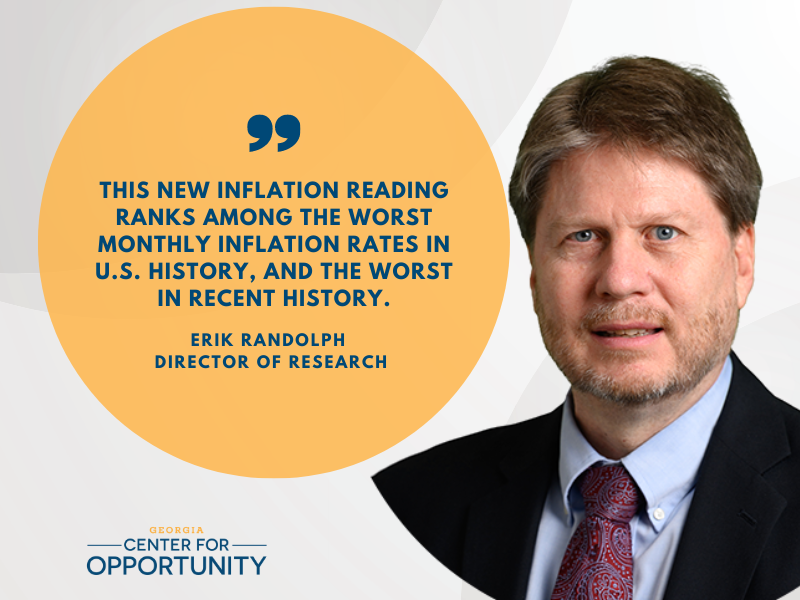
    The Georgia Center for Opportunity’s (GCO) take: “This new inflation reading ranks among the worst monthly inflation rates in U.S. history, and the worst in recent history,” said Erik Randolph, GCO’s director of research. “We have to go back to March 1980 — the last year of the Carter administration — to find a higher monthly inflation rate. The bottom line is that we may not have reached peak inflation, and there’s no telling how long the price level crisis will persist. Meanwhile, the rhetoric from the White House and Congress will do little to rectify the situation. There needs to be new thinking within the Washington Beltway.”

    GA unemployment 3%

    calculator and graphs

    Key Points

    • May the Consumer Price Index (CPI) set new record for inflation
    • Lack of discussion over the price level, which is the new ‘floor’ for prices in the economy
    • Leaving the price level elevated means we are leaving the economically disadvantaged further behind, exacerbating the economic divide in our nation

    New record for inflation

    Today, the U.S. Bureau of Labor Statistics announced that in May the Consumer Price Index (CPI) rose by 1%, not seasonally adjusted. Year over year, the CPI has gone up 8.6% in the last 12 months. The May CPI exceeded expectations and set a new recent record for inflation.

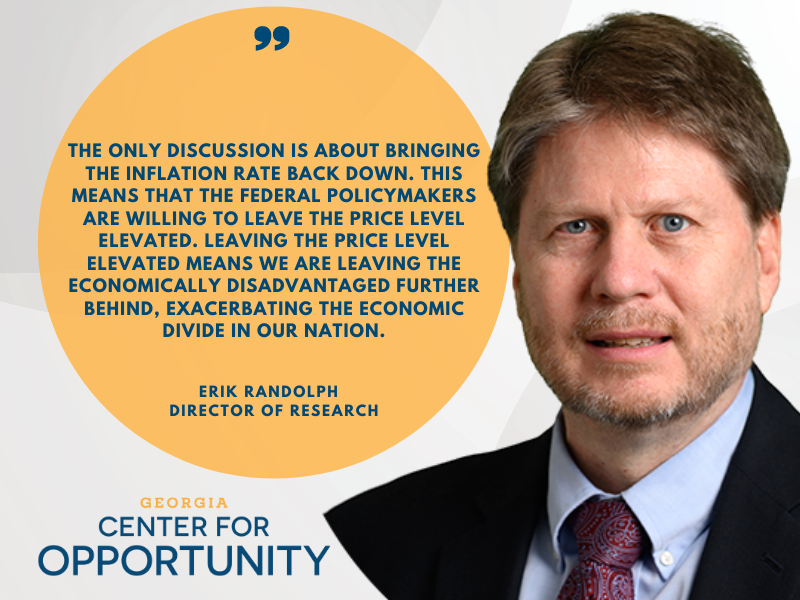
    The Georgia Center for Opportunity’s (GCO) take: “We now know that the early statements from the Biden Administration and the Federal Reserve that this inflation is transitory was an incorrect assessment. It looks a lot more like it’s becoming embedded into the economy,” said Erik Randolph, GCO’s director of research. “What’s both remarkable and troubling is the lack of discussion over the price level, which is the new ‘floor’ for prices in the economy. The only discussion is about bringing the inflation rate back down. This means that the federal policymakers are willing to leave the price level elevated. Leaving the price level elevated means we are leaving the economically disadvantaged further behind, exacerbating the economic divide in our nation.”


    Reality is likely to be less rosy…

    Some economists are hoping that inflation has peaked and will tick down in the coming months, after the pace of inflation slowed slightly in April. But Erik Randolph, director of research for the Georgia Center For Opportunity (GCO), warns that the reality is likely to be far less rosy.

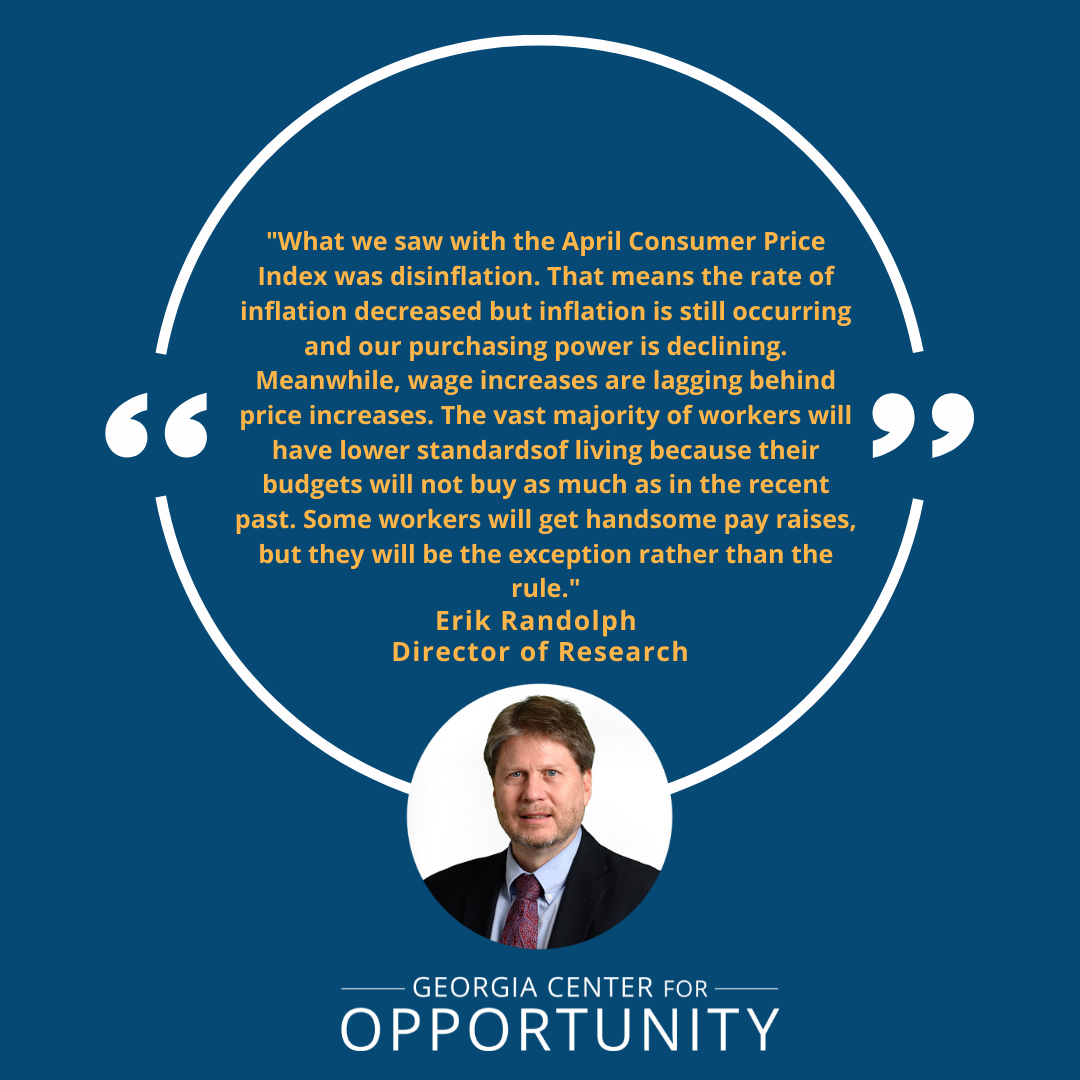
    “What we saw with the April Consumer Price Index was disinflation. That means the rate of inflation decreased but inflation is still occurring and our purchasing power is declining,” Randolph said. “Meanwhile, wage increases are lagging behind price increases. The vast majority of workers will have lower standardsof living because their budgets will not buy as much as in the recent past. Some workers will get handsome pay raises, but they will be the exception rather than the rule.

    Erik - Inflation swells quote

    What’s needed?

    “The core problem here is that the price level has risen, setting a new floor for costs. The only way to lower the price level, by definition, is to allow for deflation. But our policymakers are afraid of deflation because of the economic schools of thought that they adhere to. What is needed is new economic thinking in Washington, D.C. from economists who are not afraid of deflation but recognize it’s the only way to bring the price level down that benefits the most people. The mess we’re in now are the signs of stagflation, meaning the rising price level may be soon accompanied with slower economic growth and loss of employment. The only way to mitigate that scenario would be to adopt policies to allow for supply-side growth.”

    inflation

    A look at the highest unadjusted monthly rate of inflation

    Today, the U.S. Bureau of Labor Statistics announced that in March the Consumer Price Index (CPI) rose 1.3%, not seasonally adjusted. This is the highest unadjusted monthly rate of inflation since March 1980. When annualized, it would equal 17.3%.  The seasonally-adjusted monthly increase is 1.2%. The 12-month CPI increase continues to climb, which now stands at 8.5%, not seasonally adjusted.

    The Georgia Center for Opportunity’s (GCO) take: “Unsurprising for anyone who paid attention to prices last month, energy prices rose 32% over the last 12 months and food prices rose 8.8%. This is bad for everyone but worse for low-income and impoverished Americans, ” said Erik Randolph, GCO’s director of research. “The U.S. inflation rate reflects not only energy and food price increases, but it is also spreading to more and more industries as businesses are forced to raise prices.””Also concerning are disturbing signs pointing to a possible economic slowdown, giving credence to those who have been predicting stagflation will return. This crisis may have been initiated by the pandemic, but it was exacerbated when state governments shut down their economies and the federal government pumped unprecedented levels of money into the system to sustain aggregate demand. We’re paying for that now. The only way out of this mess is to refocus on supply-side policies at both the federal and state levels to encourage investments, risk taking, and production. It also requires fiscal restraint in the halls of Congress to reign in deficit spending.”


    statement

    Subscribe

    * indicates required

    Subscribe

    * indicates required