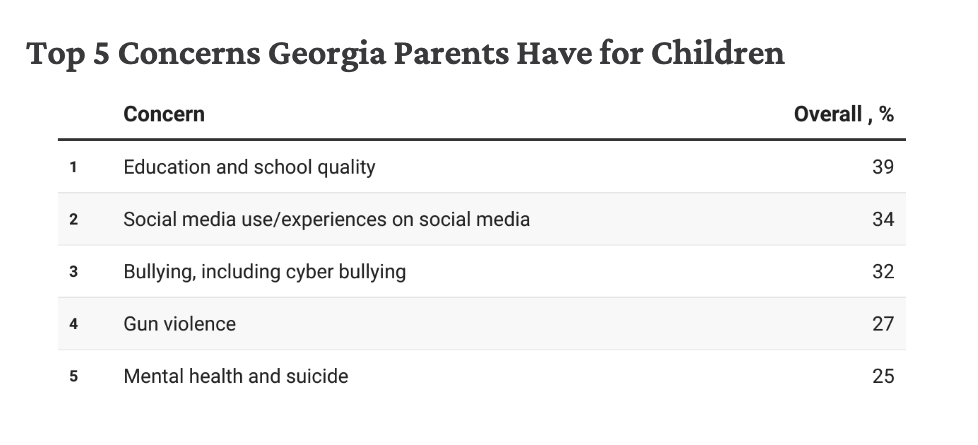
According to a new report from Emory University, ”The State of Child Health and Well-Being in Georgia 2025,” quality of education, mental health, and the effects of social media are top concerns for Georgia parents. 

The report is based on a statewide survey, which asked parents to share what they’re most worried about when it comes to their children’s health, safety, and well-being. The leading issues are not isolated worries. Instead, they are the daily realities shared by Georgia families from a variety of backgrounds and types of communities. 

Parents are most worried about education and school quality 

More Georgia parents cited education and school quality as a top concern than any other issue.

Confidence in schools is slipping across all communities, especially among Black and Hispanic families, who are more likely to rate their local schools as “fair” or “poor.” For 35% of Black parents, education quality was the second highest concern behind gun violence. 

Education is also the top issue across geographic locations: 36% of rural parents and 39% of non-rural parents said it was their highest concern, followed by social media and bullying. 

When it comes to schools, safety is just as much top-of-mind for parents as the quality of education. Overall, 60% of parents surveyed feel that schools are less safe than in the past. They overwhelmingly support measures to improve school safety, including mental health awareness and laws promoting safe firearm storage.

Image: Emory Center for Child Health Policy, “State of Child Health and Well-Being in Georgia 2025

Mental health concerns are growing

According to the report, as many as 15% of Georgia children have depression, 25% have ADHD, and 31% have anxiety. Some of these children have received an official diagnosis, while others have not—though their parents are concerned about the possibility.

Even more alarming: 63% of kids who have been diagnosed with a mental health condition aren’t yet receiving the care they need.

Georgia parents are trying to respond. Encouragingly, most parents say they feel comfortable talking to their kids about suicide and emotional well-being. 

But access to mental health services remains a major issue. Long waitlists, provider shortages, and geographic barriers keep kids from the help they need—especially in rural areas. These challenges can snowball into higher rates of school dropouts, encounters with the juvenile justice system, substance abuse, and other negative outcomes. 

Social media is fueling anxiety for both parents and kids

Georgia parents are also worried about the impact of digital life on their children’s well-being. Social media ranked among the top three concerns statewide, right alongside bullying and gun violence.

Parents recognize the growing physical and emotional tolls of social media on young people—everything from unrealistic expectations and cyberbullying to struggles with sleep and behavioral regulation. 

The takeaway is clear: families want better tools for managing digital risks—and they need help to set institutional boundaries that protect kids’ mental and emotional health.

The good news is that Georgia lawmakers are recognizing the urgency of this issue. In 2025, Georgia lawmakers passed the Distraction-Free Schools Act (HB 340) to limit cellphone use for K-8 public school students during the school day. Under the bill, phones could be restricted from the start of the school day until the end, ensuring students can fully engage in learning and schools can foster an environment that supports focus and mental well-being. 

Listening to parents is key to moving forward

For policymakers and community leaders, these findings shed light on where Georgia’s families need better solutions and support. Giving families more school choice options, improving school safety and learning environments, and strengthening access to mental health care are all areas where smart policy reforms and community-based efforts can help remove barriers to opportunity, especially for our most vulnerable communities.

Image Credits: Canva, Emory Center for Child Health Policy

Key Points

  • Summers are for more family time and enjoyment!
  • Studies show parental involvement is key to children’s health and development. 
  • Raising Highly Capable Kids (RHCK) has tools to help parents.

School breaks, warm weather, longer daylight hours—these are a recipe for more relaxation and fun as parents and kids enjoy a few weeks free of school-related commitments. On the other hand, summer can be challenging when kids have time off but parents must continue their regular work schedules and responsibilities. 

Numerous studies have shown that parental involvement is key to children’s health and overall development. But how can parents maintain this involvement and nurture their child’s development in a season where kids might be on break but adults are not? 

Our parenting class, Raising Highly Capable Kids (RHCK), has tools to help parents—and any adult caring for young people—answer this question. RHCK teaches the 40 developmental assets that are essential for raising healthy, responsible, caring kids. Several of these building blocks provide simple, inexpensive, and effective ideas that adults can use throughout the summer to support kids’ development. Plus, all of these ideas have a larger benefit of cultivating overall family well-being and connection.

1. Embrace evenings for family activities

In our Raising Highly Capable Kids parenting class, one of the developmental building blocks we teach is “Time at Home”—where a child spends some time each day interacting with their parents and doing activities at home that don’t involve TV or video or computer games. This type of interaction has been shown to improve young people’s leadership skills, health, and achievement in school. 

One benefit to summertime schedules is that flexible bedtimes and longer daylight hours can free up evenings for quality time as a family. For many families, summer evenings can be good opportunities for connection and fun, especially if parents are working during the day or if a vacation isn’t feasible for your budget. 

Activities to try:

  • Game night with your favorite board or card game
  • Family movie night
  • Visit a local pool or playground 
  • Go for a walk after dinner and talk about favorite moments from the day
  • Plan a picnic for dinner

2. Cultivate responsibility by getting kids involved around the house

Building personal responsibility in kids goes beyond rule-following. It’s about giving kids opportunities to practice caring for themselves and their environment and learning from successes and mistakes in the process. 

When it comes to the developmental asset of responsibility, summer is a great time to get creative. As kids get a break from school assignments, they can practice cultivating responsibility in other areas of life. For example, parents could have their child pick a household chore to be in charge of throughout the summer. Or, they could involve kids in tasks that introduce new skills and experiences—things like gardening, cooking, reading to siblings, or taking care of pets. 

The important thing is to involve your child in selecting responsibilities for the summer. Being able to choose, even if it’s from a limited list of options, encourages young people to feel that they have positive control over their choices and actions

 3. Let your child choose a special hobby for the summer

Participating in creative activities two or more times helps kids develop several important skills: intellectual comprehension, communication, cultural understanding, and overall creativity and problem-solving. 

Summer can be a great time to encourage kids to explore new interests. Plus, parents can use new hobbies as a tool to set much-needed routines in the midst of a less structured season. Have your child pick an activity or two to try this summer, and if it fits within your budget, take them to the store to pick out items they’ll need for their project. 

Activities to try: 

  • Creative writing or journaling
  • Painting or drawing
  • Building (lego sets, puzzles, block sets)
  • Listening to or playing music

“What we’re doing with Raising Highly Capable Kids is helping them develop those core assets so they have a strong foundation to have a successful life and be a positive contributor to our community.” 

“What we’re doing with Raising Highly Capable Kids is helping them develop those core assets so they have a strong foundation to have a successful life and be a positive contributor to our community.” 

4. Encourage reading for pleasure

Reading is strongly connected to developing positive values and learning concepts, facts, and emotions in creative, inspirational ways. Summer is the perfect time to help kids experience the pleasure of reading for fun, not just for school assignments.

Activities to try: 

  • Put reading material—chapter books, picture books, comic books, etc.—in easy-to-reach places around the house.
  • Set a family reading time once a week to read aloud to younger kids or hang out with older kids while reading different books. 
  • Take advantage of summer reading programs through local libraries or bookstores. These programs often set up reading challenges or adventures to get kids excited about completing a goal. 
  • Join forces with families in your neighborhood to create a summer book club for older kids or story time for younger children

5. Pick one way to serve others

One way to have a memorable, satisfying summer is to dedicate time to making a difference in the world around you. Research shows that young people who serve others are more likely to develop respect, kindness, patience, and helpfulness. Get together with your kids and brainstorm some ways that you could help out in your community. It could be as simple as weeding the yard for an elderly neighbor, or perhaps you could plan a volunteer activity or a home project for the whole family to help out with. 

Get your kids involved in picking summer goals for the family 

For many families, the key to a rejuvenating summer is to set a few goals that will be meaningful and enjoyable. Not sure what to prioritize? Consider having a conversation with your family to brainstorm what you want your summer to include. 

Here are a few questions to use as starting points:

    • How do you want your summer to feel? 
    • What are some local attractions or activities that you could enjoy as a family? 
    • What is a hobby or project that your child would enjoy spending time on? 
    • What are some books you would like to read or movies you would like to watch? 
    • How could you invest in your family’s physical health? How much time should your kids be outside playing or staying inside and relaxing?
    • How much screen time will be allowed? 
    • What seasonal meals or snacks would the family enjoy? 
    • How do you want to build friendships during the season?  

Finalize your list by choosing a handful of things that appeal to your family or by allowing each person to choose one thing that appeals to them. Then, go and enjoy your summer! 

Resilient Kids raising highly capable kids

Key Points

  •  Georgia Center for Opportunity has partnered with a national nonprofit, RezilientKidz, to present the Raising Highly Capable Kids parenting program to adults across Georgia.
  • Raising Highly Capable Kids is a 13-week evidence-based parenting program developed to build stronger families by empowering parents with the confidence, tools, and skills they need to raise healthy, caring, and responsible children.
  • GCO is holding a vision casting session on March 9, 2023, and if you represent a church or nonprofit that wants to get involved, you’re invited. (See below)

We’ve got some exciting news to share about what’s ahead in 2023! The Georgia Center for Opportunity has partnered with a national nonprofit, RezilientKidz, to present the Raising Highly Capable Kids parenting program to adults across Georgia. The program is specially designed to equip parents to address common child issues in our state.

Here’s a quick rundown on the new curriculum. Raising Highly Capable Kids is a 13-week evidence-based parenting program developed to build stronger families by empowering parents with the confidence, tools, and skills they need to raise healthy, caring, and responsible children. The program increases parents’ knowledge and skill level of the essential building blocks every child needs — the 40 Developmental Assets from Search Institute, which are proven to increase childhood resiliency and academic achievement.

The lessons are available to schools, nonprofits, churches, and other organizations focused on helping to build stronger families for Georgia — and ultimately stronger communities. Through a community grant issued by RezilientKidz, GCO is facilitating course offerings for interested parents who want to learn more effective skills and strategies as they raise their children. 

“It’s not just about creating resilient kids. It’s about creating resilient communities,” says Joyce Mayberry, vice president of family at GCO.

Today, kids in Georgia are facing high levels of “at-risk behavior” that sets them up for struggles in one or more areas of their lives. Ultimately, they could face unfavorable outcomes that affect them long-term — possibly for the rest of their lives. The Raising Highly Capable Kids program teaches parents the skills required to help keep their children from engaging in these risky and destructive behaviors.

To make Raising Highly Capable Kids successful, we’re depending on help from communities statewide. Here’s who we’re looking for: 

  • School leaders to provide local parents with the tools they need to help their children succeed academically. 
  • Church leaders to offer courses in their communities, with the goals of increasing local involvement and reducing risky behaviors. 
  • Nonprofit leaders and organizations to host community-based classes that ultimately reduce family and emotional stress by helping kids avoid destructive patterns. 
  • Donors to enable these leaders and organizations to offer classes for parents statewide.

Ultimately, Raising Highly Capable Kids is about helping our young people thrive and live their best possible lives. 

“We want youth to be seen, heard, and valued. Every child,” Mayberry says. “Then they will show up as their best selves.”

It’s not just about creating resilient kids. It’s about creating resilient communities.
Joyce Mayberry, VP of Family

It’s not just about creating resilient kids. It’s about creating resilient communities.

Joyce Mayberry , VP of Family

A look inside the Raising Highly Capable Kids 13-week curriculum

The Raising Highly Capable Kids curriculum is built around the Search Institute’s 40 developmental assets, compiled from decades of research involving more than 5 million young people. Parents who attend training will learn from curriculum materials built on the foundation of the developmental assets. Children won’t attend these classes, as they’re geared exclusively toward adults. 

The course is split into thirteen weeks worth of materials for parents and ranges from self assessment of parenting skills and history to monitoring social media and even building a family identity.


How you can help

We need community support — which means we need you! We’re looking for trainers, location providers, wraparound services, and individuals and organizations willing to fund the initiative. 

GCO is holding a vision casting session on March 9, 2023, and if you represent a church or nonprofit that wants to get involved, you’re invited. During that time, we’ll gather all participating organizations in one room to learn more about the The Raising Highly Capable Kids curriculum as a unit. Please register for the event here.

After the March 9 event, we’ll begin training for those individuals who signed up to launch a class. Training will take place in one four-hour session on March 25, 2023. Throughout the process, GCO will be facilitating, consulting, and ensuring all participating volunteers have the books and training materials they need to be successful. 

Contact Joyce Mayberry at joycem@foropportunity.org if you’d like to volunteer time or facilities. Alternatively, if you know someone who would be a great trainer, share your referrals with us. We’re looking forward to hearing from you and kicking off this new initiative!

magnifying positivity

Maginifying Positivity

My husband and I only had her in our care for two-weeks. She is a seven-year-old full of spunk and sass at the same time!  We adore that about her and looked forward to providing some stability and positivity in her life for the time she spent in our home.

Our great niece, whom we’ll call Spunky, to protect her name and innocence, has been suffering from dad abandonment issues and the lack of receiving or hearing positive reinforcements. Often times her conversations and attitude steered to seeing the negative side of things. My husband and I realized that she had been exposed and surrounded by so much parental and family negativity that it was challenging for her to see the positive side of anything.

At GCO, we understand how the absence of a father can negatively impact a child. That is one of the reasons why we have certified facilitators in a variety of research-based programs and partnerships with licensed professional counselors to help us provide healthy relationship education skills training for dads, parents, couples, youth and families. Together, HFI is helping families to be resilient and stable.

Unfortunately, Spunky’s dad was not willing to take a dad’s class to help him understand the true meaning of being a father or even understand how his negative behavior impacted his own daughter. He truly could benefit from a class we teach called, 24/7 Dad from the Father Source by the National Fatherhood Initiative. In this course, we deal with topics such as: Family History, What it Means to Be a Man, Showing and Handling Feelings, Men’s Health and so much more. If you are interested in hosting a men’s workshop, visit foropportunity.org/family or contact our office at 770-242-0001 ext. 701.

A family sitting on the floor together


Here are three ways to help you to magnify a positive environment for your child to thrive:


  1. Make it a habit to give 5 positives for every 1 negative to fill your child/ren “emotional bank account”
  2. Make regular time for sharing and listening to your child/ren
  3. Invite others to share in the positive experience

Research indicates negative interactions have a strong influence on relationships. Relationship researcher, Dr. John Gottman talks about for every one negative you need to counter it with five positives. He also says that making regular deposits into your child’s “emotional bank account” is extremely healthy. Although, Dr. Gottman refers to this in the context of marriage, this concept can be applied to all types of relationships.

As we began our short time with Spunky, we knew it was important for us to magnify more positivity and appreciation in her life.

We had a family meeting to talk about how excited we were to have Spunky staying with us and asked for her participation in the meeting. She enjoyed giving her input.

Next, we came up with some ground rules on how to be more positive in our language and attitude. At first, she was hesitant but after we asked for her input she began to open up. 

During the meeting, there was a light bulb moment and that is when “The Positivity Club” was formed, with Spunky as the vice-president”.

The first rule of order: When you hear someone being negative you call them out and ask them to refrain it to be more positive.

Next rule of order was to invite others who had an impact on her to join the club. Spunky was thrilled because now she had her mom, dad, grandparents, cousins and aunts all participating in “The Positivity Club”.

Every day, we were intentional about creating an environment of positivity. In less than two weeks, we saw a big shift in her language and attitude. She was modeling for her parents what it looks and feels like to have an environment where children can thrive.

Today, Spunky is back home with her mom. We talk to her regularly and continue to fill her emotional bank account by promoting positivity. She is still the VP of The Positivity Club and she continues to call people out who are not being positive. 

Magnifying positivity and appreciation may be one of the most important contributors to a child’s well-being. 

It took us less than two weeks to see the difference in Spunky and it not only changed her but also the people around her, even her dad.

Subscribe

* indicates required

Subscribe

* indicates required