construction

April’s nonfarm payroll numbers came in at 266,000, well below the 1 million people forecasters estimated would be hired that month. 

The low number wasn’t because there were a lack of jobs. There were 8.1 million open positions at the end of March. And it wasn’t due to a lack of people who need work. In April, there were 18.2 million people who received some form of federal unemployment assistance.

Hire Dynamics, a staffing and professional recruitment business that operates in the Atlanta area in addition to other locations across the U.S., has experienced the shortage of workers first hand. The following Q&A is an interview with Chuck Fallaw, regional manager for Hire Dynamics.

Q: Please explain what your business does / your focus

Hire Dynamics is a regional staffing agency headquartered in Atlanta GA. We focus on temp-to-hire staffing in the manufacturing, logistics/e-commerce, warehouse distribution, administrative, and call center verticals.

Q: What was hiring like prior to the pandemic?

Prior to the pandemic, we faced challenges with finding talent due to incredibly low unemployment. For example, in Nashville, TN where we had a 1.2% unemployment rate. Their pay rates were naturally rising due to the competition for talent. However, it was still much easier to fill positions than it has been over the last year and a half.

Q: How about during the pandemic?

Hiring during the pandemic was a unique challenge. Many of our clients are considered essential, so their need for talent never slowed down. Outside of true shutdowns, we were still able to fill some roles. That changed quite a bit in the last six months.


What we do matters.

  • Best of Staffing for Client & Talent Satisfaction by ClearlyRated – 11 years in a row:
  • Top 1% of more than 20,000 staffing companies
  • Continuously recognized as a Best Place to Work company throughout the Southeast
  • Superior client loyalty: client ratings 8 times higher and talent ratings 2.5 times higher than the industry average
  • Committed to and engaged with the communities we serve

Q: Right now, are you having trouble filling positions, and if so which ones?

Yes. All of them. Many of the manufacturers we work with are running around 50% of the workforce they typically employ. Obviously, this is tough on productivity, but it also leads to environments that are not as safe, elevated worker’s comp, and general morale issues among the employees. Light industrial staffing (at least in my region) has been the hardest hit. As I mentioned before, prior to the pandemic the economy was roaring, and talent was in demand. When the pandemic hit, those needs didn’t really go away, but the talent did.


Q: In what ways are you trying to recruit / attract employees in this environment?

Grassroots recruiting is very important right now. Getting in front of the talent and helping them get back into the workforce is a big part of what we are doing. We are doing drive-through job fairs, virtual job fairs, and massive recruiting events. In addition, we are coaching our clients on reducing barriers to entry, pay adjustments, and other ways to incentivize employees to come back.


EMPLOYMENT RESOURCES

SYSTEMIC WELFARE IN GEORGIA: PART 1 THE CASE FOR REFORM

In the first paper of our three-part series presenting a vision for systemic welfare reform in Georgia, we explore the need for a welfare system that starts with the assumption that natural support systems, including individual work and a reliance on family and community assistance, should be the primary sources of help when individuals face financial need. This report demonstrates how the current system does not meet these assumptions and points to the need for reform.

DOWNLOAD REPORT

SYSTEMIC WELFARE IN GEORGIA: PART 2 PRINCIPLES AND FRAMEWORK FOR REFORM

In the second paper of our three-part series presenting a vision for systemic welfare reform in Georgia, we explore the new system as we imagine it could be, give guiding principles, provide a general framework for how the reformed system can function, and establish preliminary steps needed to implement the vision.

DOWNLOAD REPORT

SYSTEMIC WELFARE IN GEORGIA: PART 3 HOW THE NEW SYSTEM WILL WORK

In the third and final paper of our three-part series presenting a vision for systemic welfare reform in Georgia, we propose the creation of new, consolidated program modules (including their structure, design, and expected outcomes) to replace current, disjointed programs. We go on to present a structure Georgia’s governor and executive agencies could adopt to effectively and in relatively short order implement a reformed system.

DOWNLOAD REPORT

A REAL SOLUTION FOR HEALTH INSURANCE AND MEDICAL ASSISTANCE REFORM

Medical assistance programs have long needed reforms to address high prices and lack of access. Despite the fact that federal policy tends to dominate medical assistance programs, states do have some flexibility to enact reforms. This study explores how states – and particularly Georgia – have flexibility and can experiment with Medicaid, the State Children’s Health Insurance Program (SCHIP), and the Affordable Care Act (ACA) to improve access, lower costs, and streamline the system to better serve those in need of assistance.

DOWNLOAD REPORT

HIRING WELL, DOING GOOD IN GEORGIA

Georgia has suffered from higher unemployment rates and lower high school graduation rates than the national average for many years. This report takes a look at the trends driving those problems and the potential solutions, including apprenticeships, that could lead to greater economic mobility for young adults.

DOWNLOAD REPORT

By Erik Randolph

Amidst the noise of the presidential election, the mainstream news media missed a major announcement the prior Sunday that promises to positively impact the lives of many Georgians.


The announcement could signal a turning point in the near future, giving hope to many Georgians suffering from the unintended consequences of the Affordable Care Act (ACA) since its implementation seven years ago.


Georgia has taken advantage of Section 1332, which is possibly the best provision in the ACA. It allows states to better design a system of providing health insurance coverage by applying to the federal government to waive burdensome requirements of the law itself and some other federal regulations.


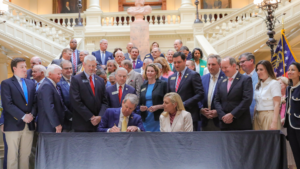
Last year, the state legislature gave Governor Brian Kemp the authority to seek waivers from the federal government, and the governor has done just that. Without much fanfare, Georgia’s Section 1332 waiver request, as amended, was finally approved on Sunday. This approval complements Georgia’s other approved waiver request on Medicaid that received widespread press coverage and was announced during a joint press conference on October 15th with the governor and Seema Verma, administrator of the federal Centers for Medicare & Medicaid Services. 


First, let’s review just some of the mess the federal law created.


The Price Sticker Shockwave


The Affordable Care Act has not lived up to its name, as demonstrated by spiking health insurance costs, especially in the individual markets.


Once the law went into effect and the new premiums took hold in the individual markets, there was a price sticker shockwave that rolled across the country. The Manhattan Institute for Policy Research calculated price increases varying from 64.5% for a 40-year-old female to a 178.8% increase for a 27-year-old male. 


Our own analysis estimated premiums increased 17 times faster than the general inflation rate from 2014 to 2019. On average, Georgians suffered average price increases of 70.7% for Bronze plans, 77.3% for Silver plans, and 70.4% for Gold plans.


The chart below shows one result of our research. We estimated that the median annual price for a pre-ACA insurance plan for a family of four in Georgia was $5,386 in January 2013. For 2019, the median prices for a family of four rose to $17,550 for a bronze plan, $18,644 for a silver plan, $23,065 for a gold plan, and $26,081 for a platinum plan.


ACAHIX

Moreover, because of the unaffordability of the premiums, many who had insurance coverage prior to the ACA found themselves uninsured. As pointed out in the governor’s Section 1332 waiver application, 129,000 Georgians dropped out of the marketplace from 2016 to 2019, a staggering decline of 22%.

A major culprit for the price spikes and loss of coverage is the ACA itself. Many insurance policies in effect prior to the law became immediately ACA noncompliant because the law redefined what constituted a policy and mandated changes to how insurers calculate premiums. This was exacerbated by how the federal bureaucracy initially implemented the law. The political promise of “if you like your plan, you can keep your plan” turned out to be untrue. 

The impact was not just on the individual markets. Employer-based plans also experienced major price increases, but this and other unintended consequences are a topic for another day.

Hope with Reinsurance and Better Access

The first part of the approved Georgia plan will begin in 2022, which naturally brings up the question: why must we wait so long? The short answer is because we’re dealing with government bureaucracies.

Despite the slowness, the Reinsurance Program will pass through federal funding from anticipated savings from the Premium Tax Credit, expected to be $285 million in Plan Year 2022, matched with state funds from either general revenue or a state user fee to reinsure insurers to bring down the cost of premiums. The reinsurance kicks in only for insurance claims above preset thresholds up to predetermined caps. It also varies based on three regions in the state intended to bring down more quickly the cost of premiums in those regions hurt worse from the premium increases since implementation of the ACA. The reinsurance only pays for a portion of the cost above those thresholds, up to the caps, to make sure insurers have a stake in the game to keep costs down.

Governor Kemp’s approved application estimates the Reinsurance Program will, on average, increase individual market enrollment by 0.4% and lower premiums by 10.2% in the first year, which are hopefully just conservative estimates considering the damage done to the market by the ACA. The Reinsurance Program targets individuals and families between 100% and 400% of the federal poverty level (FPL), who account for 57% of Georgia’s uninsured population.


pie chart GA's uninsured

The second part of the plan—that will begin with a delayed implementation in 2023 over concerns of the impact of COVID-19 and to ensure a smooth transition—is the Georgia Access Model addressing a major complaint about the ACA. The law makes Georgians go through the Federal Facilitated Exchange (FFE) to buy insurance on the individual markets. Government’s overreach includes requiring individuals to prove to bureaucrats that they endured a qualifying life event before they are allowed to buy health insurance during any time outside the government’s mandated enrollment period. 

To be run by the state instead of the federal government, the Georgia Access Model will still allow an online exchange as before, but, importantly, it frees individuals from the mandate of going through the exchange, allowing them to shop through multiple channels, including private distribution channels, brokers, and agents. It promises to return health insurance shopping to the way functioning markets work. 

Georgia is expected to run the new exchange more efficiently. Today, FFE is separate from the Georgia Gateway that handles Medicaid. Georgia will link the two together, which brings up the approved Medicaid waiver.

Helping the Poor with Pathways to Coverage

In addition to the Section 1332 waiver, the federal government also approved a Section 1115 waiver, allowing modifications to the Medicaid program. This waiver addresses adults under 100% FPL, which is 28% of the uninsured. The remaining uninsured are children under 100% FPL who already qualify for Medicaid, and families over 400% who will benefit from the lower premiums. 

Here the Georgia state legislature and Governor Kemp need to be commended for not falling into the Medicaid expansion trap. What they succeeded in doing is getting the federal government to allow Georgia to transform the program into one that makes more sense.

One big problem with Medicaid is that it traps people in poverty. There are welfare cliffs and marriage penalties associated with it. Another big problem is that the health outcomes are among the worst of any health care system in the nation. The states that expanded Medicaid have subjugated more individuals to these negatives.

Instead, Pathways to Coverage establishes a demonstration project to help adults up to 100% of the federal poverty level. Private market practices will be introduced, including incentivizing healthy behavior and creating member reward accounts. The goal is to create a pathway to help persons transition to higher quality private coverage, consistent with other welfare policy goals of not having adults languish below the poverty line by helping them move out of poverty.

The Long Run

Ultimately, implementation of these approved plans will determine their success. Therefore, the state administration needs to be vigilant and continue working on improving.

Considering constraints placed on the states by the federal government, it is probably the best deal Georgia could have received. But, as officials in the Kemp administration recognize, these waivers are not the complete solution. More needs to be done.

What we would like to see is a more aggressive agenda to adopt our vision of establishing a true risk equalization system that can deliver universal coverage with the highest quality of care only possible through leveraging the free-enterprise system. Switzerland has already shown the way, and you can read more about our vision and the Swiss system here.

If you had personal experience with the FFE, escalating health insurance costs, lost your coverage, or other thoughts on the best solutions, we are interested in your story and thoughts. Be sure to post your experience in the comments below.

*Erik Randolph is Director of Research at the Georgia Center for Opportunity. This blog reflects his opinion and not necessarily that of the Georgia Center for Opportunity.

How Second Chances Impact Communities


By Kristin Barker

We must begin to see past our biases and speak life into those who have fallen.

I recently had a mini-awakening. We were interviewing a young man who was a convicted felon. He was given a second chance to move into a job about one year ago with a company full of champions who were able to recognize his immense on-the-job potential early on. They continue to outwardly encourage him, help him as he maps out his future path, and openly show him their appreciation. The support he receives from his managers and the Human Resources team is phenomenal. But I knew this going in.

This was not the awakening. The company is Columbus Water Works in Columbus, GA. As a core company value, they believe in providing great opportunities and giving second chances. This is not because the business itself is looking to gain, although it does gain a lot, but because their corporate culture encourages this as the right thing to do. This company is a Hiring Well, Doing Good partner in part because of this important core value that we share, so this was also no surprise to me. This was not the awakening.

Watch Kevin's Story

As Kevin spoke about responsibility, he also shared his desire to influence others so they would begin see that opportunity does exist. As he continued, I saw a spark ignite in his eyes.

When he shared how he will encounter someone at a gas station and encourage him or her not to give up, it was clear that his influence on the community that surrounds him is a direct extension of the individuals who have nurtured and encouraged him since his incarceration. The responsibility he feels to share what he knows from his own experience is more valuable than any economic equation can measure. What he now knows without a shadow of a doubt is that there is hope and that he has value!

Our communities need to understand and appreciate Kevin and others like him. We must begin to see past our biases and speak life into those who have fallen. The poverty of community is just as important (if not more important) than economic poverty, and the butterfly effect I am describing is always at play either in a positive or in a negative way.

Every one of us decides daily who we will lift up and who we will allow to continue to fall. We choose every day whether we will contribute to the strength of our community by respecting and showing that respect to the weakest of our neighbors. The alternative is to fail to speak hope and to perpetuate hopelessness. As a result, this weakens our communities. 

If we, collectively, determine to see the value that is inherent in others and begin to express this belief proactively and personally in an open and vulnerable way, the same spark that I saw in Kevin today will begin to catch fire in others who have no hope. Our communities will grow stronger and healing will follow. 

As for me, I am thankful. I am thankful for the opportunity to meet Kevin and to hear his story. I am thankful to learn from his experience. I am also thankful to know the great leaders at Columbus Water Works who live their corporate values on the job every day. Above all, I am thankful to live in a community where potential is abundant, people generally support one another, and opportunities abound for most. My greatest hope is that tomorrow, those opportunities will abound for all!

EMPLOYMENT RESOURCES

SYSTEMIC WELFARE IN GEORGIA: PART 1 THE CASE FOR REFORM

In the first paper of our three-part series presenting a vision for systemic welfare reform in Georgia, we explore the need for a welfare system that starts with the assumption that natural support systems, including individual work and a reliance on family and community assistance, should be the primary sources of help when individuals face financial need. This report demonstrates how the current system does not meet these assumptions and points to the need for reform.

DOWNLOAD REPORT

SYSTEMIC WELFARE IN GEORGIA: PART 2 PRINCIPLES AND FRAMEWORK FOR REFORM

In the second paper of our three-part series presenting a vision for systemic welfare reform in Georgia, we explore the new system as we imagine it could be, give guiding principles, provide a general framework for how the reformed system can function, and establish preliminary steps needed to implement the vision.

DOWNLOAD REPORT

SYSTEMIC WELFARE IN GEORGIA: PART 3 HOW THE NEW SYSTEM WILL WORK

In the third and final paper of our three-part series presenting a vision for systemic welfare reform in Georgia, we propose the creation of new, consolidated program modules (including their structure, design, and expected outcomes) to replace current, disjointed programs. We go on to present a structure Georgia’s governor and executive agencies could adopt to effectively and in relatively short order implement a reformed system.

DOWNLOAD REPORT

A REAL SOLUTION FOR HEALTH INSURANCE AND MEDICAL ASSISTANCE REFORM

Medical assistance programs have long needed reforms to address high prices and lack of access. Despite the fact that federal policy tends to dominate medical assistance programs, states do have some flexibility to enact reforms. This study explores how states – and particularly Georgia – have flexibility and can experiment with Medicaid, the State Children’s Health Insurance Program (SCHIP), and the Affordable Care Act (ACA) to improve access, lower costs, and streamline the system to better serve those in need of assistance.

DOWNLOAD REPORT

HIRING WELL, DOING GOOD IN GEORGIA

Georgia has suffered from higher unemployment rates and lower high school graduation rates than the national average for many years. This report takes a look at the trends driving those problems and the potential solutions, including apprenticeships, that could lead to greater economic mobility for young adults.

DOWNLOAD REPORT


If You Accept this Raise, You Fall Off the Welfare Cliff


By Howard Baetjer, Jr


This article was originally posted on August 29, 2016 by the Foundation for Economic Education (FEE).

Getting a raise from $15 to $18 could cost you over $20,000 in net income. Would you work hard for that promotion?

Pretend you are a poor, single parent of two in Chicago, earning $12 an hour, working full time, and determined to do what is best for your family. And suppose your employer, impressed with your work, offers you training for and promotion to a new job paying $15. Should you take the offer?

It sounds like a no-brainer, but it’s not.

At your present $12 an hour you are eligible for refundable tax credits, food assistance, housing assistance, child care assistance, and medical assistance worth $41,465 combined. Together with your earned income after taxes of $22,121, you are now bringing home to your kids about $63,586 a year.

If you take your employer’s offer, you’ll earn $5,451 more after taxes, $27,572. You will also become eligible for an Affordable Care Act (ACA) premium tax credit. But at that level of earned income all your other benefits would decrease by $8,336, more than your increase in net pay. That means the income you would bring home would decrease from $63,586 to $60,701.

Now, would you take your employer’s offer? What would be best for you and your family, a move up the job ladder with a loss of $2885 in income? Or staying in your same job and keeping the larger income?

The Low-Wage Trap

This example, which is taken from a fascinating, and appalling study by the Illinois Policy Instituteentitled “Modeling Potential Income and Welfare Assistance Benefits in Illinois,” illustrates with clear charts and tables what is known as “welfare cliffs” or the “low wage trap,” which can trap families in poverty. When earning more means taking home less, the disincentive to work is obvious. The report provides striking visual representations of the “welfare cliffs” that poor people’s total incomes can fall off as they increase their earned incomes. Here is the chart on which the hypothetical above is based (the particular numbers in our example come from tables in the report, which clarify the visual data in the charts.)

Notice that welfare cliff we considered above, which occurs between $12 an hour and $15 an hour, is relatively small. A bigger one (and the reason I call the report “appalling”) occurs between $15 an hour and $18 an hour.

An Unaffordable Raise?

To pick up our thought experiment, let’s suppose that you want to get free of welfare eventually, and you know that moving up the job ladder is key to doing so, so you take your employer’s offer of a raise to $15 an hour and the corresponding loss of $2,885 in annual income. You cut back on spending where you can and look to the future. Now suppose further that you do well in your new job, you boost your knowledge and skills, and your employer offers you another promotion, with still more training and a raise to $18 an hour. Should you take it? Can you afford to take it?

At $18 an hour full time you would earn gross income of $37,440, and net income (after taxes) of $33,023. But earned income that high would reduce your refundable tax credit and ACA premium assistance, and eliminate your cash assistance, food assistance, housing assistance, and child care assistance, for a total reduction in government benefits of $26,820. So if you take the promotion and raise, your income would decrease from $60,701 to $39,332! A case could be made that it is irresponsible for you to reduce your family’s income that way.

Just think what that kind of welfare cliff does to the incentive to work (“on the books,” at least) and thereby to get off welfare. And the problem is not restricted to Chicago; the same kind of problem exists all across the country.

One of the tragedies of America today is that so many adults of sound mind and body do not support themselves and their families. It’s a tragedy not because they suffer material want; indeed, relatively few suffer so, because government assistance satisfies many of their material needs. It’s tragic because one of the keys to human happiness is earned self-respect, which requires, as Charles Murray has written, making one’s own way in the world. The vast majority of poor people don’t want welfare; they don’t want handouts; they want a good job with which they can support themselves and their families comfortably. The tragedy of the American welfare system is that it traps so many people in dependency on government, by hindering them from getting on and climbing up the job ladder, and thereby earning self-respect and happiness.

Welfare cliffs are of course not the only reason so many capable Americans languish in partial dependency on government assistance. Dreadful government schools in poor areas and systematic obstacles to getting a job, such as minimum wage laws and occupational licensing laws, are also to blame. But the perverse incentives of America’s welfare system really hurt.

 
Howard Baetjer Jr. is a lecturer in the department of economics at Towson University and a faculty member for seminars of the Institute for Humane Studies. He is the author of Free Our Markets: A Citizens’ Guide to Essential Economics.

DISINCENTIVES FOR WORK AND MARRIAGE IN GEORGIA’S WELFARE SYSTEM

Based on the most recent 2015 data, this report provides an in-depth look at the welfare cliffs across the state of Georgia. A computer model was created to demonstrate how welfare programs, alone or in combination with other programs, create multiple welfare cliffs for recipients that punish work. In addition to covering a dozen programs – more than any previous model – the tool used to produce the following report allows users to see how the welfare cliff affects individuals and families with very specific characteristics, including the age and sex of the parent, number of children, age of children, income, and other variables. Welfare reform conversations often lack a complete understanding of just how means-tested programs actually inflict harm on some of the neediest within our state’s communities.


DOWNLOAD WHITE PAPER

DOWNLOAD EXECUTIVE SUMMARY

VISIT WELFARECLIFF.ORG

Imagine being a worker on government assistance because your job doesn’t quite meet your bills. Then, finally, you get that raise to put you over the top and relieve some stress.

The one catch: You lose assistance needed for things like health insurance. Now, you bring home less than before.

This is called the “welfare cliff,” and it’s a situation for far too many people working to get off government assistance.

And the biggest culprit of this “welfare cliff”? Healthcare. 

A practical example

Picture a single person earning the equivalent of $8.25 per hour in a full-time job with no health benefits. She would qualify for Medicaid under the Affordable Care Act’s expansion rules. But just by earning a five-cent-per-hour raise would disqualify her entirely from Medicare due to the benefit cliff.

What’s more, the welfare system is also discouraging this single mom from marrying. Only in a situation where the dad earns enough to overcome the loss in benefits would marriage be financially worthwhile.

This example shows the negative impacts of welfare cliffs in preventing people from transitioning off assistance, moving up the economic ladder, and creating better lives for themselves and their families. While well-intentioned, these welfare benefits end up trapping people in a low-income existence.

The real tragedy of welfare cliffs is that hard-working welfare recipients who are striving to get ahead find that becoming independent of public assistance is virtually impossible because of the financial hardship they will have to endure.


Georgia Welfare Cliff

Disincentives for Work and Marriage in Georgia’s Welfare System

See How Your Community Is Impacted

A practical example

Picture a single person earning the equivalent of $8.25 per hour in a full-time job with no health benefits. She would qualify for Medicaid under the Affordable Care Act’s expansion rules. But just by earning a five-cent-per-hour raise would disqualify her entirely from Medicare due to the benefit cliff.

What’s more, the welfare system is also discouraging this single mom from marrying. Only in a situation where the dad earns enough to overcome the loss in benefits would marriage be financially worthwhile.

This example shows the negative impacts of welfare cliffs in preventing people from transitioning off assistance, moving up the economic ladder, and creating better lives for themselves and their families. While well-intentioned, these welfare benefits end up trapping people in a low-income existence.

The real tragedy of welfare cliffs is that hard-working welfare recipients who are striving to get ahead find that becoming independent of public assistance is virtually impossible because of the financial hardship they will have to endure.


Georgia Welfare Cliff

Disincentives for Work and Marriage in Georgia’s Welfare System

See How Your Community Is Impacted

What’s the solution?

We all want a welfare system that truly serves as a safety net, helping those who can’t help themselves while encouraging able-bodied adults to find work, improve their lives, and form stable marriages and families.

The Georgia Center for Opportunity has proposed welfare reforms that would:

  • Combine programs and reduce confusion and redundancy
  • Not punish welfare recipients for earning more
  • Encourage marriage and family formation

For healthcare specifically, our goal is to create a market-driven system that improves healthcare access for everyone by equalizing risk across the entire insured pool (as insurance is supposed to do), driving down prices while enhancing quality, having health insurance follow people rather than employers, and eliminating welfare cliffs and marriage penalties.

For those who are able to work, the ultimate question is this: Should the purpose of government-sponsored, means-tested healthcare programs, like Medicaid, be to get people back on their feet as they transition into the workforce? Or should the purpose be to provide perpetual benefits, with no end in sight?

Read more: A Real Solution for Health Insurance and Medical Assistance Reform

Read more: What Does an Ideal Solution to the Health Insurance Crisis Look Like?

Some in Georgia are pushing for a full expansion of Medicaid. As the Georgia Center for Opportunity (GCO) team has outlined before, this step would do more harm than good for low-income Georgia families.

But there’s another narrative unfolding that tends to not get much attention: expanding Medicaid doesn’t solve the problem of uninsured middle-class families in the Peach State. Far from it, in fact.

    “Georgia lags most of the rest of the nation on health insurance”


    The un-affordability problem

    Proposals to expand Medicaid would extend the program to households earning 138 percent or less of the federal poverty limit ($35,535 for a family of four). As GCO scholar Erik Randolph writes in a new report (What Does an Ideal Solution to the Health Insurance Crisis Look Like?), nearly 60 percent of Georgians have incomes above that threshold.  

    So, what does that mean in plain language? Simply that even with tax credits available under the Affordable Care Act (ACA) that subsidize the cost of insurance, hundreds of thousands of Georgia families still consider the cost unaffordable. 

    The statistics on who is insured and uninsured in Georgia bear this out:

    • Nearly half (46 percent) of uninsured families of four have annual incomes between $35,535 and $103,000.

    Woman's hands with pills and money in black and whiteA newly released report from the consulting firm Deloitte found that Georgia lags most of the rest of the nation on health insurance:

    • Georgia’s uninsured rate is 14.8 percent, compared to 10.5 percent nationally.
    • Around 28.5 percent of the uninsured population is below the poverty line (478,000 people) compared to 19.6 percent nationally.
    • Minorities are particularly impacted: 33 percent of Hispanics and 15 percent of African-Americans are uninsured, compared to 12 percent of whites.

    While those near or at the poverty level are impacted by the current healthcare crisis, they’re not alone. Even the middle class can’t afford health insurance. Average prices for plans on the ACA exchanges have increased by around 70 percent since 2014. And in some Georgia counties, they’ve more than doubled.


    A new system is needed

    Earlier this year, Governor Brian Kemp and lawmakers in the General Assembly took the right step when they passed a bill authorizing healthcare waivers for Georgia. This is a crucial step toward full healthcare reforms that help the truly needy while lifting people out of poverty and encouraging healthy family formation. However, this is not a comprehensive solution because once families are lifted out of poverty, they still face the mounting costs of health insurance.

    The answer comes in the form of a market-based, consumer-directed health insurance system. Under GCO proposals, Medicaid in our state would be fundamentally changed and consolidated with other programs so that the most underserved can access the same health insurance as everyone else. As a result, no one gets trapped in the welfare system.

    These proposals also make health insurance affordable for the middle class, empower consumers to shop for the right plan, and solve the portability problem by no longer tying health insurance to employers.

    In the end, everyone will benefit—poor, middle-class, and rich—under these proposals that bring common sense and sanity back into the healthcare marketplace.

    Read more: A Real Solution for Health Insurance and Medical Assistance Reform

    Read more: What Does an Ideal Solution to the Health Insurance Crisis Look Like?


    A look at the correlation between health care insurance coverage and poverty in Georgia reveals some sobering facts:  

    • 41 percent of uninsured Georgians have annual incomes at or below $35,535.
    • Lack of insurance coverage is one of the prime reasons why life expectancy for those in poor neighborhoods is fully 10 years shorter than in the richest areas. 
    • Premiums in the individual health insurance market have more than doubled since passage of the Affordable Care Act (ACA) in 2010. 
    • For low-income families and those stuck at or below the poverty threshold, healthcare is one of the top expenses and plays heavily into the welfare cliff, which keeps folks mired in poverty. 
    • Despite generous government tax credits, premiums for low-income families on the ACA health care exchanges are still unaffordable. 

    “The health care crisis is a poverty crisis.

    Clearly, America’s failing healthcare system disproportionately impacts the poor. And despite multiple federal and state programs aimed at creating a safety net, the poor still aren’t getting adequate health care. The bottom line is that our health care crisis is a poverty crisis. 


    A complicated, fragmented system

    Imagine going to the doctor and not knowing whether your visit will be covered or what you should expect to pay. That’s the exact scenario that plays out for millions of low-income Americans every week. That’s partly because of rather than receiving health care coverage through one unified plan, low-income families in Georgia frequently cobble together fragmented plans.

    For Georgians under the age of 18 living in a family at 138 percent of the poverty level or less, 60 percent have different coverage from their mother and 70 percent have different coverage from their father.  

    And depending on individual circumstances, health insurance can come through a job, individual markets, ACA exchanges, and government programs such as Medicaid, PeachCare, Medicare, TriCare, VA services, and the Indian Health Service—all with different rules for eligibility.


    The time is ripe for meaningful reforms in Georgia

    Instead of simply expanding Medicaid and trapping more people in the welfare system, we must explore options that help pull people out of poverty.

    The solution is a consumer-directed market system coupled with a reform safety net program that achieves universal coverage for all Georgians by:  

    • Untethering health care from its close association with employment so that people won’t lose their insurance because they lose or change a job.
    • Making shopping for health insurance just like buying any other insurance product so that consumers can identify coverage and price options—and compare apples to apples.
    • Providing subsidies from the government—run by the Georgia Gateway—to allow low-income individuals and families to purchase insurance on the private market. This system would be means-tested by an eligibility engine that eliminates welfare cliffs and marriage penalties.


    A Hope For Georgians

    The good news is that the President’s Administration is encouraging states to come up with their own solutions to the health care crisis through federal waiver applications. This means Georgia has a unique opportunity to enact meaningful health-insurance reform that not only addresses the health care crisis, but also helps pull families out of poverty.

    Read more: A Real Solution for Health Insurance and Medical Assistance Reform

    Read more: What Does an Ideal Solution to the Health Insurance Crisis Look Like?

    Subscribe

    * indicates required

    Subscribe

    * indicates required