Dejected Student - 640

According to the most recent data released by the National Center for Education Statistics this January, Georgia’s high school graduation rate is still one of the lowest in the nation at 72 percent, despite good improvement over the last two years. Only three states and the District of Columbia have a lower graduation rate than Georgia. Compare this to such states as Nebraska, New Jersey, North Dakota, Texas, and Wisconsin, which all have a graduation rate of 88, and Iowa which leads the pack at 90.

Georgia’s struggles don’t end with its graduation rate. Education Week released the latest report cards for each state this January in the categories of Chance-for-Success, School Finance, and K-12 Achievement in its 19th annual Quality Counts – Preparing to Launch: Early Childhood’s Academic Countdown. Georgia earned a grade of C-Minus and a ranking of 31st overall amongst the 50 states, based on its rankings of 37th, 31st, and 17th in each respective category. Georgia is below the nation as a whole, which earned a grade of C.

It would be one thing if Georgia ranked near the middle of the pack in a country whose educational outcomes far exceeded those of other developing countries around the world. However, when comparing how the U.S. education system stacks up on the international playing field, the results are not promising.

The Programme for International Student Assessment (PISA) assessed the competencies of 15-year-olds in reading, mathematics, and science in 65 countries and economies in 2012. Among the 34 countries who are members of the Organisation for Economic Co-operation and Development (OECD), the U.S. performed below average in mathematics, ranking 27th, and close to the OECD average in reading and science, ranking 17th and 20th respectively. According to PISA, U.S. students’ performance has not changed significantly over time despite the U.S. spending more per student than most countries.

So, what do these statistics teach us?

If Georgia stands in the middle of the pack when compared to other states in educating our children, in a country that is in the middle-to-the-back of the pack among developed countries, it’s safe to conclude that as a state we are failing to produce the level of excellence we desire for our children in an increasingly globalized economy.

Far too many students are stuck in failing schools that stifle them from reaching their full potential simply because their zip code affords them no other options. As a state, we cannot afford to let students spend another day in a failing school. The cost is too high individually and collectively.

Mediocre results call for a change in the status quo. Instead of keeping the same old system that is failing to produce the outcomes we hope to see, why not try a different strategy?

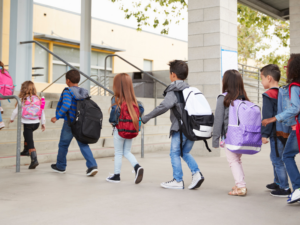
Elementary pupils outside classroom talking to teacher. Courtesy: nspt4kids.com

Elementary pupils outside classroom talking to teacher. Courtesy: nspt4kids.com

Hidden beneath academic benchmarks, league tables, and other measures of success in education, are the relationships and personal traits that fuel positive and negative outcomes for students. Attending the College Access Challenge Grant Georgia Conference earlier this week, I realized this theme as presenters with extremely challenging backgrounds–such as one man who was abandoned at a bus station when he was 5 years old–shared their stories of trial and triumph. Relationships–both the ones we build with others, and the one we nurture with ourselves–are the true challenge of preparing students to be successful in school and in life.

Prefacing the College Access Challenge Grant Georgia Conference, Georgia Center for Opportunity hosted a meeting focused on the non-academic needs of students earlier this week. Presenters Reginald Beaty and Tony Owens, independent consultants and Co-Deans of Students at Paine College in Augusta, Ga, enlightened the College and Career Pathways working group with trend leading research on non-cognitive variables.

If I just lost you, non-cognitive variables, more commonly referred to as “soft-skills,” are the qualities such as self-awareness, resilience, and even time management that bridge testable knowledge with actual successful outcomes. Notable scholars such as Angela Duckworth, and William Sedlacek, Ph.D have led the conversation on how these skills can be fostered within traditional and nontraditional school settings to transform individual students’ mindsets to ensure they are better prepared to overcome adverse learning challenges.

Paring my experience at the conference with the meeting on non-cognitive variables, I gained 2 important take-aways this week:

  1. Personal experiences with adversity can build “soft-skills” such as self-perception and grit (the ability to preserve past challenges to reach long-term goals) that aid academic success. However, the framing of these vital skills in a negative context can potentially render them useless to students.

  1. Actively working to connect with students on an individual level, in some cases weeding through the traumas of a student’s life, can change the context through which students utilize these traits to close achievement gaps and reach personal redemption.

Ruby K. Payne, Ph.D notes in her acclaimed book A Framework for Understanding Poverty, that “support systems are simply networks of relationships.” From both meetings, the consensus was that  more streamlined support systems are needed to empower students, and there is still much debate around how to deliver a more relationship-focused infrastructure. Seeking a solution for this issue will continue to be at the heart of the College and Career Pathways working group.

Below is a guest blog by Dr. Eric Wearne of Georgia Gwinnett College and formerly with the Governor’s Office of Student Achievement. Dr. Wearne currently leads GCO’s College & Career Pathways working group.

****************************

By: Dr. Eric Wearne

What it means to be “college ready” has been a popular topic of conversation among educators in school systems, state agencies, and even at the national level for several years.  Local schools certainly think about this, though they are not directly held accountable for their graduates’ outcomes (other than graduation itself). The Georgia Department of Education and the University System of Georgia have worked on college readiness definition and alignment issues for several years.  SAT and ACT publish their opinions of what constitutes “college readiness” (based on their respective tests) every year.  And the federal report that was meant as a “blueprint” for reform of no child left behind very clearly discusses USED’s desire to increase “college readiness.”

Over the past few months, GCO’s working group on college and career readiness has met and started defining its research agenda in the area of improving college readiness outcomes.

In its first few meetings, the group has looked specifically at college readiness.  The group has chosen to focus its efforts in this area by looking at the particular issues of three sets of students:

a.       Students in college but not prepared for it;

b.      Students currently in high school and in danger of dropping out;

c.       Students in high school (not in danger of dropping out), but not on track for college or careers.

Today, the group will meet at Georgia Gwinnett College, and will hear presentations about issues related to students in need of remediation and first-generation college students.  SAT, ACT, and USED have suggested college readiness standards or goals, as noted above.  More practically for Georgia schools, the University System of Georgia has defined what it means to be “college ready” through its Required High School Curriculum.  The requirements are reasonable, and both public and private schools in Georgia know what these requirements are and help their students meet them.  But the fact remains that large numbers of students who would like to attend college, and work toward (and often attain) these credentials are still not college ready.  How might colleges support students who they have admitted, but who are not really college ready?  What can K12 do to ensure that their graduates are able to do what they want to with their lives, or, as GCO often puts it, reach “middle class by middle age?” This ground is where GCO’s working group will conduct its research and find recommendations.

This is just the first stage in the group’s work.    In the coming months, the group will look more specifically at career readiness, broadly-defined: career academies, vocational education, apprenticeships, etc.  Other areas the group will explore as it works toward policy recommendations are: looking at the impact of teacher effectiveness, teacher training, and teacher career responsibilities on college- and career-readiness outcomes; exploring the possibilities that may come from online learning technologies and related strategies such as competency-based learning; and other areas the group finds necessary and worthwhile.

Subscribe

* indicates required

Subscribe

* indicates required