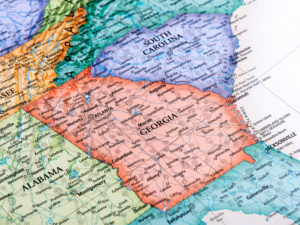
As August ushers in a new school year, nearly two million students are headed back to Georgia’s 2,300 public schools. How are Georgia schools doing when it comes to preparing kids for work and life? Here are a few key measures of education in Georgia that parents and communities should know as students return to the classroom. 

Learning in Georgia

Results from the latest Georgia Milestones Assessment show students are still struggling with math and reading. In math, 54% of third-graders and 56% of eighth-graders were below proficiency. 

In reading, 45% of eighth-graders were at grade level or above. Third-graders are even further behind—only 38% met proficiency in reading. While that number is up from 36% in 2020, it’s still below pre-pandemic levels. In 2019, 42% of third-graders were reading at grade-level or above. 

Demographic data from the Milestones Assessment shows Black and Hispanic third-graders are struggling most when it comes to reading.

Reading proficiency by third grade is a crucial milestone for Georgia’s students. Not only is it necessary for learning in later grades, but it’s also an indicator of future stability and economic opportunity. That’s because literacy is closely linked to high school completion and participation in the workforce. 

 Children who can’t read proficiently by third grade are more likely to drop out of high school, have lower earning potential, and experience higher rates of poverty and unemployment. 

  • The median annual earnings of adults ages 25 to 35 who had not completed high school was $6,300 less than those with a high school diploma.
  • Data from the Bureau of Labor Statistics shows a 6.2% unemployment rate for people with no high school diploma. It drops to 4.2% for high school graduates and 2.8% for those with an associate’s degree.
  • The poverty rate for those with no high school diploma is 25.1%, compared to 13.1% for those who have finished high school. In Georgia, where an estimated 1.4 million people live in poverty, 25% would roughly equate to 350,000 people. 

A literacy study from the Annie E. Casey Foundation sums up what’s at stake for kids in Georgia and the country if reading proficiency continues to slide: 

 “The bottom line is that if we don’t get dramatically more children on track as proficient readers, the United States will lose a growing and essential proportion of its human capital to poverty, and the price will be paid not only by individual children and families, but by the entire country.” 

Enrollment

Georgia public schools enrolled 1,736,730 students in pre-kindergarten through 12th grade, according to the Georgia Department of Education’s spring 2025 enrollment count. That number marks a drop of 10,964 students from spring 2024. 

As Georgia has taken steps to expand education opportunities, more families are embracing new schooling options to find the best education fit for their kids. Homeschooling is on the rise, and over 15,000 families applied to Georgia’s newest school choice program, the Promise Scholarship, between March 2 and June 30.

Students missing school

Georgia, like many states, is battling a crisis of chronic absenteeism. These are students missing 10% or more of school days—a situation that puts kids further behind in academic progress and raises the high school dropout risk.

Chronic absenteeism and its risks tend to be higher among students from low-income families, students of color, and students with disabilities.  

In Georgia, absenteeism skyrocketed between 2020 and 2021 in the wake of pandemic school closures. In 2019, 12.1% of students had been chronically missing school. By 2021, that number had jumped to 20.1%. Only recently, in 2025, did the percentage dip below 20% for the first time in four years. 

Public school spending

On average, Georgia spends $14,660 on K-12 education per pupil. Pre-kindergarten and K-12 education spending accounts for 38% of the state budget, making it Georgia’s biggest line item. In 2025, the state budget included $13.3 billion for Georgia’s public schools, which was a $1.4 billion increase from 2024. 

Despite these amounts, state funding is only a portion of overall revenue for public schools. Local taxes are the biggest source of education dollars, and a small percentage comes from federal funding. 

New education laws in place this year

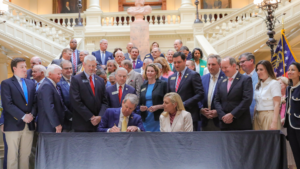
Georgia lawmakers passed a handful of education-related bills in 2025 that will impact schools as of this academic year. 

The Georgia Literacy Act stops the use of an instructional reading method called “three-cueuing,” which research has shown to be ineffective. Instead, the law ensures teachers are trained in the science of reading—the evidence-based methods that have proven most successful for teaching reading. 

This is a hopeful step for Georgia students, especially in light of results that similar reforms have had in other states. ExcelinEd specifically noted the astonishing transformation in Mississippi: “Mississippi’s fourth-grade Black students have risen to third in the nation in both reading and math, and Hispanic and low-income students have claimed the top spots in reading and second place in math nationwide.” 

In addition to addressing literacy, Georgia lawmakers have also taken steps to improve school learning environments. Starting this year, a new cell phone law will put stricter limits on student phone use during school hours. The goal is to cut down on distractions and help students stay engaged in the classroom. 

What’s next for education in Georgia?

Georgia’s education measures are more than data. Behind the numbers are real children who will be the next generation of mothers, fathers, business owners, employees, and voters in our state. A quality education is necessary for giving them strong, opportunity-filled futures. 

Solutions to boost math and reading proficiency and address chronic absenteeism can strengthen Georgia’s public schools. These are worthwhile steps to support students whose best—and often only—education option is the local public school. 

At the same time, Georgia leaders should be doing everything possible to remove financial and social barriers to quality education and empowering students and families to access the school of their choice. Prioritizing more opportunities over limited choices is the best way to prevent a lack of quality education from locking Georgia’s kids and communities into poverty.

Image Credit: Canva

Key Points

  • Parental involvement in education yields significant benefits for both students and schools. 
  • Students with engaged parents tend to have better academic outcomes, attendance rates, and behavior in the classroom. 
  • Schools and communities can employ a few concrete strategies to facilitate parental involvement and empower students to succeed at school and in life.

    Raising and educating young people takes a group effort. Everyone—parents, grandparents, aunts, uncles, teachers, friends, clergy, coaches—plays an important role. Within this collaboration, parental involvement is especially powerful and yields numerous benefits for both children and schools. 

    Research consistently demonstrates that children with engaged parents tend to have higher academic performance, better attendance rates, improved behavior, and increased motivation to learn. Moreover, schools benefit from parental involvement by gaining valuable insights, fostering a supportive environment, and enhancing overall student outcomes. When our kids are successful and able to show up as their best selves, our entire communities benefit from future generations of healthy, responsible, caring adults who are well prepared for meaningful work, relationships, and community involvement. 

    As families prepare for a brand new school year, here are six ways that schools and communities can empower students and their parents and caregivers throughout the school year. 

    1. Build strong communication channels between parents, children, and schools. 

    Schools can employ various strategies, such as regular newsletters, parent-teacher conferences, class websites, and digital communication platforms to keep parents informed about their child’s progress, school activities, and opportunities for involvement. Encouraging two-way communication ensures that parents feel valued and heard, enabling them to participate in their child’s educational journey.

    2. Offer and promote parent education programs. 

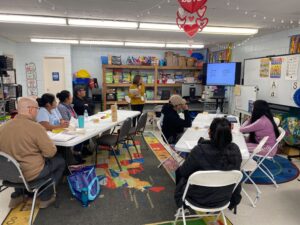
    Parent education programs and workshops play a vital role in equipping parents with the necessary skills and knowledge to support their children’s learning. Schools can organize workshops on topics like homework assistance, effective communication strategies, and understanding curriculum standards. By empowering parents with the right tools, they become better equipped to engage in their child’s education and make informed decisions.

    3. Encourage volunteering and participation. 

    Volunteering opportunities provide parents or other primary caregivers with hands-on involvement in their child’s school and community. Schools can offer various volunteering options, such as assisting in the classroom, organizing events, or participating in extracurricular activities.

    Volunteering strengthens the parent-child bond, and it helps parents understand the educational environment and feel a sense of belonging within the school community. 

    When our kids are successful, entire communities benefit from future generations of healthy, responsible, caring adults who are well prepared for meaningful work, relationships, and community involvement. 

    4. Create family engagement events. 

    Family engagement events serve as an excellent platform to bring parents, children, and educators together. These events can range from family fun days, cultural celebrations, or academic showcases. 

    By organizing inclusive and interactive events, schools can create an inviting atmosphere that encourages parents to participate and form connections with other families, thereby enhancing the sense of community.

    5. Leverage technology to give parents flexibility.  

    In today’s digital age, technology can bridge the gap between parents, children, and schools.  Online platforms and applications give parents easy access to information about their child’s progress, assignments, and upcoming events. Schools can use technology for virtual parent-teacher conferences, webinars, or online discussion forums, enabling greater flexibility and engagement for parents who may have time constraints.

    6. Partner with the community to enrich students’ educational experiences. 

    Collaborating with the wider community enriches the educational experience and broadens the opportunities available to students. Schools can engage local businesses, organizations, and professionals to offer mentorship programs, career guidance, or specialized workshops. Community partnerships foster real-world connections, expose children to diverse perspectives, and demonstrate the importance of community involvement.

    Additional Resources

    Want to learn more about how communities can support parents and foster the academic achievement and well-being of our youth? Check out these resources based on our Raising Highly Capable Kids parenting program:


    The undeniable truth is that parents want more educational options for their children and the kids certainly deserve it after historic learning losses caused by government-mandated school closures.
    A recent poll from the Walton Family Foundation found that 72% of voters believe “improving K-12 education” should be a top priority for state lawmakers headed into 2023. Only the economy and inflation ranked higher at 76%. Furthermore, the poll reveals the number of parents who want bold actions jumped by 10% from 2021 to 2022. Nearly half are now demanding major changes because minor, incremental improvements are not helping their kids catch up.
    Of the learning losses from pandemic-induced classroom closures, 75% of parents said their “students are mostly still behind,” while two-thirds said their students have lost learning due to the pandemic.
    Let’s not merely dismiss parental concerns about education with more lip-service or another round of half-hearted efforts that merely pour more money into unworkable solutions. After all, if one-size-fits-all solutions or throwing more money at the status quo worked, major educational reforms wouldn’t be in such high demand across the nation.
    Behind the statistics are real-life stories of students and parents devastated because they are not succeeding academically but can see other promising options that are just out of reach financially. This is a heartbreaking scenario too many families are facing.
    The good news is there are real ways to address learning loss by tailoring education to fit individual needs. The simplest and best way to empower students is through funding scholarship accounts that provide the flexibility that parents and guardians need and offer real results.
    Direct scholarships that fund students over an educational bureaucracy tips the balance of power in favor of those who best understand the needs of their child. It allows parents and guardians to access funds directly so they can purchase curriculum, pay for private school tuition, private tutoring, or even individual therapy for the child they love. It’s better than vouchers because it can do more than just pay a tuition bill. The added assistance will improve many public schools — since it boosts student performance no matter where families decide to access education.
    Unfortunately, last year’s Promise Scholarships, which would have allocated $6,000 in funds for ESAs, did not pass the legislature. It was a major lost opportunity for students and their frustrated families throughout our state.
    Given that state lawmakers reconvene this month, it’s time for them to make up for the lost opportunity by passing ESAs into law and expanding educational freedom for young Georgians and their families.
    And we have reason to be hopeful that that’s just what they’ll do. The new lineup of leadership in the Georgia legislature increases the likelihood that ESAs will become law. In both chambers of the General Assembly, the leadership teams have nearly universal pro- educational opportunity voting records in recent history — something very new to the Georgia political landscape.
    The simple truth is that it’s past time for our elected leaders to make good on their fundamental obligation to provide for the effective education of every child in Georgia. Parents and guardians are demanding it and their students are suffering without it. It’s time for true leaders to step forward and deliver.
    We will stand and fight with these families until more options like Promise Scholarship are a reality.

    Read the full article here

    Originally published in the Atlanta Journal-Constitution

    In The News

    Buzz Brockway, a former Republican legislator from Gwinnett, is vice president of public policy for the right-leaning think tank Georgia Center for Opportunity, which promotes school choice.

    In this guest column, Brockway discusses solutions to pandemic learning loss.

    Georgia students are flocking back to their classrooms, but in addition to the usual assortment of back-to-school supplies, kids are taking something else with them — profound learning losses from the past two years of the COVID-19 pandemic.

    A 2022 research brief reveals that K-2 students are the greatest victims of learning loss. Furthermore, the literacy gap between minority and white students is now larger post-pandemic. Parents and teachers know that the earliest years of instruction are often the most impactful.

    Read the full article here


    students elementary

    Key Points

    • Voters are not saying other issues, such as race and gender, are not important, just that learning loss is more important.
    • We can’t be thinking of this as a one-year catch-up.
    • There are other interventions that have been shown to have effects, it’s just that no single intervention gets you all the way. 

    It has been well documented that school closing due to the pandemic caused students to lose ground (see here and here). Recent polling suggests that parents are very concerned about this learning loss and want political leaders to focus on this issue.

    Consider this from The74Million.com:

    Matt Hogan, a partner at Impact Research, said that it was striking to see Republicans seize an edge on an issue that “has historically been one of the Democrats’ strengths.” 

    “There’s just a perception that Democrats’ focus on education is not where voters want it to be, which is helping kids make up the ground they lost,” Hogan said. “They think both parties are too focused on race and gender issues in schools, rather than focusing on catching kids up — but notably, they think that is true of Democrats even more so than Republicans.”

    Notice that voters are not saying other issues, such as race and gender, are not important, just that learning loss is more important. Yet as we survey the political landscape, very few politicians or candidates are talking about what parents are most concerned about. 

    Perhaps this is because there is no magic wand that can be waived to fix the problem. There is no list of “five easy steps to catch your kids up, and number four will blow your mind.” There are, however, things that can and should be done immediately.

    Recently, Harvard economist Tom Kane produced a study of the impact of learning loss and proposed solutions. Kane’s research found that one-on-one tutoring was effective, but not effective enough to eliminate the learning loss for students in schools that were closed most of the 2020-2021 school year. Schools, he said, should plan on implementing learning recovery strategies for multiple years. Kane said:

    So what can schools and districts realistically be expected to do in this situation? 

    We can’t be thinking of this as a one-year catch-up. If we really are committed to making students whole and eliminating these losses, it’s going to be multiple years. There are other interventions that have been shown to have effects, it’s just that no single intervention gets you all the way. 

    In March, Congress passed the American Rescue Plan Act of 2021 which included substantial funding for education. However, only 20% of those funds are required to be spent on recovering learning loss. Kane suggests districts spend more than 20% or perhaps all of their ARPA funds on learning loss recovery:

    We try to put the scale of the [learning] losses and the amount of aid that districts have received in the same scale. We report both as a share of an annual school district budget, which I think is a useful starting point for thinking about what it’s going to cost a district to recover. If a district has lost the equivalent of, say, 22 weeks of instruction as a result of being remote, and you’re asking what it’s going to cost to make up for that, the lower bound of the estimated cost would have to start with [the question], “What does it cost to provide 22 weeks of instruction in a typical school year?”

    We think that’s a useful starting point for people, and what they’d see is that in the high-poverty districts that were remote for more than half of 2021, the amount of aid they received is basically equivalent to — maybe a little more, but not much more than — the magnitude of their losses in terms of instructional weeks. That just means that, rather than spending the 20 percent minimum that was required in the American Rescue Plan, some districts should be thinking that they’ll need all of that aid for academic catch-up.

    Imagine how much better off our society would be if politicians and school leaders truly committed to not only eliminating the pandemic learning loss, but using those interventions to insure every student is on grade level. How wonderful would that be?

    Imagine how much better off our society would be if politicians and school leaders truly committed to not only eliminating the pandemic learning loss, but using those interventions to insure every student is on grade level. How wonderful would that be?

    Additionally, empowering parents to choose a school that best fits their child, be it traditional public school, tuition-free charter school, private school, or homeschool, should also be a tool we deploy to help get kids caught up. 

    Polling has made it clear that parents want learning loss recovery to be a high priority for their child’s school. In this election year, candidates and elected officials would be wise to make this an issue in their campaigns. Parents should demand this of their candidates, and then hold them accountable to eliminating learning loss for every student. 

    Imagine how much better off our society would be if politicians and school leaders truly committed to not only eliminating the pandemic learning loss, but using those interventions to insure every student is on grade level. How wonderful would that be?

    girl remote learning

    Key Points

    • Georgia’s request to waive several testing and attendance measurements for the 2022 school year was approved by U.S. Dept. of Education
    • This move locks in the learning loss that took place during the COVID-19
    • American Relief Package Act requires at least 20% of funds be spent on recovering learning loss

      Georgia’s request approved

      The U.S. Department of Education has approved Georgia’s request to waive several testing and attendance measurements for the 2022 school year. “Our goal is to establish a new baseline, rather than compare your schools’ performance to pre-pandemic norms,” said School Superintendent Richard Woods.

      Buzz - GA School quote

      The Georgia Center for Opportunity’s (GCO) take:

      “By doing this we are locking in the learning loss that took place during the COVID-19 pandemic,” said Buzz Brockway, vice president of GCO. “This means for some students, they will never recover from the pandemic learning loss they experienced, nor are they expected to recover. This ignores the millions and millions of dollars Georgia’s school districts are being sent via the American Relief Package Act, which requires that at least 20% of those funds be spent on recovering learning loss. What will local districts do with that money? Is giving up best for students? Georgia’s parents should march in loud protest to accepting that pandemic learning loss is the new norm.”


      Special Needs

      For some students virtual classes during the past year have been fine. Some have even thrived. But for many special needs students, it has not gone well, as a parent tells the Georgia Center for Opportunity:

      A virtual classroom worked fine for Jennifer’s two older children, but her youngest son, 10-year-old Joey, has Down syndrome. Online learning is entirely unworkable for him due to his special needs.

      For example, DeKalb is following a normal bell schedule but staying engaged on Zoom for hours on end is not working. Morning classes will sometimes go well, but by lunchtime Joey is tuned out. It is impossible to get him back online after the lunch break for specials, such as music and art, and Jennifer cannot stay tied up until 2:30pm every day. She has seen academic and social regression for her son as he has little to no interaction with peers.

      Additionally, his academic growth is limited due to repetitive practice of current skills on worksheets with no new individual instruction to learn new concepts in language arts or math. As a highly visual and experiential learner, he is missing the magic that happens in a classroom that cannot be replicated on a Zoom call.

      “It’s day-by-day and minute-by-minute,” Jennifer shares. “One class he is engaged and on task, and the next minute he is hiding under the bed or taking his shirt off.”

      All children, no matter their needs, deserve the opportunity for a high-quality education that meets their individual requirements. 

      Today, Axios wrote about a newly released report on 130 studies on the safety of school reopening. The report found:

      • Any benefits to closing schools are far outweighed by the grave risks to children from remote-only schooling — risks that intensify the longer it continues, the report says.
      • The harms include academic loss — so severe that it could set children back for life — and mental health problems related to loneliness and isolation.
      • There are also severe hardships on parents — mothers in particular, about two million of whom have left the workforce to care for their kids as part of remote learning.
      • “Schools are not super-spreaders,” observes the report, written by John P. Bailey, a former deputy policy director at the Department of Commerce.

      Fortunately almost 73% of Georgia’s school districts are open for face to face learning. The rest need to reopen ASAP, and plans need to be made to help students who fell behind catch up.


      This post originally appeared on PeachPundit.com on March 11, 2021.


      While commonly referred to as the “Nation’s Report Card,” the National Assessment of Educational Progress or “NAEP” assesses student knowledge in “math, reading, and other subjects” and has been “viewed as a credible national measure of academic progress.” Last week’s release of NAEP test scores reflect a dismal outlook for Georgia students.

      Peggy Carr, acting commissioner of the National Center for Education Statistics, said that the national scores were not encouraging and represent an unexpected downturn.

      The percentage of Georgia fourth graders reading at a proficient level fell one point from 2013 to 33 percent. Making sure students improve their reading efficiency is a must. If a child is struggling with reading by the time they reach the fourth grade, their ability to learn new concepts and subjects is hindered, and they fall behind in other key areas where reasoning and logic are required.

      For eighth grade students, the percentage of students scoring at a proficient level decreased to 30 percent from 32 percent in 2011. Students in the eighth grade must be able to read and comprehend different “works of fiction and nonfiction,” analyze information from different mediums and be able to interpret their findings and present them in a clear report.

      For mathematics, fourth grade is when students are not just learning concepts, but are learning to problem-solve. The number of fourth graders who scored proficient in mathematics fell four points to 34 percent in 2015. The Atlanta Journal Constitution reported that “state education officials were particularly concerned about the four-point drop in fourth-grade math, and planned to refocus efforts on getting students better prepared in ‘foundational’ work.”

      Eighth grade mathematic proficiency also decreased in 2015 to 28 percent (from 29 percent in 2013).

      Georgia’s proficiency scores put the state on par with Arkansas and South Carolina, with only a point or two difference between the states. Most Southeastern states scored below the national average with the exception of Florida, which scored above the national average in both fourth and eighth grade reading. Florida is also home to the most robust school choice program options in the nation, allowing parent to choose the best learning environment for their children.

      For several years Georgia students have fallen short of the national average education scores. Students are falling behind and parents need additional options and resources to put their children in the education environment that best fits their learning needs. Georgia currently has some limited choice programs, but expanding choice – through ESAs or other school choice programs – is the only way to put Georgia students first.

       Georgia Flag

      Attempts at reforming the public education system in Georgia are not new. Even just looking over the last 20 years, numerous reform efforts have been introduced as a means to improve educational outcomes among the state’s youth. Some of these ideas have had a better effect than others, yet as a whole they have not achieved the level of progress Georgia has hoped for. While modest gains have been made in the National Assessment of Educational Progress (NAEP)  scores for eighth grade students and the graduation rate for high school students has risen since 2002, Georgia still has a grade of C-Minus overall and one of the lowest graduation rates in the country.

      Below is a list of reforms that Georgia has tried since the introduction of the Hope Scholarship and the charter school law that was passed in 1993. Comparing these reforms to the two graphs that follow demonstrates that achievement among Georgia’s eighth grade and high school students has been relatively stagnant compared to the amount of money spent to improve education over the last two decades.

      Past Reforms

      1993 – HOPE Scholarship created and funded by lottery. Charter school law passed; only public schools can convert to charters; commissioned by local and state board.

      2000 – A+ Education Act mandates end-of-course assessments and Criterion-Referenced Competency Test (CRCT) in core subjects.

      2001 – No Child Left Behind and Title I grants public schools with high percentages of students receiving free or reduced lunch additional federal funding.

      2005 – Georgia Performance Standards implemented as a result of Quality Core Curriculum (QCC) reform to align with national standards.

      2008 – HB 881 creates the Georgia Charter Schools Commission. Qualified Education Expense (QEE) Tax Credit Bill passed (HB 1183).

      2009 – American Recovery Reinvestment Act; Georgia received almost $2 billion dollars to invest in education. HB555 requires local schools systems to grant charters within the district access to unoccupied buildings at no cost.

      2010 – As a result of Common Core State Standards initiative, Georgia adopts new content standards in language arts, math, science, and social studies.

      2011 – HB881 Georgia Charter Commission declared unconstitutional; 16 charters, 15,000 students impacted. QEE Tax Credit Bill amended (HB 325) creating student scholarship organizations (SSOs); individual and corporate taxpayers can contribute to SSOs in exchange for a state tax credit.

      2012 – Amendment One passes and Georgia Charter Commission is reinstated. College and Career Performance Readiness Index (CCPRI) conducted “study year” of public schools’ performance.

      2013 – Tax Credit Bill amended (HB283); cap increased to $58 million. Career Clusters curriculum implemented in schools.

      2014 – Students are to take Georgia Milestones instead of CRCT and EOCT. Charter schools reach a total of 315.

      • 77 start-ups
      • 31 conversions
      • 207 charter system schools
      • 16 charter systems
      • 13 state commissioned specialty schools
      • 13.5% of total student population


      Total Spending vs. NAEP Scores

      Total Spending vs. NAEP Scores


      Total Spending vs. High School Graduation Rate

      Total Spending vs. H.S. Graduation Rate


      It seems that Georgia will have to do something different than what has been attempted thus far if we want to experience real gains in educational outcomes among K-12 students – something different than pumping more money into the current system, aligning state curriculum to national standards, or allowing only a limited number of parents and students school choice. We need greater options that ensure tax dollars are well spent and students’ educational needs are met. Only then will be begin to see a more dramatic increase in the number of high school graduates who are ready for college, career, and life.


      Subscribe

      * indicates required

      Subscribe

      * indicates required