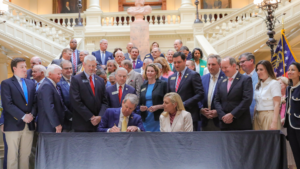
The Kentucky General Assembly has passed a law (House Bill 136) that improves the data collection and transparency practices of the state’s criminal justice system.
The bill, crafted with research and expertise from the Georgia Center for Opportunity, addresses the state’s lack of comprehensive data on sentencing, parole, and recidivism. Because of these gaps, policymakers have relied on incomplete data and anecdotal evidence to make serious decisions—ones that are often life-and-death.
The criminal justice system is the primary way government protects families and communities. It’s also the point of intersection between government and citizens when an individual breaks the law and decisions must be made about the future of their liberty and life.
With such high stakes, nothing should be more important and deserving of respect than the criminal justice system and its ability to make informed, just decisions. That’s where HB 136 comes in.
HB 136 equips lawmakers to assess the criminal justice system based on evidence, not anecdotes
The bill requires the state’s Department of Corrections to provide the Kentucky General Assembly with comprehensive data on sentence lengths, parole outcomes, recidivism rates, and demographic data.
Length of stay for first-time offenders: Data on the number of inmates released, average sentence lengths, time served, and parole release rates must all be made available under the bill.
Parolee data and supervision outcomes: This includes demographic information—including race, gender, age, and parental status—plus education levels, gang affiliation, and engagement in rehabilitation programs.
Supervision activities: Drug test results, employment outcomes, housing stability, and program compliance would all be made available.
Recidivism and criminal history trends: Under the measure, the state government would track repeat offenses to evaluate the effectiveness of parole or probation programs.
With this information, elected leaders can make better decisions, improve transparency and accountability in the system, and direct resources to the most successful rehabilitation and reentry programs.
These changes would bolster the downward trend in crime that Kentucky is already seeing this year, thanks in part to implementation of other GCO recommendations in the 2024 Safer Kentucky Act. In Louisville alone, homicides are down 30%, non-fatal shootings have dropped by 40%, and carjackings have plummeted by 43%.
HB 136 turns data into a fairer system and safer communities
With these changes in place, Kentucky communities will have the benefits of enhanced public safety, a fairer system, and improved use of taxpayer dollars.
Reduced recidivism: Access to detailed data on reoffending rates and parole violations allows Kentucky to invest in programs that truly help individuals reintegrate into society, reducing the likelihood of repeat offenses.
Fairer sentencing practices: Analyzing trends in sentencing and parole provides lawmakers with the tools to ensure that policies are applied consistently and equitably—and criminals are appropriately held accountable for their crimes.
Improved public safety: By identifying practices that reduce recidivism and improve parole outcomes, policymakers can enhance community safety and stability.
Better allocation of funding: Tracking incarceration and parole data helps Kentucky allocate resources effectively, ensuring that correctional facilities and rehabilitation programs are adequately funded without unnecessary overspending.
Lower racial and gender disparities: Detailed demographic data illuminates any potential disparities in sentencing or parole practices, enabling targeted reforms to promote equity within the justice system.
While these data practices are new to Kentucky, they are common in other states. Georgia, Tennessee, Florida, and even California have implemented similar data-driven approaches and seen positive results. Now Kentucky can join these states as a leader in transforming data into insights that empower lawmakers to shape a better criminal justice system.
Watch GCO’s Testimony on HB 136
Key Points
Education plays a powerful role in breaking the cycle of poverty and helping children lead healthy, flourishing lives. Education savings accounts in Georgia are a solution to help more kids get the benefits of a quality education.
Georgia’s education savings account program is the Promise Scholarship. Starting in fall 2025, it will give eligible families $6,500 scholarships to access the education option that best meets their child’s needs.
Education savings accounts, or ESAs, in Georgia can have several positive impacts on communities, including better support for public schools, less crime, and greater upward mobility.
Education is an essential building block for a healthy, flourishing life. It has the power to break the cycle of poverty that can persist across generations.
When children from impoverished backgrounds receive a quality education, they’re more likely to escape poverty themselves and provide better opportunities for future generations.
Good education goes hand-in-hand with many other positive outcomes—like better jobs, higher personal income, valuable relationships, better physical health, and a longer life.
We all want these good things for children in our communities. Education savings accounts are one solution that Georgia can use to increase opportunity and prosperity for students who need it most.
What are education savings accounts?
Education savings accounts, also called ESAs, give parents a portion of state education funding that they can use to tailor their child’s education if traditional public school isn’t a good fit.
ESA programs expand education opportunity by giving parents greater flexibility and freedom in education choices. Whether a family prefers homeschooling, private schooling, or other alternatives, ESAs let parents access the best type of education for their child’s unique needs and interests.
Get Started With Georgia’s ESA Program: The Georgia Promise Scholarship
Georgia is getting ready to launch Promise Scholarships in the fall of 2025. If you’re interested in enrolling your child, make sure you’re signed up to hear about next steps.
To create education savings accounts programs, states must first pass a law. States then take a portion of what they would have spent on the student’s public school education and put it into a state-administered account.
Parents can use these funds for a range of education expenses—tuition, tutoring, homeschooling curriculum, educational therapies, online programs, or even a combination of educational services. States require parents to complete an application process to switch to an ESA.
What do families get from education savings accounts in Georgia?
Flexibility: ESAs let parents customize their kid’s education.
Financial Support: ESAs allow states to expand access to options that families may not be able to afford otherwise.
Empowerment: Parents can take charge of their child’s education journey with confidence.
Diverse Options: Parents can explore various educational paths that suit their child’s needs and interests.
What is Georgia’s ESA program?
Created in 2024, Georgia’s ESA program is the Georgia Promise Scholarship. It provides state-funded scholarship accounts that give eligible families $6,500 per student for each school year.
The program will be available starting in the 2025-2026 school year, and it will be limited to students in the lowest-performing public schools.
Georgia’s Promise Scholarship Explained Find out what the program is, how it works, and which students will be eligible.
ESAs are for all kinds of students. Whether a child is struggling in school or has special learning needs, ESAs can help. Georgia’s ESA program, the Promise Scholarship, is specifically designed to help families who may not have the resources to access better opportunities.
Students in Underperforming Schools
Thousands of Georgia kids are stuck in public schools that have received a failing grade from the Governor’s Office of Student Achievement. To help these kids in particular, the Promise Scholarship will be for students in the bottom 25% of Georgia’s public schools. With an ESA, these students can access higher-quality education options that prepare them for successful careers and fulfilling lives.
Low-Income Students
Choosing a different school or educational path has often been a privilege for wealthier families. What about families that struggle to make ends meet?
With an ESA, low-income families can consider schooling options that may be out of reach otherwise. The Georgia Promise Scholarship makes sure these students are helped first. Available scholarships will go to families below 400% of the federal poverty level (around $120,000/year for a family of four). Any leftover funding can then serve students above that threshold.
Students With Special Needs
ESA programs are a lifeline for students who need support beyond what their local public school can provide. ESAs make it possible to access schools that are set up to help students who have unique learning needs and disabilities. ESA funds can also help pay for other essential resources like tutoring, therapies, and learning technologies.
Homeschooling Families
ESAs don’t just cover school tuition. They can pay for curriculum, online programs, and supplies, giving parents the option to fully customize their child’s education. This flexibility means that ESAs can help families who want to homeschool as an alternative to public or private schools.
What kind of impact could ESAs have on communities in Georgia?
Since Georgia’s ESA program, the Georgia Promise Scholarship, is new, it will be a few years before we know its exact impact on our communities. But we can get an idea from other states that have ESAs, including a couple of Georgia’s neighbors.
Better support for public schools: In 2011, Arizona became the first state to adopt ESAs. The state soon found that the program was helping to redirect state and federal dollars back to public schools where it could be used for teacher pay and operational needs.
Better outcomes for low-income students: Created in 2019, Florida’s ESA program is now the largest in the country. A November 2023 study of Florida’s education system looked at the impact of growing school choice. It found students of lower socioeconomic backgrounds—including those who stayed in public schools—experienced some of the greatest benefits.
Better economic opportunity and healthier societies: Tennessee is still working to expand its ESA program, but a study from the Beacon Center of Tennessee found that a statewide program could have incredible social impact. Their model predicted that Tennessee could have more high school graduates, higher overall personal income, less criminal activity and fewer felons, and $2.9 billion in economic benefits.
Do parents want education savings accounts in Georgia?
Overall, Americans are worried about the direction of public K-12 education.
82% of teachers say the state of public K-12 education has worsened in the last five years.
Only 46% of school parents in Georgia think K-12 education is on the right track in the state of Georgia.
It’s not surprising, then, that Georgia parents are open to more school choice policies: 76% of Georgia school parents say they’re in favor of an ESA program.
What are common concerns about education savings accounts in Georgia?
Concern: ESAs take funding away from public schools.
Georgia communities don’t have to worry about this because state lawmakers are not using public school funding for the Georgia Promise Scholarship. Promise Scholarship funding is also not allowed to exceed 1% of public school funding. This set-up means public school funding is fully protected.
Concern: ESAs favor wealthy families and don’t help kids who actually need the opportunity.
Quality education is a building block of a healthy, flourishing life, regardless of a family’s financial situation. ESAs are a tool states can use to ensure there’s more equality when it comes to education opportunities.
Even if an ESA program is universal—where every student is eligible—the students who gain the most opportunities are those most in need. Here in Georgia, our ESA program, the Promise Scholarship, limits eligibility to students in low-income households to make sure they get helped first.
Concern: ESAs are just another private school voucher.
Education savings accounts can be used for private school tuition but also for much more! Unlike private school scholarships, ESAs can be used for a wider range of education expenses—including tuition, tutoring, online programs, education therapies, curriculum, and textbooks.
Concern: ESAs don’t help families in rural areas.
Rural areas may not have as many schools to choose from, but thanks to the flexibility of ESAs, this doesn’t have to be a reason for states to avoid ESA programs.
Take Tanya Schlegel’s story, for example. Tanya is a mom of two kids with special needs living in rural Georgia. Despite her best efforts to work with the local public school, it just isn’t equipped to give special needs students the help they need. An ESA would give her the resources to homeschool and access specialized therapies so that her kids can have the type of education that matches their needs.
Public school transfers are an education option that allows parents to move their child to a public school they’re not zoned for (as long as the school has space).
Georgia currently allows public school transfers within a student’s district but not outside of it.
Parents must apply for a public school transfer. Scroll down to find out how to check with your local school district for availability and application deadlines.
Public school transfers explained
Public school transfers, also referred to as open enrollment for public schools, allow parents to move their student to a different public school than the one they’re zoned for.
This is a great option for states to provide because it increases flexibility within the public school system—something parents increasingly want. The majority of Georgia students (84%) attend public school, so transfers empower more parents to choose the public school environment that’s right for their child.
Public school transfers available in Georgia
Allowed: Transfers within assigned school districts. Georgia offers restricted public school transfers. Families can send their child to any school within their assigned local district as long as that school has space and has been operating for at least four years. This option is known as an “intra-district transfer.”
Not yet allowed: Transfers outside of assigned school districts. Another type of public school transfer, called an “inter-district transfer,” permits students to switch to a public school outside of the district they’re zoned for. This option isn’t allowed in Georgia yet. Georgia lawmakers would need to pass a bill to make it available to families.
How Georgia’s public school transfers work
Parents must contact their local school system to see which schools will accept transfers and for which grades. The Georgia Department of Education provides a database of public school contact information.
Each school system is required to notify parents by July 1 about which schools have space, and many systems post this information on their websites before that date. Most districts only allow transfers at the beginning of the school year, but all can choose to accept students throughout the year.
Parents must then apply for a transfer through their district’s website, at the district office, or at the local school. If more students apply than space is available, some school systems will make decisions on a first-come, first-served basis. Others will hold a random lottery.
Eligibility requirements
A student must be enrolled in a public school in Georgia.
School options
Transfers open up access to other public schools within a student’s school district.
Transfers don’t apply to public schools outside a student’s assigned district. They also don’t apply to non-public schools.
A student who transfers to another public school may continue to attend that school until they’ve completed all grades at the school.
Cost to families
School systems can’t charge tuition for students transferring within their district.
Transportation is the parents’ or guardians’ responsibility.
Five application guidelines to follow:
1. Contact your local school system to see which schools accept transfers and in which grades.
2. Check your school system’s website by July 1. Each system is required to notify parents annually about which schools have space available. State law requires school systems to post this information by July 1, but it’s often available earlier, so consider checking the website as early as April or May.
3. Access the transfer application on your district’s website, at the district office, or at your local school and complete the application (note: some school systems require parents to do this in person at the district office).
4. Application periods can be as short as one to two weeks. For many districts, this application window opens in June or July. In other areas, it can open as early as January. Get in touch with your district or check its website early and often so you don’t miss any deadlines.
5. The school system will notify parents about whether their transfer request was accepted or denied. If more students apply than space is available, school systems will make decisions on a first-come, first-served basis or through a random lottery.
How Georgia can expand public school options
Georgia lawmakers could expand opportunities in the public school system by removing all restrictions on open enrollment and allowing both inter-district and intra-district transfers.
Parents with children in schools across the country are widely in favor of reforms like this. Polling from June 2025 by EdChoice-Morning Consult showed that 78% of parents nationwide—regardless of their political affiliation—support open enrollment.
To set up a successful transfer program, Georgia could look to many other states’ examples. In 2025, the Reason Foundation reported that policymakers in 24 states introduced at least 54 bills that focused on open enrollment, providing more evidence of the strong interest in these policies.
Of Georgia’s neighbors, Florida offers the broadest transfer opportunities to students and their families. The state passed a law in 2016 allowing state-wide open enrollment and required all districts to participate. Through the program, students can transfer from the school they’re zoned for to any public school that has space in their grade level. These transfers allow Florida students to attend the school that’s the best fit for them. They also enable parents to send their children to schools near their jobs, which helps lift barriers to rewarding work.
South Carolina followed suit in 2025 when it passed a bill requiring school districts to implement an inter-district transfer policy once the state’s Department of Education issues guidelines. Intra-district transfers have already been allowed there for some time.
The open enrollment policies in other nearby states vary:
Tennessee: The state currently allows intra-district transfers.
Alabama: Open enrollment is limited and voluntary for school districts.
North Carolina: There is no statewide policy on open enrollment.
To better position Georgia as a leader in education choice, state lawmakers are paying attention to advances in open enrollment like those in Florida and South Carolina.
In Georgia’s 2026 legislative session, the House of Representatives is considering a bill (HB 917) that would significantly expand current intra-district transfer options and also provide inter-district transfer options for Georgia students.
If the bill becomes law, the state will be able to provide families with more educational opportunities and, ultimately, an educational system that better serves every child’s unique situation and needs.
Key Points
Building off our success in 2023, the new year presents unique opportunities to build better lives for our neighbors through the power of work, education, family, and safer communities.
Our goal is for 2024 to be the year that safety-net reform takes hold in states across the country, while educational freedom becomes a reality at home here in Georgia as Promise Scholarships finally become a reality.
We hope this year will also bring safer communities in big and small cities alike through key public safety reforms.
One word that often comes to mind at the beginning of a new year is “hope.” As 2024 dawns, the Georgia Center for Opportunity (GCO) is working hard to help everyone — especially the poor and disadvantaged — experience the wonder of hope by envisioning a better future for themselves and their loved ones. They can live better. They can become better.
Time and time again, government has proven that it can’t help people escape systemic, generational poverty. While the safety net is important, viewing it as a way of life saps people of their humanity and unfairly limits their potential. The poor deserve to know that poverty is escapable, not just survivable. And they deserve a helping hand to escape.
These solutions come from homes, neighborhoods, and local communities. This is where aspirations and dreams are born. No handout can substitute for this.
With this vision in mind, we will be dedicating 2024 to making positive changes in a few key areas that greatly affect the quality and trajectory of life for those who are most vulnerable. We built significant momentum last year on a range of issues, and that’s setting the stage for even bigger impact this year.
Here’s some of what’s on tap for us in the new year.
Safety-net reform will yield new opportunities
We’re taking on the safety-net system by advancing reforms in Congress, Georgia, and states across the country to create a more humane system that rewards work and creates a bridge to self-sufficiency.
We should look to Utah as an example of a state in the nation that is leading the way on safety-net reforms. The Beehive State’s One Door policy has integrated human services with workforce services and provides citizens with a single program to work through. Welfare becomes work support, and people have a clear path to get the help they need while receiving education, training, and other support to find employment. This year, working with our Alliance for Opportunity partnership as a platform, we are advancing federal legislation to allow all states to adopt the One Door model—something that federal law currently prohibits. In Georgia, we are working with state policymakers to create a One Door task force so that our state is prepared to implement more holistic safety-net policies, especially when federal law is no longer a barrier.
On a similar front, we are working to educate lawmakers and the public on the problem of benefits cliffs. Put simply, benefits cliffs are when an individual, family, or household loses more in net income and benefits from governmental assistance programs than it gains from additional earnings. This net loss is a perverse incentive that undermines the natural desire to earn more income. Thanks to GCO’s original research, we are crafting program-specific solutions to reduce benefits cliffs in food stamps/SNAP and childcare assistance.
These solutions will build off the momentum created in states like Missouri, which became the first last year to address public assistance provisions, breaking ground in reforming safety-net benefits.
Safety-net programs have a role in helping the most vulnerable in our society. Ultimately, reforms are not about making government more efficient. They are about ensuring safety-net progams serve as a bridge, not a barrier, to better opportunities and futures.
Expanding educational opportunity will benefit all students
Could 2024 be the year that—finally—education opportunity is extended to all of Georgia’s students, not just a privileged few?
Our hope is the answer is yes. We’re fighting to give every child in Georgia access to a quality education as the Georgia Promise Scholarship bill comes back for a final vote in the recently convened 2024 legislative session. Promise Scholarships would give parents $6,500 per student per year to find the right education option for their kids. The bill cleared the state Senate in 2023 but stalled in the House.
Promise Scholarships are the cornerstone of our education agenda in 2024, but they are not the only priority. We are also encouraging lawmakers to expand the ceiling on the tax-credit scholarship, to free up families to transfer students between public schools within districts and in separate districts entirely, and make key improvements to charter school laws.
It’s well past time Georgia caught up with the rapidly growing list of other forward-thinking states that are expanding educational opportunity to all.
Support for parents will strengthen families
This year is an exciting phase for our Raising Highly Capable Kids (RHCK) program, which we launched in 2023 to give communities a better resource for nurturing family stability and well-being.
RHCK is a 13-week evidence-based parenting program designed to build stronger families by empowering parents with the confidence, tools, and skills they need to raise healthy, caring, and responsible children.
A driving factor of long-term poverty is a lack of connection and supportive relationships, especially at home. That’s why we are prioritizing RHCK. At its heart is a curriculum that teaches the building blocks of healthy child development. In 2024, we’re working with partners and schools to expand RHCK. We believe the program will be a powerful way to give parents, caregivers, and educators tools and support to improve kids’ academic achievement, relationships, and overall success in life.
In 2024, the Georgia Center for Opportunity spearheads transformative initiatives, ranging from safety-net reforms and educational advancements to family support and community safety, all geared towards breaking the cycle of poverty and fostering a brighter, more empowered future for individuals and families.
Key reforms will lead to safer communities
Community violence is another barrier to economic opportunity and healthy communities. Individuals and families can only truly thrive when neighborhoods and streets are safe.
Through community collaborations with law enforcement, policymakers, and community leaders, we’ll help Georgia cities like Atlanta and Columbus reverse the tide of rising violence that has been damaging the family bonds, work opportunities, and educational pathways needed to break the cycle of poverty.
Our team is also active in moving forward policy in other states, including California, Massachusetts, Tennessee, Washington State, and Kentucky. In Louisville, for example, our work has helped shape an omnibus crime solution bill, which is expected to pass their state House this year. Louisville is important as a national example because it’s one of the most challenging public safety environments in the country, and solutions that work in this city have a good probability of working elsewhere—including Georgia.
Breaking down employment barriers will transform generations
For those who struggle in poverty, an upwardly mobile job is often the first and best step toward self-sufficiency. That’s why we will continue to work through our BETTER WORK initiative in Gwinnett County and Columbus to build our local support systems to empower men and women to find work. We’ll also cultivate an environment of community safety where business and job opportunities abound.
In Columbus, a new focus for 2024 will be on partnering with local leaders and law enforcement to keep crime from driving away businesses and job opportunities. Meanwhile in Gwinnett, we’re laser focused on building out our network of employer partners, nonprofits, schools, and other community organizations to provide a bridge to a better life for the disadvantaged. And overall, we will continue our partnership with Jobs for Life as well as our mentor program.
Key Points
The Georgia Promise Scholarship is a statewide program that empowers parents to access the best education for their child. It creates state-funded scholarships that give eligible families up to $6,500 per student for each school year.
Eligibility is limited to students zoned for low-performing public schools and who meet certain other criteria.
Applications will be open for families during four periods in 2026. Sign up to be notified of application deadlines and tips.
Across the country and in Georgia, parents have been calling for more choice and flexibility in K-12 education. In 2024, Georgia took a major step forward by passing the state’s first-ever education savings account program, the Georgia Promise Scholarship.
The Promise Scholarship gives families financial support to access education opportunities outside the public school system. Families can receive up to $6,500 per year for approved education expenses. This type of program is also known as an education savings account.
How does the Georgia Promise Scholarship work?
The state sets aside the scholarship amount in an account that the parent can direct. Parents can use these funds to choose the education environment that supports their child’s unique learning needs.
Families accepted into the program will receive funding for the 2026-2027 school year. See the Georgia Promise Scholarship website for more details.
What can Georgia families use Promise Scholarships for?
Families can use the funds for a variety of educational expenses, giving them flexibility to choose the best education for their child’s needs. Approved expenses include:
Private school tuition and fees
Tutoring services
Textbooks and curriculums
Education therapies
Education-related technology
Transportation costs
Who can apply for a Promise Scholarship?
To be eligible, families and students must meet the following criteria:
Parents must have lived in Georgia for at least one year, with exceptions for active-duty military families.
The student must be zoned for an eligible public school (one included on the Governor’s Office of Student Achievement’s list of the bottom 25% of public schools based on performance).
The student must have been enrolled in a Georgia public school for two consecutive semesters or be a rising kindergarten student.
The student can’t be enrolled in a local school system, charter school, or state charter school while participating in the scholarship program.
The program prioritizes lower-income Georgia families. If applications exceed available slots, priority goes to families with household incomes below 400% of the Federal Poverty Level (roughly $129,000 for a family of four).
Parents must agree to use the accounts only for qualifying educational expenses. Once a child receives a scholarship, they remain eligible through 12th grade, until they enroll in a public school, or until they leave Georgia.
How is the Promise Scholarship amount determined?
Amounts have initially been set at $6,500, which is approximately the average per-pupil amount the state sends to local school districts based on Georgia’s current student funding formula. The final 2026-2027 scholarship amount will be announced soon.
Who does the Georgia Promise Scholarship help?
Parents: Parents know better than anyone that children are unique and that a one-size-fits-all education approach doesn’t work for most kids. Georgia’s Promise Scholarship gives parents financial support to access other education opportunities when the local public school isn’t the best fit.
Students: For families seeking alternatives to under-performing public schools, Promise Scholarships provide an opportunity for students to access other school options, including those that may not be available or affordable otherwise.
Public schools: States with robust education choice programs see better outcomes for all students, including those in the public school system. Education savings account programs, in particular, have a track record of empowering public schools to improve their budgets and increase student achievement.
Are Promise Scholarships the same thing as school vouchers?
No, they’re two different types of programs. School vouchers allow parents to use public education dollars for private school tuition only. Parents can use the Promise Scholarship for a wider range of education expenses, offering families more flexibility.
Are Promise Scholarships the same thing as 529 plans?
No. With a 529 plan, parents are responsible for contributing money to an account to save for their child’s education expenses. Promise Scholarships are state-funded and don’t require parents to contribute any of their own money. Parents can choose to use a Promise Scholarship account for education savings because up to 50% of unused funds can be carried forward to the next school year, but the account doesn’t have the same tax benefits that 529 plans do.
Do other states have programs like Georgia’s Promise Scholarship?
Yes, 18 states have adopted some form of an education savings account program, including all of Georgia’s immediate neighbors.
Alabama passed the CHOOSE Act, which gives parents up to $7,000 annually per student to use for the education option of their choice.
Several other states are moving their education savings account programs to a universal eligibility set-up, where every kid has access regardless of income, race, zip code, or other circumstance.
Georgia is paying attention, and legislators are considering options that will grant Promise Scholarship eligibility to more families. During the state’s 2025 legislative session, senators introduced SB 124, which would allow the children of active-duty military families to be eligible for the Promise Scholarship program, even if they aren’t zoned for a low-performing public school. Georgia lawmakers also introduced SB 152, which would grant eligibility to the biological or adopted children of foster parents, even if their local school isn’t under-performing.
These bills didn’t become law in 2025, but they could be reintroduced in the 2026 legislative session. If they move forward, they could give more kids the best possible opportunities at school and in life.
Do Promise Scholarships take money away from Georgia’s public schools?
No. The Promise Scholarship is funded separately from the money allocated to public schools.
Will Promise Scholarships help low-income families?
Yes. Programs like the Promise Scholarship are some of the most equitable education pathways for students. They give low-income families more opportunity to access schooling options that are often only available to families with greater financial resources.
Georgia’s Promise Scholarship is also set up to give lower-income families priority if applications exceed the number of slots available.
Does the Promise Scholarship hurt homeschooling families?
No. There are no provisions in the proposed law that would prevent homeschooling families from continuing down that education path.
In fact, Georgia’s Promise Scholarship could make homeschooling an even more feasible option. Eligible families can use the funds to pay for curriculums, courses, tutoring, or other education resources needed to homeschool.
Does the Promise Scholarship hurt homeschooling families?
No. There are no provisions in the proposed law that would prevent homeschooling families from continuing down that education path.
In fact, Georgia’s Promise Scholarship could make homeschooling an even more feasible option. Eligible families can use the funds to pay for curriculums, courses, tutoring, or other education resources needed to homeschool.
As of June, 35 states and D.C. have not recovered the number of lost jobs
The labor force has shrunk despite population growth.
Its stated goal of the Federal Reserve remains the same–to reduce inflation to its 2% target, meaning it will take steps to prevent the price level from coming back down. This bad policy goal will burden the working class and the poor and retired persons the most.
It may not matter if federal policy does not change.
We’ve seen some back-to-back encouraging news within the last few weeks. The Employment Situation Report for July showed that the United States finally recovered the number of its lost jobs from the start of the pandemic, and the Consumer Price Index (CPI) inflation rate for July was essentially zero. But digging a little deeper to put the news into perspective reveals real concerns that stagflation will not end anytime soon.
The States Who Are Driving the Job Recovery
On the jobs front, yes, it’s true we’ve recovered the number of lost jobs benchmarked to February 2020 before the drastic impact on the labor market from COVID-19. This indicates we’re on the mend, but the job recovery process has not been the “V” shape hoped for at the beginning of the pandemic, one that would have meant a robust job recovery.
Two-and-a-half years later, the civilian non-institutionalized population base that feeds the labor force grew by 4.8 million. Our own ARIMA Model job forecast shows we are approximately 5.8 million jobs short of where we would have been had the pandemic not happened.
But this is not the case for all 50 states. Astoundingly, four states—Montana, Utah, Idaho, and Wyoming—have matched or nearly matched their pre-pandemic ARIMA Model forecasts, effectively eliminating any impact from the pandemic on the number of lost jobs.
In the meantime, the national job recovery to pre-pandemic levels is driven probably by just 15 states who already recovered their number of lost jobs prior to the nation as a whole. These states are Utah, Idaho, Texas, Montana, North Carolina, Georgia, Florida, Tennessee, Arizona, South Dakota, Colorado, Arkansas, Indiana, and Nevada.
As of June, the remaining 35 states and D.C. have not recovered the number of lost jobs. We have to wait another week before we know whether another state slipped onto the list of leading states that helped tip the balance for the national July data.
According to our analysis, a common feature of the leading states is that they tend to have policies that value economic freedom more than the other states do. Incidentally, and for explanatory reasons and not for the purpose of getting political, all but three of the 15 leading states have given political control to the governor’s office and both chambers of the state legislature to the Republican Party.
Jobs Versus People Employed
One problem with job data is that the dataset allows for double counting. If we want to count the number of people employed, it paints a different picture.
The Current Population Survey shows the U.S. is still more than half a million workers short when compared to February 2020. In fact, we had fewer employed persons in July than March of this year, using seasonally adjusted data.
The reason is that the labor force has shrunk despite population growth. This can be seen with the 62.1% labor force participation rate that is more than a percentage point below where it stood in February 2020.
This means that the 3.5% unemployment rate—which now matches its pre-pandemic level—is misleading. The shrinkage of the labor force is distorting the meaning of the metric.
Taken together on a national scale, jobs have recovered but the number of employed persons has not. This can mean only one thing. More people are working multiple jobs to make ends meet.
Inflation versus the Price Level
July’s CPI ever-so-slightly decreased. It ticked down 0.2% at an annualized rate–a welcome change from the past 25 months. Just to keep this in perspective, the price level nonetheless increased 14.1% since the start of the pandemic. But there is no need to tell this to average consumers who have been feeling it in their pocketbooks.
Disturbingly, the Federal Reserve shows no interest in doing something about the elevated price level–and who isn’t even discussing it. Its stated goal remains the same–to reduce inflation to its 2% target, meaning it will take steps to prevent the price level from coming back down. This bad policy goal will burden the working class and the poor and retired persons the most.
“Disturbingly, the Federal Reserve shows no interest in doing something about the elevated price level–and who isn’t even discussing it. Its stated goal remains the same–to reduce inflation to its 2% target, meaning it will take steps to prevent the price level from coming back down. This bad policy goal will burden the working class and the poor and retired persons the most.”
Fiscal and Regulatory Policy
The Federal Reserve does not stand alone with its bad policy. Congress and the Administration are just as guilty, if not more so.
Excessive fiscal spending also drives up the price level. Worse, increasing business taxes will pull resources from businesses. These resources are needed to produce goods and services that we all use and enjoy. It also enables these very same businesses to pay workers and compensate investors, and it leads to more economic growth and prosperity. Likewise, more excessive regulatory restrictions have similar negative effects on people and the economy.
Increasing business taxes and regulating businesses even more at this time will not help keep prices down. Rather, a good portion of these higher costs will be passed onto consumers. And they will be passed on to consumers to the degree that individual businesses are able to do so. If businesses can’t pass all or even some of those costs on to consumers, then they will be forced to make more difficult decisions, such as cutting back on the number of employees or suspending pay raises to employees. Profits will clearly suffer that may cause a few businesses to scale back or exit the industry altogether. These consequential actions all aggravate stagnation. Add in the price increases and we get more stagflation, not less.
Unfortunately, the President just signed into law the erroneously named Inflation Reduction Act that will do nothing about inflation, but it will hike business taxes and increase regulations that will only worsen the economic situation.
Congress and the Administration need to start following the lead from the states who are doing it right. Only pro- growth policies relying on innovation and production organically sprouted from within the economy will help us out of this mess, and it won’t work if politicians think that means taking money from successful businesses or imposing new mandates on others or picking the winners and losers in the economy.
Key Points
Total nonfarm payrolls for the U.S. rose by 372,000
Unemployment rate remained at 3.6%.
On Friday, the U.S. Bureau of Labor Statisticsreported that total nonfarm payrolls for the U.S. rose by 372,000 in June and the unemployment rate remained at 3.6%. The increase was higher than expected.
The Georgia Center for Opportunity’s (GCO) take: “The job numbers are seen as positive overall, but the real story is at the state level where economically free states are performing so much better than more restrictive states,” said Erik Randolph, GCO’s director of research. “Of the 14 states that have recovered all their jobs lost due to the COVID-19 pandemic, 12 of them are governed by leaders more friendly to economic freedom. Recent migration data show that businesses and workers are leaving more restrictive states — like California and New York — to migrate to more free states, like Georgia, Texas, Florida, and Tennessee. These states are far better positioned to weather an economic recession as well.”
April’s nonfarm payroll numbers came in at 266,000, well below the 1 million people forecasters estimated would be hired that month.
The low number wasn’t because there were a lack of jobs. There were 8.1 million open positions at the end of March. And it wasn’t due to a lack of people who need work. In April, there were 18.2 million people who received some form of federal unemployment assistance.
Hire Dynamics, a staffing and professional recruitment business that operates in the Atlanta area in addition to other locations across the U.S., has experienced the shortage of workers first hand. The following Q&A is an interview with Chuck Fallaw, regional manager for Hire Dynamics.
Q: Please explain what your business does / your focus
Hire Dynamics is a regional staffing agency headquartered in Atlanta GA. We focus on temp-to-hire staffing in the manufacturing, logistics/e-commerce, warehouse distribution, administrative, and call center verticals.
Q: What was hiring like prior to the pandemic?
Prior to the pandemic, we faced challenges with finding talent due to incredibly low unemployment. For example, in Nashville, TN where we had a 1.2% unemployment rate. Their pay rates were naturally rising due to the competition for talent. However, it was still much easier to fill positions than it has been over the last year and a half.
Q: How about during the pandemic?
Hiring during the pandemic was a unique challenge. Many of our clients are considered essential, so their need for talent never slowed down. Outside of true shutdowns, we were still able to fill some roles. That changed quite a bit in the last six months.
Best of Staffing for Client & Talent Satisfaction by ClearlyRated – 11 years in a row:
Top 1% of more than 20,000 staffing companies
Continuously recognized as a Best Place to Work company throughout the Southeast
Superior client loyalty: client ratings 8 times higher and talent ratings 2.5 times higher than the industry average
Committed to and engaged with the communities we serve
Q: Right now, are you having trouble filling positions, and if so which ones?
Yes. All of them. Many of the manufacturers we work with are running around 50% of the workforce they typically employ. Obviously, this is tough on productivity, but it also leads to environments that are not as safe, elevated worker’s comp, and general morale issues among the employees. Light industrial staffing (at least in my region) has been the hardest hit. As I mentioned before, prior to the pandemic the economy was roaring, and talent was in demand. When the pandemic hit, those needs didn’t really go away, but the talent did.
Q: In what ways are you trying to recruit / attract employees in this environment?
Grassroots recruiting is very important right now. Getting in front of the talent and helping them get back into the workforce is a big part of what we are doing. We are doing drive-through job fairs, virtual job fairs, and massive recruiting events. In addition, we are coaching our clients on reducing barriers to entry, pay adjustments, and other ways to incentivize employees to come back.
EMPLOYMENT RESOURCES
SYSTEMIC WELFARE IN GEORGIA: PART 1 THE CASE FOR REFORM
In the first paper of our three-part series presenting a vision for systemic welfare reform in Georgia, we explore the need for a welfare system that starts with the assumption that natural support systems, including individual work and a reliance on family and community assistance, should be the primary sources of help when individuals face financial need. This report demonstrates how the current system does not meet these assumptions and points to the need for reform.
SYSTEMIC WELFARE IN GEORGIA: PART 2 PRINCIPLES AND FRAMEWORK FOR REFORM
In the second paper of our three-part series presenting a vision for systemic welfare reform in Georgia, we explore the new system as we imagine it could be, give guiding principles, provide a general framework for how the reformed system can function, and establish preliminary steps needed to implement the vision.
SYSTEMIC WELFARE IN GEORGIA: PART 3 HOW THE NEW SYSTEM WILL WORK
In the third and final paper of our three-part series presenting a vision for systemic welfare reform in Georgia, we propose the creation of new, consolidated program modules (including their structure, design, and expected outcomes) to replace current, disjointed programs. We go on to present a structure Georgia’s governor and executive agencies could adopt to effectively and in relatively short order implement a reformed system.
A REAL SOLUTION FOR HEALTH INSURANCE AND MEDICAL ASSISTANCE REFORM
Medical assistance programs have long needed reforms to address high prices and lack of access. Despite the fact that federal policy tends to dominate medical assistance programs, states do have some flexibility to enact reforms. This study explores how states – and particularly Georgia – have flexibility and can experiment with Medicaid, the State Children’s Health Insurance Program (SCHIP), and the Affordable Care Act (ACA) to improve access, lower costs, and streamline the system to better serve those in need of assistance.
Georgia has suffered from higher unemployment rates and lower high school graduation rates than the national average for many years. This report takes a look at the trends driving those problems and the potential solutions, including apprenticeships, that could lead to greater economic mobility for young adults.
As a teacher, Julie Young knew her grandson was going to need help outside of the classroom. He had been diagnosed with dyslexia, and he struggled to “retain anything he saw on paper,” Julie said.
Julie and her family live in Arizona, where students with special needs are among the children eligible for education savings accounts. Julie applied for an account and saw results almost immediately.
She used the account to enroll him in occupational therapy, and “within a matter of weeks, I noticed a huge improvement,” Julie says. “His OT helped him memorize his multiplication tables by using silly songs. Every day he made gains in areas that never seemed to stick before,” she says.
With an education savings account, the state deposits a portion of a child’s funds from the state education formula into a private account that parents use to buy education products and services for their children. Lawmakers in six states have enacted such laws, including Georgia’s neighbors: Florida, Tennessee, and Mississippi (Nevada and North Carolina legislators have also passed legislation).
The accounts are distinct from private school scholarships because parents and students can select multiple learning options simultaneously. It’s not unusual for account holders to find a personal tutor for their child, enroll their student in education therapy services, and pay for instructional materials to be used at home. Research from Arizona finds that approximately one-third of account holders use education savings accounts for a set of learning options. More than 40 percent of Florida account holders do so.
Parents want to be able to challenge their students and are prepared to customize their child’s learning experience. One Arizona mom explained that doctors had diagnosed her son as being on the autism spectrum, and despite special services in a district school, he had not learned to talk. After using an account to select a speech therapist of their choosing, “Nathan has learned to talk and he loves learning to spell and even reading books… He’s using complete sentences and even asking and answering questions on a regular basis.”
In Florida, a mom of three adopted children and two biological children uses an account (called Gardiner Scholarships) for her adopted daughter, Elizabeth, to buy instructional materials for use in the home. In an interview, the mom said, “I could reinforce what was and wasn’t happening in the classroom.” Today, Elizabeth has returned to a district school, and her mom says she “wouldn’t be where we are without the intense therapies that I was able to do because of the Gardiner scholarship.”
Now Georgia lawmakers are considering a proposal that would make accounts available to children with special needs, students from low income families, adopted children, students in active duty military families, and children who have been bullied in school.
Experiences from other states demonstrate that students from all walks of life can benefit from the accounts. Arizona lawmakers enacted the nation’s first law in 2011 for children with special needs but have expanded student eligibility since. By the 2015-2016 school year, approximately 40 percent of account holders were children that met other eligibility criteria: 15 percent of account holders were students previously assigned to failing schools; 11 percent were children from military families; 8 percent were adopted students; and 6 percent were Native American students living on tribal lands.
As for Julie, an education savings account has allowed her to set new goals for her grandson. “My grandson understands his limitations,” she says. “He has a long road to go before all of his basic skills are mastered, but I feel confident that so long as we can… [meet] his individual needs, he will succeed in anything he chooses to do.”
Every Georgia parent or loved one wants to have the same vision for success for their child. The education savings account proposal puts these aspirations within reach for thousands of students across the state. Every family wants to have an opportunity like this.
Education savings accounts could help Georgia lawmakers ease overcrowding in public schools, an ongoing challenge for some school districts. Legislators are considering bills that would allow students to use an account to choose how and where they learn, modeled after the accounts in Arizona, Florida, Mississippi, Tennessee, and Nevada.
Under the proposed legislation, and as described on this blog, the state deposits a portion of a child’s funds from the state formula into a private account that parents use to buy educational products and services for their children. Parents can choose different learning options like online classes, personal tutors, and private school tuition simultaneously, customizing a child’s education to meet their needs.
Some Georgia parents have complained of surging enrollment in public schools in recent years. Between 2014 and 2016, Georgia public school enrollment increased 7 percent or 117,000 students, according to state and federal sources. Decatur’s increases have been dramatic: District schools experienced a 123 percent increase over the past decade. Recent reports of overcrowding have also come from Horry County, Dalton, and DeKalb. In some cases, students have been forced to sit on the floor of school buses on the way to school due to class reassignments.
In Dalton, a Daily Citizen headline said residents are imploring lawmakers to “do something” about student overcrowding. Data from states where lawmakers have enacted education savings accounts demonstrate that student participation can help relieve the pressure on schools that see rapid enrollment growth. In Arizona, 3,500 are using accounts today (approximately 1 percent of the eligible student population). In Florida, 7,000 students are using the accounts. These modest figures can help with overcrowding issues.
Estimates that 156,000 Georgia students would use the accounts after 3 years and cost taxpayers $700 million bears no resemblance to student participation or funding in other states where students are using the accounts. This estimate is equivalent to having all the students leave DeKalb County and Atlanta Public Schools.
Even Georgia’s existing private school choice options which have been in place for many years have not grown this fast. Georgia’s private school scholarships for children with special needs have been available for nearly a decade, and fewer than 4,000 students are using a scholarship. Another Georgia private school scholarship offering is available to nearly all state students, and 13,000 children are using a scholarship (less than 1 percent of students in the state)—a figure that has held steady since 2012.
Meanwhile, lawmakers should consider how education savings accounts can be an efficient use of taxpayer money. According to the legislation, each Georgia account would be worth $4,500. The average student attending a traditional public school in Georgia is funded at $10,300. Average per student funding figures indicate Decatur’s 4,662 students—an all-time high—require more than $48 million from taxpayers annually. Their education savings accounts would use less than half this amount.
Estimates that education savings accounts would syphon students and funds from Georgia schools do not correspond with existing evidence. But the accounts can be a solution for Georgia lawmakers to moderate crowded classrooms while also providing families more educational options.
For more information about ESAs in Georgia, click here.