HomePostTopic: Supplemental Nutrition Assistance Program

Supplemental Nutrition Assistance Program

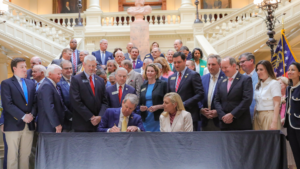
Georgia Governor Brian Kemp signs a bill into law.

Key Points


  • Georgia’s future is on the ballot in 2026 as voters elect a new governor to lead the state for the next four years. In the May 19th primary elections, Georgians picked candidates to represent each political party. They’ll choose the final winner in the general election on November 3.


  • The governor influences major issues that affect Georgians every day, like taxes, education, health care, work opportunities, and public safety.


  • Understanding the governor’s role can help voters cast their ballots for a candidate who can bring even more hope, well-being, and prosperity to people and communities across the state.


When Georgians vote for governor, they’re choosing more than a public figure. They’re electing the leader who sets the direction for everything from schools and public safety to taxes and the economy. 

While the governor can’t create laws like the legislature does, they shape daily life by deciding how the state will spend money, what bills get signed, and how certain public programs for families will operate. 

Quick Facts About Georgia’s Governor

  • Current Governor: Brian Kemp
  • Next Election Date: November 3, 2026, for the general election 
  • Term Length: Four years, with a maximum of two back-to-back terms
  • Minimum Age Requirement: 30 years old by Inauguration Day
  • Counties the Governor Serves: 159
  • State Budget the Governor Oversees: $36.6 billion

How Does the Governor Impact Everyday Lives in Georgia?

1. The governor can sign—or stop—new laws.

After a bill passes in Georgia’s House and Senate, it goes to the governor, who can sign it, veto it, or let it become law without a signature. 

If the governor vetoes a bill, Georgia’s legislators can override that action, but only with a two-thirds majority in both chambers. To avoid a veto, lawmakers usually aim to pass legislation that reflects the governor’s policy priorities.

In 2026, Georgia’s legislature passed bills that created pathways for kids to take advanced math classes in earlier grades and to improve their reading skills. The bills aligned with Governor Kemp’s goal of increasing opportunities for Georgia students, and he signed them into law right after the legislative session ended.

Georgia Governor Brian Kemp signs 2026 bills to support literacy, math education, and K-12 public schools.

On May 5, 2026, Governor Brian Kemp signed nine bills to support reading, math education, and K-12 schools in Georgia.
Photo Credit: Office of the Governor Photo Gallery

2. The governor helps decide where the money goes.

Every year, Georgia’s governor proposes a state budget that outlines how taxpayer dollars should be spent. Because the budget reflects the programs and services that will receive funding, it reveals the governor’s top priorities for the state. 

The legislature revises and passes the budget, but the governor still has a final influential role. Before signing the budget into law, the governor can use a line-item veto to remove parts of the budget they don’t agree with while leaving the rest as is. 

In May 2026, Governor Kemp signed House Bill 974, the state budget bill for the fiscal year starting July 1. The $36.6 billion budget directs most funding toward education, health care services, public safety, and economic growth—a clear signal of what the governor cares about. Before signing, Governor Kemp used his line-item veto authority, removing some expenses to keep the budget in balance after approving income tax cuts.

3. The governor chooses the leaders behind key family services.

Government policies aren’t implemented in one big speech or one dramatic vote. Instead, they’re carried out every day by state agencies, boards, and commissions.

The governor appoints many of the heads of those administrative offices. They oversee daily operations in workforce development, child and family services, public safety, licensing, education administration, and programs that help low-income Georgians.

The governor steers welfare (safety net) policies, for example, by appointing the members of the Board of Human Services. The members establish the state’s goals for welfare programs like the Supplemental Nutrition Assistance Program (SNAP).

4. The governor sets the policy agenda.

The governor has a powerful microphone: the annual “State of the State” address. At the beginning of the legislative session, the governor uses this speech to outline their priorities and encourage lawmakers to act on specific policies. 

And when the governor elevates an issue—whether it’s education, workforce development, public safety, or taxes—it usually moves quickly from a policy idea to serious legislative action. 

In his 2026 State of the State address, Governor Kemp proposed decreasing the state income tax to 4.99% to help Georgians keep more of what they earn. The legislature followed up by passing House Bill 463, which the governor signed into law.

5. The governor leads during emergencies.

The governor uses executive orders and emergency powers to quickly mobilize state resources when storms, wildfires, public safety threats, or other emergencies hit. 

In April 2026, Governor Kemp declared a state of emergency for 91 counties in response to South Georgia wildfires and empowered state agencies to help affected residents and their families.

FAQs: The Georgia Governor’s Race in 2026 and the Election Process

How Is Georgia’s Governor Elected?

Georgians elect their governor through a direct popular vote. Unlike presidential elections, there isn’t an electoral college that casts deciding votes.

During primary elections, voters pick final candidates from each political party. Contenders have to earn at least 50% of the votes in the primary to win, so run-off elections are possible. 

The same requirement applies in the general election. If no candidate earns more than half the votes, the top two competitors head to a run-off.

Who Can Run for Governor?

A candidate must:

  • Be at least 30 years old by the time they take office
  • Have lived in Georgia for at least six years before the election
  • Have been a U.S. citizen for at least 15 years

How Long Can a Governor Serve?

Georgia governors have four-year terms and can serve up to two back-to-back terms. Former governors can run again after sitting out for at least one term.

What Happens if a Governor Leaves Office Early?

The lieutenant governor is next in line for the job and serves until the next general election.

Which Political Parties Have Georgia’s Governors Belonged to Historically?

Georgians have elected Republican governors since 2003. Before then, Democratic governors had held the office continuously since 1872.

Timeline of political party affiliations of past Georgia governors from 1971 to 2026.

Source: Former Governors in Georgia, National Governors Association

What Issues Are Candidates Talking About in 2026?

The rising cost of living is one of the biggest concerns for Georgia families—and it’s become a major focus in the 2026 governor’s race. Key affordability issues include:

  • Income Taxes: Some candidates are proposing plans to further reduce or eliminate the state income tax so Georgians can keep more money in their own pockets. 
  • Property Taxes: As housing costs continue to rise, contenders are thinking about freezing property taxes or increasing exemptions to ease the burden on homeowners. 
  • Housing Shortages: Candidates are debating how much the state should get involved in local land-use regulations to spur construction of more homes, especially those at lower prices.
  • Health Care: Gubernatorial hopefuls are proposing options to address Georgians’ health care concerns, including expanding Medicaid and reducing the cost of health insurance.

Beyond affordability, candidates are focusing on several other issues affecting families and communities across Georgia:

Welfare Reform: Contenders are thinking about how to lead the state in making big changes to welfare programs, including: 

Education: To give Georgia’s children better pathways to academic success, candidates are debating on more school choice vouchers, increased public school funding, and new early childhood education options. 

Public Safety: Competitors are prioritizing safety and security for Georgia communities by looking at ways to tackle gang activity, reform the juvenile justice system, and reduce repeat offenses. 

Why Does Understanding the Governor’s Role Matter?

Candidates know that more needs to be done to break down the economic and social barriers so many people are facing, and they’re making plans to take action if elected. But policymakers aren’t the only ones responsible.

Understanding the governor’s vital role and what they’ll do to meet the daily needs of Georgia families and neighborhoods can help voters guide meaningful change. By casting their ballots, Georgians can bring even more promise and prosperity to the state—making it a place where everyone has the chance to achieve their full potential and thrive.

Additional Resources

2026 Polls: Georgia Governor
270 to Win

Keeping Vulnerable Americans on Track: One Door out of Poverty and into Opportunity
Alliance for Opportunity

What States Can Expect with the New SNAP Match: Options to Reduce State Error Rates
Alliance for Opportunity

Georgia Candidates for Governor Should Make Welfare Reform a Top Priority
Atlanta Journal-Constitution

Georgia Gubernatorial Election, 2026
Ballotpedia

Governor of Georgia
Ballotpedia

Lieutenant Governor of Georgia
Ballotpedia

Georgia 2026 Election: Here’s Who Will Be on the Ballot During May’s Governor, Senate Primaries
CBS News

Understanding Welfare Work Requirements: New Eligibility Rules for SNAP and Medicaid
Georgia Center for Opportunity

Organization of the Executive Branch
Georgia Public Broadcasting

What Does a Governor Do?
Georgia Public Broadcasting

Short Supply: How Many More Homes Does Georgia Need?
Georgia Public Policy Foundation

10 Races for Governor to Watch in 2026
NBC News

Governor’s Office
State of Georgia

Lieutenant Governor’s Office
State of Georgia

The Three Branches of Georgia’s State Government
State of Georgia

Image Credits: Canva; Governor’s Photographer, Georgia Office of the Governor

Georgia's favorite halloween candy is getting more expensive

Key Points

  • Candy and chewing gum prices have increased by 38% in just the last five years. These costs have even outpaced the 25% increase in grocery prices during the same period.
  • With rising costs of living, many Georgia families are struggling to cover their basic needs. This leaves them with little extra to buy fun treats like Halloween candy.
  • Georgia policymakers can help put money back into Georgians’ pockets by fixing regulations that make housing unaffordable, removing barriers to good jobs, and restructuring safety net programs to help people find rewarding work.

As Halloween approaches, Georgia families usually look forward to making great memories involving irresistibly adorable costumes and big candy hauls. Many of us know—maybe even from our own childhood experiences—that trick-or-treaters often cheer with delight when they find their favorite sweets in their candy bags.

Halloween is the season for treats. It’s the biggest day of the year for candy sales, slightly surpassing Valentine’s Day. Data on consumer purchases shows that Georgia’s favorite Halloween candies are Life Savers, Jolly Ranchers, and Trolli gummies, with M&M’s and Reese’s Peanut Butter Cups following close behind.

Most of us indulge in these sweet treats every now and then, especially around Halloween. But for many Georgia families, candy is becoming hard to afford. 

Candy and chewing gum prices have increased by an astonishing 38% over the last five years. That’s even more than grocery prices, which have gone up 25% during the same period.

Halloween candy prices have gone up 38% in just the last five years.

Candy and chewing gum prices, January 2021 to July 2025

For chocolate treats in particular, recent bouts of bad weather and crop diseases have damaged cocoa trees around the world. This has led to a cocoa shortage that has driven up prices

High costs like these are making it difficult for some Georgians to give their children and their young neighbors the happy and memorable Halloween they’re hoping for.  

The struggle to afford life in Georgia (beyond Halloween candy)

Many low- and middle-income families in Georgia are struggling to cover the basic costs of living, as prices for just about everything seem to be rising. The increasing costs add extra hardship to the many barriers that already impact people’s well-being and their ability to afford the occasional fun extras like Halloween candy.

  • Shortage of affordable housing: At least 94 of Georgia’s 159 counties don’t have enough housing for their residents. The shortage is driving up prices and making affordable homes hard to come by. High mortgage rates, rising costs of construction materials, and a big increase in Georgia’s population since 1980 are contributing to the problem. Restrictive local regulations regarding land use and infrastructure, including roads and water lines, are making the housing shortage even more severe.

  • Barriers to work and upward mobility:About a quarter of prime age (25-54) adults aren’t working in 96 Georgia counties. Many of these Georgians are facing limited economic opportunities in their communities. And some workers feel forced to stay in low-paying jobs to remain eligible for the safety net benefits that protect their family’s well-being. These difficult situations keep people from rising out of poverty and growing their income.

Policy solutions Georgia can’t afford to ignore

Georgia lawmakers have the ability to make valuable reforms that would help people have more money in their pockets for family expenses.

  • Fewer housing regulations: To increase the supply of lower-priced houses, local leaders in Georgia need to allow greater flexibility in lot sizes in new subdivisions. They should also grant more permits for varied housing types—like duplexes, triplexes, and townhomes—and for additional homes near commercial centers. These changes would enable builders to construct more affordable homes.

  • Reduced occupational licensing requirements: Georgia policymakers have many opportunities to lower barriers to meaningful work and upward mobility, including by reducing occupational licensing requirements. These licenses are typically mandatory for certain professions. By implementing licensing reforms, lawmakers could open more doors for workers, streamlining processes and removing some of the exclusions for people who have been incarcerated.

  • Revamped welfare system: To improve Georgia’s welfare system, state lawmakers should explore a “One Door” strategy for managing safety net and workforce services. In this scenario, both benefits and job training support would be linked together in a single location. This would provide welfare recipients with a clear path back into the workforce and toward financial independence.

These vital policy changes would strengthen and stabilize Georgia families, helping to lift them above the poverty line and making it possible for them to thrive, even in the face of rising costs. Strong families, in turn, would help their communities prosper. And with more opportunities to flourish, life would be sweeter for Georgians—not just at Halloween but all throughout the year.

Additional Resources

Eliminating the Benefit Cliff and Achieving Savings for Taxpayers: A Reform Proposal for the Supplemental Nutrition Assistance Program
(American Enterprise Institute)

End Broad-Based Categorical Eligibility in SNAP and Address Benefit Cliffs
(American Enterprise Institute)

State Occupational Licensing Index 2025
(Archbridge Institute)

Georgia: Supplemental Nutrition Assistance Program
(Center on Budget and Policy Priorities)

A Better Way to Get Welfare Recipients Back into the Labor Force
(City Journal)

Non-Working Adults Concentrated in Georgia’s Distressed Communities
(Georgia Center for Opportunity)

Solving the Food Assistance (SNAP) Benefits Cliff
(Georgia Center for Opportunity)

Short Supply: How Many More Homes Does Georgia Need?
(Georgia Public Policy Foundation)

SNAP Data Tables
(U.S. Department of Agriculture Food and Nutrition Service)

Image Credit: Canva

Subscribe

* indicates required

Subscribe

* indicates required