Education savings accounts in Georgia empower parents to customize their child's education.

Key Points

  • Education plays a powerful role in breaking the cycle of poverty and helping children lead healthy, flourishing lives. Education savings accounts in Georgia are a solution to help more kids get the benefits of a quality education. 
  • Georgia’s education savings account program is the Promise Scholarship. Starting in fall 2025, it will give eligible families $6,500 scholarships to access the education option that best meets their child’s needs. 
  • Education savings accounts, or ESAs, in Georgia can have several positive impacts on communities, including better support for public schools, less crime, and greater upward mobility. 

Education is an essential building block for a healthy, flourishing life. It has the power to break the cycle of poverty that can persist across generations.

When children from impoverished backgrounds receive a quality education, they’re more likely to escape poverty themselves and provide better opportunities for future generations. 

Good education goes hand-in-hand with many other positive outcomes—like better jobs, higher personal income, valuable relationships, better physical health, and a longer life. 

We all want these good things for children in our communities. Education savings accounts are one solution that Georgia can use to increase opportunity and prosperity for students who need it most.

What are education savings accounts?

Education savings accounts, also called ESAs, give parents a portion of state education funding that they can use to tailor their child’s education if traditional public school isn’t a good fit.

ESA programs expand education opportunity by giving parents greater flexibility and freedom in education choices. Whether a family prefers homeschooling, private schooling, or other alternatives, ESAs let parents access the best type of education for their child’s unique needs and interests.

The Georgia Promise Scholarship helps students in low-performing public schools access education options for their needs.

Get Started With Georgia’s ESA Program: The Georgia Promise Scholarship

Georgia is getting ready to launch Promise Scholarships in the fall of 2025. If you’re interested in enrolling your child, make sure you’re signed up to hear about next steps.

Get on the List for Updates

How do ESAs work?

To create education savings accounts programs, states must first pass a law. States then take a portion of what they would have spent on the student’s public school education and put it into a state-administered account.

Parents can use these funds for a range of education expenses—tuition, tutoring, homeschooling curriculum, educational therapies, online programs, or even a combination of educational services. States require parents to complete an application process to switch to an ESA. 

What do families get from education savings accounts in Georgia?

  • Flexibility: ESAs let parents customize their kid’s education.
  • Financial Support: ESAs allow states to expand access to options that families may not be able to afford otherwise. 
  • Empowerment: Parents can take charge of their child’s education journey with confidence.
  • Diverse Options: Parents can explore various educational paths that suit their child’s needs and interests.

What is Georgia’s ESA program?

Created in 2024, Georgia’s ESA program is the Georgia Promise Scholarship. It provides state-funded scholarship accounts that give eligible families $6,500 per student for each school year.

The program will be available starting in the 2025-2026 school year, and it will be limited to students in the lowest-performing public schools.

Child raising hand in classroom

Georgia’s Promise Scholarship Explained
Find out what the program is, how it works, and which students will be eligible. 

See the Promise Scholarship FAQs

Who do education savings account help in Georgia?   

ESAs are for all kinds of students. Whether a child is struggling in school or has special learning needs, ESAs can help. Georgia’s ESA program, the Promise Scholarship, is specifically designed to help families who may not have the resources to access better opportunities. 

Students in Underperforming Schools

Thousands of Georgia kids are stuck in public schools that have received a failing grade from the Governor’s Office of Student Achievement. To help these kids in particular, the Promise Scholarship will be for students in the bottom 25% of Georgia’s public schools. With an ESA, these students can access higher-quality education options that prepare them for successful careers and fulfilling lives.  

Low-Income Students

Choosing a different school or educational path has often been a privilege for wealthier families. What about families that struggle to make ends meet? 

With an ESA, low-income families can consider schooling options that may be out of reach otherwise. The Georgia Promise Scholarship makes sure these students are helped first. Available scholarships will go to families below 400% of the federal poverty level (around $120,000/year for a family of four). Any leftover funding can then serve students above that threshold. 

Students With Special Needs

ESA programs are a lifeline for students who need support beyond what their local public school can provide. ESAs make it possible to access schools that are set up to help students who have unique learning needs and disabilities. ESA funds can also help pay for other essential resources like tutoring, therapies, and learning technologies. 

Homeschooling Families

ESAs don’t just cover school tuition. They can pay for curriculum, online programs, and supplies, giving parents the option to fully customize their child’s education. This flexibility means that ESAs can help families who want to homeschool as an alternative to public or private schools. 

What kind of impact could ESAs have on communities in Georgia? 

Since Georgia’s ESA program, the Georgia Promise Scholarship, is new, it will be a few years before we know its exact impact on our communities. But we can get an idea from other states that have ESAs, including a couple of Georgia’s neighbors.

  • Better support for public schools: In 2011, Arizona became the first state to adopt ESAs. The state soon found that the program was helping to redirect state and federal dollars back to public schools where it could be used for teacher pay and operational needs.

  • Better outcomes for low-income students: Created in 2019, Florida’s ESA program is now the largest in the country. A November 2023 study of Florida’s education system looked at the impact of growing school choice. It found students of lower socioeconomic backgrounds—including those who stayed in public schools—experienced some of the greatest benefits.

  • Better economic opportunity and healthier societies: Tennessee is still working to expand its ESA program, but a study from the Beacon Center of Tennessee found that a statewide program could have incredible social impact. Their model predicted that Tennessee could have more high school graduates, higher overall personal income, less criminal activity and fewer felons, and $2.9 billion in economic benefits.

Do parents want education savings accounts in Georgia? 

Overall, Americans are worried about the direction of public K-12 education. 

  • Half of Americans think it’s moving in the wrong direction. 
  • 82% of teachers say the state of public K-12 education has worsened in the last five years. 
  • Only 46% of school parents in Georgia think K-12 education is on the right track in the state of Georgia. 

It’s not surprising, then, that Georgia parents are open to more school choice policies: 76% of Georgia school parents say they’re in favor of an ESA program.

A majority of school parents in Georgia think it's a good idea to have education savings accounts in Georgia.

What are common concerns about education savings accounts in Georgia?

Concern: ESAs take funding away from public schools.  

Georgia communities don’t have to worry about this because state lawmakers are not using public school funding for the Georgia Promise Scholarship. Promise Scholarship funding is also not allowed to exceed 1% of public school funding. This set-up means public school funding is fully protected. 

In general, more research is showing that, when states invest in school choice programs like ESAs, public schools benefit financially and academically. They have more per-pupil funding, less budgetary pressure, and better student outcomes

Concern: ESAs favor wealthy families and don’t help kids who actually need the opportunity. 

Quality education is a building block of a healthy, flourishing life, regardless of a family’s financial situation. ESAs are a tool states can use to ensure there’s more equality when it comes to education opportunities. 

Even if an ESA program is universal—where every student is eligible—the students who gain the most opportunities are those most in need. Here in Georgia, our ESA program, the Promise Scholarship, limits eligibility to students in low-income households to make sure they get helped first. 

Concern: ESAs are just another private school voucher. 

Education savings accounts can be used for private school tuition but also for much more! Unlike private school scholarships, ESAs can be used for a wider range of education expenses—including tuition, tutoring, online programs, education therapies, curriculum, and textbooks. 

Concern: ESAs don’t help families in rural areas. 

Rural areas may not have as many schools to choose from, but thanks to the flexibility of ESAs, this doesn’t have to be a reason for states to avoid ESA programs.

Take Tanya Schlegel’s story, for example. Tanya is a mom of two kids with special needs living in rural Georgia. Despite her best efforts to work with the local public school, it just isn’t equipped to give special needs students the help they need. An ESA would give her the resources to homeschool and access specialized therapies so that her kids can have the type of education that matches their needs. 

Georgia ESAs: Quick Facts

  • Georgia is one of 16 states with an ESA program. 
  • 10 states have universal ESA programs, meaning all students are eligible. Georgia is not yet one of them. 
  • Georgia’s ESAs are worth $6,500 per student per school year.
  • 76% of school parents in Georgia support ESAs.

Interested in Georgia’s ESA program? 

Go here to sign up for updates as the Georgia Promise Scholarship gets up and running. 

Other Schooling Options in Georgia

Rural families in Georgia, like mine, don’t always have access to educational options. Promise Scholarships would fix this inequity.

My family moved to Burke County six years ago. My husband and I have two children, both with Individualized Education Plans for special needs. My daughter has dyslexia and dysgraphia, while my son has mild autism, Tourette Syndrome, ADHD, dyslexia and severe dysgraphia.

For the past five years, I’ve been fighting for my children every single day in the local public school system. Unfortunately, children in Burke County with special needs don’t always have access to the help they desperately need.

I began my fight by advocating on behalf of my daughter. Although she had an IEP, she continued to fall behind in reading and writing. I was able to convince the school district to purchase the Barton Reading Program for my daughter. I wanted all students with reading challenges to have access to the program. When this program wasn’t implemented with fidelity, she was able to access tutoring that would support her needs. She remains in the public school but only because we have advocated every step of the way. 

The story with my son has been more challenging. He would routinely come home from school with tears in his eyes, saying the school wasn’t treating him fairly. In digging more, I discovered they were not implementing his IEP as written but were putting pressure on my son to perform outside of the accommodations that were agreed upon. It caused a lot of meltdowns and angst.

The situation eventually became so severe that he began self-harm. That progression broke my heart because he is a good kid. He’s not aggressive. He’s not violent. But the pressures the school system put on him caused him to hurt himself.

For his own safety, we decided that he needed to be homeschooled. But what many people don’t realize is that home education is anything but cheap. My son has so many needs that we simply can’t pay for. He requires specialized therapies that our budget won’t allow for right now.

That’s where Promise Scholarships come in. These accounts would provide up to $6,000 a year for families like mine to devote to a flexible menu of education options, such as occupational, speech or other therapies for special needs, tutoring assistance or homeschool co-ops that would help my son socialize and connect with other young people his age. Traditional vouchers that are available in Georgia right now wouldn’t work for our situation. Promise Scholarships would. I think many rural families are in the same boat.

It’s time for Georgia’s General Assembly to pass this legislation. Many other states have recently expanded school choice options to help families who have struggled during the pandemic with learning loss. We can’t afford to wait any longer.

There are so many other families like mine in Burke County. We basically have no school choice here, as the only private schools around do not have special educators or services and our closest charter school is 35 minutes away. Home education is our best option so that we can tailor an education to the unique needs of our children. Promise Scholarships would provide the type of resources to ensure that our children are not left behind.

Originally Posted in The Augusta Chronicle


Helping Marginalized Students Access Quality Education

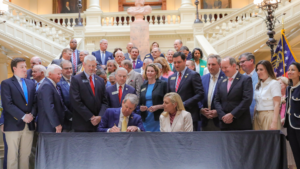
Mountain Area Christian Academy recently celebrated the passage of the Georgia Special Needs Scholarship Expansion bill, also known as SB 47. After Governor Kemp signed SB 47 into law, Mountain Area Christian Academy hosted the Georgia Center for Opportunity, our partner organizations, and the two sponsors of the bill (state Senator Steve Gooch and state Representative Will Wade) to simply say “Thank you.”

SB 47 increases both funding and access to a quality education for students with special needs. The new law helps schools like Mountain Area Christian Academy address exceptional students according to their needs.

I don’t have to tell you how much this pandemic has damaged students’ educational outcomes—particularly for those with special needs—but what I will tell you is that we will not stop fighting for all students.

At the Georgia Center for Opportunity, we believe that this bill is an important first step as we move to help more marginalized communities access quality educational options statewide.


The Special Needs Scholarship expansion opens doors to kids not able to access education opportunities. This is a vital first step in efforts to insure that ALL our kids have access to quality education.

Visit our new resource for parents looking for educational opportunities for their children with special needs. This page includes the latest information about GEERs funding, as well as expanded options for the 2021-2022 school year.

We have some great news to share!

Lawmakers in the Georgia House are likely to take up Senate Bill 47 as soon as today. SB47 makes vital improvements and updates to the Georgia Special Needs Scholarship Program in light of the COVID-19 pandemic. This is an important way we can serve Georgia families and the special-needs community, as many of these students have been left behind due to school closures, learning loss, and lack of access to crucial therapies.

Among other key changes, SB47 would:

    • Expand the program to include a limited list of students with special needs (including autism spectrum disorder, cerebral palsy, and dyslexia) who have a 504 plan and formal diagnosis from a licensed doctor.
       
    • Allow students who attended a public special needs preschool in Georgia to participate.
       
    • Allow students with special needs who are adopted from foster care to access the program immediately.
       
    • Make other updates to the scholarship program in line with the renewed need among families for help due to COVID-19.

Sadly, the Georgia School Board Association is lobbying hard against SB47. The organization recently sent an email to supporters listing a number of objections to the measure and urging people to oppose it.


“Every child deserves to be wanted.” As a parent of a special needs student, Aidan’s mother, Tiffany struggled to find an education option that saw her son’s value.

Our response to GSBA

Here are those objections and our responses from the Georgia Center for Opportunity team:

There is no requirement that a student be re-evaluated to determine the students’ continued needs or eligibility. For example, an elementary student might have an IEP to receive speech therapy that they would not need after a few years.”

This seems like a red herring. It’s unfair to burden both public school systems and parents with constant revaluations in an attempt to catch a handful who no longer warrant an Individualized Learning Plan (IEP) or 504 plan. This would also create a massive burden on schools to evaluate kids who are no longer in the public school system.

The bottom line is that if a child is succeeding in a new environment, that’s a good thing. It doesn’t mean we should take them away from that school and put them back in an environment where they were not succeeding. We must prioritize the needs of individual students and get them the help they need. That standard is even more important for our neighbors in the special-needs community.

“There is no requirement that a private school provide the services in the IEP or 504 plan that the taxpayers are funding them to receive.”

No, but parents aren’t going to send their child to a school (especially if they need to come out of pocket with resources to do so) if the school cannot or is not meeting the child’s needs.

“There is no report to the taxpayers as to whether the students are receiving services or not.”

“Receiving services” is not an indicator of success. Children who are enrolled in public schools are also “receiving services,” but if their families choose to leave based on this scholarship, those services presumably are not meeting their needs. Parents have their children in the school of their choice voluntarily and they aren’t going to choose a school that can’t meet their child’s needs.


“Parents must give up all federal rights under IDEA or Section 504 of the Rehabilitation Act to take the voucher.”

IDEA was something disability advocates had to fight for so that public schools would treat students with special needs the right way. IDEA rights only apply to public schools, so by definition if a child is not in public school, those specific rights do not apply.

This doesn’t mean that these students are being mistreated. In fact, a parent has the ability to leave any private school that isn’t serving their child well, which is currently not the case for public schools. If a child returns to public school at any time, their rights under IDEA are still fully intact. 

An imperfect analogy: You carry insurance on your car in case something happens. Then you move to a large city and can either walk or take the subway everywhere, so you sell the car. Someone might say, “But you gave up your insurance!” No, you gave up your car.


“There has never been an independent evaluation of the voucher program so we have no idea about a number of things including its effectiveness.”

There is literally a report that comes out on the program every year that includes 40 pages or so of information including academic performance data.

Parental satisfaction has been the major measure for accountability for this program and nothing in this bill changes that. That is completely inconsistent with a belief in transparency and accountability for the use of taxpayer dollars.

The issue lands here, providing quality education to all students is the goal and responsibility of our education system. It is a system that must take child and parental needs into the equation. When quality education is not accessible to a child (for WHATEVER reason that is) we must provide options. It is our responsibility to give each child a sense of purpose & belonging as we prepare them for their future.


group of students

We have some great news to share! Lawmakers in the Georgia House are likely to take up Senate Bill 47 as soon as today. SB47 makes vital improvements and updates to the Georgia Special Needs Scholarship Program in light of the COVID-19 pandemic. This is an important way we can serve Georgia families and the special-needs community, as many of these students have been left behind due to school closures, learning loss, and lack of access to crucial therapies. 

Among other key changes, SB47 would:

  • Expand the program to include a limited list of students with special needs (including autism spectrum disorder, cerebral palsy, and dyslexia) who have a 504 plan and formal diagnosis from a licensed doctor.
     
  • Allow students who attended a public special needs preschool in Georgia to participate.
     
  • Allow students with special needs who are adopted from foster care to access the program immediately.
     
  • Make other updates to the scholarship program in line with the renewed need among families for help due to COVID-19.


Students are not all the same, so their education shouldn’t be a one-size-fits-all model. 


Sadly, the Georgia School Board Association is lobbying hard against SB47. The organization recently sent an email to supporters listing a number of objections to the measure and urging people to oppose it.


Here are those objections and our responses from the Georgia Center for Opportunity team:

There is no requirement that a student be re-evaluated to determine the students’ continued needs or eligibility. For example, an elementary student might have an IEP to receive speech therapy that they would not need after a few years.”

This seems like a red herring. It’s unfair to burden both public school systems and parents with constant revaluations in an attempt to catch a handful who no longer warrant an Individualized Learning Plan (IEP) or 504 plan. This would also create a massive burden on schools to evaluate kids who are no longer in the public school system.

The bottom line is that if a child is succeeding in a new environment, that’s a good thing. It doesn’t mean we should take them away from that school and put them back in an environment where they were not succeeding. We must prioritize the needs of individual students and get them the help they need. That standard is even more important for our neighbors in the special-needs community.

“There is no requirement that a private school provide the services in the IEP or 504 plan that the taxpayers are funding them to receive.”

No, but parents aren’t going to send their child to a school (especially if they need to come out of pocket with resources to do so) if the school cannot or is not meeting the child’s needs.

“There is no report to the taxpayers as to whether the students are receiving services or not.”

“Receiving services” is not an indicator of success. Children who are enrolled in public schools are also “receiving services,” but if their families choose to leave based on this scholarship, those services presumably are not meeting their needs. Parents have their children in the school of their choice voluntarily and they aren’t going to choose a school that can’t meet their child’s needs.

“Parents must give up all federal rights under IDEA or Section 504 of the Rehabilitation Act to take the voucher.”

IDEA was something disability advocates had to fight for so that public schools would treat students with special needs the right way. IDEA rights only apply to public schools, so by definition if a child is not in public school, those specific rights do not apply.

This doesn’t mean that these students are being mistreated. In fact, a parent has the ability to leave any private school that isn’t serving their child well, which is currently not the case for public schools. If a child returns to public school at any time, their rights under IDEA are still fully intact. 

An imperfect analogy: You carry insurance on your car in case something happens. Then you move to a large city and can either walk or take the subway everywhere, so you sell the car. Someone might say, “But you gave up your insurance!” No, you gave up your car.

“There has never been an independent evaluation of the voucher program so we have no idea about a number of things including its effectiveness.”

There is literally a report that comes out on the program every year that includes 40 pages or so of information including academic performance data.

Parental satisfaction has been the major measure for accountability for this program and nothing in this bill changes that. That is completely inconsistent with a belief in transparency and accountability for the use of taxpayer dollars.

The issue lands here: Providing quality education to all students should be the goal of our education system. That system must prioritize the needs of individual students and families. When quality education is not accessible to a child — for whatever reason — we must provide options. It is our responsibility to give each child a sense of purpose and belonging as we prepare them for their future.


Aidan's Story

“Every day was truly a dark day.”

That’s how Tiffany Pearce describes life during the hardest weeks of trying to care for her son, Aidan. Diagnosed with bipolar with mania, on top of an earlier diagnosis of autism and sensory integration disorder, Aidan couldn’t do most things we take for granted—everything from communicating his feelings to using the restroom. 

But tragically, that extended to Aidan trying to hurt himself during his manic episodes. To help, Tiffany would try to hold Aidan to prevent injuries. The results from this strong eight-year-old boy were that Tiffany herself would often get injured.

“He was having episodes three to four times a day lasting anywhere from one hour to three or four,” Tiffany says. “With these episodes, it’s like he didn’t know who he was at the time.”

When the manic episode calmed down and Aidan would recover, he would look at the blood on his mother and ask, “Why don’t you move out and leave. I don’t want to hurt you any more.”

Tiffany took her son to a long list of doctors and specialists for help before he was eventually admitted to the Atlanta-based Peaceford Hospital, a behavioral health treatment facility. But even that didn’t help. Aidan continued to struggle. It was all made worse by the fact that Tiffany could not stay with him at night.

“I’ll never forget the time he looked up at me and said, ‘Mommy, I want to be in heaven.’ You just feel completely helpless as a parent at that moment,” says Tiffany. “To hear an eight-year-old say that is devastating.”

Later on, Tiffany waged a battle with the insurance company to move Aidan from Peachford to a residential facility where they would better be able to serve his needs. At the same time, she had to make a choice about where to send the young man to school.


It was the first time his mother heard, “we want Aidan.”

All students deserve the chance to succeed.

But Tiffany soon discovered that not many schools were willing to support a child like Aidan. The local public schools in Cobb County wanted to put him on an EBD (Emotional and Behavioral Disorder) satellite campus, but Aidan’s doctors and therapists said that would have been detrimental to his behavioral and development issues.

Thankfully, there was another option: CORE Community School, a private school in Atlanta. 

“I’ll never forget them saying, ‘We want him. We want Aidan.’ That was the first time I felt hope in a year, because he deserves to be wanted. All kids should feel that. They deserve that,” Tiffany says.

Today, Aidan is thriving at this private school that prioritizes serving students with unique needs and challenges.

“Being at school is the first time in a year and a half that I see Aidan smile,” Tiffany says. “I didn’t think I would see that again. I wondered if this boy with the biggest heart would ever feel like he was worth anything. And he did here.”


Get Buzz'd Blog Header

A focus on the state legislature and the policies effecting Georgian’s everyday life. 

Buzz Brockway, VP of Policy, is in downtown Atlanta at the state Capitol building, and walks us through the proposed changes to The Special Needs Scholarship, occupational licensing, a current protest, and more.


Get Buzz'd - at capitol - March 17 2021

Our state lawmakers create policies that better the lives of Georgians. Learn more about active legislation and how it translates into everyday life for all of us.

Special Needs

For some students virtual classes during the past year have been fine. Some have even thrived. But for many special needs students, it has not gone well, as a parent tells the Georgia Center for Opportunity:

A virtual classroom worked fine for Jennifer’s two older children, but her youngest son, 10-year-old Joey, has Down syndrome. Online learning is entirely unworkable for him due to his special needs.

For example, DeKalb is following a normal bell schedule but staying engaged on Zoom for hours on end is not working. Morning classes will sometimes go well, but by lunchtime Joey is tuned out. It is impossible to get him back online after the lunch break for specials, such as music and art, and Jennifer cannot stay tied up until 2:30pm every day. She has seen academic and social regression for her son as he has little to no interaction with peers.

Additionally, his academic growth is limited due to repetitive practice of current skills on worksheets with no new individual instruction to learn new concepts in language arts or math. As a highly visual and experiential learner, he is missing the magic that happens in a classroom that cannot be replicated on a Zoom call.

“It’s day-by-day and minute-by-minute,” Jennifer shares. “One class he is engaged and on task, and the next minute he is hiding under the bed or taking his shirt off.”

All children, no matter their needs, deserve the opportunity for a high-quality education that meets their individual requirements. 

Today, Axios wrote about a newly released report on 130 studies on the safety of school reopening. The report found:

  • Any benefits to closing schools are far outweighed by the grave risks to children from remote-only schooling — risks that intensify the longer it continues, the report says.
  • The harms include academic loss — so severe that it could set children back for life — and mental health problems related to loneliness and isolation.
  • There are also severe hardships on parents — mothers in particular, about two million of whom have left the workforce to care for their kids as part of remote learning.
  • “Schools are not super-spreaders,” observes the report, written by John P. Bailey, a former deputy policy director at the Department of Commerce.

Fortunately almost 73% of Georgia’s school districts are open for face to face learning. The rest need to reopen ASAP, and plans need to be made to help students who fell behind catch up.


This post originally appeared on PeachPundit.com on March 11, 2021.


Subscribe

* indicates required

Subscribe

* indicates required