Georgia law expands protections for donors' privacy and confidence that their gift will be used as intended.

Key Points

  • Georgia lawmakers passed two new bills in 2024 that strengthen protections for charitable giving in Georgia. 
  • The Donor Intent Protection Act allows donors to file a legal complaint if their gift is misused. 
  • The Personal Privacy Protection Act protects individuals from having their personal information publicly disclosed by the government when they volunteer for or financially support a cause. 

Guest post by Megan Schmidt, senior director of government affairs at Philanthropy Roundtable

There are over 64,000 nonprofit organizations in Georgia, and in 2021 Georgia donors gave $9.4 billion to charity, according to the IRS. These generous donations to charitable organizations are about to get important protections under two bills passed by the state legislature in 2024.

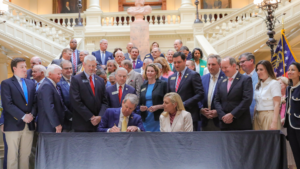
Gov. Brian Kemp signed the Donor Intent Protection Act and the Personal Privacy Protection Act into law. Both pieces of legislation offer donors and charities new avenues to ensure the proper use of donations, while safeguarding donors’ right to privacy in giving.

The two bills offer legal protections for donors and nonprofits to ensure charitable giving can continue freely and effectively in the state. When donors are free to give where and how they choose without fear of their information being unfairly released or their donations being misused, charitable organizations are better suited to help those who need their support.

The Donor Intent Protection Act

Sponsored by Sen. Bill Cowsert (R), the Donor Intent Protection Act passed the legislature on a strong bi-partisan vote, co-sponsored by Sen. John F. Kennedy (R) and Rep. Matt Reeves (R).

The Donor Intent Protection Act provides a legal pathway for donors to enforce written endowment agreements. Donors may give to a charitable endowment with specific written instructions for how they would like their gift used or invested.

Prior to this bill, when a charity agreed, accepted the gift and then violated the agreement, donors had no legal standing or recourse to enforce their written agreement. But under the Donor Intent Protection Act, donors now have the ability to file a legal complaint in court if their gift is misused.

This protection encourages giving and benefits donors, charities, and the many individuals served by nonprofit organizations in Georgia. It also bolsters levels of trust between donors and charities by adding an extra layer of protection for donor intent. Donors can give freely and generously without concern their mutually agreed upon instructions will be violated.

The Personal Privacy Protection Act

The second bill, the Personal Privacy Protection Act, also earned bipartisan support and protects individuals who volunteer or give to causes they care about from having their personal information publicly disclosed by the government.

The ability for donors to give privately to causes they believe in is a First Amendment right that historically has been upheld. In the 2021 Americans for Prosperity Foundation v. Bonta decision, the U.S. Supreme Court upheld donor privacy and concluded that California’s bulk collection of nonprofit donor information was unconstitutional.

Georgia donors should be able to give privately to causes they care about without fear of retaliation or public exposure. Whatever their motivation for privacy, this bill is aligned with the U.S Supreme Court decision and makes any unlawful disclosure of this information a misdemeanor under the law. This also provides protection for nonprofits from being forced to release their donor and member lists to government agencies and officials.

Laws Like These Encourage Generosity in Helping Our Neighbors and Communities

Donors give to nonprofits whose cause and mission they support. With the enactment of these two bills, Georgians can continue donating generously without fear their wishes will be violated or their identity disclosed.

The Donor Intent Protection Act is now law in three states and the Personal Privacy Protection Act is now law in 19 states. The protections offered by both bills will encourage donors to remain generous with their resources more than they might otherwise be.

Donors in states without these protections face uncertainty when they give because they don’t have the reassurance their identity is protected or that the court will grant them legal standing in the case of a violation.

Georgia is primed to move forward with a healthy charitable giving environment with the passage of these two bills so communities in need around the state can benefit from the generosity of Georgians.

SCALE THIS CONTENT To properly fit into the middle of this box but adjusting the spacing in DIVI.

Insert the same content here to work on mobile and tablet.

Key Points

  • A disproportionately large number of able-bodied adults have checked out of the workforce.
  • This Labor Day, we’d like to acknowledge five reasons why work remains so important.

Labor Day became a federal holiday in 1894 under President Grover Cleveland. The core meaning of the holiday is to celebrate the achievements and value of everyday workers. But here at the Georgia Center for Opportunity, we see another important part of Labor Day celebrations — to acknowledge the value of work itself.

The United States has a rich history of viewing work as ennobling. That’s part of what has helped each succeeding generation of Americans have a brighter economic future than the one before. But in recent history, we’ve witnessed an anti-work spirit arise in our nation.  

A disproportionately large number of able-bodied adults have checked out of the workforce. Even though the unemployment rate in the U.S. is at historic lows, the labor force participation rate has not caught up — indicating that millions of workers are absent from the workforce who could otherwise be working.

This Labor Day, we’d like to acknowledge five reasons why work remains so important.

  1. Work provides a key source of dignity

Work is about bettering one’s self and one’s family materially, that’s true. But that is not the only benefit. Another benefit is the way the work itself benefits the individual, the intangible but no less important side benefits of work.

When we are separated from work, we lose more than just monetary compensation or the food, shelter, clothing, and other basics that money can buy. We also face a loss of social connection, meaningful activity, self-respect, and overall purpose.

  1. Work helps to establish our daily rhythms

Work establishes the daily rhythms of life. It dictates when we rise from bed, when we eat our meals, how we schedule our weeks, how we interact with our families. Work provides important structure for our lives.

  1. Work benefits all of society

Workers make contributions that extend beyond their own families to society as a whole. They generate value and rely on themselves rather than government assistance. Employed people are also less likely to commit crime and their families tend to be healthier.

Bringing The Dignity of Work to every individual.


We believe that every able-bodied individual should have a path to fulfilling work. We do this through initiatives that create a flourishing job market, remove barriers to those unable to find work, and work directly with communities to move the un and underemployed into work.

  1. Work provides an opportunity to be generous to others

Work gives us the monetary resources to be generous to those in need. Maybe that’s why the U.S. is one of the most generous nations in the world for private philanthropy — historically, we’ve valued hard work and the generosity made possible by it.

  1. Work honors God

Our religious traditions teach that work has intrinsic value. In the Hebrew account of creation, God placed Adam in the Garden of Eden and instructed him “to work it and keep it.” In the New Testament, Paul stated that “if a man will not work, he will not eat.” The Calvinist work ethic brought to our shores by the Puritans equated diligent work with duty to God. 

Eda Beacham

Importance of Family

At GCO, the impact area of Family, we always need volunteers. Since  we devote much of our time and efforts to family, we enjoy hearing what about family inspires people to volunteer.  

Eda Beacham is a current volunteer for GCO and we wanted to share her story with you.  Let us know in the comments what strength and or similarities you have in common with Eda. We invite you to send in stories about your family, too. 


Eda’s Inspiration

The makeup of my family has changed over time. Through marriage, divorce, birth and death, there has been an ever-changing clan at the Thanksgiving table. The birth of nieces, nephews and our own two sons added to the joy; and the passing of my mom and later, my husband, brought sorrow and some empty chairs. Then the grandchildren came, and they filled the empty spaces with laughter and love. The cycle continues today with this next generation, as it does in most families.


Families are always changing, but what holds them together? For me, it was my mother and her eternal optimism. Her life was not easy, but she always believed things would get better. With a limited education, she worked hard and put all her love and determination into raising a family. She came through the Great Depression and WWII, so she knew how to stretch a dollar and “make do.” She taught us values like hard work and sharing with others. She believed in God and made sure we went to church.


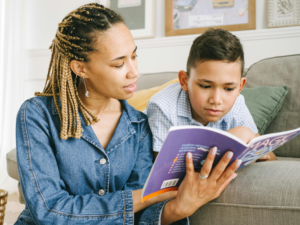
a family playing on the couch

Our family will likely have the greatest impact on our lives and play a critical role as we grow throughout our lifetime. 

Creating strong family bonds and healthy family relationships is key to family wellness, mental stability, and physical health.

Learn more about free tools and resources available in the community to strengthen your relationships. 

Overcoming Circumstances

When my dad left after 27 years of marriage, Mom’s faith took on a new freshness and devotion; and she ventured out in search of where she could be of service. She decided to sell everything and move into a home as cook and housekeeper for a man who had survived a brain tumor, but was left with the mind of an eight-year old. After this gentleman passed away, my mom began to dream about a little piece of land in the country where she could put down new roots and serve.  She found a small tumbledown house on two acres, so she  went to work making it a home. While working full-time in the nearby little town, she hosted home Bible studies, planted big gardens every year, served scrumptious down-home meals to family, friends, or whoever came by, and took in few strays along the way. Even though my mother never made much money, she found a way to help people who were down on their luck – a friend or family member who was out of work and needed a place to live, a relative in prison who received encouragement and hope from her letters, families who needed food or money in a crisis. In what turned out to be my mom’s last year, just shy of 66 years old, she had taken in her first foster child, a young teenage girl. My mother never stopped dreaming; she never stopped giving. And Mom saw her dreams come to life.


depressed man

“I don’t know what I’m going to do if I don’t find a better job; I might have to go back [to prison].”

Two months out of prison, Ray (name changed for anonymity) was explaining to me that he had reached the end of his rope. He had been struggling to find work that paid enough so that he could simply afford the basics. His part-time, minimum-wage job, just wasn’t cutting it. But, at least it was something.

Ray had the added complication of having to take custody of his son shortly after being released, meaning another mouth to feed when he could barely feed himself.

During his most desperate days after leaving prison, Ray said he was blessed to have the help of local church ministries who provided temporary housing for him and his son at a local extended stay hotel. He called GCO because that assistance was running out. He needed more help so he could remain at the extended stay but, more than that, Ray knew he had to solve the job problem to have any hope of getting off the hamster wheel he was on.

“I’m “clean” and have no intention of going back to that life.”

With a record that included drug and property crimes, Ray worried he might not have a shot at a better job. “But I’m willing to do any job that pays enough,” he assured me.

With those details in hand, our team started looking for the resources Ray needed and found some great opportunities for him and his son. There was a local church ministry offering help with additional days in the extended stay motel, there was the local restaurant eager to interview Ray for a better-paying job.

In the end, help came from a place Ray least expected it: the extended stay motel owner himself.

After hearing Ray’s story and observing him on the motel property, he offered Ray a job as a maintenance technician, a position that also included room and board on the motel property – an answer to Ray’s prayer for better pay and housing stability for him and his son.


The Success Sequence provides an outline of how to reverse the cycle of poverty in our communities. GCO uses this as a framework for much of our work.

Like Ray, you might be surprised the motel owner stepped in to help the way he did, but you shouldn’t be. Many times, our local business owners bridge the gap for those in need in big and small ways – from helping support the nonprofits that serve emergency needs to, like the motel owner did for Ray, helping directly.

Too often, it’s business owners who get the negative press and little credit for the good they do. In reality, as Ray’s story reminds us, they are a huge part of the solution to poverty – both in the jobs they provide through their risk-taking and in their philanthropy made possible through the profits they generate.

Is this the end of Ray’s story? I don’t think so. Ray seems to have a drive that’s going to keep him reaching for better opportunities and, of course, if we can help him, we’ll be here to do that.

The point is that Ray’s story isn’t unique. For those reaching out and seeking help – for housing, for work, for food – there are often caring community members willing to help.

And sometimes that help comes from the place you least expect it.

If you or someone you know is struggling to find employment in Gwinnett or is looking for help to meet their basic needs, please visit www.betterworkgwinnett.org to find resources or to be connected to one of our “guaranteed-interview” employment partners.


Subscribe

* indicates required

Subscribe

* indicates required