Key Points

  • The Georgia General Assembly has passed a bill that will lay the groundwork for improving literacy rates among the state’s students.
  • Major measures in the bill include requiring literacy coaches in schools, making kindergarten mandatory, assessing students’ reading skills more often, and expanding the use of curriculums based on the science of reading.
  • By becoming stronger readers, Georgia’s students will be more successful in school and better prepared for rewarding work, financial stability, and meaningful community engagement as adults.

The Georgia Early Literacy Act of 2026 (House Bill 1193) is poised to make a powerful impact on students across the state. Legislators drafted the bill to help increase literacy rates among young Georgians and prepare them for higher levels of learning and greater success in life. 

Georgia’s literacy statistics are undeniably troubling—62% of the state’s third graders aren’t reading proficiently. Georgia’s proficiency percentage is just slightly above the average reading level in the United States. The Nation’s Report Card, which tracks how well students across the country are reading in fourth grade, recently showed that 69% of American fourth graders aren’t reading proficiently. And proficiency is a key indicator of children’s progress and readiness for more advanced work.  

Third grade also marks a critical point in a student’s academic development. Between third and fourth grade, children should be transitioning from learning to read to using reading to learn. If students fall behind in reading during this crucial period, they can start to have a hard time in other school subjects, too. This struggle often takes a big toll on children as they grow up, and it can limit economic opportunities later on. 

But with support from organizations like the Georgia Center for Opportunity (GCO), state legislators are paving the way for children to overcome challenges with literacy. This will empower them to thrive in their academic development and build flourishing lives for themselves and their families in the future.

“GCO applauds the state’s General Assembly for passing the Georgia Early Literacy Act of 2026. This important legislation helps Georgia make sure that students read proficiently so they can excel in school and reach their full potential in life.”

Buzz Brockway, Vice President of Policy, Georgia Center for Opportunity

What Are the Core Requirements in This Bill?

Policymakers have included several key measures in the new literacy bill to help the youngest Georgians become skilled readers.

  • Literacy Coaches in Every School: All schools that serve students in kindergarten through third grade will be required to hire literacy coaches—educators with expertise in teaching reading. The coaches will support teachers through lesson planning, co-teaching, and mentoring.
  • Mandatory Kindergarten Enrollment: Students will be required to attend kindergarten before starting first grade (exemptions are possible if students pass the assessment described below). The bill will also encourage families to enroll their children in school or establish a home study program beginning at age 5. These measures should strengthen children’s foundational reading skills early on.
  • First Grade Readiness Assessments: Schools will test students before they start first grade to make sure they’re academically prepared. If a kindergartener isn’t reading on grade level, the school will design a plan to help them.

  • Expanded Use of Science of Reading Curriculums: Schools will continue to expand the use of materials grounded in the science of reading, a field of research that focuses on how students develop reading skills. Teachers will no longer be able to use the older three-cueing system, which encourages students to guess words.

Have Other States Passed Similar Laws?

Yes. Mississippi, in particular, has set the standard for effective literacy legislation. Recent reforms in that state include:

  • Placing literacy coaches in the lowest-performing schools to guide reading teachers 
  • Regularly screening students in grades K-3 for challenges with reading and creating plans to help children who are struggling
  • Requiring third graders to demonstrate reading proficiency before starting fourth grade
  • Training teachers to shift to an approach based on the science of reading

As a result of the strong focus on literacy, Mississippi’s fourth grade reading proficiency scores went from 49th place in the nation in 2013 to ninth place in 2024. Georgia and many other states have taken notice of this significant improvement and have modeled legislation after Mississippi’s laws.

When Will the New Requirements Take Effect?

Governor Brian Kemp is expected to sign the Georgia Early Literacy Act once the 2026 legislative session ends. After it becomes law:

  • Schools will likely have literacy coaches on staff by the 2028-2029 school year.
  • Mandatory kindergarten enrollment and enhanced readiness assessments will go into effect for the 2027-2028 school year.
  • Every K-3 classroom will use only state-approved materials aligned with the science of reading by July 1, 2027.

What Is the Science of Reading

The science of reading is a field of research focused on how the brain learns to read and how to teach reading. It promotes proven practices that support students of all abilities. These practices involve several essential elements:

  • Phonemic Awareness: the ability to hear and identify individual sounds in spoken words
  • Phonics: the relationship between letters and the sounds they represent
  • Fluency: the ability to read texts smoothly, accurately, and with the right expression
  • Vocabulary: an understanding of what words mean and how to say and use them correctly
  • Comprehension: the ability to understand, interpret, and analyze texts

What’s the Difference Between Reading on Grade Level and Reading Proficiently?

People often use these two phrases interchangeably, but they actually mean different things.

  • Reading on Grade Level: A student who reads on grade level can figure out words and follow a basic plot, but they might still struggle to analyze more complex texts. This is the minimum expected skill level for a child in a specific grade.
  • Reading Proficiently: A proficient reader has a higher-level skill set, including the ability to analyze more challenging material and to think critically about it. Reading proficiently makes it easier for students to use reading for learning as they develop academically.

This difference is important for understanding literacy rates in Georgia. The state’s Department of Education reports that 65% of third grade students are reading at or above grade level, but the Georgia Council on Literacy has shown that only 38% of the state’s third grade students are reading proficiently

How Can Increasing Reading Proficiency Open Doors to Opportunity?

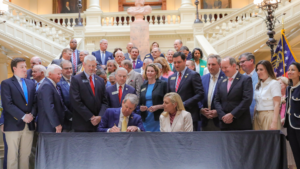
The state legislature passed the Georgia Early Literacy Act in March of 2026 with unanimous bipartisan support. The strong approval of the bill confirms that Georgia’s policymakers have made literacy a priority.

This attention to literacy will make a meaningful difference for many Georgians. Research has shown that children who aren’t proficient in reading by third grade are four times as likely to drop out of school before getting their high school diploma. And without that degree, access to higher levels of education, fulfilling jobs, and economic opportunities is more limited. For students who come from vulnerable families, struggles with reading can also make it harder to escape poverty.

Through the Literacy Act, Georgia legislators aim to remove barriers for children and encourage them to follow brighter paths to promising futures. By becoming stronger readers, Georgia’s students will be more successful in school. They’ll also learn to think more critically about the world around them. Their advanced skills will then lead young people toward more rewarding work and economic mobility as adults, and they’ll be able to positively impact their communities. The bill has the power to make all this possible, with literacy as the key that unlocks the door to these life-changing opportunities.

Additional Resources

students elementary

Key Points

  • Voters are not saying other issues, such as race and gender, are not important, just that learning loss is more important.
  • We can’t be thinking of this as a one-year catch-up.
  • There are other interventions that have been shown to have effects, it’s just that no single intervention gets you all the way. 

It has been well documented that school closing due to the pandemic caused students to lose ground (see here and here). Recent polling suggests that parents are very concerned about this learning loss and want political leaders to focus on this issue.

Consider this from The74Million.com:

Matt Hogan, a partner at Impact Research, said that it was striking to see Republicans seize an edge on an issue that “has historically been one of the Democrats’ strengths.” 

“There’s just a perception that Democrats’ focus on education is not where voters want it to be, which is helping kids make up the ground they lost,” Hogan said. “They think both parties are too focused on race and gender issues in schools, rather than focusing on catching kids up — but notably, they think that is true of Democrats even more so than Republicans.”

Notice that voters are not saying other issues, such as race and gender, are not important, just that learning loss is more important. Yet as we survey the political landscape, very few politicians or candidates are talking about what parents are most concerned about. 

Perhaps this is because there is no magic wand that can be waived to fix the problem. There is no list of “five easy steps to catch your kids up, and number four will blow your mind.” There are, however, things that can and should be done immediately.

Recently, Harvard economist Tom Kane produced a study of the impact of learning loss and proposed solutions. Kane’s research found that one-on-one tutoring was effective, but not effective enough to eliminate the learning loss for students in schools that were closed most of the 2020-2021 school year. Schools, he said, should plan on implementing learning recovery strategies for multiple years. Kane said:

So what can schools and districts realistically be expected to do in this situation? 

We can’t be thinking of this as a one-year catch-up. If we really are committed to making students whole and eliminating these losses, it’s going to be multiple years. There are other interventions that have been shown to have effects, it’s just that no single intervention gets you all the way. 

In March, Congress passed the American Rescue Plan Act of 2021 which included substantial funding for education. However, only 20% of those funds are required to be spent on recovering learning loss. Kane suggests districts spend more than 20% or perhaps all of their ARPA funds on learning loss recovery:

We try to put the scale of the [learning] losses and the amount of aid that districts have received in the same scale. We report both as a share of an annual school district budget, which I think is a useful starting point for thinking about what it’s going to cost a district to recover. If a district has lost the equivalent of, say, 22 weeks of instruction as a result of being remote, and you’re asking what it’s going to cost to make up for that, the lower bound of the estimated cost would have to start with [the question], “What does it cost to provide 22 weeks of instruction in a typical school year?”

We think that’s a useful starting point for people, and what they’d see is that in the high-poverty districts that were remote for more than half of 2021, the amount of aid they received is basically equivalent to — maybe a little more, but not much more than — the magnitude of their losses in terms of instructional weeks. That just means that, rather than spending the 20 percent minimum that was required in the American Rescue Plan, some districts should be thinking that they’ll need all of that aid for academic catch-up.

Imagine how much better off our society would be if politicians and school leaders truly committed to not only eliminating the pandemic learning loss, but using those interventions to insure every student is on grade level. How wonderful would that be?

Imagine how much better off our society would be if politicians and school leaders truly committed to not only eliminating the pandemic learning loss, but using those interventions to insure every student is on grade level. How wonderful would that be?

Additionally, empowering parents to choose a school that best fits their child, be it traditional public school, tuition-free charter school, private school, or homeschool, should also be a tool we deploy to help get kids caught up. 

Polling has made it clear that parents want learning loss recovery to be a high priority for their child’s school. In this election year, candidates and elected officials would be wise to make this an issue in their campaigns. Parents should demand this of their candidates, and then hold them accountable to eliminating learning loss for every student. 

Imagine how much better off our society would be if politicians and school leaders truly committed to not only eliminating the pandemic learning loss, but using those interventions to insure every student is on grade level. How wonderful would that be?

Helping Marginalized Students Access Quality Education

Mountain Area Christian Academy recently celebrated the passage of the Georgia Special Needs Scholarship Expansion bill, also known as SB 47. After Governor Kemp signed SB 47 into law, Mountain Area Christian Academy hosted the Georgia Center for Opportunity, our partner organizations, and the two sponsors of the bill (state Senator Steve Gooch and state Representative Will Wade) to simply say “Thank you.”

SB 47 increases both funding and access to a quality education for students with special needs. The new law helps schools like Mountain Area Christian Academy address exceptional students according to their needs.

I don’t have to tell you how much this pandemic has damaged students’ educational outcomes—particularly for those with special needs—but what I will tell you is that we will not stop fighting for all students.

At the Georgia Center for Opportunity, we believe that this bill is an important first step as we move to help more marginalized communities access quality educational options statewide.


The Special Needs Scholarship expansion opens doors to kids not able to access education opportunities. This is a vital first step in efforts to insure that ALL our kids have access to quality education.

PEACHTREE CORNERS—The Georgia Center for Opportunity (GCO) announced today that it has signed on to policy recommendations to Congress that would expand educational access for more schoolchildren. The recommendations were jointly issued by GCO in partnership with other nonprofit think tanks across the U.S.

“The education landscape in Georgia will look vastly different this summer and fall, and we need to include all schools—and as a result all students—in our planning to ensure full educational equity,” said Buzz Brockway, GCO’s vice president of public policy. “While the lion’s share of support will go to Georgia’s 1.7 million students enrolled in traditional public schools, we can’t afford to neglect the over 315,000 students attending public charter, private, and home schools. These recommendations would have the greatest impact on low-income, working-class, and impoverished families, the very ones who need help the most.”

The recommendations include:

Enabling educational access and providing direct support to families:
Expand the use of 529 education accounts, support education through Emergency Education Savings Accounts or microgrants, and create a “student checkup” account that provides funds to parents for use over the summer for tutoring, testing, or other expenses to foster academic progress.

Supporting private schools:
Provide a federal tax credit for donations directly to private schools, provide a temporary refundable tax credit to help low-income families continue paying private school tuition, and create equitable funding sharing requirements between traditional public schools and non-traditional options (such as public charter and non-public schools).

Improving Internet access for vulnerable families:
Address online equity issues for low-income and rural communities by expanding E-rate and providing incentives to spur the broadband infrastructure.

Supporting teachers and the transition to distance learning:
Provide a microgrant for teachers to learn and develop distance learning.

Press Release

GCO’s Vice President of Public Policy, Buzz Brockway is joined by GCO’s Jamie Lord to discuss the ways education will be impacted in the coming years. The state of Georgia faces new struggles both financially and with renewed expectations of what education is.

How and will the state meet the need of public education in the coming year? 

Below is a guest blog by Dr. Eric Wearne of Georgia Gwinnett College and formerly with the Governor’s Office of Student Achievement. Dr. Wearne currently leads GCO’s College & Career Pathways working group.

**********************************

aurorak12_org_-e1397744747248

In its 2013 Report Card, Digital Learning Now, a project of the Foundation for Excellence in Education, argued:

State policy can remove barriers to innovative approaches or it can stifle them with restrictions, red tape, and reinforcement of traditional, unsustainable approaches. It can accelerate reform or it can further entrench the status quo. Without changing state policy, innovative tools and models will fail to scale.

According to the Report Card, however, the news is good:

“states are rising to the challenge of supporting next generation models of learning. In 2013, states debated more than 450 digital learning bills with 132 signed into law. This builds on a record year in 2012 when state lawmakers introduced nearly 700 bills and signed 152 into law.”

To explore these issues specifically, Georgia Center for Opportunity’s College and Career Readiness Working Group heard from Sam Rauschenberg, Deputy Director of the Governor’s Office of Student Achievement, who facilitated the Task Force, and Carla Youmans, Instructional Technology Specialist at South Forsyth High School in Forsyth County, who is coordinating a new hybrid program at that school.

The Governor’s Digital Task Force

In 2012, Governor Deal created a task force to look into online learning in Georgia.  The Governor’s Digital Learning Task Force met over the course of 2012-13, and provided recommendations to Governor Deal in December of last year.  The Task Force’s recommendations fall into three categories:

  • Infrastructure
  • Digital Content and Courses
  • Blended and Competency-Based Learning

The state has already started to implement some of the Task Force’s recommendations on infrastructure.  For example, the FY15 budget includes $3.9 million to connect school systems to the University System’s PeachNet.  The AFY14 and FY15 budgets also include $14 million in bond funds to the Georgia Department of Education for district and school grants for equipment required to receive and use added bandwidth (edge devices, LAN, wireless, etc.), and $25 million in general funds to the One Georgia Authority for grants to support extension of high-speed internet access in schools.

Still, opportunities exist in the areas of digital content and courses, and experimenting with new models for blended and competency-based learning.  For example the state, via the Georgia Department of Education, currently provides teachers with access to lesson and video content online. However, to maximize teachers’ use of the materials and the potentially transformative power of online learning, much more can be done.  The working group discussed the concept of course choice, as has been adopted in Louisiana, and the idea of opening online schools developed in one school system to students from any other school system.  Conceptually, the competition should make for improved products and services, all for the purpose of better serving Georgia children.  The Governor’s Task Force report alludes to barriers that could make online learning easier and higher-quality.  Enabling competition and other market-based approaches would help do that.

South Forsyth High School Hybrid

One school in Georgia that is experimenting within current structures is South Forsyth High School.  South Forsyth is preparing to offer a hybrid schedule to a select group of students next year.  Mondays are “synchronous”: students will sign on to their class websites when school starts, teachers will teach them online for a portion of the class period, and then students will work independently at home for the rest of the period.  Then students will check in again when their next class starts.  Tuesdays, Wednesdays, and Thursdays, students come to campus and attend class as all other SFHS students do.  Fridays are “asynchronous”: students receive their assignments online, but are free to complete them at their own speed.  If a students’ grade drops below a certain level, however, that student is obligated to come in and meet individually (or in very small groups) with the teacher.  The implications of this kind of system are many: struggling students can be identified and also given individual help more easily, and within the normal time constraints of a school week; students receive the kind of practice in self-regulation they will need in college; etc.

South Forsyth’s arrangement may not work for every school or every student, and digital learning overall is still in its infancy – we simply don’t yet know the best methods or all the possibilities involved with online learning.  But as one task force member argued, we don’t necessarily need one 100 percent solution to improve student achievement and to increase opportunities; we could be successful with 100 one percent solutions.  The Governor’s Task Force and South Forsyth High School’s hybrid program play important parts in state and local experimentation that can lead to better outcomes for Georgia students.

Below is a guest blog by Dr. Eric Wearne of Georgia Gwinnett College and formerly with the Governor’s Office of Student Achievement. Dr. Wearne currently leads GCO’s College & Career Pathways working group.

****************************

By: Dr. Eric Wearne

What it means to be “college ready” has been a popular topic of conversation among educators in school systems, state agencies, and even at the national level for several years.  Local schools certainly think about this, though they are not directly held accountable for their graduates’ outcomes (other than graduation itself). The Georgia Department of Education and the University System of Georgia have worked on college readiness definition and alignment issues for several years.  SAT and ACT publish their opinions of what constitutes “college readiness” (based on their respective tests) every year.  And the federal report that was meant as a “blueprint” for reform of no child left behind very clearly discusses USED’s desire to increase “college readiness.”

Over the past few months, GCO’s working group on college and career readiness has met and started defining its research agenda in the area of improving college readiness outcomes.

In its first few meetings, the group has looked specifically at college readiness.  The group has chosen to focus its efforts in this area by looking at the particular issues of three sets of students:

a.       Students in college but not prepared for it;

b.      Students currently in high school and in danger of dropping out;

c.       Students in high school (not in danger of dropping out), but not on track for college or careers.

Today, the group will meet at Georgia Gwinnett College, and will hear presentations about issues related to students in need of remediation and first-generation college students.  SAT, ACT, and USED have suggested college readiness standards or goals, as noted above.  More practically for Georgia schools, the University System of Georgia has defined what it means to be “college ready” through its Required High School Curriculum.  The requirements are reasonable, and both public and private schools in Georgia know what these requirements are and help their students meet them.  But the fact remains that large numbers of students who would like to attend college, and work toward (and often attain) these credentials are still not college ready.  How might colleges support students who they have admitted, but who are not really college ready?  What can K12 do to ensure that their graduates are able to do what they want to with their lives, or, as GCO often puts it, reach “middle class by middle age?” This ground is where GCO’s working group will conduct its research and find recommendations.

This is just the first stage in the group’s work.    In the coming months, the group will look more specifically at career readiness, broadly-defined: career academies, vocational education, apprenticeships, etc.  Other areas the group will explore as it works toward policy recommendations are: looking at the impact of teacher effectiveness, teacher training, and teacher career responsibilities on college- and career-readiness outcomes; exploring the possibilities that may come from online learning technologies and related strategies such as competency-based learning; and other areas the group finds necessary and worthwhile.

Subscribe

* indicates required

Subscribe

* indicates required