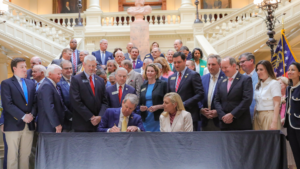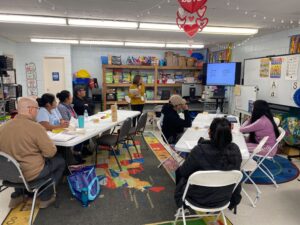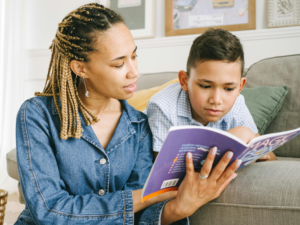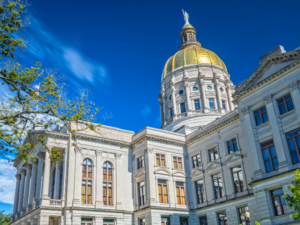
Georgia lawmakers passed bills affecting schooling, work, and family opportunities in 2025.

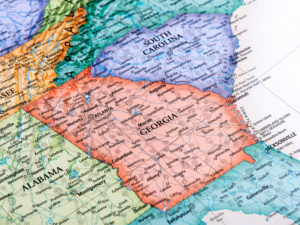
Georgia lawmakers wrapped up the 2025 legislative session with some big decisions that affect our state’s families, students, and workers.

Several new laws were passed to improve education, job opportunities, and access to childcare — while a few important changes didn’t quite make it through.

“The 2025 session included some key victories to improve public school classrooms, expand school choice options, and improve workforce opportunities,” said Buzz Brockway, vice president of policy for GCO. “While there were some disappointments on bills that didn’t make it across the finish line, we are pleased with the progress lawmakers made this year in promoting an agenda to allow all Georgians to flourish.”

What Passed: New Georgia Laws in 2025

These bills passed out of both the House of Representatives and the Senate and are headed to the governor for signing. 

House Bill 340: Less phone distraction, more student engagement

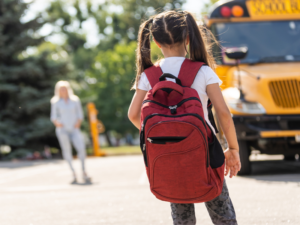
K-8 classrooms now face stricter limits on student cell phone use during school hours. The goal of this policy is to cut down on distractions and help kids stay engaged in the classroom.

Senate Bill 82: More support for charter schools

With this legislation, local boards of education must reconsider denied charter petitions and provide detailed explanations for their decisions. To incentivize approvals, schools receiving charters are eligible for grants of $250,000 a year for three years to help them get started.

House Bill 307 and Senate Bill 93: Helping kids read better

Two bills aimed to boost reading skills among Georgia students. HB 307 updates dyslexia screening and interventions and improves statewide coordination to help at-risk students earlier. SB 93 makes sure future teachers are trained in proven methods to teach reading. State-approved educator preparation programs must align their core curricula with the science of reading—a move that aims to enhance literacy instruction by prioritizing evidence-based methods.

House Bill 136: Bigger tax break for child care

Families can now get a larger credit on their state taxes (up to 40% of the federal tax credit) for expenses related to child and dependent care. By allowing Georgia families to subtract more child care expenses from their annual taxes, this measure eases the financial burden on working families across the states.

House Bill 579: Simplifying licensing for businesses and trades

HB 579 makes it simpler and faster to get professional, business, or trade licenses in Georgia, reducing paperwork, red tape, and other barriers getting in the way of people looking for steady work.

Senate Bill 63: Free college prep tests for homeschoolers

SB 63 mandates that homeschool students in Georgia must have free access to take AP, SAT, and PSAT exams at their local public schools. Improving access to testing for  all students helps level the playing field for college readiness.

​​What Didn’t Pass (But Could Still Come Back) 

Despite these successes, some significant bills were left on the table when the legislative session abruptly adjourned early.

Senate Bill 207: Second chance for job-seekers with a criminal record 

This measure would have helped people with past criminal records get job licenses more easily.  A simpler, fairer process gives returning citizens better opportunities to rejoin  the workforce and build stable livelihoods and futures. However, due to legislative discord, the bill didn’t get a final vote. 

House Resolution 884: Making Georgia’s welfare programs work better 

This proposal sought to create a task force to streamline safety net and workforce development systems in Georgia. It was shelved due to disagreements, but it’s on the radar for next year’s session. Connecting welfare and workforce programs should be an immediate priority because it’s one of Georgia’s best opportunities to remove barriers to work and upward mobility for more people. 

Image Credit: Canva

Stanford University’s Center for Research on Education Outcomes (CREDO), charter schools, charter school, alternative education, education options, GA schools, GA education, ga learning

Key Points

  • Research shows between years 2014 and 2019, charter school students were more advanced in math and reading than their public school counterparts. 
  • Students  who experienced the greatest benefits were black and Hispanic student.
  • The data shows that charter schools have consistently performed better than public schools.

When it comes to favorable education outcomes, charter schools consistently outshine the traditional public school system. 

According to an annual report from Stanford University’s Center for Research on Education Outcomes (CREDO), between the years 2014 and 2019, charter school students were more advanced in math and reading than their public school counterparts. CREDO’s research concluded that over the course of a year, those gains equated to an extra six math learning days, and 16 extra reading days, above what public school students receive. 

In terms of performance, 83% of charter school students had stronger reading skills than their counterparts in public school. Seventy-five percent of students in charter schools had higher math performance. 

This is CREDO’s third study on charter schools since 2000. It covered 6,200 schools in 29 states. CREDO used data from standardized tests to obtain its findings.

“It’s clear that charter schools benefit Georgia families by offering a crucial alternative to a traditional public school,” said Buzz Brockway, vice president of public policy for the Georgia Center for Opportunity. “We can add this CREDO study to a growing body of research bearing this out.”


Charter schools benefit marginalized students most

According to the data in the CREDO report, marginalized students benefited the most from charter schools’ curricula and practices. Of these students, those who experienced the greatest benefits were black and Hispanic students, students enrolled in English-as-a-second-language programs, and students living in poverty. 

CREDO concluded that black charter school students experienced approximately 35 days of additional progress in reading, and for math, 29 days. These results added up to an extra month and a half of learning per school year. 

It’s crucial that those responsible for students’ wellbeing, from the family to the highest levels of government, take note of these findings. If we want to offer historically marginalized students their best possible educational opportunities, then we must consider making charter schools more accessible than ever before.


“Over time, the data shows that charter schools have consistently performed better than public schools.”

“Over time, the data shows that charter schools have consistently performed better than public schools.”

High-quality charter school networks have consistently performed better over time

Over time, the data shows that charter schools have consistently performed better than public schools. CREDO’s research team ultimately ran three studies from 2000 to 2023 to prove that an established pattern existed. With this year’s data in hand, it’s safe to say that charter schools continue to perform well, and the future is looking bright. 

Researchers at CREDO took their initial 2014-2019 time frame and expanded it to cover the years 2009 through 2023. They then compared it to national public school performance. Again, the results remained consistent, with outcomes continuing to track positively for charter school students. 

It’s also important to note the boom in charter school enrollment since 2019. According to the National Center for Education Statistics (NCES), enrollment at charter schools jumped by seven percent between fall 2019 and fall 2020 (the start of the pandemic). By the same token, public school enrollment dropped by four percent during that time. 

This increase in demand, combined with emerging data about charter school performance, indicates that we may continue to see charter schools rising in popularity well into the future. 


Georgia opted out of this year’s study. Why?

Although Georgia participated in CREDO’s previous two studies, the state opted out of this year’s study. It’s unfortunate, given that Georgia’s charter schools are improving education, graduation rates, and career opportunities for students all over the state. With additional positive data from Georgia in hand, we may have seen even further success reflected in the CREDO study.

That being said, we do have some Georgia specific data to share. The State Charter School Commission (SCSC) compared state authorized charter school growth scores to the growth scores of traditional public schools the students would otherwise attend, following the CREDO study methodology.


  • Charter school academic growth compared to local traditional schools is rising nationally. The number of state charter schools in Georgia with higher progress scores than the local traditional schools increased from 2015 to 2019, with over half outperforming in the most recent school year for which data are available 2021-2022.


  • Students of color perform better in charter schools. Nationally, the academic performance of Black and Hispanic students attending charters grew by large margins relative to their peers attending traditional public schools. In Georgia, the share of majority-minority state charter schools outperforming their local traditional school comparisons rose dramatically from 17 percent to 60 percent between 2015 and 2019.


  • Charter schools yield better academic performance for students living in poverty. From 2015 to 2019, the academic progress of charter school students living in poverty nationwide surpassed that of their peers attending traditional public schools. In 2015, Georgia had 11 state charter schools serving large populations of economically disadvantaged students, and only one had higher growth scores than the traditional local schools. However, by 2019, the number climbed to eight out of 17.


  • The instructional delivery model matters and varies by location. At the national level, student performance in fully online charter schools floundered across the five-year period compared to traditional brick-and-mortar schools. Conversely, in Georgia, virtual state charters showed significant progress during the same period. By 2021-2022, both statewide virtual charter schools outperformed their traditional brick-and-mortar counterparts in several grades.


The SCSC analysis mirrors the result of the CREDO study in all areas except one: Georgia’s virtual charter schools are performing better than virtual charter schools nationally.


Wrapping up

It’s essential that every participating state share their outcomes whenever possible. Studies like the one conducted by CREDO provide families and government entities with the compelling, factual information they need to make informed decisions. For families, that decision may mean the choice between a traditional public school and a higher-performing charter school that opens up new opportunities for their students.

For government entities, having plenty of hard data in hand to support charter schools could make it much easier for states to open up charter school access to more students. When states opt out of providing this all-important information, children ultimately suffer most.

education outcomes 2023

We have much to celebrate as the 2023 Georgia legislative session comes to a close. At the same time, there is still much work to be done. That’s what this blog post is all about. First, we’ll take a look at recent victories in the area of education during the session. Then, we’ll talk about the road ahead—what still needs to be accomplished for the good of Georgia’s schoolchildren and families.

The Georgia Center for Opportunity team serves as an important source of information to lawmakers on the impact new laws can have on communities around Georgia, particularly the poor and underrepresented.

School literacy bills

A bright spot in the 2023 legislative session was the passage of two literacy bills that will improve reading and writing skills among Georgia’s kids. According to the Georgia Department of Education, only 64% of Georgia’s third-graders read at or above grade level. These bills will pave the way for our children to enjoy greater literacy, which will impact their educational and professional future.

Here is more about the two bills:

House Bill 538: The Georgia Early Literacy Act requires the state Board of Education to “approve high-quality instructional materials to be used for teaching students in kindergarten through third grade.” This will give Georgia an opportunity to raise the bar on literacy education for public school students in every community. 

Senate Bill 211: This legislation establishes the Georgia Council on Literacy. The Council will work with local school systems to develop a five-year plan to improve reading and writing among Georgia’s students. Coupled with state-approved instructional materials, we have renewed hope for seeing significant improvements in literacy over the next few years.


School safety

The next bill passage regards school safety, which is always an incredibly important topic, but which has received heightened attention in recent months. Here’s a look at the coming changes.

    • House Bill 147: The Safe Schools Act requires local school districts to develop safety plans and submit those plans to the Georgia Emergency Management and Homeland Security Agency (GEMA/HS). Because of the heightened threats on schools these days, having districts work with the experts at GEMA/HS will increase the safety of our children.

 It’s important to act quickly, and act together, for the benefit of our kids.

 It’s important to act quickly, and act together, for the benefit of our kids.

School accreditation

Finally, let’s go over the school accreditation bill that passed during this year’s session. 

    • Senate Bill 204: This legislation puts parameters on what K-12 school accreditation organizations can consider when they evaluate school districts. The bill is designed to address concerns that these organizations were limiting local elected school boards’ important discussions and debates.


Bad news from the 2023 Georgia legislative session

Now for the bad news. Despite passing in the Senate and making significant gains in the House, the Promise Scholarship bill (SB 233) didn’t get enough votes to pass on the last day of session. This delay has forced 500,000+ kids in failing public schools to wait yet another year for this critical education option.

Georgia’s General Assembly missed opportunities to adopt three other good education reforms. We’ll address each, but first, we’ll cover what happened to SB 233. 


What happened to promise scholarships?

The Georgia Promise Scholarship Act, SB 233, would have given parents $6,500 per year, per student to find the right education options for their kids. This would have opened up many non-traditional options, including private school, for families who want alternatives to the public school route. Eligibility would have been narrowed to around 400,000 kids stuck in the bottom 25% of public schools, based on the Georgia Department of Education’s evaluation.

    • The Promise Scholarship bill passed the Senate with unanimous support from Republican senators but, sadly, received no support from Democratic senators. It went all the way to the House of Representatives for a vote. The fact that the bill made it that far in the legislative process is good news.
    • On the last day of session, SB 233 received 85 votes in the House—six votes short of the 91 needed for passage. Sixteen Republican representatives voted against the bill. All but one Democratic representative voted against SB 233: the brave Rep. Mesha Mainor (Atlanta), who voted for the bill on behalf of her constituents’ interests.
    • Thankfully, SB 233 is still on the table for the 2024 legislative session. In the meantime, Georgia students stuck in underperforming schools will be forced to wait another year for this education option to be considered.

The ugly: Public school transfers, charter school management, and tax credit scholarships

As promised, let’s look at three other important opportunities the Georgia Legislature missed during the 2023 session. None of the following bills gained the traction they needed, depriving Georgia families and children of important or increased educational opportunities for at least one more year. 

    • Senate Bill 147 would have allowed students to transfer to attend better public schools, even if it was in a different school district. Other states like Arizona, Florida, and Indiana have seen success with similar laws. The bill never gained any traction, but can be considered again next year.
    • House Bill 318 would have streamlined the oversight of state- and locally-authorized charter schools. The bill passed the House and Senate with bipartisan support, but late amendments to the bill delayed the process. The Legislature adjourned for the session without the opportunity to agree to the Senate changes.
    • House Bill 54 would have increased the cap on Georgia’s Tax Credit Scholarship program from $120 million to $130 million. After going through changes in the House, the bill passed that chamber and moved on to the Senate. In a raucous Senate Committee meeting, the Tax Credit Scholarship portion of the bill was amended several times with unfriendly amendments, and ultimately, the bill died. Fortunately, the program is still operating under the existing cap of $120 million, giving Student Scholarship Organizations the opportunity to continue serving many Georgia students.

Looking toward 2024

While Georgia made important strides forward in school literacy, safety, and accreditation for 2023, there’s still much to be desired when it comes to opportunities for students and their families. It’s our mission to continue championing the value of bills like SB 233. Putting school funding into the hands of parents who wish to depart from the state’s status quo only makes sense; families’ tax dollars should support whatever educational path they choose. 

Likewise, school choice and tax credit scholarships should be open to a wider demographic of families statewide. It’s important to act quickly, and act together, for the benefit of our kids. As we look forward to the next legislative session, we’ll do everything we can to champion positive change.


In The News

As states like Utah and Iowa pass sweeping school choice legislation, it is important to understand no one is trying to defund public schools. The millions of American parents pleading with legislators across the country to open up educational options for their kids are not secretly hoping public schools go away. It’s a partisan myth that is dividing us on education and resulting in burnout and frustration for everyone.

I grew up riding the big yellow bus to my local public school. My kids spent most of their education in public schools. I’m thankful for public schools and the teachers who work so hard to educate and enlighten our children.

Public schools are immeasurably valuable.

It’s my respect for that value that makes me question why so many have politicized fear around educational concepts like school choice, charter schools and scholarship programs. We must face the fact that our education system is overwhelmed. There is no possible way an area public school can meet the diverse needs of every single student.

Yet that is exactly what many expect of them. We expect that public schools will be able to address the learning needs of kids with a wide array of abilities, physical and emotional needs and unique home and personal challenges. You can understand why teachers are leaving the profession in droves.

Imagine going to work with a lesson plan and knowing that five of your students will struggle because they have a diagnosed or undiagnosed learning disability, another five will have ADHD and struggle to focus and another five will be facing home issues and food insecurity. A teacher’s lesson plan is expected to get each of these different students to the same level of success. Add in that we are asking teachers to instruct or guide moral standards and you have a recipe for frustration and burnout.

But it’s not just about teachers. It’s about the kids getting a quality education. Let me be clear, quality education is not an input solely determined by great teaching but an output of what is learned. You can have the greatest teacher, but if the child isn’t learning, they aren’t receiving a quality education. Many years ago, I worked on filming a documentary on education called “Flunked.”

Then, like now, the United States was falling behind internationally, and we wanted to see if there were any schools doing something different. We traveled up and down the West Coast talking with schools that served low-income, inner-city students, schools in rural areas and others that focused on performing arts. As a young parent, it was fascinating and inspiring to see what was available.

Sadly, as I returned home, I faced a different reality for my family. The teacher assigned to my then-5-year-old daughter told my wife and I that our daughter was likely to be bored and not challenged. The local school simply couldn’t provide what she needed, and we were forced to find alternatives.

Thankfully, we had family and others who helped us collect the money necessary to get her into an option that would challenge her. Eventually, we moved and were able to get her back into a public school where she thrived.

But what about the many kids and parents who have no opportunity because they can’t afford it or live in the wrong district? Is quality education only promised to those who can pay up or live in the right ZIP code?

We are stressing public schools by expecting them to be all things to all kids and we are failing to deliver quality education. Even as school choice options become more mainstream across the country, we’re still clinging to the fear of public schools going away. Even the fear that public schools will suddenly be defunded is a myth with per-student funding actually going up over the last decade despite more options being available.

We need to look to innovation in education and stop fearing change. Keep public schools at the center while decreasing the stress on the system by creating alternatives. After all, what we all want is a great education for our kids.

Originally posted by The Atlanta Journal-Constitution

Key Points

    • The Harris Poll found that 89% of parents whose children have switched school types report that they or their child experienced a positive change as a result of the switch.
    • A silver lining of the pandemic is that parents’ eyes have been opened to the many alternative educational options available to them.
    • We are hopeful that lawmakers will pass Promise Scholarship Accounts in the upcoming legislative session.

    Did you know that one-in-five families switched the school their child attended during the pandemic?

    That 20% figure might seem remarkable given that it covers just a two-year period, from March 2020 to May 2022. That remarkable statistic is one of many findings in a national survey of more than 5,000 parents, conducted by the Harris Poll in May 2022. The poll not only documented whether parents switched schools, but their reasons for doing so and whether they ended up happy with their choice.

    On that note, the poll found that 89% of parents whose children have switched school types report that they or their child experienced a positive change as a result of the switch.

    The pandemic changed everything

    Clearly, the seismic changes brought on by the COVID-19 pandemic have prompted millions of families to switch up their approach to education. The demand for alternatives to traditional public schools is evident here in Georgia. For example, charter schools experienced a 5% increase in enrollments during the pandemic, while traditional public school enrollments dipped by 2%.

    We’re excited to see the growth of schools like DeKalb Brilliance Academy, a new charter school serving the Decatur area, and Bright Futures Academy, a private school serving students in some of the poorest zip codes in the Atlanta area. Also encouraging is the number of families continuing to homeschool even after classrooms have re-opened. A silver lining of the pandemic is that parents’ eyes have been opened to the many alternative educational options available to them.

    The bottom line is that public education should be about ensuring all students have access to a quality school. As parents exercise their rights and choose the schools that best meet the needs of their child, it is imperative that leadership in the state and country respond with legislation that supports and does not hinder the needs of students and parents. The pandemic changed everything and policymakers must respond.


    We are hopeful that lawmakers will pass Promise Scholarship Accounts in the upcoming legislative session.

    We are hopeful that lawmakers will pass Promise Scholarship Accounts in the upcoming legislative session.

    What’s next

    That’s why we are hopeful that lawmakers will pass Promise Scholarship Accounts in the upcoming legislative session. The version of the bill introduced in the last legislative session would give each student $6,000 to be used on an approved education expense, such as private school tuition, tutoring, homeschool curriculum, virtual classes, college classes, therapies (for kids with special needs), or technology.


    The COVID-19 pandemic has been a watershed moment for expanding educational options for Georgia students. For many parents and families, the pandemic was the crisis point that showed them, in stark reality, the dire need for a full menu of educational options – whether that be a traditional public school, a public charter school, virtual educational programs or home education.

    You don t have to look far to understand why. During the worst of the pandemic and resulting school closures, many familes were forced into alternative ways of schooling for tthe first time ever. Families’ experience with how traditional public schools handled the shift to distance learning were mixed and inconsistent. Some schools and teachers excelled, ensuring students did not lose out on learning. Others threw their hands up –and the towel in — early. Kids have suffered as a result. 

    Read the full article here


    PEACHTREE CORNERS—The Georgia Center for Opportunity (GCO) announced today that it has signed on to policy recommendations to Congress that would expand educational access for more schoolchildren. The recommendations were jointly issued by GCO in partnership with other nonprofit think tanks across the U.S.

    “The education landscape in Georgia will look vastly different this summer and fall, and we need to include all schools—and as a result all students—in our planning to ensure full educational equity,” said Buzz Brockway, GCO’s vice president of public policy. “While the lion’s share of support will go to Georgia’s 1.7 million students enrolled in traditional public schools, we can’t afford to neglect the over 315,000 students attending public charter, private, and home schools. These recommendations would have the greatest impact on low-income, working-class, and impoverished families, the very ones who need help the most.”

    The recommendations include:

    Enabling educational access and providing direct support to families:
    Expand the use of 529 education accounts, support education through Emergency Education Savings Accounts or microgrants, and create a “student checkup” account that provides funds to parents for use over the summer for tutoring, testing, or other expenses to foster academic progress.

    Supporting private schools:
    Provide a federal tax credit for donations directly to private schools, provide a temporary refundable tax credit to help low-income families continue paying private school tuition, and create equitable funding sharing requirements between traditional public schools and non-traditional options (such as public charter and non-public schools).

    Improving Internet access for vulnerable families:
    Address online equity issues for low-income and rural communities by expanding E-rate and providing incentives to spur the broadband infrastructure.

    Supporting teachers and the transition to distance learning:
    Provide a microgrant for teachers to learn and develop distance learning.

    Press Release

    Subscribe

    * indicates required

    Subscribe

    * indicates required