Georgia lawmakers have crafted bills that will expand opportunities for students to take advanced math classes and pursue meaningful careers.

Key Points

  • Both chambers of the Georgia General Assembly have drafted bills that will create opportunities for students to take advanced math classes earlier in their academic development.
  • Among other measures, the bills will require automatic enrollment for qualified students to make sure all children have equitable access to the advanced classes. This will help close racial, ethnic, gender, and socioeconomic achievement gaps among young Georgians.
  • Research shows that students who pass Algebra I by ninth grade are more likely to graduate from high school. They’re also more likely to succeed in college, accept meaningful jobs, and become financially stable.

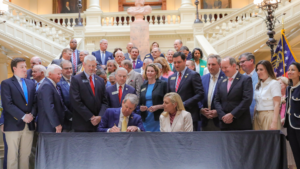
Legislators in the Georgia General Assembly have drafted a pair of bills that are set to transform the way math is taught in the state. If the bills become law, they’ll open doors for students to receive a high-quality math education and ultimately shape the direction of their lives.
The Senate’s Quality Basic Education Act (SB 171) will require Georgia’s Board of Education to develop an advanced math pathway for children in grades 3-8. This compressed and accelerated math track will prepare students to take high school-level math classes like Algebra I in middle school and, if desired, to pursue careers in science, technology, engineering, and math (STEM). 

The House of Representatives’ Math Matters Act (HB 1030) will bring detailed updates to the way math is taught in Georgia schools, including the adoption of new math standards, increases in the amount of time spent on math during the school day, and new requirements for teacher certifications. It shares SB 171’s goal of preparing students to take advanced math classes and setting them up for greater success after graduation.

The bills are based in part on recommendations from the Georgia Center for Opportunity (GCO), with additional support from ExcelinEd and GeorgiaCAN. The opportunities they create will pave the way to fulfilling jobs, economic opportunity, and brighter futures for participating students, and especially for young African Americans, Latinos, and girls, who haven’t traditionally received significant STEM education.

“GCO has helped lead the charge in crafting these bills to bring more opportunity to all of Georgia’s students. A strong math education will empower young Georgians to reach their full potential and flourish in their careers and lives.”

Buzz Brockway, Vice President of Policy, Georgia Center for Opportunity

What Are the Key Elements of These Bills?

The two bills are similar in several ways. They differ just slightly in how they’ll require schools to prepare students for advanced math classes.

School Requirements

  • Per SB 171, all local school systems will offer an advanced math pathway in grades 6-8, and they’ll be able (but not required) to offer it as early as third grade.
  • Per HB 1030, schools will provide at least an hour of core math classes every day starting in grades 4 and 5.

Automatic Enrollment
School districts will automatically enroll students in advanced math courses if they meet the program’s qualifications. 

  • Parents or guardians will have the option to withdraw their child from the classes if they think the standard math track is a better fit for their child.
  • Parents of students who don’t qualify for the advanced math classes will still be able to enroll their child if the student’s score on the previous year’s math assessment is above a certain level.

Additional Assistance for Teachers 
The bills enable local school systems to provide extra training and resources to teachers so they can help students build positive mindsets around math and excel in the classes.

Supportive Student Services
The bills grant school systems the ability to offer tutoring or bridge programs to support students in the faster-paced courses.

Annual Reporting
Georgia’s Department of Education will publish annual reports on student demographics, enrollment, and test scores to make sure the advanced math curriculum is meeting its equity and achievement goals.

How Will Students Qualify for the Program?

Students who receive high scores on statewide end-of-grade math assessments will be eligible for the advanced classes during the following school year.

What Types of Classes Will Students Take as Part of the New Program?

Students on the advanced math track will be able to complete high school-level math classes—usually Algebra I—by the time they finish eighth grade. They’ll then be ready to tackle subjects like calculus in high school.

When Will the Advanced Math Courses Be Available?

The advanced classes should be available during the 2027-2028 school year.

What Impact Will Automatic Enrollment Have?

Automatic enrollment supports equitable access to the program by removing barriers like possible teacher bias, a student’s lack of confidence, or participation fees. In the past, obstacles like these have sometimes prevented qualified but traditionally underserved students from setting foot on advanced academic pathways.

Barriers to early educational opportunity are still being reflected in the composition of our nation’s workforce. For example, a recent report from the National Science Foundation revealed that the nation’s STEM workers were:

  • 62.9% white 
  • 14.8% Hispanic
  • 9.5% Asian American
  • 8.2% Black
  • 4.3% multi-racial 
  • 0.3% American Indian or Alaska Native

And just 18% of working women in the United States held a STEM job, per the report. 

Opening doors to all students and exposing them to challenging math coursework early in their academic development can help close racial, ethnic, gender, and socioeconomic achievement gaps and pave the way for young people’s future success and upward mobility. 

How Can Advanced Math Classes Build Bridges to Opportunity?

Research indicates that students who pass Algebra I by ninth grade are twice as likely to graduate from high school. They’re also more likely to succeed in college and then accept meaningful jobs in STEM fields, which are critical to the nation’s economic success. And outside of work, the essential skills math teaches—analytical, logical, and problem-solving skills—will empower young people to serve as engaged members of their communities.

The advanced math track will give young Georgians the chance to experience the sense of dignity and purpose that comes from rewarding work—both academic and professional. And for students who are part of vulnerable families, this opportunity sets the stage for them to break out of generational cycles of poverty and to achieve their full potential. Their success will then ripple out, transforming their future families, workplaces, and neighborhoods.

Additional Resources

Indicator: Successful Completion of Algebra I by 9th Grade
Education-to-Workforce Indicator Framework

Math Policy
ExcelinEd

From Gatekeeper to Gateway: Creating More Paths to Algebra I Success
National Math Improvement Project

The STEM Labor Force: Scientists, Engineers, and Skilled Technical Workers
National Science Foundation

Employment in STEM Occupations
U.S. Bureau of Labor Statistics

2024 Black Students and STEM Report
YouScience and Black Girls Do STEM

Image Credit: Canva

Top 2026 issues for Georgia lawmakers and citizens include welfare, cost of living, education, and crime.

Key Points

  • In 2026, Georgia voters will elect key political leaders who will have the ability to remove barriers and open doors to better futures for the state’s residents. 
  • Top concerns for both lawmakers and citizens include welfare reform, the cost of living, educational opportunities, and public safety. 
  • Proposed policies and reforms will help lift many Georgians above the poverty line and provide clearer pathways to upward mobility and thriving communities.

Opportunities to drive progress and hope will greet Georgians in 2026. Critical issues will dominate the legislative agenda, and top governmental positions will be up for election.

The well-being of many Georgians, their families, and their communities is at stake as pressing concerns like welfare reform, the cost of living, educational opportunities, and public safety take center stage in political discussions. These issues involve significant challenges, but policymakers are working to find promising solutions that will enable people across the state to flourish.
Electing leaders to fill key political offices

Georgians will elect new officials for the state’s top posts in 2026. The primary election will take place on May 19, and the general election is scheduled for November 3.

The roles of both the governor and lieutenant governor will be on the ballot. Georgia’s current governor, Brian Kemp, isn’t eligible to run again because he’s reached his term limit, so several candidates are competing for the position, including Lieutenant Governor Burt Jones. 

Georgians will also vote on one of the state’s U.S. senatorial positions—Senator Jon Ossoff currently holds the post. All of Georgia’s seats in the U.S. House of Representatives will be up for election as well.

These political races are pivotal because the elected officials will have the power to remove barriers and open more doors to opportunity for the state’s residents.

Reforming Georgia’s public assistance programs and creating a pathway out of poverty

The candidates running for office will likely take positions on ways to reform government assistance (welfare or safety net) programs in Georgia. This should be a top priority because about 13.5% of the state’s population is currently living in poverty

One of the main concerns about the welfare system is that it isn’t helping to lift people above the poverty line or empowering them to become self-sufficient. Instead, the complexities and regulations in the system tend to trap people in long-term cycles of poverty that affect families for generations.

To make real change, Georgia’s top lawmakers need to focus on streamlining the state’s welfare system and integrating it with workforce development programs. This strategy, called the One Door model, connects recipients of government benefits with one caseworker who not only helps them meet their immediate needs but also provides resources to support them in finding a rewarding job.

In Georgia, around 28% of prime-age (25-54) adults aren’t working, and disengagement from work is one of the primary reasons people seek public assistance. Developing a One Door strategy in Georgia will help these individuals become self-sufficient and also enable them to experience the sense of dignity and purpose meaningful work provides.

Georgia’s political leaders can take steps toward implementing a One Door model by advocating for federal authorization to do so. At the state level, they can also establish a task force to explore ways to connect and improve Georgia’s public assistance and workforce programs.

A reform called the One Door model would allow Georgia to connect more welfare recipients to meaningful work and economic opportunity. 

Making life more affordable in Georgia

Many low- and middle-income families in Georgia are struggling to cover the basic costs of living, as prices for just about everything seem to be rising. The increasing costs add extra hardship to the numerous barriers that already impact people’s well-being. But Georgia’s policymakers have opportunities to make some things more affordable for the state’s residents.

  • Housing shortages and costs: At least 94 of Georgia’s 159 counties don’t have enough housing for their residents. The shortage is driving up prices and making affordable homes hard to come by. Builders want to construct more houses, but they face restrictive regulations regarding land use and infrastructure, including roads and water lines. Local policymakers can address the issue by allowing greater flexibility in lot sizes and housing types. Doing so will bring more affordable homes to the market, and that will reduce rent and mortgage payments and free up income to cover other necessities.

  • State income taxes: Georgia’s state income tax is set to drop to 4.99% in January 2027, but some lawmakers want to eliminate it completely. For many Georgians, every dollar matters, and doing away with the tax would allow them to keep more of their income in their own pockets. State leaders are considering eliminating corporate tax breaks to offset the potential loss in government revenue from income taxes. But it’s important to note that they could also raise the sales tax to recoup the state’s lost revenue. That could leave lower-income families worse off because essential goods would cost them more.

Creating an educational system that meets the needs of every child

In 2026, Georgia lawmakers will continue their efforts to develop an educational system that honors every child’s unique situation and needs.

Several education-related bills that carried over from 2025 will likely be up for consideration in the Georgia General Assembly.

  • Senate Bills 124 and 152: These bills will expand eligibility for Promise Scholarship accounts to students with a parent who’s an active-duty military service member stationed in Georgia and to biological or adopted children of foster parents. The bills will help support more families who want to consider alternative education options for their children

  • Senate Bill 171: This bill will require Georgia’s Board of Education to develop an advanced math pathway for students in grades 3-8. The program will prepare students to take higher-level math classes in middle school and ultimately to pursue careers in science, technology, engineering, and math (STEM). The opportunity will pave the way to brighter futures and upward mobility for participating students, and particularly for young African Americans, Hispanics, and girls who haven’t traditionally received significant STEM education.

  • House Bill 917: This bill will provide open enrollment processes for students who want to transfer between local school systems or from one school to another within a school system. This will enable students to attend the school that’s the right fit for them, regardless of where they live.

Charter school funding will also be on policymakers’ radar. In 2025, the Georgia Senate created the Study Committee on Funding for Charter School Capital Improvements. The committee was tasked with reviewing current funding processes for public schools, examining the differences in capital funding between charter and public schools, and analyzing the challenges charter schools face in getting funding. Georgia’s leaders will likely use the study’s findings to make sure charter schools have equal access to capital improvement funds so they can continue to offer alternate educational options for families. 

Prioritizing neighborhood safety and reducing crime

Public safety is a top concern for Georgians, and especially for those living in impoverished communities. High crime rates lead to losses in property value, community resources, business activity, and job opportunities—all making it increasingly difficult for people to escape poverty.

Among several public safety bills, Georgia lawmakers will likely consider two that were drafted during the 2025 session.

  • Cognitive behavioral therapy (CBT) for juveniles: The first bill will enable greater use of CBT with young people who get arrested, even those who are non-violent or have minor convictions. CBT teaches participants to look at the relationship between their thoughts, feelings, and behaviors and helps them respond to challenging situations more effectively. Studies show that CBT programs can reduce recidivism by an impactful 25%. They also set participants on a path toward healing and growth, which will, in turn, help their communities flourish.

  • Support for local law enforcement agencies: The second bill will create grants for local law enforcement agencies to assist them in solving more violent crimes. Local departments can use the funds to improve investigations, enhance the technology and data systems officers use, and support victims and families. The resources will also help authorities deter future crime and boost community safety and resiliency.

Taking action to transform lives and communities

Georgia’s policymakers know that more needs to be done to break down the social and economic barriers so many people are facing, and they’re taking action. But this responsibility doesn’t lie with government leaders alone.

Georgia residents should pay close attention to the issues lawmakers discuss, but also to the needs of their families and communities. They can then use what they learn, along with their voices and votes, to create real change. 

In doing so, Georgians will bring even greater promise and prosperity to the state—making it a place where everyone has the opportunity to achieve their full potential and thrive.

Additional resources

Alliance for Opportunity applauds introduction of the House “One Door to Work” Act
Alliance for Opportunity

How do we know the One Door model works?
Alliance for Opportunity

Georgia candidates for governor should make welfare reform a top priority
Atlanta Journal-Constitution

Georgia lawmakers explore plan to eliminate state income tax
CBS News

A better way to get welfare recipients back into the labor force
City Journal

How Georgia can fix its housing shortage
Dalton Daily Citizen

The Georgia Promise Scholarship (SB 233): questions and answers
Georgia Center for Opportunity

How many adults aren’t working in Georgia communities?
Georgia Center for Opportunity

National poverty rate fails to capture the problem of poverty concentration in Georgia and beyond
Georgia Center for Opportunity

The One Door model: a solution to improve economic opportunity for safety net participants
Georgia Center for Opportunity

Reducing crime in Atlanta
Georgia Center for Opportunity

What Georgia can learn from other states about fixing welfare
Georgia Center for Opportunity

Short supply: How many more homes does Georgia need?
Georgia Public Policy Foundation

The safety net “system” that isn’t
Governing

Unlocking opportunity – how Pelican Institute brought “One Door” to Louisiana
Pelican Institute for Public Policy

Image Credit: Canva

Mesha Mainor, education, party switch, ga politics

Key Points

  • Mainor’s party switch shows her dedication to expanding educational options.
  • There is a growing national movement in favor of educational opportunity, with several states enacting universal access to education.
  • Parents show public support for school choice, especially within minority communities, and Mainor’s recognition of the urgent need for better educational options in her district says she’s listening to her constituents.

Our state and nation would be far better off if there were more principled lawmakers like Rep. Mesha Mainor around.

Mainor recently made national headlines by announcing her change in party affiliation from Democrat to Republican. A prominent Georgia Democrat and sitting state senator has already vowed to ensure she is defeated in next year’s primary election. Partisanship aside, one of Mainor’s primary reasons for switching was due to her support for expanding educational options to all students.

Mainor was the only Democrat to vote in favor of Georgia’s Promise Scholarships Act earlier this year. The measure would have put $6,500 per student back into parents’ pockets so they could fund the best educational approaches for their children, including private school tuition. The bill was targeted so that students in some of the poorest performing public school districts across the state would have access.

The measure passed the Senate with unanimous Republican support but fell short in the House with a number of Republicans breaking with their party to oppose the measure. Thankfully, the bill is alive for the upcoming 2024 session.

Mainor is a prime example of a lawmaker putting the best interests of her constituents first — especially her constituents who are impoverished and reside in zip codes with limited educational options. This type of integrity is rare in politics and policy making these days.

But her decision doesn’t stand in a silo. It is reflective of a growing national movement in favor of educational opportunity. Half a dozen states have already enacted universal — or near universal — access to educational opportunity in 2023 alone. Lawmakers across the U.S. are recognizing the growing national consensus around this issue. 

The most recent evidence is a new poll showing that 71% of Americans support the concept of “school choice,” which is defined as giving taxpayer dollars back to parents to empower them to choose the right school for their child. The COVID-19 pandemic was a catalyst for even stronger public support, with backing for school choice growing seven percentage points between now and the beginning of the pandemic.

Crucially, 73% of African Americans and 71% of Hispanics support school choice. This is a reality Mainor has recognized in her own district, which is predominantly minority — she sees the desperate need these families have for an educational lifeline.

“In my district in particular, we have schools with 3% reading proficiency, 3% have obtained math proficiency by the eighth grade,” Mainor told Fox News Digital. “And so to say that this is just how it is and that the kid needs to just suffer these consequences, I don’t agree with that. And I don’t think that all parents agree with that either.”

Perhaps more revealing is the fact that the poll found widespread support for school choice even among Democrats — to the tune of 66%.

It’s a shame that Mainor was forced from her political party in large part because she refused to toe the line on what should be a bipartisan issue — and an issue that clearly is viewed as bipartisan among the electorate in general.

A poll found widespread support for school choice even among Democrats — to the tune of 66%.

A poll found widespread support for school choice even among Democrats — to the tune of 66%.

It’s an issue that helps students like Aiden, a young man with special needs who wasn’t getting the specialized education he needed in local public schools in Cobb County. The answer came through a specialized private school in Atlanta. Or the story of Hudson, another student with special needs whose life was transformed by access to an alternative education option.

We commend Mainor for her bravery and integrity as we build a future where every child has access to an excellent education.

Talk To An Expert

About The Author

David Bass

Press Manager

David Bass is a journalist and communications professional with nearly two decades of experience in the world of PR, marketing, and publications.

Black History Month School Choice

Key Points

  • Access to quality education is a top conversation in Georgia and many other states and has been for decades.
  • Stories of black educators offer inspiration for continuing to pursue better education opportunities for every kid. 
  • The examples set by African American educators remind us how critical education is for supporting kids’ mental health, preparing them for jobs, and helping them become active citizens in their communities.

No matter what chapter of history you look at, education is often one of the top issues that states and communities have wrestled with. Even today, Georgia is grappling with the reality that thousands of kids are stuck in underperforming schools, and change is needed if we are going to give them a chance to thrive. 

As we celebrate Black History Month this February, it’s a perfect time to look to the African American community for inspiration on the issue of education. Having suffered obstacles ranging from zero education access to segregation and racism in schools, numerous African Americans throughout our country’s history know firsthand the struggle—and the gift—that education can be. Many have dedicated themselves to the cause of education, driven by a shared passion and vision for giving every kid a quality education, regardless of their race or circumstance of their birth. 

Let’s meet a few of these leaders who dedicated their lives to fighting for more educational freedom and opportunity.   

  1. Charlotte Forten Grimké (1837-1914)

Charlotte Forten Grimké grew up in Philadelphia in a family well-known for its activism against slavery. In her early school years, she was taught at home by tutors. Because Philadelphia’s school system was segregated, Charlotte’s parents sent her to Salem, Massachusetts, where she could attend a more progressive school that accepted Black students. As an adult, Charlotte paid the opportunity of education forward. She attended teacher training school, and during the Civil War, she was the first Black teacher to work at the Penn School in South Carolina, a school established to teach African-American children both while they were enslaved and after they were freed. After the war, Charlotte worked for the Freedmen’s Union Commission and the U.S. Treasury Department to help recruit and train more African-American teachers. 


May those whose holy task it is,

To guide impulsive youth,

Fail not to cherish in their souls

A reverence for truth;

For teachings which the lips impart

Must have their source within the heart.

– From The Journal of Charlotte Forten, 1853

    1. Fanny Jackson Coppin (1837-1913)

    Fanny Jackson Coppin was born into slavery and was not freed until age 12. For the rest of her young adult years, she worked as a servant for author George Henry Calvert in Newport, Rhode Island. Fanny yearned for education, so she used her earnings to employ a tutor for about three hours a week. Thanks to her academic diligence and financial help from an aunt and the local African Methodist Church, Fanny entered Oberlin College, Ohio, which was the first college in the United States to enroll both black and female students. 

    It was at Oberlin College that Fanny embarked on her career as an educator—a vocation that would create learning opportunities for thousands of African Americans. While a student at Oberlin, she taught a free night class for African Americans in reading and writing. The College also appointed her to teach classes at their preparatory division, the Oberlin Academy, making Fanny the first black teacher among the Academy’s faculty. After graduating with her bachelor’s degree in 1865, becoming one of only three African American women to do so, she accepted a position at Philadelphia’s Institute for Colored Youth. Over the course of her career, Fanny would become the first African American woman to serve as a school principal and to fill the role of superintendent of a United States school district. 


    “I feel sometimes like a person to whom in childhood was entrusted some sacred flame…This is the desire to see my race lifted out of the mire of ignorance, weakness and degradation; no longer to sit in obscure corners and devour the scraps of knowledge which his superiors flung at him. I want to see him crowned with strength and dignity; adorned with the enduring grace of intellectual attainments.” – Fanny Jackson Coppin, writing to Frederick Douglass in 1876

    1. Inez Beverly Prosser (1895-1934)

    Inez Beverly Prosser was born into a family that highly valued education. Opportunities were scarce for African American kids during Inez’s childhood, and her family moved often in search of the best education available for Inez and her 10 siblings. Inez’s schooling led her to earn a teaching certificate, a bachelor’s degree, and a master’s degree in educational psychology. 

    Inez had a deep passion for education and believed in its power to change lives. She held various roles as a teacher and assistant principal in segregated schools, but her interest in psychology set her apart from other educators. She devoted herself to understanding and improving the educational and psychological development of African American students. In 1933, she became one of the first black women to earn a PhD in psychology. Her research undertook a pioneering and bold examination of segregation’s impact on black students’ social, psychological, and educational development. Findings and arguments from her dissertation were cited in the larger debate about school segregation, carving out a legacy for Inez as one of the leading advocates for the educational and mental health of African American kids.  


    “I am interested in that type of research which will lead to better teaching in elementary and high schools.” – Inez Beverly Prosser

    “Many have dedicated themselves to the cause of education, driven by a shared passion and vision for giving every kid a quality education, regardless of their race or circumstance of their birth.”

    “Many have dedicated themselves to the cause of education, driven by a shared passion and vision for giving every kid a quality education, regardless of their race or circumstance of their birth.”

    1. Kelly Miller (1863-1939) 

    From his early school days, Kelly Miller showed a talent for math. After an impressive academic career spanning the study of math, sociology, Latin, and Greek, Kelly received a bachelor’s degree from Howard University. He became the first black man to be accepted into Johns Hopkins University for post-graduate work in mathematics, physics, and astronomy. 

    However, Kelly was forced to leave Johns Hopkins when the school increased its fees, and he returned to Howard University where he took a teaching job and continued his own education, earning advanced degrees in math and law. In 1907, Kelly became the dean of the College of Arts and Sciences at Howard. His passion for education motivated him to modernize the College’s curriculum and to tour states across the South in recruitment of new students. Under his leadership, enrollment tripled, and curriculum improved. 

    “The instruction which you have received here, and upon which your diplomas set a seal, will be of value to you only in so far as you digest and assimilate it, and wisely adapt it to the tasks which lie before you.” — Kelly Miller

    1. Nannie Helen Burroughs (1879-1961)

    Nannie Helen Burroughs was born in Virginia, and after her father’s death, she moved to Washington, D.C., with her mother where she completed high school and graduated with honors. While Nannie’s career began with roles in secretarial and bookkeeping work, education would eventually become her focus. 

    Her mark in education was a unique one: Nannie wanted to help poor, working African American women. She believed that these women should have opportunities to learn skills beyond domestic work, so in 1909, she founded the National Training School for Women and Girls in partnership with the National Baptist Convention and through the support of small donations from the black community. The school provided job training and academic instruction to young black women, giving them the option to enter the workforce and pursue careers. The school was one of the first of its kind in the early 20th century, and Nannie served as its president until her death in 1961. 


    “To struggle and battle and overcome and absolutely defeat every force designed against us is the only way to achieve.” — Nannie Helen Burroughs

    1. Esau Jenkins (1910-1972) 

    Esau Jenkins was a shining example of how community members can contribute to improving education for underserved kids. Having grown up in the era of segregation, Esau knew what it was like not to have access to educational opportunities. If he had anything to do with it, the kids in his South Carolina community would not have to suffer the same injustice. 

    So, Esau and his wife used part of their income to buy a bus to transport their own kids and fellow children on South Carolina’s Sea Islands to schools in Charleston. Esau also used his bus to help adult workers get to their jobs. During these rides, he and his wife would teach the workers about the U.S. Constitution and other information that was required to pass literacy exams and become a registered voter. This experience showed Esau that a better approach to adult education was desperately needed, and he founded the first Citizenship School on Johns Island to provide more structured education for adults, including instruction in basic literacy and politics. Thanks to his efforts, thousands of African Americans became registered voters. 

    Even while supporting adult education, Esau’s motivation to help kids did not falter. In 1951, Esau played a key role in establishing Haut Gap School on Johns Island so that the youth in that community would have a quality education option. Today, Haut Gap is a middle school that functions as a magnet school—a type of public school option that specializes in certain curriculum areas, such as STEM (Science, Technology, Engineering, and Math), the arts, or vocational training.


    “It takes a pretty large person to love. Any small person can hate.” – Esau Jenkins


    1. Septima Poinsette Clark (1898-1987) 

    Septima Poinsette Clark’s legacy was that of a community teacher. Septima grew up in Charleston, South Carolina—a place where the lines of segregation and class were strictly and harshly drawn, especially when it came to education. Septima was a bright student. After sixth grade, she tested directly into ninth grade at the Avery Institute and graduated from high school in 1916. Financial constraints prevented her from attending college, but even without a degree, she passed the state examination that allowed her to teach. 

    Charleston did not allow African Americans to teach in its public schools, so Septima took a teaching job in the rural community of Johns Island just outside of Charleston. Throughout her 40 years as an educator, Septima had various jobs where she would teach children during the day. At night, on her own time, she would teach African American adults how to read and write and, in the process, she developed several innovative methods to help them pick up these skills more quickly. Septima believed that literacy and citizenship went hand-in-hand, so as she taught basic literacy skills, she also helped adults learn about their rights and become informed, registered voters. Through her work, she became an influential civil rights leader and activist, known as “The Mother of the Movement” by Dr. Martin Luther King, Jr., and many others. 


    “What we are working for is an educational program that has become a resource and rallying point for scores of brave southerners who are leading the fight for justice and better race relations in these crucial days.”

    Circles in Columbus

    A focus on the contributions of the African American family

    BETTER WORK Columbus delivers Marketing Yourself training to clients of our non-profit partners upon request. This training gives students insight into the perspective of an employer and what matters to them during the hiring process. They leave this training more hopeful and with a new understanding of steps they can take to communicate well when they are looking for work. If you have clients who are preparing to look for better work opportunities in the Columbus area, they will benefit from this training. Send an email to kristin.barker@georgiaopportunity.org to schedule a training for your organization. 

    Barbara Moushon, Circles Coordinator at Open Door Community House shares below why this program is helpful to Circles Leaders in training.

    “We are very grateful for the Marketing Yourself training brought to our Circles Group here at Open Door Community House. Our group was very engaged with this presentation and they appreciated the information Kristin and Inez shared. They are still talking about this training. The topic of ‘What Employers Want’ explained to our group why it is so important to stop and really reflect when preparing for an interview. This information explained that the interviewee needs to analyze why an employer would want to select them.  The concept of knowing themselves and what they really want before going into an interview was a powerful message. Our clients understood that they need to spend a little time in self-reflection prior to seeking a job.” –Barbara Moushon


    middle school charter school

    The COVID19 pandemic has disrupted many things here in America. As every parent knows, one of the major disruptions took place in the realm of education. News has been coming out that among the disruptions in education has been the number of parents choosing to homeschool their kids. Now, we’re not talking about the quasi-homeschooling that all kids experienced when their schools closed and all the kids went to Zoom School. We’re talking about folks who have decided to unenroll their students from public or private school and teach their children themselves, most using a curriculum and resources crafted for homeschooling.

    In March, the Census Bureau released results of their Household Pulse Survey. The Survey said…

    By fall, 11.1% of households with school-age children reported homeschooling (Sept. 30-Oct. 12). A clarification was added to the school enrollment question to make sure households were reporting true homeschooling rather than virtual learning through a public or private school.

    That change represents an increase of 5.6 percentage points and a doubling of U.S. households that were homeschooling at the start of the 2020-2021 school year compared to the prior year. 

    In Georgia, the Survey additionally reported that a staggering 16% of households were homeschooling last fall. This is also the number of African-American households homeschooling nationwide (up from 3% pre-pandemic!). It will be interesting to see if data for the 2021-2022 school year reflects a return to public and private schools as school buildings reopen, or if these parents decide to continue homeschooling.

    The reasons people choose homeschooling vary. Joyce Burgess of the National Black Homeschool Association explains why some African-Americans are choosing to homeschool: 

    They’re making these conclusions that peer pressure, they don’t have to be bothered with unnecessary racism, they don’t have to be bothered with bullying, they don’t have to be bothered with negative peer pressure. Some parents have chosen to bring their children home because the virtual setting, some parents just aren’t able to navigate that,” said Burgess.

    A recent guest post in Bari Weiss’ Substack provides further insight to why some parents chose homeschooling 

    When the covid lockdowns hit in March 2020 — in a matter of a few weeks, some 124,000 public and private schools with 55.1 million students shut down  American families suddenly had to adjust to school-via-screen.

    The parents weren’t just upset about all the screen time their kids were logging. They were upset about what they saw on those screens. For the first time, millions of moms and dads could watch, in real time, their children’s teachers teaching.

    It was a moment of “parent empowerment,” said Kerry McDonald, a senior fellow at the libertarian Foundation for Economic Education. That’s one way to put it. 

    Here’s another: “My kindergartener was getting maybe twenty minutes of instruction per day,” said Pauline, a house cleaner in Durham, North Carolina, who prefers using only her middle name to stay anonymous. 

    Pauline and her child lasted about two weeks in remote school before she decided it was a waste of everyone’s time. After a summer of lockdown, Pauline opted for a “homeschool co-op” with four other families. She was planning to send her now seven-year-old back to public school this year. “Being isolated made my kid miserable,” she said. “And I like public school. I was excited to send my kid there.”

    The Delta variant, combined with her husband’s asthma, and the fact that there is no vaccine requirement for teachers in her district threw a wrench in that plan. What started as a short-term solution has morphed into a new normal. 

    As my colleague Jamie Lord and I recently discussed, this demonstrates the real beauty of the concept of school choice: whether you want kids masked, or unmasked, have your school teach a certain curriculum or not, all parents, no matter their income status or location, should have choices in how and where their kid is educated.  

    We at the Georgia Center for Opportunity will continue to fight for the right of all parents to choose the best method of educating their children. 


    sad girl and mom

    How to help working families the most

    During a focus group session on working class families we recently conducted at the Georgia Center for Opportunity, Jazmine* made an observation more perceptive than most experts.

    Our focus group consisted of working-class African-Americans who did not have a college degree and who were not employed in a managerial position nor on track to become a manager. 

    Knowing financial stress up close, Jazmine essentially said that either the minimum wage should be increased or the cost of living should be lowered.

    Her observation is a perfect segue from my prior blogs on:


    The Success Sequence provides an outline of how to reverse the cycle of poverty in our communities. GCO uses this as a framework for much of our work.

    Promoting Purchasing Power 

    The Employment Act of 1946 declared it is the policy and responsibility of the federal government to:

             “promote maximum employment, production, and purchasing power.”

    Promoting purchasing power means lowering the cost of living, as Jazmine suggested. 

    Solidified in the 1951 Accord with the Treasury Department, the responsibility ultimately fell to the Federal Reserve to conduct monetary policy as we know it today.

    How well has the Fed done with promoting purchasing power? Horribly, quite frankly.

    Since 1951, prices have increased 3.4% annually on average, as measured by the geometric mean. In other words, the price level was tenfold higher in 2020 than in 1951. Prices doubled each generation.

    It is widely accepted that the poor suffer most from inflation because they spend a higher portion of their income on necessities, and their income growth typically lags others. 

    For example, according to the most recent mid-year consumer expenditure report from the Bureau of Labor Statistics, consumers in the lowest income quintile spend 82.2 percent of their income on housing, transportation, food, and healthcare, compared to 64.4 percent for the highest quintile. A five percent inflation rate would cost those in the lowest quintile an additional $1,156 for these items on a budget that is already tight, averaging $28,141. A 10% inflation rate would double those costs to $2,312.

    Worse, those in the lowest quintile are unable to save for their future, and inflation erodes away the value of the little savings they do have. Consider that on average, those in the lowest quintile purchased only $563 in personal insurance or toward their pensions, compared to $19,736 for those in the highest quintile. This disparity guarantees the poor will be inadequately prepared for retirement or unforeseen loss or tragedy.


    inflation

    Prior to the federal government taking on the responsibility of promoting purchasing power, prices not only remained fairly stable but actually decreased during times of relative peace. Typically, they only increased dramatically during times of war. 

    This pattern can be seen visually in the accompanying chart using the Consumer Price Index and related data from the Federal Reserve Bank of Minneapolis. For example, the price level increased 24% due to the War of 1812 but then deflated 57% over 47 years until the start of the Civil War, even after accounting for a slight bump up due to the Mexican War. 

    The pattern was similar for the remainder of the century. Prices increased 74% during the Civil War but then deflated 47% to its pre-Civil War level until the start of the 20th Century.*  Although the price level rose somewhat during the progressive era, it was still 30% lower at the start of World War I than at the close of the Civil War.


    inflation 2

    America’s inflationary policy 

    Unfortunately, a 1978 law changed promoting purchasing power to become the lame “reasonable price stability,” which is not the same thing.

    Over the years, the Fed has allowed inflation as a matter of policy. In 2012, Fed Chairman Ben Bernanke explicitly stated for the first time an inflation target of 2% per year. If the Fed can somehow hold to this target, which it has not been able to do historically, it equates to doubling the price level every 35 years. Last August, it backed away from this policy. Because of all the pandemic spending and monetary expansions, the Fed approved a policy to allow inflation to rise “modestly” above its 2% target. 

    It is not just the Fed that has shied away from promoting purchasing power. In 1978, and in the midst of the stagflation years, Congress legislated the modest goal that inflation should be 3% or less, but the target rate was supposed to come down to zero percent by 1988 unless it might have impeded employment.  

    The Fed is not alone to blame for the inability of the federal government to control inflation. Congress’s lack of fiscal discipline resulting in soaring budget deficits place the Fed in a tenuous position to keep interest rates low so federal debt service costs also remain low. Furthermore, recent Fed direct purchases of Treasury debt because of all that federal spending adds to the money supply, eroding—not promoting—purchasing power.


    How Congress can better help the average working family

    If economics has any immutable law, it must be that you can’t get something out of nothing. This explains why the Consumer Price Index increased 5.4% since last year, as announced today by the Bureau of Labor Statistics. And the rate of increase appears to be accelerating. The monthly rate was 0.6% in May but 0.9% in June. If this June inflation rate persists, and hopefully it does not, we will have double digit inflation. A 0.9% monthly rate equates to an 11.4 % annual rate.  

    Considering all the recent deficit spending by Congress and expansionary policies by the Fed, expect more of the same, or worse. In fact, according to a survey of economists in yesterday’s Wall Street Journal, “Americans should brace themselves” because economists are waking up to the prospect of higher inflation, expecting “brisk price increases for a while.”

    Economic history indicates deflation should be the norm. In fact, innovation spawns increased productivity that allows prices to fall, which should show up as deflation. We have the opposite: productivity gains with inflation. This outcome places the blame squarely on monetary and fiscal policy. 

    In the meantime, Jazmine and other hard working Americans struggle to keep up with rising prices. Instead of pushing for increases in the minimum wage that help some at the expense of others, Congress needs to renew our nation’s purchasing power policy and get its fiscal house in order. 


     *Jazmine’s last name withheld for confidentiality.


    *This is not intuitive. It takes a smaller percent decrease to offset a percent increase, such as a 43% reduction will offset a 74% increase. For example, suppose you receive a 20 percent pay raise this week, but next week you receive a 20 percent pay cut. Are you back where you started? The answer is no; you are worse off. If your weekly pay was $100, the increase took you to $120, but then your pay cut took you to $96, even lower than your starting point.


    Erik Randolph is the Director of Research at the Georgia Center for Opportunity.


    A focus on the contributions of the African American family

    As we head into February, we at the Georgia Center for Opportunity (GCO) are proud to celebrate Black History Month and the experience of the African American community. In particular, we plan to take this month to celebrate and promote the African American family and how it has positively shaped our nation as a whole.

    We believe that all communities can learn from each other. The strength and generational bond that is particularly strong within the African American family is something that should be applauded and modeled for others. African American families have had to face so much in our nation’s history—from slavery to legally sanctioned discrimination—yet there are so many stories of the triumphs and stories of these strong relationships. They inspire us all.

    So this month we will feature blogs and commentary around family and the strength of the African American community.  Expect to see features on Marriage Week (Feb. 7-14), the foundational principles that define family, creating an extended family for foster children, and fundamentals for a healthy marriage. These universal principles will help shape our understanding of what it means when we say “better relationships”.


    The Success Sequence provides an outline of how to reverse the cycle of poverty in our communities. GCO uses this as a framework for much of our work.

    Family makes us stronger

    We are all stronger when we have the support base of a family that will stand by us throughout hardships. We know that the support structure and relationships formed out of strong family bonds lead to success throughout life. It is why we provide training and support to further family development in our communities. Healthy relationships and strong family bonds are a key part of the Success Sequence, a process that helps people avoid poverty and leads to meaningful work, finances, and relational lives.  In short, it leads to a vibrant and thriving life.

    We value the importance of listening and learning from the experiences of others. That is why throughout February we will be highlighting the strength and values of the African American family from the perspective of those in the African American community. GCO staff members will share their experiences and we will draw on the experiences of those we serve—all of this with the purpose of applauding the marriage, family, and diversity of experience


    To Rebuild Trust in Law Enforcement, We Must Reform Civil Asset Forfeiture Laws

    By Buzz Brockway


    In the wake of the tragic deaths of George Floyd, Breonna Taylor, Ahmaud Arbery, and now Rayshard Brooks, issues of racism and questions about use of force by police dominate the news. Understandably, emotions are high as people want answers and change. The Georgia Center for Opportunity has worked diligently over the years on issues of criminal justice reform.  We see this as a key issue in pursuit of our goal of a society where everyone has the opportunity to flourish. We stand with our African-American sisters and brothers as they call for justice.

    One key area in need of reform is called civil asset forfeiture. Civil asset forfeiture is a process in which law enforcement officers take assets from persons suspected of involvement in illegal activity without necessarily charging the owners with wrongdoing.  The assets are thought to be either obtained as a result of illegal activity, or used in the commission of a crime. A civil court proceeding takes place to determine if the assets are to be forfeited and the funds used for law enforcement purposes.

    As solutions are being offered, it is important to keep in mind the vital role law enforcement play in protecting the vulnerable and seeking justice for victims. Human flourishing and freedom cannot take place in unsafe communities. Therefore, law enforcement can and should be a key part of the solution to issues such as racism and discussions about the proper application of force against those suspected of criminal activity.

    While the facts surrounding each of the tragic deaths listed above differ, one common thread moving through each case is lack of trust. Lack of trust that officers will use force responsibly, lack of trust that officers will properly deal with arrest warrants, and lack of trust that prosecutors will prosecute crimes equally, especially crimes committed against the African-American community.  As we consider potential reforms, focusing our efforts on restoring trust between law enforcement and the communities they serve would seem to be efforts that could bear much fruit.

    To that end, let me suggest we look at increasing transparency and oversight of Georgia’s civil asset forfeiture laws. The Georgia Center for Opportunity recently completed a study of these laws, how the system works, and made recommendations around increased transparency and accountability. 

     officers investigating a carCivil forfeiture of assets from law enforcement activities has become an important      funding mechanism for many law enforcement agencies as well as multi-jurisdictional task forces crucial to fighting criminal gangs. However, the issue raises concerns about justice, freedom and prosperity.  While a 2015 law made major improvements in civil asset forfeiture reporting requirements, it is not possible to know whether there was a conviction in the case that resulted in the property being forfeited. To restore trust, collecting this information is crucial.

    Additionally, understanding the outcome of the case would allow us to determine if Georgia civil asset forfeiture laws violate the 8th Amendment prohibition on excessive fines. The recent Supreme Court decision in Timbs v. Indiana makes it clear that the 8th Amendment applies to the state. As it relates to civil asset forfeiture, is it an “excessive fine” to forfeit a car worth several thousand dollars for a minor drug conviction?  To restore trust in law enforcement, this question must be answered.

    Rebuilding trust between law enforcement and the community will take time and many policies and practices must be reviewed and debated.  Increasing transparency and accountability in Georgia’s civil asset forfeiture laws is an important step in the right direction.


    To learn more about Civil Asset Forefeiture in Georgia click here

    CAN THE POLICE REALLY CONFISCATE MY PROPERTY WITHOUT CONVICTING ME OF A CRIME?

    Subscribe

    * indicates required

    Subscribe

    * indicates required