HomePostTopic: United States Department of Education

United States Department of Education

The Georgia Early Literacy Act is a new bill to improve literacy rates and support stronger readers.

Key Points

  • The Georgia General Assembly has passed a bill that will lay the groundwork for improving literacy rates among the state’s students.
  • Major measures in the bill include requiring literacy coaches in schools, making kindergarten mandatory, assessing students’ reading skills more often, and expanding the use of curriculums based on the science of reading.
  • By becoming stronger readers, Georgia’s students will be more successful in school and better prepared for rewarding work, financial stability, and meaningful community engagement as adults.

The Georgia Early Literacy Act of 2026 (House Bill 1193) is poised to make a powerful impact on students across the state. Legislators drafted the bill to help increase literacy rates among young Georgians and prepare them for higher levels of learning and greater success in life. 

Georgia’s literacy statistics are undeniably troubling—62% of the state’s third graders aren’t reading proficiently. Georgia’s proficiency percentage is just slightly above the average reading level in the United States. The Nation’s Report Card, which tracks how well students across the country are reading in fourth grade, recently showed that 69% of American fourth graders aren’t reading proficiently. And proficiency is a key indicator of children’s progress and readiness for more advanced work.  

Third grade also marks a critical point in a student’s academic development. Between third and fourth grade, children should be transitioning from learning to read to using reading to learn. If students fall behind in reading during this crucial period, they can start to have a hard time in other school subjects, too. This struggle often takes a big toll on children as they grow up, and it can limit economic opportunities later on. 

But with support from organizations like the Georgia Center for Opportunity (GCO), state legislators are paving the way for children to overcome challenges with literacy. This will empower them to thrive in their academic development and build flourishing lives for themselves and their families in the future.

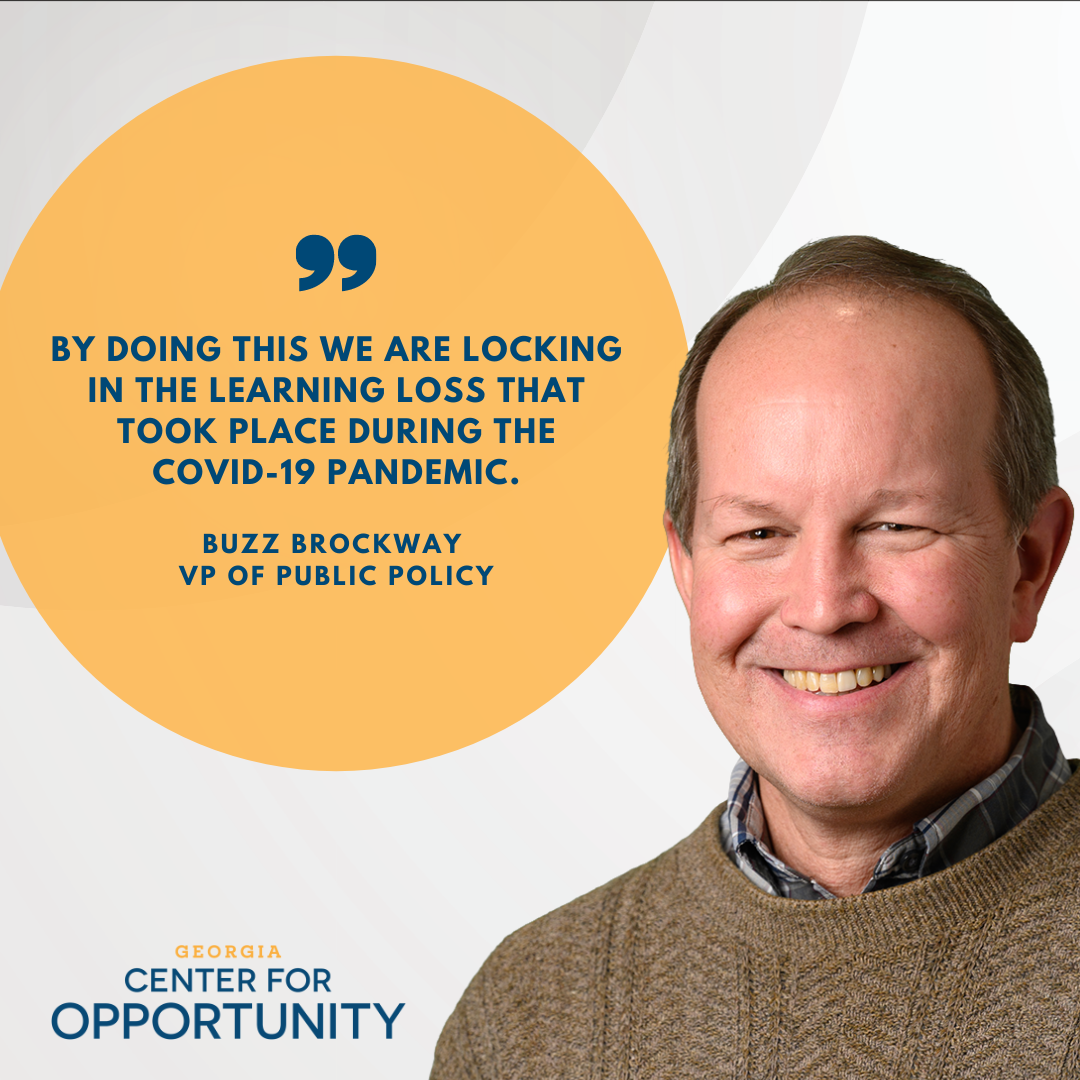
“GCO applauds the state’s General Assembly for passing the Georgia Early Literacy Act of 2026. This important legislation helps Georgia make sure that students read proficiently so they can excel in school and reach their full potential in life.”

Buzz Brockway, Vice President of Policy, Georgia Center for Opportunity

What Are the Core Requirements in This Bill?

Policymakers have included several key measures in the new literacy bill to help the youngest Georgians become skilled readers.

  • Literacy Coaches in Every School: All schools that serve students in kindergarten through third grade will be required to hire literacy coaches—educators with expertise in teaching reading. The coaches will support teachers through lesson planning, co-teaching, and mentoring.
  • Mandatory Kindergarten Enrollment: Students will be required to attend kindergarten before starting first grade (exemptions are possible if students pass the assessment described below). The bill will also encourage families to enroll their children in school or establish a home study program beginning at age 5. These measures should strengthen children’s foundational reading skills early on.
  • First Grade Readiness Assessments: Schools will test students before they start first grade to make sure they’re academically prepared. If a kindergartener isn’t reading on grade level, the school will design a plan to help them.

  • Expanded Use of Science of Reading Curriculums: Schools will continue to expand the use of materials grounded in the science of reading, a field of research that focuses on how students develop reading skills. Teachers will no longer be able to use the older three-cueing system, which encourages students to guess words.

Have Other States Passed Similar Laws?

Yes. Mississippi, in particular, has set the standard for effective literacy legislation. Recent reforms in that state include:

  • Placing literacy coaches in the lowest-performing schools to guide reading teachers 
  • Regularly screening students in grades K-3 for challenges with reading and creating plans to help children who are struggling
  • Requiring third graders to demonstrate reading proficiency before starting fourth grade
  • Training teachers to shift to an approach based on the science of reading

As a result of the strong focus on literacy, Mississippi’s fourth grade reading proficiency scores went from 49th place in the nation in 2013 to ninth place in 2024. Georgia and many other states have taken notice of this significant improvement and have modeled legislation after Mississippi’s laws.

When Will the New Requirements Take Effect?

Governor Brian Kemp is expected to sign the Georgia Early Literacy Act once the 2026 legislative session ends. After it becomes law:

  • Schools will likely have literacy coaches on staff by the 2028-2029 school year.
  • Mandatory kindergarten enrollment and enhanced readiness assessments will go into effect for the 2027-2028 school year.
  • Every K-3 classroom will use only state-approved materials aligned with the science of reading by July 1, 2027.

What Is the Science of Reading?

The science of reading is a field of research focused on how the brain learns to read and how to teach reading. It promotes proven practices that support students of all abilities. These practices involve several essential elements:

  • Phonemic Awareness: the ability to hear and identify individual sounds in spoken words
  • Phonics: the relationship between letters and the sounds they represent
  • Fluency: the ability to read texts smoothly, accurately, and with the right expression
  • Vocabulary: an understanding of what words mean and how to say and use them correctly
  • Comprehension: the ability to understand, interpret, and analyze texts

What’s the Difference Between Reading on Grade Level and Reading Proficiently?

People often use these two phrases interchangeably, but they actually mean different things.

  • Reading on Grade Level: A student who reads on grade level can figure out words and follow a basic plot, but they might still struggle to analyze more complex texts. This is the minimum expected skill level for a child in a specific grade.

  • Reading Proficiently: A proficient reader has a higher-level skill set, including the ability to analyze more challenging material and to think critically about it. Reading proficiently makes it easier for students to use reading for learning as they develop academically.

This difference is important for understanding literacy rates in Georgia. The state’s Department of Education reports that 65% of third grade students are reading at or above grade level, but the Georgia Council on Literacy has shown that only 38% of the state’s third grade students are reading proficiently

How Can Increasing Reading Proficiency Open Doors to Opportunity?

The state legislature passed the Georgia Early Literacy Act in March of 2026 with unanimous bipartisan support. The strong approval of the bill confirms that Georgia’s policymakers have made literacy a priority.

This attention to literacy will make a meaningful difference for many Georgians. Research has shown that children who aren’t proficient in reading by third grade are four times as likely to drop out of school before getting their high school diploma. And without that degree, access to higher levels of education, fulfilling jobs, and economic opportunities is more limited. For students who come from vulnerable families, struggles with reading can also make it harder to escape poverty.

Through the Literacy Act, Georgia legislators aim to remove barriers for children and encourage them to follow brighter paths to promising futures. By becoming stronger readers, Georgia’s students will be more successful in school. They’ll also learn to think more critically about the world around them. Their advanced skills will then lead young people toward more rewarding work and economic mobility as adults, and they’ll be able to positively impact their communities. The bill has the power to make all this possible, with literacy as the key that unlocks the door to these life-changing opportunities.

Additional Resources:

Literacy Bill, Cellphone Ban Among Education Bills Approved by Georgia House
Atlanta Journal-Constitution

With End of Session Near, Georgia Lawmakers Tackle Childhood Literacy
Atlanta Journal-Constitution

Assessing the Economic Gains of Eradicating Illiteracy Nationally and Regionally in the United States
Barbara Bush Foundation for Family Literacy

Your Home for GA Dyslexia Resources
Decoding Dyslexia GA

The State of Literacy in Georgia
Deloitte

Family Resources: Supporting Your Child’s Reading Development
Georgia Department of Education

The Incredible Importance of Teaching Children to Read
Georgia Municipal Association

Lawmakers Push Plan to Lift Georgia’s Lagging Literacy Rates
Georgia Recorder

Student Literacy Overhaul Poised for Georgia Governor’s Signature After Compromise
Georgia Recorder

How Education Impacts Chicago Poverty
Illinois Policy Institute

10 Ways to Support Your Child’s Literacy at Home
National Center on Improving Literacy

Unemployment Rates for People 25 Years and Older by Educational Attainment
U.S. Bureau of Labor Statistics

Georgia lawmakers have crafted bills that will expand opportunities for students to take advanced math classes and pursue meaningful careers.

Key Points

  • Both chambers of the Georgia General Assembly have drafted bills that will create opportunities for students to take advanced math classes earlier in their academic development.
  • Among other measures, the bills will require automatic enrollment for qualified students to make sure all children have equitable access to the advanced classes. This will help close racial, ethnic, gender, and socioeconomic achievement gaps among young Georgians.
  • Research shows that students who pass Algebra I by ninth grade are more likely to graduate from high school. They’re also more likely to succeed in college, accept meaningful jobs, and become financially stable.

Legislators in the Georgia General Assembly have drafted a pair of bills that are set to transform the way math is taught in the state. If the bills become law, they’ll open doors for students to receive a high-quality math education and ultimately shape the direction of their lives.

The Senate’s Quality Basic Education Act (SB 171) will require Georgia’s Board of Education to develop an advanced math pathway for children in grades 3-8. This compressed and accelerated math track will prepare students to take high school-level math classes like Algebra I in middle school and, if desired, to pursue careers in science, technology, engineering, and math (STEM). 

The House of Representatives’ Math Matters Act (HB 1030) will bring detailed updates to the way math is taught in Georgia schools, including the adoption of new math standards, increases in the amount of time spent on math during the school day, and new requirements for teacher certifications. It shares SB 171’s goal of preparing students to take advanced math classes and setting them up for greater success after graduation.

The bills are based in part on recommendations from the Georgia Center for Opportunity (GCO), with additional support from ExcelinEd and GeorgiaCAN. The opportunities they create will pave the way to fulfilling jobs, economic opportunity, and brighter futures for participating students, and especially for young African Americans, Latinos, and girls, who haven’t traditionally received significant STEM education.

“GCO has helped lead the charge in crafting these bills to bring more opportunity to all of Georgia’s students. A strong math education will empower young Georgians to reach their full potential and flourish in their careers and lives.”

Buzz Brockway, Vice President of Policy, Georgia Center for Opportunity

What Are the Key Elements of These Bills?

The two bills are similar in several ways. They differ just slightly in how they’ll require schools to prepare students for advanced math classes.

School Requirements

  • Per SB 171, all local school systems will offer an advanced math pathway in grades 6-8, and they’ll be able (but not required) to offer it as early as third grade.
  • Per HB 1030, schools will provide at least an hour of core math classes every day starting in grades 4 and 5.

Automatic Enrollment
School districts will automatically enroll students in advanced math courses if they meet the program’s qualifications. 

  • Parents or guardians will have the option to withdraw their child from the classes if they think the standard math track is a better fit for their child.
  • Parents of students who don’t qualify for the advanced math classes will still be able to enroll their child if the student’s score on the previous year’s math assessment is above a certain level.

Additional Assistance for Teachers 
The bills enable local school systems to provide extra training and resources to teachers so they can help students build positive mindsets around math and excel in the classes.

Supportive Student Services
The bills grant school systems the ability to offer tutoring or bridge programs to support students in the faster-paced courses.

Annual Reporting
Georgia’s Department of Education will publish annual reports on student demographics, enrollment, and test scores to make sure the advanced math curriculum is meeting its equity and achievement goals.

How Will Students Qualify for the Program?

Students who receive high scores on statewide end-of-grade math assessments will be eligible for the advanced classes during the following school year.

What Types of Classes Will Students Take as Part of the New Program?

Students on the advanced math track will be able to complete high school-level math classes—usually Algebra I—by the time they finish eighth grade. They’ll then be ready to tackle subjects like calculus in high school.

When Will the Advanced Math Courses Be Available?

The advanced classes should be available during the 2027-2028 school year.

What Impact Will Automatic Enrollment Have?

Automatic enrollment supports equitable access to the program by removing barriers like possible teacher bias, a student’s lack of confidence, or participation fees. In the past, obstacles like these have sometimes prevented qualified but traditionally underserved students from setting foot on advanced academic pathways.

Barriers to early educational opportunity are still being reflected in the composition of our nation’s workforce. For example, a recent report from the National Science Foundation revealed that the nation’s STEM workers were:

  • 62.9% white 
  • 14.8% Hispanic
  • 9.5% Asian American
  • 8.2% Black
  • 4.3% multi-racial 
  • 0.3% American Indian or Alaska Native

And just 18% of working women in the United States held a STEM job, per the report. 

Opening doors to all students and exposing them to challenging math coursework early in their academic development can help close racial, ethnic, gender, and socioeconomic achievement gaps and pave the way for young people’s future success and upward mobility. 

How Can Advanced Math Classes Build Bridges to Opportunity?

Research indicates that students who pass Algebra I by ninth grade are twice as likely to graduate from high school. They’re also more likely to succeed in college and then accept meaningful jobs in STEM fields, which are critical to the nation’s economic success. And outside of work, the essential skills math teaches—analytical, logical, and problem-solving skills—will empower young people to serve as engaged members of their communities.

The advanced math track will give young Georgians the chance to experience the sense of dignity and purpose that comes from rewarding work—both academic and professional. And for students who are part of vulnerable families, this opportunity sets the stage for them to break out of generational cycles of poverty and to achieve their full potential. Their success will then ripple out, transforming their future families, workplaces, and neighborhoods.

Additional Resources

Indicator: Successful Completion of Algebra I by 9th Grade
Education-to-Workforce Indicator Framework

Math Policy
ExcelinEd

From Gatekeeper to Gateway: Creating More Paths to Algebra I Success
National Math Improvement Project

The STEM Labor Force: Scientists, Engineers, and Skilled Technical Workers
National Science Foundation

Employment in STEM Occupations
U.S. Bureau of Labor Statistics

2024 Black Students and STEM Report
YouScience and Black Girls Do STEM

Image Credit: Canva

College and Career Ready Performance Index (CCRPI) metrics, Georgia opt out, reporting, learning loss, grading system for schools, Georgia news, ga news

Key Points

  • Georgia received a waiver from reporting its College and Career Ready Performance Index (CCRPI) metrics, including the A-F grading system for schools.
  • The CCRPI metrics assess student performance, including comprehension of class content and preparedness for college and the workforce.
  • GADOE announced its intention to request a permanent waiver from CCRPI grading, raising concerns about transparency and public input.

In the wake of the COVID-19 pandemic, many state school systems across the country were waived from receiving a grade from the US Department of Education (DOE) under The Elementary and Secondary Education Act (ESEA).

The unprecedented circumstances brought on by the pandemic created unforeseen educational  challenges. Naturally, children who spent time in lockdown, away from school, and relegated to unfamiliar online classes could be expected to fall behind educationally. Like many other states, Georgia received a waiver from reporting its College and Career Ready Performance Index (CCRPI) metrics, specifically the A-F grading system for schools that gauge their performance.

But now the state of Georgia has asked to be permanently excused from reporting the A-F grading CCRPI evaluations. The state allowed less than a week for public comment on the proposal, opting not to announce the request via press release. In the past, similar issues have allowed a 30-day window for public comment, at the very least.

With students back in school and educational institutions back to their regular operations, why make this request now? And why the lack of transparency in the process? The exemption from the A-F reporting requirement takes away the public’s ability to easily assess how schools are performing. It’s a knock against real transparency that serves no one but the educational bureaucracy.

The bottom line is that wise school choice depends on parents’ ability to access information about school performance. Without that information, they’re risking their children’s educational opportunities—and maybe even their future.


“The bottom line is that wise school choice depends on parents’ ability to access information about school performance.”

“The bottom line is that wise school choice depends on parents’ ability to access information about school performance.”

About the CCRPI and temporary COVID waivers

In 2012, the CCRPI was launched. Its purpose was to encourage more transparency in terms of school performance. Parents and the public needed to know more about how their local school systems were performing, and the CCRPI not only provides this information—it also allows parents to compare their child’s current school with others in the area.

In terms of measuring performance, the CCRPI assigns a letter grade of A-F to each school. The scoring system reveals how well students are performing in each school, including how well they comprehend their class content and whether they’re keeping up with their grade level. This score also reveals how well-prepared older students are for college and the workforce.

CCRPI scoring was waived beginning in March of 2020, and schools weren’t required to report data as usual. This waiver continued throughout 2021. However, in 2022, as the nation largely resumed business as usual, the Georgia Department of Education (GADOE) was awarded additional waivers.


Seeking a permanent exemption

GADOE published an announcement on its website on January 25, 2023, informing the public that it intended to ask the DOE for a permanent waiver from CCRPI grading. Although the state collects and aggregates all the required metrics, GADOE now seeks to stop submitting the data completely.

As the ESEA requires each state to create its own school accountability system and report its findings to the DOE, it seems questionable that Georgia would completely extract itself from transparency not only at the state level, but at the federal level, too.

Most alarming was the lack of transparency involved in the process. There was no press release published to announce the potential change. As previously mentioned, what’s even worse is that GADOE allowed for fewer than five business days for members of the public to submit their feedback, rather than the standard 30 days.


Reducing transparency hurts Georgia families 

While GADOE attempts to evade school grading, numbers don’t lie. Georgia’s most recent CCRPI scores from 2019 indicate that over 780 schools in Georgia received Ds and Fs. That’s about one-third of the state’s students. GADOE might argue that the proof of school performance lies in the state’s graduation rates, but graduation rates can be manipulated and aren’t a reliable indicator of how well a school performs academically.

Schools that receive Ds and Fs from CCRPI are, by default, not serving their students well. No matter how high their graduation numbers may be, the real proof is in how well (or poorly) they score according to CCRPI academic standards.

There is no compelling case that can be made as to why Georgia’s exemption from CCRPI reporting is an improvement, or how it helps families in our state.

GADOE appears to be skirting the standard process for notifying the public and seeking appropriate input. It’s up to Georgia voters to make their voices heard and demand continued school transparency from its elected officials.

survey

Key Points

  •  A new survey puts forward more evidence of increased social and behavioral problems among students in K-12 public schools arising from the pandemic.

  • Georgia parents need more education options for their children. 
  • GCO is working to bring a new curriculum, called Raising Highly Capable Kidz (RHCK), to schools, nonprofits, churches, and other outlets across the state.

We’ve paid a lot of attention to learning loss arising from school shutdowns during the pandemic, and rightly so. The results of the latest Nation’s Report Card from the U.S. Department of Education, for example, show test scores in reading and math in public schools at their lowest levels in decades.

But there is another side to the cost of school closures that doesn’t get as much attention — the social side. Now, a new survey puts forward more evidence of increased social and behavioral problems among students in K-12 public schools arising from the pandemic.

According to the annual School Pulse Panel published by the U.S. Department of Education’s Institute for Education Sciences, more than eight in 10 public schools “have seen stunted behavioral and socioemotional development in their students because of the COVID-19 pandemic.”

The survey went on to find that “minor offenses, such as tardiness and classroom disruptions, are the most frequently cited illicit behaviors that have increased in part due to the COVID-19 pandemic.”

Here are some notable excerpts from the survey:

  • 84% of surveyed public school leaders said the pandemic had “negatively impacted the behavioral development of students” in their schools
  • 30% reported an increase in bullying as a result of the pandemic
  • 33% reported physical attacks between students
  • 36% reported threats of physical attacks or fights between students
  • 49% reported a jump in student “rowdiness outside of the classroom (e.g., hallways, lunchroom)”
  • 56% reported “classroom disruptions from student misconduct”
  • 42% reported “use of cell phones, computers, other electronics when not permitted”
  • 24% reported vandalism
  • 11% of public schools reported an increase in physical attacks on teachers or staff members influenced by the pandemic
  • 13% reported threats to injure a teacher or staff member
  • 36% reported verbal abuse of teachers or staff members.


The Raising Highly Capable Kids model is built on an evidence-based program that teaches 40 developmental assets that reduce risky behavior in kids and teens. We are looking for partners to help bring this to our community.

The Raising Highly Capable Kids model is built on an evidence-based program that teaches 40 developmental assets that reduce risky behavior in kids and teens. We are looking for partners to help bring this to our community.

Where to go from here

So, what are we supposed to do with this information? Here are three takeaways.

  1. Learning loss is only part of the equation

We must remember that other factors are also at play beyond learning less when determining strategies to help students recover. Isolation, increased screen time, chance of physical or emotional abuse, substance abuse, and general anxiety over the direction of society are just some of the factors in play here. And the sad reality is that many of these negative trend lines were already in place for young people prior to the pandemic. The pandemic simply revealed and worsened them.

  1. Georgia needs more options

The struggles students are facing in public schools underscores the need for a diverse menu of educational options, open and available to all families regardless of income or zip code. Every student deserves an education customized to his or her individual needs and aptitudes. This is why tools like an Education Scholarship Account are so important. An ESA in Georgia would empower parents to pick the best educational option — or the best assortment of educational tools — for their unique student.

In the last session of the Georgia Legislature, lawmakers fell short of passing ESAs in the form of Promise Scholarships, which would have allotted $6,000 a year for families to choose alternative educational approaches. The Georgia Center for Opportunity team is hopeful things will be different this session and that ESAs will finally become a reality.

  1. Students in traditional public schools need help, too

Even as educational options expand in Georgia, the fact remains that most families will still choose their locally zoned public school. These students need help, too. That’s why GCO is working to bring a new curriculum, called Raising Highly Capable Kidz (RHCK), to schools, nonprofits, churches, and other outlets across the state. RHCK is a 13-week evidence-based parenting program developed to build stronger families by empowering parents with the confidence, tools, and skills they need to raise healthy, caring, and responsible children. The course works through 40 key development assets to help kids.

The GCO team will be working to roll out the RHCK curriculum across Georgia in the coming weeks and months, so stay tuned for more!

Georgia made national headlines after Tuesday’s primary elections. Most of the coverage focused on long lines, mail-in ballots, new voting machines, and results that were not finalized until the wee hours of the morning. (In fact, some results are still pending). 

There were some high profile contests, including a couple of congressional races. Every member of Georgia’s General Assembly (except, of course, for those retiring) were also on the ballot. 

But there was one outcome of Tuesday’s election that you’ve likely heard nothing about.

Both parties have the ability to put non-binding referendum questions on their respective primary ballots. While the results of these questions have no force of law, it is a great way to test voter opinion on various policy ideas. The results are far more accurate than a poll and can help parties and candidates understand the will of the super voters among the electorate.

This year, Republicans included the following as ballot question #1: “Should Georgia lawmakers expand educational options by allowing a student’s state education dollars to follow to the school that best fits their needs, whether that is public, private, magnet, charter, virtual or homeschool?”

The results were overwhelming: as of this writing (results are still coming in), more than 73 percent of voters said “yes.” In fact, the question had majority support in every single one of Georgia’s 159 counties, destroying a common narrative that rural voters don’t support school choice. In all but 12 counties, support was over  two-thirds. In many cases, the ballot question will ultimately receive more support than the Senate or House member representing the district. 

You might be tempted to argue that this only speaks to support for educational options among Republicans. And while the Democratic Party of Georgia didn’t include this question on their primary ballots, making an apples-to-apples comparison impossible, other polling in the state consistently shows support for school choice among all Demographics—Republicans, Democrats, rural, urban, young, old, men, and women. 

Even an AJC poll, worded in such a way as to be biased in the negative, found that 61 percent  of voters supported school choice, even when warned that it might “undercut public school funding.”

During the COVID-19 pandemic and resulting school closures, many families were forced into alternative ways of schooling for the first time ever. Families’ experience with how traditional public schools handled the shift to distance learning was mixed and inconsistent. Some schools and teachers excelled, ensuring students did not lose out on learning. Others threw their hands up  early, and kids have suffered. 

In the aftermath of these experiences, and in light of all the uncertainty facing a reopening of traditional public schools in the fall, many families have begun searching for alternatives–virtual education programs, private schools, and innovative public charter schools. 

But will public policy change to support these students who need something outside of the traditional model of education? So far, CARES Act relief has focused millions of dollars to the state Department of Education, local districts, and traditional public schools. Nothing to date has been offered to families whose students fell behind, need to play “catch-up” over the summer, or need a different environment when school returns in the fall. 

If legislators and state leaders are paying attention, that should change.

In recent years, there has been a reluctance on the part of legislators to expand existing school choice programs or create new ones. Usually, the argument goes that it will not be politically expedient to do so. 

Legislators might be dismissive of polling, but if they ignore actual voters who went all the way to the end of the ballot and chose to say “yes” when asked if money should follow the child to the best school for them, it could ultimately be at their own peril. 

Now that voters have spoken—clearly and specifically—how will legislators respond? Will they listen to the will of those who elected them? Elected officials (or those who wish to be elected in the future) have the ultimate opportunity for a win-win: they can give kids the educational opportunities they need and deserve while giving voters what they support and demand.


As the saying goes, you get what you pay for. Unless you’re a taxpayer, in which case you will get less than you wanted from Washington even though they used your money.

President Obama has left office, and the results of the ideas issued under his watch are coming in. Education research demonstrates we didn’t always get a bargain. A new study finds that a multi-billion-dollar federal grant program that incentivized district schools to change their operations neither changed such operations nor resulted in student achievement.

From 2009 to 2016, the U.S. Department of Education awarded School Improvement Grants (SIG). Each year, the agency divided approximately $500 million between states as part of Obama’s stimulus package to help ease schools out of the financial crisis that started in 2007. Georgia schools received approximately $16 million per year from 2014-16.

Schools could fire the principal, replace half of the teachers, and change instructional strategies like adding instructional time to the school day (part of what are called the “transformation” and “turnaround” methods); convert to a charter school; or close the school and send students to better-performing schools.

The result? SIG had no effect—none—on student achievement, graduation rates, or college enrollment.

Note this key detail: Researchers studied 1,200 participating schools and found that the transformation/turnaround methods were by far the most popular choices for schools. Just 33 schools converted to a charter school and 16 closed and allowed students to attend higher performing schools (3 percent and 1 percent of 1,253 schools, respectively). Thus, more money and grant applications promising to teach differently did not result in drastic changes.

Remarkably, researchers had already documented that some of the strategies SIG incentivized in the transformation/turnaround approaches were not supported by rigorous evidence: “Previous literature provides mixed evidence on the effectiveness of some of these practices at raising student achievement.” Yet Washington still spent some $7 billion over nearly a decade encouraging these activities.

Meanwhile, approximately 2,000 new charter schools opened without this federal slush fund from 2009 to 2016. Today, more than 6,000 charter schools operate nationwide. Charter schools are different state-to-state, but in some areas where all public school results disappoint, like Detroit, Michigan, charter schools are outperforming district schools. Those opposing President Donald Trump’s nominee for U.S. Department of Education Secretary, Betsy DeVos, have cited Detroit’s low scores and DeVos’s support of parental choice in Michigan as evidence that she is not qualified for the post.

But multiple studies demonstrate that Detroit charter school students are outperforming their peers in traditional schools. DeVos’s skeptics are free to scrutinize her policy positions, but opponents lose credibility when they misrepresent data.

Likewise, in Arizona, charter schools outperform district schools in terms of eventual college graduates. Charter schools account for 14 percent of Arizona’s total public school population, yet charter schools make up for 5 of the top 10 public schools in the state for students finishing college in 4 years.

Arizona charter schools—like nearly all charter schools in the U.S.—are producing these results despite being funded with less money per student than district public schools. Georgia charter schools are funded at approximately $3,000 less per student than district schools, and low-income 8th grade charter students are outperforming their peers in a national comparison. Now there’s a bargain.

Again, more SIG schools opted not to convert to a charter school with their grant money, choosing more administrative changes instead. And researchers did not find better student outcomes.

Let’s hope policymakers learned a lesson from a failed experiment relying on more taxpayer money for public schools. Lawmakers should commit to giving parents and children more quality educational choices over the next four years. Families will get a better deal when they can choose how and where their children learn.

Six years ago, supporters of the national Common Core academic standards thought they had the formula to measure student success. Under the Common Core, states would agree to teach the same material in the same sequence to all students. The ensuing tests would measure all students according to the same material. We would track the results and compare student achievement across the country.

If only teaching children was so simple.

As centrally-planned policies are prone to do, the Common Core unraveled. South Carolina and Oklahoma left the standards citing, among other things, “federal intrusion” and vowed to replace the standards with better content. A group of states that agreed to offer the same test to students lost half of its state members by 2015. Three months ago, New Jersey had to postpone all student testing in grades 3-11 because the Pearson Education’s testing software malfunctioned.

Then came the Gates Foundation’s admission earlier this year that the Common Core isn’t ready and the “foundation underestimated the level of resources and support required.” The foundation’s mea culpa is significant because of the organization’s commitment to national standards and the associated financial support.

Despite this morass, some in Georgia still claim that alternatives to national standards and testing will cause more problems than pressing ahead with the Common Core. Most parents would agree that “whether they come from a civilian or military family, all children deserve to be held to high, consistent academic expectations that fully prepare them to succeed after high school.”

Yet there are other—and better—ways to do this than national standards.

In 2015, the U.S. Department of Education approved New Hampshire’s pilot project to administer the Common Core tests in fewer grades and use the SAT for high schoolers. Students will have ongoing projects during the school year to measure learning. Education leaders in states like Indiana are considering this alternative.

Arizona Gov. Doug Ducey signed HB 2544 this year, which allows public schools to choose from a “menu” of tests to measure student progress. Rep. Paul Boyer, chair of the House Education Committee, and Sen. Sylvia Allen, chair of the Senate Education Committee, led the legislative effort.

Schools should be allowed to choose from existing national norm-referenced achievement tests like the Stanford series of tests or the Iowa Test of Basic Skills. This way, schools could use a test that aligns with what they already teach—not curriculum imposed from somewhere else—and, because the tests are nationally normed, the scores could be compared across schools.

Critically, district and charter schools would have the same autonomy to choose what and how to teach while still measuring achievement in a comparable way across localities. The Common Core didn’t deliver, so Georgia lawmakers should be looking for solutions like those in Arizona and New Hampshire.

 Photo - Man in Stone Church

On July 25th, AJC columnist Jay Bookman dismissed Georgia House Speaker David Ralston’s “Pastor Protection Bill” as an essentially meaningless symbolic gesture. I’m uncharacteristically inclined to agree with him.

In its current form the bill simply states that “[n]o minister of the gospel or cleric or religious practitioner ordained or authorized to solemnize marriages according to the usages of the denomination, when acting in his or her official religious capacity, shall be required to solemnize any marriage in violation of his or her right to free exercise of religion.” This would seem to follow pretty directly from the First Amendment Free Exercise Clause, as University of Maryland law professor Mark Graber has observed.

While I’m not averse to symbolism and, indeed, regard it as an important teaching function of the law, the prospect that pastors will actually be compelled to perform same-sex marriages is a remote one. To be sure, in our current circumstances anything is possible, but that’s not one of the pressing concerns keeping me up at night.

Here are the things that, to my mind, are causes of concern:

  • The tax-exempt status of churches and other faith-based institutions that remain faithful to the traditional understanding of marriage
  • The eligibility of faith-based institutions (above all, schools, universities, and social service agencies) to compete on a level playing field for government funding if they continue to act in accordance with their long-held belief that marriage is between a man and a woman
  • The ability of churches and other faith-based institutions—if they so choose—to demand doctrinal and behavioral conformity, not just of ministers, but of all employees

In a nutshell, I’m concerned that we’re facing a significant challenge to the ability of churches and other faith-based institutions to remain theologically and morally faithful while fully and equally participating in civil society.

And before I discuss these substantive concerns in a bit more detail, let me add a procedural worry. I fear that Speaker Ralston and many other Republicans, having been chastened by the religious freedom contretemps earlier this year in Indiana, Georgia, and elsewhere, will regard this pastor protection legislation as all they need to do. If true friends of religious liberty accept this down payment on a robust commitment to our first freedom as the full price, they will have left our religious institutions vulnerable to all sorts of threats. I recognize that some of my concerns will have to be addressed at the federal level by something like the First Amendment Defense Act, but there is no reason why Georgia could not provide similar protections at the state level. And I also recognize that laws are mere parchment barriers, weaker than constitutional provisions (which may themselves be no more than papier-mâché); neither will protect religious liberty from a public (or an elite) that has grown indifferent or hostile to it.

I turn now to the challenges, beginning with tax-exempt status. During the oral arguments for Obergefell v. Hodges, Solicitor General Donald Verrilli conceded to Justice Samuel Alito that the tax-exempt status of religious institutions that uphold the traditional understanding of marriage is “certainly going to be an issue.” The dissenters took note of this exchange. Chief Justice John Roberts said this:

Hard questions arise when people of faith exercise religion in ways that may be seen to conflict with the new right to same-sex marriage—when, for example, a religious college provides married student housing only to opposite-sex married couples, or a religious adoption agency declines to place children with same-sex married couples. Indeed, the Solicitor General candidly acknowledged that the tax exemptions of some religious institutions would be in question if they opposed same-sex marriage.… There is little doubt that these and similar questions will soon be before this Court.

Justice Clarence Thomas seconded this concern:

Numerous amici—even some not supporting the States—have cautioned the Court that its decision here will “have unavoidable and wide-ranging implications for religious liberty.” … In our society, marriage is not simply a governmental institution; it is a religious institution as well…. Today’s decision might change the former, but it cannot change the latter. It appears all but inevitable that the two will come into conflict, particularly as individuals and churches are confronted with demands to participate in and endorse civil marriages between same-sex couples.

Justice Samuel Alito spoke of the larger consequences of the Court’s decision:

Today’s decision usurps the constitutional right of the people to decide whether to keep or alter the traditional understanding of marriage. The decision will also have other important consequences.

It will be used to vilify Americans who are unwilling to assent to the new orthodoxy. In the course of its opinion, the majority compares traditional marriage laws to laws that denied equal treatment for African-Americans and women …   The implications of this analogy will be exploited by those who are determined to stamp out every vestige of dissent.

Perhaps recognizing how its reasoning may be used, the majority attempts, toward the end of its opinion, to reassure those who oppose same-sex marriage that their rights of conscience will be protected.…   We will soon see whether this proves to be true. I assume that those who cling to old beliefs will be able to whisper their thoughts in the recesses of their homes, but if they repeat those views in public, they will risk being labeled as bigots and treated as such by governments, employers, and schools.

Let me emphasize this last point, for it is a clear allusion to the context of Justice Alito’s exchange with the Solicitor General, which involved the Supreme Court’s affirmation of the IRS’s revocation of the tax-exempt status of Bob Jones University over its policy forbidding interracial dating. If the analogy—insisted upon by the Court’s majority—between opposition to same-sex marriage and opposition to interracial marriage holds, then the former amounts to the same sort of bigotry as the latter and, perhaps, deserves the same legal treatment.

In the Bob Jones case, the Supreme Court held that the First Amendment Free Exercise Clause does not protect the University from the IRS’s revocation of its tax exempt status. The Court’s reasoning was that, in the first place, tax exempt status is granted under the Internal Revenue Code only to institutions and organizations that “serve a public purpose” and are not “contrary to established public policy.” While the University might well serve a public purpose, augmenting or supplanting public efforts at higher education, its practice of racial discrimination was certainly contrary to established public policy. And if free exercise claims, in the best instance, require strict scrutiny, overcoming racial discrimination is surely the kind of compelling state interest that justifies an abridgement of that right.

It doesn’t require much imagination or legal expertise to see how this line of reasoning could be applied to churches and other faith-based institutions that act “contrary to established public policy” in upholding the traditional understanding of marriage.

This doesn’t mean that the IRS must or will revoke their tax exempt status, only that it can, and that the First Amendment provides no sure defense against that action. If countering discrimination based on sexual orientation comes to be regarded as a compelling state interest, then the free exercise rights of religious institutions will likely have to give way if the IRS bows to the pressure that will surely be brought to bear on it to use its powers for that end.

I think that a case can be made on behalf of continuing to extend those exemptions, both in terms of the manifold human needs all churches address and in terms of preserving the pluralism that is the essential ground of free institutions and a free people, but we have to make that case over and over again, in the face of a faction that isn’t particularly interested in listening to it. I take some solace from the fact, that, at the moment, public opinion seems to favor religious freedom, but that delicate flower needs to be carefully cultivated.

Now, if tax exemptions are a problem, then you know eligibility for government grants will be. To be sure, this isn’t an issue for houses of worship as houses of worship (which, generally speaking are not and should not be eligible for government grants), but it is one for schools and colleges, as well as for social service agencies. While the Supreme Court has frequently upheld the channeling of government aid to religious institutions under certain circumstances (see, for example, Mitchell v. Helms, Zelman v. Simmons-Harris, and the Arizona Christian School Tuition Organization case), it has also held that governments are perfectly within their rights to deny otherwise generally available aid and facilities to religious organizations (see, for example, Locke v. Davey and CLS v. Martinez).

Governments can attach any number of conditions to the aid they provide. Adoption agencies may be required to place children with couples without regard to the gender of the partners. Universities may be required to provide housing—if they provide it at all—to couples that are married in the eyes of the state, regardless of whether those marriages have the sanction of the sponsoring religious body. And if you put the recent EEOC ruling on sexual orientation together with the way in which the Department of Education is interpreting Title IX of the Education Amendments of 1972, it’s pretty easy to see how a lot of government money could be riding on conformity with what appears to be the new normal in regard to sexual orientation and marriage.

For higher education institutions, access to government money is a big deal. According to the U.S. Department of the Treasury, 55% of spending on undergraduate education in 2009-10 came from federal aid (which amounted to $124 billion that year). While there are a few colleges (Hillsdale and Grove City, for example) that take pride in not accepting a dime of federal money, most would at the moment not be able to survive without it.

Again, this doesn’t have to happen. Congress could pass legislation that protects religious freedom, or agencies could voluntarily refrain from impinging on it. But pressure will be brought to bear on behalf of those who, as they would put it, don’t want to subsidize discrimination.

This brings me to my next concern, the religious hiring rights of churches and faith-based organizations. Title VII of the 1964 Civil Rights Act permits them to take religion into account when hiring. And the “ministerial exception” based in the First Amendment—recently vindicated in the Hosanna-Tabor case—means that a number of federal laws granting employees enforceable rights cannot be applied to those a church holds out as ministers. But these provisions do not provide comprehensive protection of religious hiring rights. There is certainly a gap between the legislatively-acknowledged right to hire coreligionists and the constitutionally-grounded ministerial exception. What if someone who signs a statement of faith as a condition of employment comes out as gay and/or enters into a same-sex marriage? Unlike the Employment Non-Discrimination Act, the recent EEOC ruling about sexual orientation discrimination does not contain exceptions for religious organizations. It isn’t at all clear that Courts will find that the Free Exercise Clause will protect them from EEOC complaints, in the event that these organizations choose to enforce doctrinal or behavioral requirements on their employees.

Now, this parade of horribles does not have to march into our sanctuaries. The threats that loom on the horizon do not have to materialize. Those who currently hold the upper hand in government may practice forbearance, either out of a genuine commitment to pluralism and religious freedom or out a fear of overplaying their hand and alienating public opinion.

We on our part must be both vigilant and winsome, vigorously defending and advocating for our rights when they are threatened and offering a model of the charity and forbearance that we hope others will also display. Our society is pluralistic, reflecting deep disagreements about how we ought to live. History teaches us that faith doesn’t require hegemony to prosper. But it does require that those who have it live it, loving their neighbors as themselves. There is room both for political and legal action, and for the building and maintenance of personal relationships. If we forgo the former, there may be no room for the latter. If we focus on the former, we run the risk that those parchment barriers will be swept away by the animosity we have done nothing to disarm and dispel.

Subscribe

* indicates required

Subscribe

* indicates required