Get Buzz'd Blog Header

A focus on the state legislature and the policies effecting Georgian’s everyday life. 

Buzz Brockway, VP of Policy, is in downtown Atlanta at the state Capitol building, and walks us through the the last day or sine die of the legislative session. 


Our state lawmakers create policies that better the lives of Georgians. Learn more about active legislation and how it translates into everyday life for all of us.

Get Buzz'd Blog Header

A focus on the state legislature and the policies effecting Georgian’s everyday life. 

Buzz Brockway, VP of Policy, is in downtown Atlanta at the state Capitol building, and walks us through the proposed changes to The Special Needs Scholarship, occupational licensing, a current protest, and more.


Get Buzz'd - at capitol - March 17 2021

Our state lawmakers create policies that better the lives of Georgians. Learn more about active legislation and how it translates into everyday life for all of us.

The Pandemic Doubles the Food Stamp Program

Part 2

By Erik Randolph

It has been said that haste makes waste. Apparently, this saying also applies to legislation.

Back in March with the pandemic looming, Congress quickly passed major legislation to address the pain of the pandemic. It was well known at the time that the quickness by which the pandemic legislation became law would lead to mistakes and inefficiencies. Here is just one of them.

The Food Stamp Cliff

My last blog highlighted the new food stamps rule created by Congress to address the pandemic. I hinted at how it made welfare cliffs worse.

Welfare cliffs, also known as benefits cliffs, show up whenever a loss in benefits exceeds an increase in earnings. These cliffs are disincentives for earning more money and can show up in tax and welfare programs individually or in combination. 

When it comes to the food stamp program, our research shows that normally these cliffs are fickle. Whether a cliff occurs for a family depends on several factors. In some cases, such as when there is an elderly or disabled member of the household, there are no welfare cliffs. However, if the household has no member who is disabled or elderly and especially receives the maximum deductions and allowances, there can be significant cliffs.

Now with the pandemic food stamp program, all households have cliffs—and they are steeper than ever before.

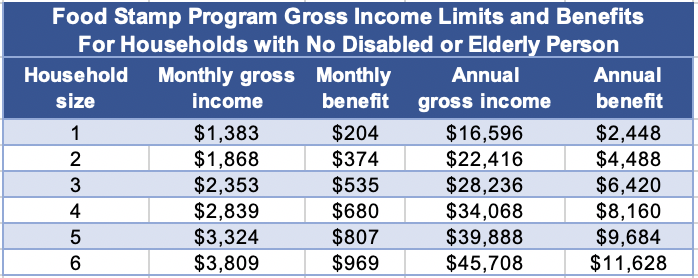
The table below shows the cliffs for households up to six6 persons when no member of the household is disabled or elderly. The benefit amounts stay the same no matter what income a household receives. Therefore, any household over the gross income limit—even just one dollar over the limit—would lose the entire benefit no matter what level of income it had prior to its income exceeding the limit.


Food Stamps Double - Cliff Table 2

Households with an elderly or a disabled member also have cliffs of the same magnitude. However, the gross income level when they hit the cliffs varies depending on the net income calculations, but in every case, these levels would be greater than the gross income limits listed in the table. 

From March 2020 to August 2020, these cliffs were immaterial because the Georgia Division of Family and Children Services (DFCS) received permission from the Federal government to extend eligibility certification for six months. In practice, this meant that those households no longer qualifying for benefits were allowed to stay in the program. 

However, DFCS began processing renewals again in September, and now households gaining in earnings can find themselves faced with the cliffs at the magnitudes displayed in the table.

What was Congress thinking? 

The food stamp changes were part of the Families First Coronavirus Response Act (P.L. 116-127), which had overwhelming bipartisan support. With the legislation, Congress intended to ensure the physical and financial security of families.

One concern was access to food. Congress wanted to make more food available through the food stamp program. Fair enough. 

However, changing the rule so that every household participating in the program gets the maximum allowable benefit was crude and blunt. It guaranteed steep welfare cliffs across the board. A single-parent household with one child earning $1,868  a month would lose $374 in monthly benefits if the parent received just one dollar more in income. 

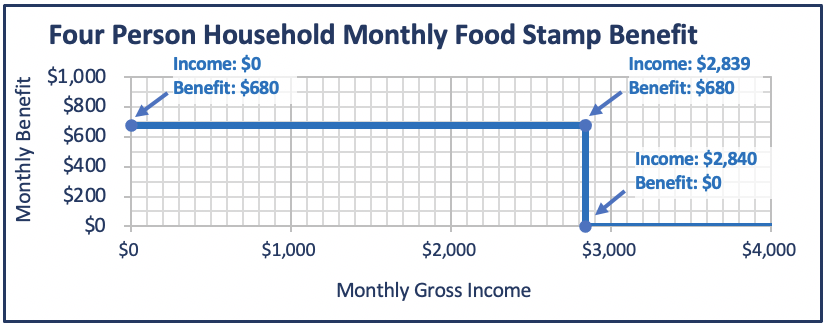
The action also favored wealthier participants. A four-person household with $2,839 in monthly income gets $680, which is exactly the same amount received by a four-person household with no income despite being more vulnerable. 


Four Person Household Food Stamp Benefits

Congress did not have to be so crude and blunt in its approach. Just as easily, Congress could have simply increased the maximum allotment. This action would have spread out the extra funding across all incomes more evenly among the participants. 

Congress could have also been more daring by simultaneously increasing the gross income limit, making any potential cliffs less severe.

The dilemma 

Perhaps Congress chose not to consider these two easy alternatives because key members believed it would be too difficult to roll back the enhanced benefits once the pandemic is finally over. 

There is probably some truth to this fear. However, we do not escape the political difficulty. My next blog will focus on the coming food stamp crisis. 

If you have experience with the food stamp cliff, we would like to hear from you. Be sure to let us know in the comments below. 


Erik Randolph is Director of Research at the Georgia Center for Opportunity. This blog reflects his opinion and not necessarily that of the Georgia Center for Opportunity.

DISINCENTIVES FOR WORK AND MARRIAGE IN GEORGIA’S WELFARE SYSTEM

Based on the most recent 2015 data, this report provides an in-depth look at the welfare cliffs across the state of Georgia. A computer model was created to demonstrate how welfare programs, alone or in combination with other programs, create multiple welfare cliffs for recipients that punish work. In addition to covering a dozen programs – more than any previous model – the tool used to produce the following report allows users to see how the welfare cliff affects individuals and families with very specific characteristics, including the age and sex of the parent, number of children, age of children, income, and other variables. Welfare reform conversations often lack a complete understanding of just how means-tested programs actually inflict harm on some of the neediest within our state’s communities.

DOWNLOAD WHITE PAPER

DOWNLOAD EXECUTIVE SUMMARY

VISIT WELFARECLIFF.ORG

How Can You Measure Welfare Program Success?

Part 1

By Erik Randolph

If you want to know how well welfare programs work, ask welfare agency administrators how they measure success. This was suggested by Randy Hicks, President and CEO of the Georgia Center for Opportunity (GCO), years ago. Almost invariably these administrators will answer that they measure success by how many people they serve. When the total number of people they serve goes up, the programs are more successful. Or are they?

To the contrary, program participation does not measure success. Furthermore, the chances are that welfare agency administrators lack the metrics to tell us how successful the programs truly are.

Program participation can measure demand for the program, or it might indicate the number of people in need. In these cases, program participation is useful information. But does it actually measure success? 

The more important goal of welfare programs is to help people overcome their financial difficulties and escape poverty. This enables them to live more fulfilling lives. Public policy should not encourage them to languish on assistance for years on end but rather help them improve their circumstances until they no longer need assistance, or their reliance on assistance becomes lessened. Welfare agencies generally lack metrics to effectively measure this important goal.

Which revises our original question slightly: How can you measure success?

Dependency Metrics

One potential way to measure success is to use dependency metrics that evaluate the percent of the population who are dependent on major welfare programs. This is partially done at the federal level but not at all at the state level.

In 1994, Congress passed the Welfare Indicators Act. It focuses on food stamps, Temporary Assistance for Needy Families (TANF) cash grants, and Supplemental Security Income (SSI). Every year, the U.S. Secretary of Health and Human Services is required to file a report with Congress showing dependency on those three welfare programs.

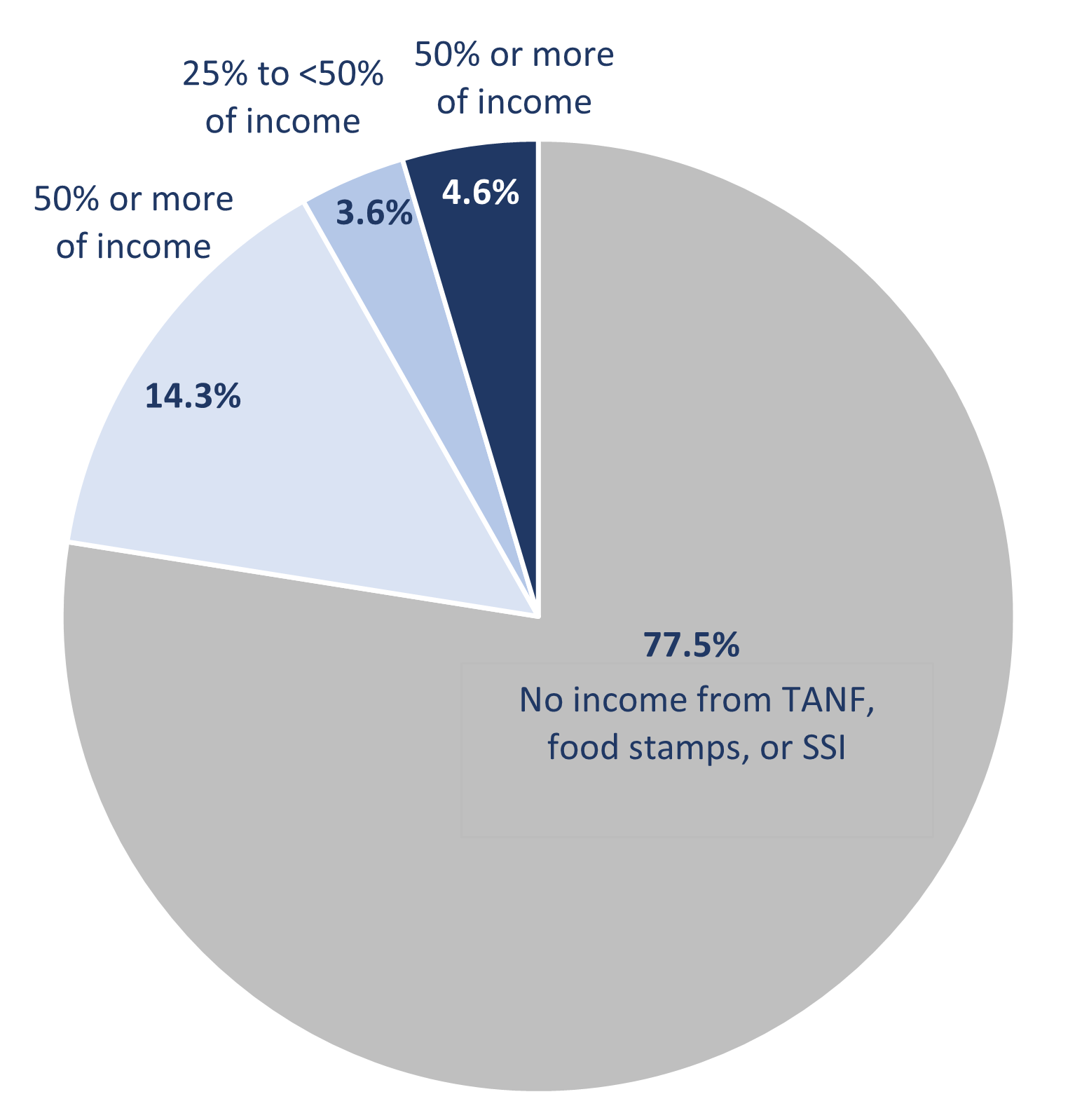
The most recent report was released in 2018. The pie chart below comes from page eight of that report, showing for the year 2015 the percentages of the national population according to their proportion of their total income dependent on the value of food stamps, TANF cash grants, and SSI. The higher the proportion of an individual’s income that comes from these three assistance programs, the worse off the person probably is. For example, if the value of food stamps constitutes more than 50 percent of an individual’s income, that person cannot be well off financially. In comparison, when food stamps constitute 25 percent to 50 percent of an individual’s income, it means the person has more additional income and is better off than when food stamps comprise more than 50 percent  of total income. And having less than 25 percent of total income coming from food stamps is better than having 25 percent to 50 percent of total income on food stamps.

Georgia has the ability to generate dependency metrics through the Georgia Gateway, including TANF cash grants, food stamps, medical assistance, and two other programs. These are means-tested programs, meaning the Department of Human Services has not only participation numbers but also income information of the applicants and recipients. The Department could relatively easily have its I.T. crew write scripts to spit out reports periodically showing the number of individuals and families by dependency on their income on those programs captured through the Gateway. Coupled with Census data, the Department could produce periodic reports showing how dependency changes over time and further break down the data by demographic groups. 

Furthermore, because every individual has a unique identifier, the I.T. crew could produce additional scripts to follow people over time. This would allow for more sophisticated analytics showing the financial progress of people and families in the system. 

Dependency metrics are not perfect. They do not capture persons who would be eligible for the program but do not participate. However, the number of these individuals are regularly estimated and could be presented as additional information in the analysis. 

Ideally, it would be best if the dependency metrics captured all assistance programs. Currently, this is not possible.
Assistance Programs Breakdown

Exactly How Many Programs Do People Benefit From? 

Often people qualify for multiple assistance programs. Their children might be on Medicaid and receiving free school lunches. At the same time, the household may be receiving food stamps. Additionally, if the parent or parents work, they may be receiving the Earned Income Tax Credit (EITC) and Additional Child Tax Credit. We just listed five programs that welfare families typically receive. 

And there are more programs. If the family has young children under five, they could receive food packages from the Women, Infants, and Children (WIC) program. Additionally, the family may be receiving childcare assistance, Section 8 rental assistance, and/or energy assistance.

Now you might think that we have a dataset somewhere telling us the total number of welfare programs families are benefiting from. If you assumed that we do, you would be wrong. No such dataset exists.

The reason? First, the welfare system is disjointed. There is no single agency or dataset that can tell us the total number of programs people are on. Even Georgia’s award winning Gateway, which is one of the better integrated eligibility systems in the country, cannot tell you. While the Gateway can tell us about food stamps, Medicaid, WIC, TANF, and subsidized childcare services, it is missing the refundable tax credits, free school lunches breakfasts, Section 8 rental assistance, and other welfare programs not listed. 

Second, statistical sources do not include all welfare programs in their questionnaires and have other limitations, such as serious time lags. For example, the American Community Survey asks about food stamps, Medicaid, and Supplemental Security Income but practically none of the other programs, making a statistical inference for the complete picture impossible. 

The Survey of Income and Program Participation gets us closer, giving us childcare assistance, WIC, energy assistance, and public housing, among others. However, it is still missing the refundable tax credits, including the EITC which is one of the big three welfare programs. Worse, SIPP is structured for longitudinal studies that makes the survey totally impractical for monitoring program participation on a regular and timely basis.

Adopting Dependency Metrics in Georgia

Dependency metrics would improve our ability to measure success, and state leaders should consider implementing them in Georgia. 

Georgia would do a better job than the federal government with dependency metrics. The Gateway houses the data for critical programs, enabling Georgia to produce monthly estimates, more timely estimates, and for more programs. In contrast, the Feds apparently cannot meet its obligation in producing annual reports, provides only national data for only three programs, and there are significant time lags. The most recent Federal report came out on May 4, 2018, with 2015 and some 2016 data.

Once implemented at the state level, dependency metrics will improve over time. If and when further integration, consolidation, and streamlining of eligibility systems occur, as recommended by GCO, dependency metrics will become more complete and more useful.

However, they are not the sole answer. There is another way to measure success that would complement well dependency metrics. This will be the topic of my next blog.

In the meantime, do you have ideas on how we can measure success in welfare programs? We would love to hear them. Be sure to put them down in the comments below.

Erik Randolph is Director of Research at the Georgia Center for Opportunity. This blog reflects his opinion and not necessarily that of the Georgia Center for Opportunity.

DISINCENTIVES FOR WORK AND MARRIAGE IN GEORGIA’S WELFARE SYSTEM

Based on the most recent 2015 data, this report provides an in-depth look at the welfare cliffs across the state of Georgia. A computer model was created to demonstrate how welfare programs, alone or in combination with other programs, create multiple welfare cliffs for recipients that punish work. In addition to covering a dozen programs – more than any previous model – the tool used to produce the following report allows users to see how the welfare cliff affects individuals and families with very specific characteristics, including the age and sex of the parent, number of children, age of children, income, and other variables. Welfare reform conversations often lack a complete understanding of just how means-tested programs actually inflict harm on some of the neediest within our state’s communities.

DOWNLOAD WHITE PAPER

DOWNLOAD EXECUTIVE SUMMARY

VISIT WELFARECLIFF.ORG

Georgia made national headlines after Tuesday’s primary elections. Most of the coverage focused on long lines, mail-in ballots, new voting machines, and results that were not finalized until the wee hours of the morning. (In fact, some results are still pending). 

There were some high profile contests, including a couple of congressional races. Every member of Georgia’s General Assembly (except, of course, for those retiring) were also on the ballot. 

But there was one outcome of Tuesday’s election that you’ve likely heard nothing about.

Both parties have the ability to put non-binding referendum questions on their respective primary ballots. While the results of these questions have no force of law, it is a great way to test voter opinion on various policy ideas. The results are far more accurate than a poll and can help parties and candidates understand the will of the super voters among the electorate.

This year, Republicans included the following as ballot question #1: “Should Georgia lawmakers expand educational options by allowing a student’s state education dollars to follow to the school that best fits their needs, whether that is public, private, magnet, charter, virtual or homeschool?”

The results were overwhelming: as of this writing (results are still coming in), more than 73 percent of voters said “yes.” In fact, the question had majority support in every single one of Georgia’s 159 counties, destroying a common narrative that rural voters don’t support school choice. In all but 12 counties, support was over  two-thirds. In many cases, the ballot question will ultimately receive more support than the Senate or House member representing the district. 

You might be tempted to argue that this only speaks to support for educational options among Republicans. And while the Democratic Party of Georgia didn’t include this question on their primary ballots, making an apples-to-apples comparison impossible, other polling in the state consistently shows support for school choice among all Demographics—Republicans, Democrats, rural, urban, young, old, men, and women. 

Even an AJC poll, worded in such a way as to be biased in the negative, found that 61 percent  of voters supported school choice, even when warned that it might “undercut public school funding.”

During the COVID-19 pandemic and resulting school closures, many families were forced into alternative ways of schooling for the first time ever. Families’ experience with how traditional public schools handled the shift to distance learning was mixed and inconsistent. Some schools and teachers excelled, ensuring students did not lose out on learning. Others threw their hands up  early, and kids have suffered. 

In the aftermath of these experiences, and in light of all the uncertainty facing a reopening of traditional public schools in the fall, many families have begun searching for alternatives–virtual education programs, private schools, and innovative public charter schools. 

But will public policy change to support these students who need something outside of the traditional model of education? So far, CARES Act relief has focused millions of dollars to the state Department of Education, local districts, and traditional public schools. Nothing to date has been offered to families whose students fell behind, need to play “catch-up” over the summer, or need a different environment when school returns in the fall. 

If legislators and state leaders are paying attention, that should change.

In recent years, there has been a reluctance on the part of legislators to expand existing school choice programs or create new ones. Usually, the argument goes that it will not be politically expedient to do so. 

Legislators might be dismissive of polling, but if they ignore actual voters who went all the way to the end of the ballot and chose to say “yes” when asked if money should follow the child to the best school for them, it could ultimately be at their own peril. 

Now that voters have spoken—clearly and specifically—how will legislators respond? Will they listen to the will of those who elected them? Elected officials (or those who wish to be elected in the future) have the ultimate opportunity for a win-win: they can give kids the educational opportunities they need and deserve while giving voters what they support and demand.


GCO’s Vice President of Public Policy, Buzz Brockway is joined by GCO’s Jamie Lord to discuss the Georgia Governor’s suggestions for returning to school in the Fall. While these are merely suggestions, and schools will be able to choose their plans by district, these new guidelines paint a picture of what school in Georgia could look like in light of Coronavirus.

GCO’s Vice President of Public Policy, Buzz Brockway goes over the data to discuss the impact the reopening is having on the general population. He also discusses the data around welfare cliffs. How do we help those in need without hurting their chances to grow their income?

This week the Governor of Georgia announced that he would be rolling back some of the restrictions on businesses. While the “reopening” has drawn a lot of criticism, VP of Policy, Buzz Brockway discusses the details that many may have overlooked.

Watch Buzz’s weekly update:

Subscribe

* indicates required

Subscribe

* indicates required