Media statement, in the news, Georgia news, ga news

The latest Consumer Price Index released today by the U.S. Bureau of Labor Statistics shows that in the past month, the Federal Reserve successfully achieved its inflation target by meeting a 2% increase in prices on a seasonally adjusted monthly basis. This signifies a step towards maintaining economic stability and balance. But there are still storm clouds on the horizon.

The Georgia Center for Opportunity’s (GCO) take: “While this is positive news, a concerning trend has emerged since the onset of the pandemic,” said Erik Randolph, GCO’s director of research. “Overall, goods cost 18.2% more today than they did before the start of the pandemic due to rampant inflation. Simply put, everyday essentials are far less affordable in 2023 than they were three or four years ago. That hits the impoverished and low-income Americans the hardest. At the federal level, there appears to be a lack of substantive discussion regarding measures to restore the diminished purchasing power of consumers. That is concerning.”

    In The News

    Today, the U.S. Bureau of Labor Statistics announced that in April the Consumer Price Index (CPI) rose by 0.4%, not seasonally adjusted. Year over year, the CPI has gone up 4.9% in the last 12 months.

    The Georgia Center for Opportunity’s (GCO) take: “Not only has the federal government abandoned restoring purchasing power, they do not appear even capable of bringing inflation down to the Federal Reserve’s inflation rate target of 2%,” said Erik Randolph, GCO’s director of research. “Devaluing the dollar means that Americans must have comparable wage inflation just to keep with prices. That’s worse for Americans living on fixed incomes, the working class, and the poor.”


    Erik R - statement - July job numbers

    Media Statement: Number of people working hasn’t caught up to pre-pandemic levels

    On Friday, the U.S. Bureau of Labor Statistics announced that total non-farm payroll employment rose by 528,000 in July. The result was much higher than expected.

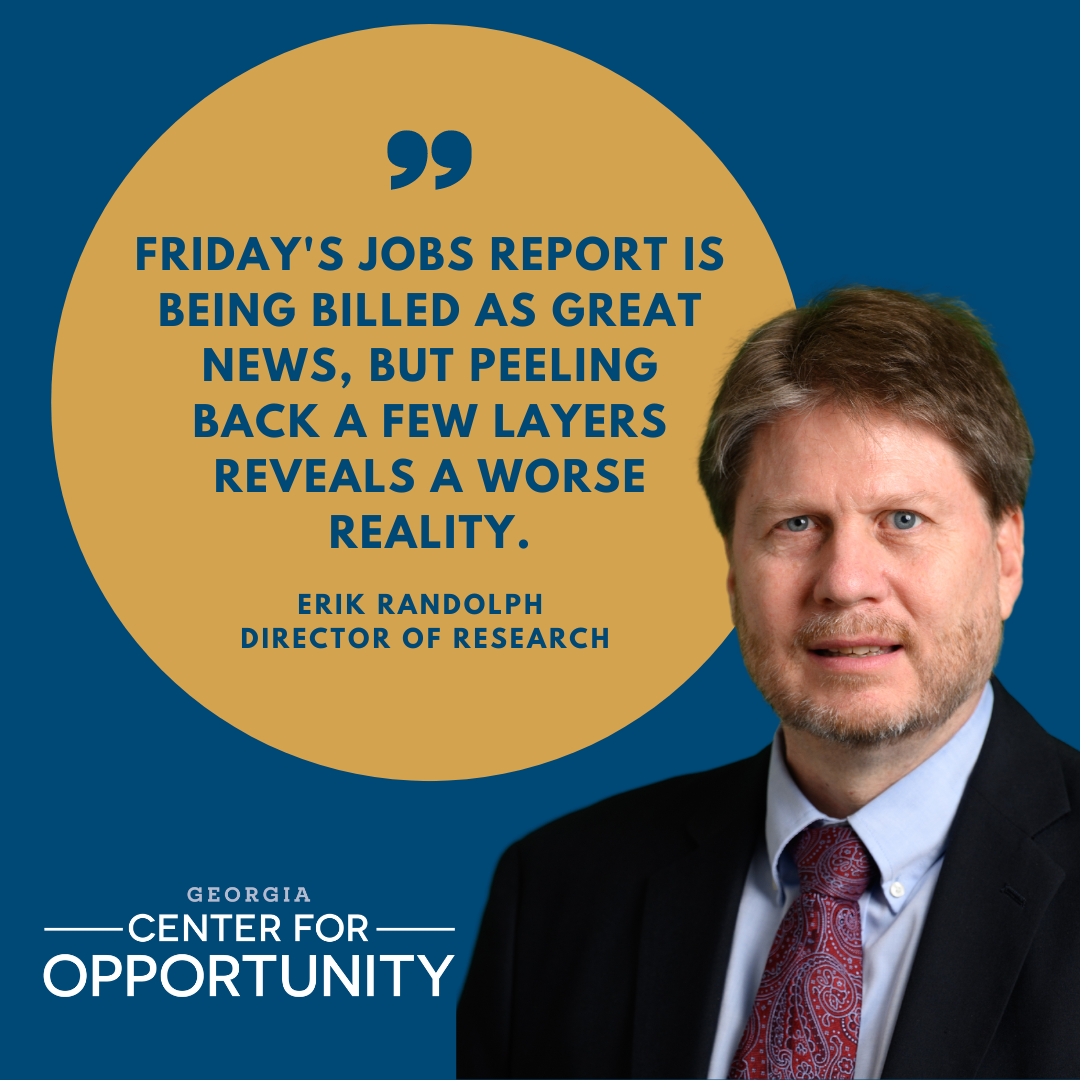
    The Georgia Center for Opportunity’s (GCO) take: “Friday’s jobs report is being billed as great news, but peeling back a few layers reveals a worse reality,” said Erik Randolph, GCO’s director of research. “It’s true the number of jobs in the United States is now at pre-pandemic levels. The difference is that the number of people who are actually working hasn’t caught back up. That implies more people are working two or even three jobs to make ends meet in this highly inflationary environment. Meanwhile, wage growth isn’t keeping pace with inflation, putting poor and working class Americans even further behind.”

    inflation swells

    Key Points

    • Consumer Price Index (CPI) rose by 1.3
    • June CPI exceeded expectations
    • Fastest pace for inflation in four decades

    Today, the U.S. Bureau of Labor Statistics announced that in June the Consumer Price Index (CPI) rose by 1.3, not seasonally adjusted. Year over year, the CPI has gone up 9.1% in the last 12 months. The June CPI exceeded expectations and was the fastest pace for inflation in four decades.

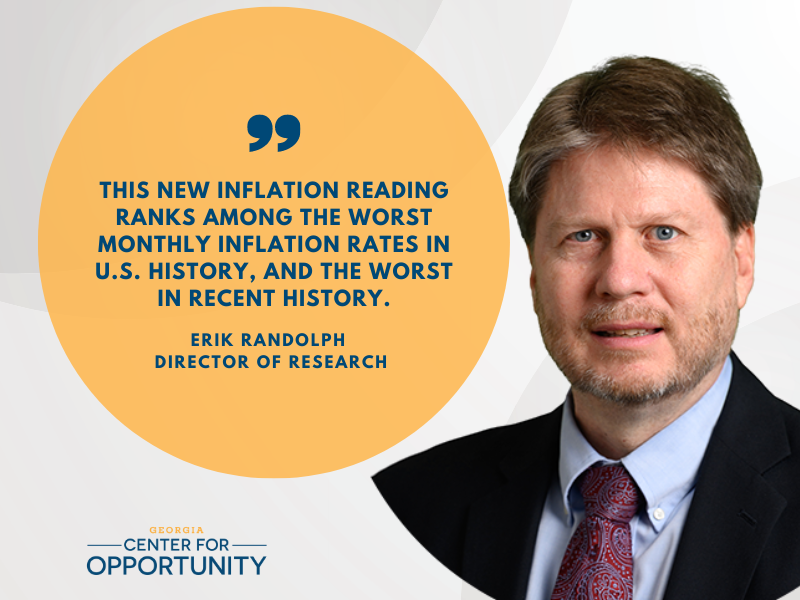
    The Georgia Center for Opportunity’s (GCO) take: “This new inflation reading ranks among the worst monthly inflation rates in U.S. history, and the worst in recent history,” said Erik Randolph, GCO’s director of research. “We have to go back to March 1980 — the last year of the Carter administration — to find a higher monthly inflation rate. The bottom line is that we may not have reached peak inflation, and there’s no telling how long the price level crisis will persist. Meanwhile, the rhetoric from the White House and Congress will do little to rectify the situation. There needs to be new thinking within the Washington Beltway.”

    GA unemployment 3%

    calculator and graphs

    Key Points

    • May the Consumer Price Index (CPI) set new record for inflation
    • Lack of discussion over the price level, which is the new ‘floor’ for prices in the economy
    • Leaving the price level elevated means we are leaving the economically disadvantaged further behind, exacerbating the economic divide in our nation

    New record for inflation

    Today, the U.S. Bureau of Labor Statistics announced that in May the Consumer Price Index (CPI) rose by 1%, not seasonally adjusted. Year over year, the CPI has gone up 8.6% in the last 12 months. The May CPI exceeded expectations and set a new recent record for inflation.

    The Georgia Center for Opportunity’s (GCO) take: “We now know that the early statements from the Biden Administration and the Federal Reserve that this inflation is transitory was an incorrect assessment. It looks a lot more like it’s becoming embedded into the economy,” said Erik Randolph, GCO’s director of research. “What’s both remarkable and troubling is the lack of discussion over the price level, which is the new ‘floor’ for prices in the economy. The only discussion is about bringing the inflation rate back down. This means that the federal policymakers are willing to leave the price level elevated. Leaving the price level elevated means we are leaving the economically disadvantaged further behind, exacerbating the economic divide in our nation.”


    stimulus

    U.S. Gross Domestic Product update

    U.S. Gross Domestic Product declined at a 1.4% rate in the first quarter of 2022. The numbers surprised economists, who had predicted a 1% gain.The Georgia Center for Opportunity’s (GCO) take: “The tab is coming due for all the reckless stimulus spending during the COVID-19 pandemic,” said Erik Randolph, GCO’s director of research. “The declining GDP in the first quarter is the strongest indicator yet that our nation is headed into a recession. Even worse, our trajectory is straight toward stagflation, an environment marked by rampant inflation combined with high unemployment. This will hurt poor and middle-class Americans the most.”

    statement

    social distancing

    Long-term pain for labor market due to the COVID-19 pandemic

    New research predicts long-term pain for the labor market due to around 3 million workers who plan to remain permanently sidelined over concerns of physical illness or physical impairment due to the COVID-19 pandemic.

    The Georgia Center for Opportunity’s (GCO) take: “The authors of the long social distancing study have produced very helpful data on those no coming back into the labor force, estimating a 3.5 million shortfall in March by comparing the current observed level with a linear trend using the time period of January 2015 to December 2019 as the basis for the forecast,” said Erik Randolph, GCO’s director of research. “Using the current employment statistics survey instead of the current population survey, our own research shows a shortage of 6.6 million employed persons that would include persons holding multiple jobs. We use the same method of comparison by subtracting the forecasted data from the observed data, but instead of using a linear trend as the basis for comparison that can often overestimate the forecasts, or the reverse, we use an ARIMA forecast model, not for five years but starting at the low point after the Great Recession. In addition, our research provides forecasts and analyses for each of the 50 states where there is a wide disparity when it comes to job recovery.”

    For more, read Randolph’s research report on the economic impact of the pandemic shutdowns.


    statement

    employment rate

    State unemployment rate stands at a record low

    On Friday, April 15th, the U.S. Bureau of Labor Statistics released state employment numbers for Georgia. They show that our state unemployment rate stands at a record low of 3.1%, the lowest since the BLS began tracking in 1976.

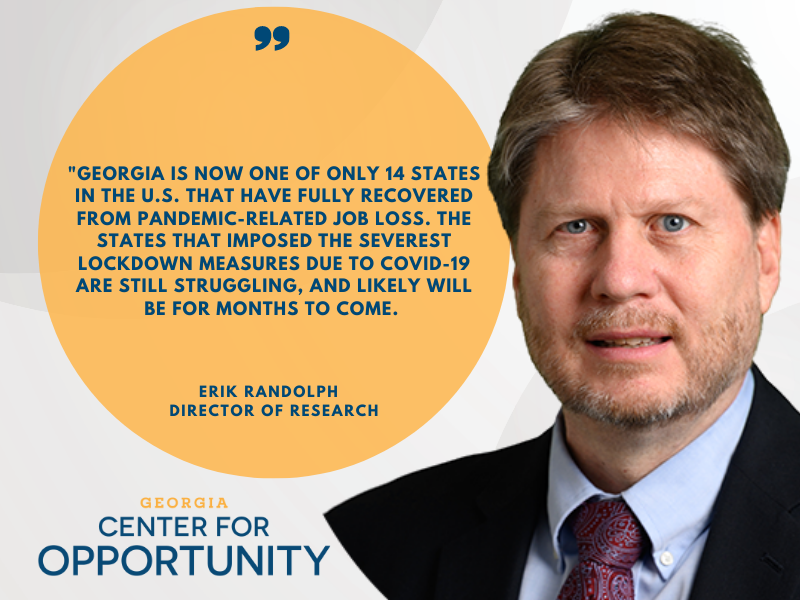
    The Georgia Center for Opportunity’s (GCO) take: “At 3.1%, Georgia is tied with Arkansas for the 16th lowest unemployment rate, a half point below the national unemployment rate of 3.6%,” said Erik Randolph, GCO’s director of research. “Georgia is among the 16 states that have recovered all the private employment lost due to the pandemic. According to our analysis, Georgia ranks 10th in the nation when comparing private employment to each state’s pre-pandemic private employment growth trajectory.”

    “Labor force participation is still an area of weakness. Georgia’s rate ranks 26th in the nation. While Georgia’s labor force participation rate edged up from 61.9% in February to 62.1% in March, it is still below its pre-pandemic rate of 62.8%. It is also well below the states with the highest rates. Nebraska leads the nation with 69.8% participation, just 0.2 points below its pre-pandemic rate”

    “The national economic picture is worrisome and can put a damper on the improving job picture. Rising inflation and supply-side problems are creating uncertainty that will impact entrepreneurial decision-making and alter the economic outlook. Some economic indicators are beginning to point to a possible economic slowdown. Although these prognostications are not certain, they are concerning.”

    For more, read Randolph’s research report on the economic impact of the pandemic shutdowns.


    statement

    inflation

    A look at the highest unadjusted monthly rate of inflation

    Today, the U.S. Bureau of Labor Statistics announced that in March the Consumer Price Index (CPI) rose 1.3%, not seasonally adjusted. This is the highest unadjusted monthly rate of inflation since March 1980. When annualized, it would equal 17.3%.  The seasonally-adjusted monthly increase is 1.2%. The 12-month CPI increase continues to climb, which now stands at 8.5%, not seasonally adjusted.

    The Georgia Center for Opportunity’s (GCO) take: “Unsurprising for anyone who paid attention to prices last month, energy prices rose 32% over the last 12 months and food prices rose 8.8%. This is bad for everyone but worse for low-income and impoverished Americans, ” said Erik Randolph, GCO’s director of research. “The U.S. inflation rate reflects not only energy and food price increases, but it is also spreading to more and more industries as businesses are forced to raise prices.””Also concerning are disturbing signs pointing to a possible economic slowdown, giving credence to those who have been predicting stagflation will return. This crisis may have been initiated by the pandemic, but it was exacerbated when state governments shut down their economies and the federal government pumped unprecedented levels of money into the system to sustain aggregate demand. We’re paying for that now. The only way out of this mess is to refocus on supply-side policies at both the federal and state levels to encourage investments, risk taking, and production. It also requires fiscal restraint in the halls of Congress to reign in deficit spending.”


    statement

    Subscribe

    * indicates required

    Subscribe

    * indicates required